


[This Iran war post again launched before complete. Please return at 8:00 AM EDT or refresh this page then for a final version]
It has been frustrating to see the media, particularly Bloomberg, latch on to the thinnest shred of positive developments and present it as if it was representative of the state of play. We are seeing that continue as the US again attacked Iran during negotiations, albeit not as seriously before but still another demonstration of bad faith and bad intent, Trump alienates Arab allies by trying to push them into the Abrams Accords, and Israel doubles down on its attacks in Southern Lebanon. All of these are negatives for any negotiated settlement. Yet the orthodox press continues to portray the talks as making progress. That can be true if you equate activity to being progress.
Specifically much of the Western press is misrepresenting these Iran positions, which it has held and has not changed:
1. No discussion of nuclear issues now. Iran is insisting on sequencing, as in a cessation of hostilities, acknowledgement of it and Oman’s control of the Strait of Hormuz, freeing of at least some of the frozen assets in the first 60 days, and relief of sanctions of Iran’s energy.
2. Even though #1 means Iran is making no commitments whatsoever regarding the status of its enriched uranium, the most credible sources indicate it will not leave Iran (if there is ever a deal, dilution seems a more realistic outcome)
3. Iran also requires that $12 billon of its frozen assets be returned at the publication of the agreed memorandum of understanding. There is simply no way that will happen. Even though this demand is entirely reasonable form the Iran side, the US will choke on it.
Iran has also reiterated that it will not sign a partial “deal”:
BREAKING: 🇮🇷🇺🇸
Iran says indirect negotiations with the U.S., reportedly being mediated through Pakistan, are still ongoing.
Tehran added:
“Nothing is finalized until every issue is agreed upon.”
Markets are now bracing for extremely high volatility as tensions and diplomacy… pic.twitter.com/jpnzkn1Rg9
— IRGC NEWS (@IRGC_IRAN_News) May 27, 2026
Larry Johnson confirms this assessment in his latest post:
The Pakistan-Qatar mediation channel toward a possible memorandum of understanding remains active. But “active” does not mean “settled.” The unresolved center of gravity remains sequencing. The following is based on information I received from a knowledgeable source with access to the negotiations. It mirrors my analysis.
Washington and Israel want Iranian concessions first, while Tehran wants tangible, front-loaded economic and security relief before it gives ground on anything that matters. That is the heart of the present deadlock.
Iran’s position is not theatrical. It is rooted in a clear strategic doctrine: after decades of sanctions, pressure, assassinations, sabotage, and military threats, Tehran will not trade hard leverage for verbal assurances or a memorandum of understanding.
Promises are not enough. Mechanisms matter. Sequencing matters. Asset movement matters. Enforcement matters. The central judgment is this: Iran is not blinking…
The Nuclear File: Sovereignty Is the Red Line
According to a knowledgeable source, enrichment is not a negotiable bargaining chip. Tehran views enrichment as three things simultaneously:
1. A sovereign right;
2. A deterrence instrument;
3. A domestic legitimacy anchor.
No meaningful quantity of enriched uranium will leave Iranian territory under the present framework. That line is firm…
Strait of Hormuz: Tehran’s Non-Nuclear Strategic Lever
The Strait of Hormuz is Iran’s most powerful non-nuclear instrument. The logic from Tehran is blunt: the United States cannot freeze Iranian assets, sanction Iranian exports, suffocate Iranian banking channels, and then expect unconditional maritime passage as though nothing has happened.
Iran’s emerging posture appears tiered and deliberate. Friendly states receive passage. Neutral states are handled selectively. Hostile or adversary-linked shipping will face interdiction, delay, or denial. This is not simply military posturing. Tehran is attempting to convert maritime geography into a regional security architecture based on reciprocity: if Iran’s economy is strangled, the economic arteries of others will not remain entirely immune.
The reported MOU framework involving the Strait appears real: Iranian de-escalation in exchange for sanctions relief, asset movement, and restoration of commercial access. But the sequencing dispute remains unresolved. Iran wants assets released before surrendering maritime leverage. Washington wants compliance in the Strait before releasing assets. As I write this (Tuesday evening eastern time) this issues remains unresolved….
Lebanon and Hezbollah: The Detonator Built Into the System
Lebanon remains the most dangerous variable in the entire equation. The diplomatic architecture now being constructed contains a structural flaw, and that flaw runs directly through Beirut. Lebanon is not a side theater. It is the tripwire.
Israel wants continued freedom of operation in southern Lebanon. Iran views Hezbollah as a central pillar of its regional deterrence architecture. From Tehran’s perspective, Hezbollah is not a disposable card. It is non-negotiable.
This update in the Aljazeera live feed is consistent with Johnson’s take, albeit it pre-supposes a fig-leaf-level memorandum of understanding:
US, Iran ‘closer than ever to a deal’, but that deal is ‘very superficial’
Ali Vaez, director of the Iran Project at the International Crisis Group think tank, explains that the deal being negotiated “is only going to try to consolidate the ceasefire and reopen the Strait of Hormuz”.
“But it is not really going to fundamentally resolve any of the problems between Iran and the United States. It is going to defer them to a 60-day, negotiating period that would start once the memorandum of understanding is finalised,” he said.
Vaez told Al Jazeera that Iran – given its mistrust of the US and the Trump administration, in particular – wants to ensure that sanctions relief is a “real and verifiable and concrete” element of any agreement.
“That’s why you saw Iran’s parliamentary speaker, foreign minister, and head of the central bank in Doha yesterday to try to negotiate the very details of that mechanism,” he said, adding that Tehran also wants an end to Israel’s attacks on Lebanon.
For Washington’s part, reopening the Strait of Hormuz is a major red line. “There are mismatches in expectations,” Vaez said. “But I think given that the alternative to a negotiated settlement is so much more unattractive for both sides, there is a high likelihood that they will cross the finish line.”
And look as schizophrenic messages like this:
Iran to open Hormuz 30 days after US deal to end fighting: source
Tehran still not close to signing an agreement, Foreign Ministry spokesperson sayshttps://t.co/xD1kFXWTPn
— Nikkei Asia (@NikkeiAsia) May 27, 2026
Again, to point to the elephant in the room: Israel has agency and is continuing to pound Lebanon. Iran will not accept a “deal” unless fighting ends on all fronts. Even if Trump wanted to drop a hammer on Israel (like denying intelligence support), the screams of betrayal from Zionists and evangelical Christian nutters would force him to relent. Recall how quickly the Biden Administration went into reverse over a rumored intel cut-off to the vastly-less-influential Ukraine (less than a week along with media muddying as to whether it had happened).
To confirm the degree of coordination between Israel and the US, Netanyahu paused a security meeting to take a call from Trump..1
There is also the question of what the US thought it was accomplishing with its attack on Iran. If you though it might move Iran, think twice. As Press TV pointed out. Iran says latest ceasefire violations prove US ‘ill-will’, vows decisive response PressTV
Larry Wilkerson contends this strike was a manifestation of how Trump thinks negotiations go: punch out the other side if they are not giving in to your demands. Karen Kwatkowski argues that it was a probing attack and she does expect the US to launch big strikes, even as she stresses that that is a very bad idea. Note that Iran may be holding back on its promised retaliation due to the Hajj; see Almayadeen as an example of the coverage given to the pilgrimage.
We will also cover more discussion in the business media of the approaching energy cliff and other signs of below-the-waterline damage.
From a fresh talk between Larry Wilkerson and Nima. Wilkerson does say he was convinced the US would take one more big whack at Iran but is now confused as to what is going on on the US side.
From a lightly-edited machine transcript:
Nima: Let me start Larry with what has happened last night and the night before the confrontation between Iran and the United States firing at each other. It was started by a by fighter jets, US fighter jets attacking speedboats in the Persian Gulf….
Wiilkerson: Well, it’s the Trump method of diplomacy.
It’s a method that I think is pretty obvious to the world now that particularly with the case of Iran and the United States that we get into diplomacy and we feel like that part of the diplomacy this is the only way we can operate anymore Nima is sanctions and military force military force and sanctions and we get in the middle of the diplomacy such as it is it isn’t real diplomacy and if they’re not adhering to our points the way we want them to adhere or we want to move them a certain direction, we start the bombing over again. We start the kinetic action over again. That’s the only way we know how to negotiate. The only way we know how to deal. Um, and we’re teaching the world in many respects this sort of technique. So, we can expect it back at us, if not soon, more so than not. And it’s a terrible thing, terrible precedent we’re setting.
First of all, if you look at this very closely, there has been no contact between an Iranian diplomat or an Iranian government representative or both and an American of equivalent stature.
There there simply hasn’t because we’ve put no diplomats forward. There are no diplomats dealing with this. There’s only people like Jared Kushner and Steve Whitoff. And I don’t even include Marco Rubio in what I would call a diplomat.
He’s made it clear that he’s not a diplomat. He’s an advocate of bombs, bullets, bayonets, and sanctions, just typical of the empire. So, this is the strangest diplomacy. At no point in time since we commenced this quote diplomacy unquote, have we actually talked with Iranians, nor are they with us, probably at their behest on their side or their decision on their side because they don’t trust us worth of crap and certainly because Trump won’t let anybody talk directly with Iranians…..So there’s no diplomacy going on, Nima.
Period. There is no diplomacy going on.
There’s only a pronouncement here and a pronouncement here and then Bibi in the center saying I don’t like that. I’ll start the bombing again in Lebanon or I’ll do something else.
Karen Kwiatkawski, in a talk with Mario Nawfal, by contrast, views the US as readying an attack and the dustup in the Strait of Hormuz as probing.
From a lightly-edited machine transcript:
Kwiatkowski: It’s sad that we’re reduced to trying to interpret um the whole entirety of US foreign policy by how many tweets uh or how many truth social posts the president makes. Um you know, Israel had uh doesn’t want the war to end. And they had just ordered an acceleration, intensification, of their campaign in Lebanon. So, um and they’ve done this before.
I mean it’s so predictable like when the war comes close to an end or there’s talk that hey we can come to some solution Israel accelerates. It is they’re doing and they don’t really listen to the United States even though Trump periodically says, you know, like he said last week “Netanyahu does whatever I tell him.” That’s not that’s not true. But it’s nice that Trump is aware that he has to actually vocalize that because everybody thinks it’s not true…
I’m not optimistic and I see really, not that I know any more than anybody else. I don’t. But the I think what we were doing with the shooting of the boats and some of the land targets that we had that to me that’s a probe. that’s practice and probe to test. What are they gonna do?
Kwiatkowski also argues that Zionists are taking advantage of Trump’s cognitively challenged state. She believes the sure-to-alienate-the-Gulf-States-and-Pakistan Abraham Accords pressure was their bright idea to undermine the talks.
The continued movement of aircraft into theater lends credence to Witkowski’s warning. From Anadolu Agency in US deploys F-22 fighter jets, dozens of refueling aircraft in Israel: Report:
The US has deployed F-22 fighter jets and dozens of refueling aircraft across military facilities and airports in Israel in what Israeli media described Tuesday as an unprecedented military presence.
Israel’s public broadcaster KAN, citing Israeli security sources, said Washington is interested in maintaining the deployment at least through the end of the year, in addition to longstanding US military forces stationed across the Middle East.
The broadcaster said satellite imagery reviewed over recent months showed an unprecedented deployment of US fighter jets and refueling aircraft inside Israel.
The analysis covered the period from the start of Israel’s attacks on Iran on Feb. 28 through last week.
According to the report, F-22 fighter jets were deployed at Ovda Air Base in southern Israel, while dozens of US refueling aircraft were stationed at Ben Gurion and Ramon airports…
Israel’s Channel 12 previously reported that dozens of US refueling aircraft stationed at Ben Gurion and Ramon airports were already affecting airport operations and airline ticket prices.
The broadcaster also cited Civil Aviation Authority chief Shmuel Zakai as warning that Ben Gurion was being operated “as a military base rather than a civilian airport.”…
KAN said the unusually large US deployment in Israel has remained intact since the ceasefire with Iran took effect last month.
And Israel is inflicting plenty of pain in Southern Lebanon.
Israel’s Channel 12 reports Israeli forces have crossed the “Yellow Line” in Lebanon, the ceasefire boundary that, until now, marked the outer limit of Israeli ground presence since 2006.
With diplomacy stalling, U.S. strikes on Iran underway, and Washington firmly behind… pic.twitter.com/x4IBoAv1q4
— Ahmed Shihab-Eldin (@aseisfree) May 26, 2026
From the Aljazeera live feed:
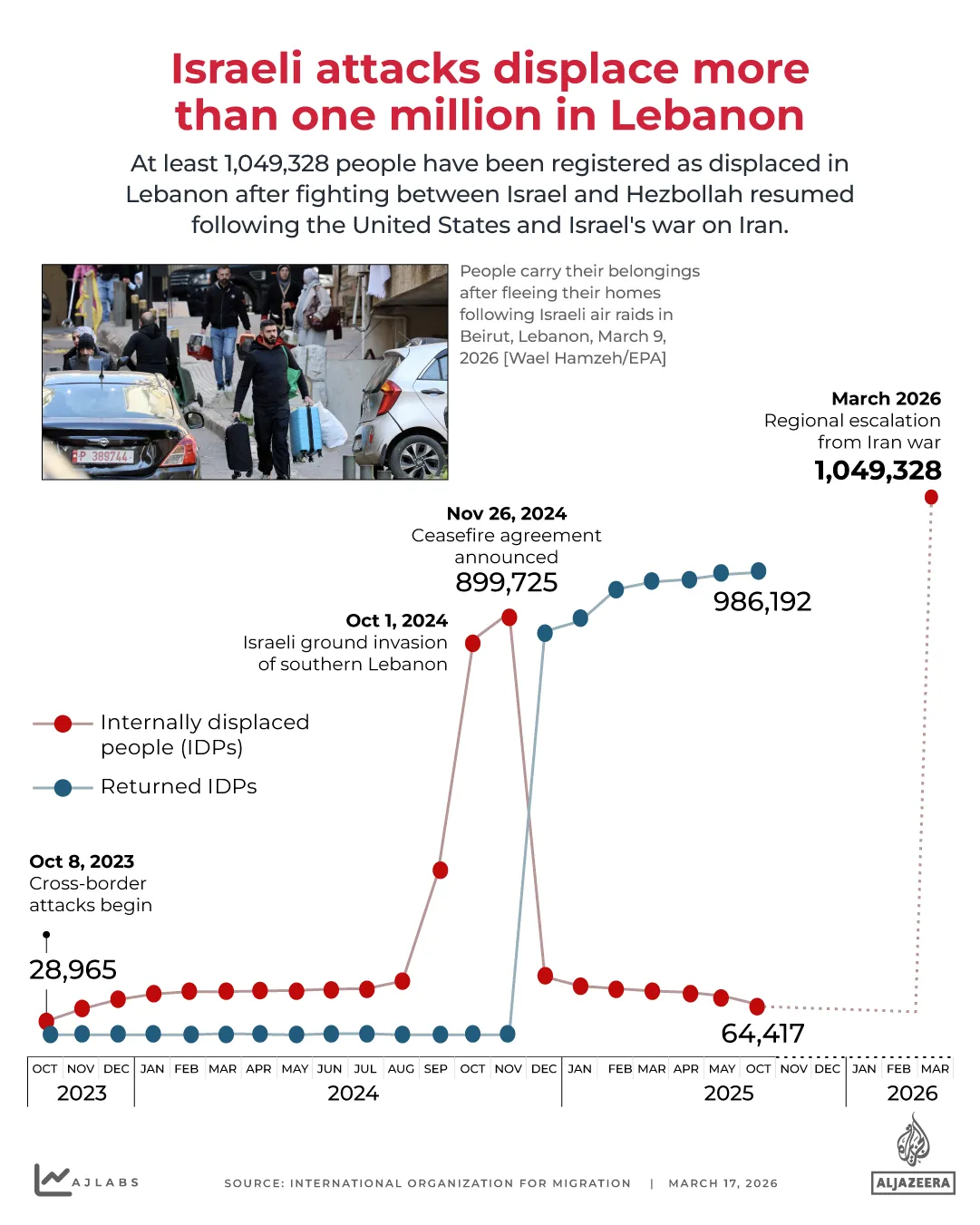
Humanitarian crisis deepens in southern Lebanon as Israel invades
Israel has issued about 50 forced displacement orders for Lebanese towns and villages over the past 24 hours, as well as a blanket displacement order for the entire city of Nabatieh.
This, combined with the recent attacks, is causing a huge humanitarian crisis that is only continuing to grow, putting pressure on the Lebanese government to find a fast end to this conflict.
But as Israel says, it is going to continue expanding its military “operations”. It’s not clear how that’s going to end, but this is going to have a huge impact on civilian life as the attacks continue to intensify and the death toll continues to go up.
And on the economic front. Reread the sections above on progress to a deal, which is actually nada. The Strait of Hormuz is certain to remain under tight Iranian control for a bare minimum of 60 days after a memorandum of understanding is inked, if that ever happens. That means that even if traffic were to move towards normalization, the level would still stay well below where it is now. And that charitably assumes no kinetic action which would correctly deter operators from moving into the Strait of Hormuz.
Lloyd’s List provides a reality check in a new story, Strait of Hormuz traffic falls as reopening efforts make little headway:2
According to Lloyd’s List Intelligence data, traffic volumes slumped 48% last week on the previous week
Despite the overall collapse in transits, at least half of all transits continued to involve Iranian cargoes
Towards the end of the week, dark transits peaked as the security situation deteriorated
Hormuz transits plunged to nearly half their previous levels last week, with US interdictions, Iran’s new traffic authority and stalled negotiations combining to push vessel movements below early war lows
And some are waking up to the implications:
3 months of continued Hormuz disruption is inevitable, writes @TheMichaelEvery
My take: No Hormuz resolution ever.
Flows will return to 25-50% in 2027 with crushing effects that will change the world forever.
The biggest blunder in history.#oil #Hormuz #IranWar pic.twitter.com/FEmOIAIBEM
— Art Berman (@aeberman12) May 26, 2026
In the meantime, the US is in close to party-on mode as the energy cliff approaches:
You can see how unsustainable current US oil exports are here…
Crude stocks are draining, refining runs rates have surpassed seasonal highs, & imports have fallen nearly 500k bpd.
And despite all of that, crude exports reach all time highs, pushing the US nearly to a… https://t.co/fviV8hzdNe pic.twitter.com/9RDD0zS4WK
— Wisdom & Boats (@wisdomandboats) May 26, 2026
“Whenever it starts to reopen, resuming supplies through the strait is not a case of flicking a switch. With no export ability, many oilfields were fully shut in; S&P Global estimates that some could take seven months to restart. Some resumed oil flows will have to go into…
— Gregg Carlstrom (@glcarlstrom) May 26, 2026
Another mammoth SPR release last week, with a flow equal to ~1.3m b/d (nearly 9.1 million barrels over the week).
The weekly release is the **second highest on record**, just a notch below the all-time high set the previous week of 9.9 million barrels. pic.twitter.com/TqcSVvyqDb
— Javier Blas (@JavierBlas) May 26, 2026
I just noticed the US EIA isn’t updating its SPR dataset since February – maybe that’s why trading algorithms behave as if there is no energy crisis, considering when these data are fetched via API, no drop in SPRs is being recorded 🤭
Nice hat trick here pic.twitter.com/4dvmIfCvHS
— JustDario (@DarioCpx) May 27, 2026
Done for today! See you tomorrow!
_____
.1
BREAKING: Netanyahu unexpectedly left a limited-security cabinet meeting for an emergency phone call with Trump, per Channel 14.
— The Hormuz Letter (@HormuzLetter) May 26, 2026
2 Some misinformation yesterday, apparently triggered by the Wall Street Journal:
🚫CLAIM: Recent media reporting claims that the U.S. Navy has restarted escorting or assisting commercial vessels during transits through the Strait of Hormuz. FALSE.
✅TRUTH: Project Freedom has not resumed, and U.S. forces are not currently escorting commercial vessels through… pic.twitter.com/JD9cY5FUNN
— U.S. Central Command (@CENTCOM) May 26, 2026
But then again, this is the sort of “play stupid games, win stupid prizes” behavior that appeals to the Trump Administration:
🚨🔥Urgent: The US Navy begins escorting the first ship to cross the Strait of Hormuz.. and within minutes, it caught fire The strait is not as Washington thinks.” pic.twitter.com/pafcnDbrJS
— Middle Eastern Affairs (@OpsHQs) May 26, 2026
UKMTO reports that an Oil Tanker was struck in the Gulf of Oman this morning.
My guess: It’s the Oil Tanker that US forces escorted throught the strait of Hormuz last night, before striking Iranian boats. https://t.co/1DeyNcdYpA pic.twitter.com/TQu8mQNXJZ
— MenchOsint (@MenchOsint) May 26, 2026
