


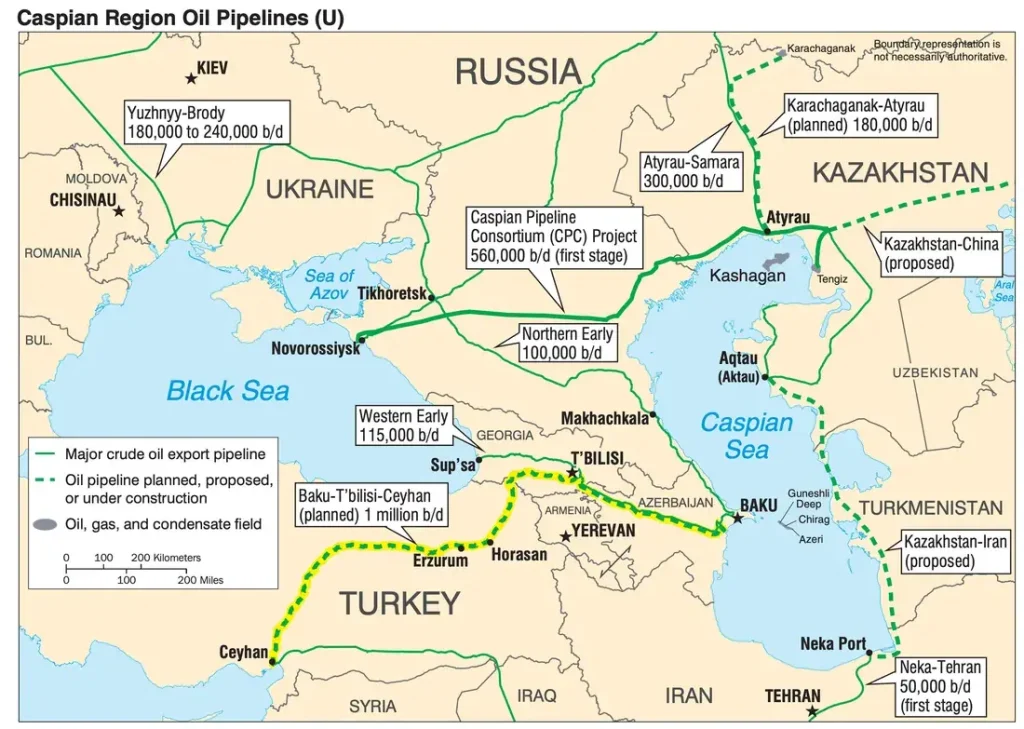
A Liberian-flagged crude oil tanker was attacked twice by drones on the night of July 17, as part of the escalation of the NATO-Ukraine campaign against Russia’s energy infrastructure. A fire then broke out on board, forcing the ship to cancel a call to the Black Sea terminal of the Caspian Pipeline Consortium (CPC).
The CPC is a 1,510km oil pipeline that connects Kazakhstan’s Caspian Sea oil fields with the Russian Black Sea port of Novorossiysk, and brings approximately 80% of Kazakhstan’s oil exports to the world market. Its operations were disrupted at various points during the war by Ukrainian attacks on Russian pumping stations and drone attacks on CPC loading terminals.
Ukraine, of course, denies any involvement in the Novorossiysk attack. What’s interesting is that, according to Reuters, major Western companies are not the only ones with ownership of CPC, and this particular tanker that was hit by the drone was chartered by ExxonMobil. The attack followed an attack on another tanker chartered by Chevron two weeks ago.
CPC’s ownership structure, courtesy of BlackSea Energy & Commodities, is as follows:
Attacks on CPCs are not new for NATO-Ukraine. Back in April, Moscow accused Kiev of attacking the terminal with drones, which likely led to a three-day planned shutdown for maintenance. Last year, following multiple attacks, Kazakhstan demanded that Kiev stop attacks on pipeline loading facilities.
However, despite the best efforts of the Ukrainian side, the CPC terminal in Novorossiysk transshipped a record 70.52 million tons of crude oil last year, an increase of 7 million tons from the previous year.
CPCs bring just over 1 percent of the world’s oil to market, but they play an outsized role for some countries. According to BlackSea Energy & Commodities:
The CPC pipeline is not only essential for Kazakhstan, but also plays an important role in global oil stability. At its peak, it transports approximately 1.4 million barrels per day to global markets, supplying major economies in Europe and Asia. This amount is enough to influence global oil prices and alleviate supply disruptions, positioning CPC as a stabilizing force in international energy markets.
Will Kazakhstan say thank you?
Kazakhstan relies heavily on CPC for oil exports, with more than 80% of its crude oil being routed through pipelines.
But even as NATO and Ukraine continue to attack its economic lifelines, Kazakhstan continues to move toward the West with open arms, harming its relations with Russia.
Kazakhstan is currently building a shell factory to NATO standards and last year signed a military cooperation plan with Turkiye. They followed this up with an April agreement with Turkiye allowing the transport of military cargo and personnel. Such deals are frowned upon in Moscow and Beijing, as Turkiye is a member of NATO and helps the CIA export Islam. Kazakhstan currently carries out military intelligence cooperation, joint defense industrial projects, drone production, and joint military exercises with Ankara.
Kazakhstan and US companies recently signed an agreement on artificial intelligence worth $10 billion.
Kazakhstan is party to a corrupt deal that enriches the descendants of Trump and Lutnik and potentially gives the US access to large quantities of Kazakh tungsten, a critical mineral that is in short supply because China has choked the US war machine.
At the 12th Organization of Turkish States (OTS) Summit at the end of last year, Turkiye, Azerbaijan, Kazakhstan, Kyrgyzstan, Uzbekistan, and Turkmenistan agreed to deepen cooperation in a wide range of areas, including trade and logistics (encouraging Russia to strengthen cooperation with the EU) and defense cooperation, including joint military exercises.
Kazakhstan also plays a role in squeezing Russia’s wheat exports. NATO and Ukrainian attacks in the Sea of Azov are forcing Russian wheat exporters to consider more expensive alternative routes just as new crops are coming to market. At the same time, Kazakhstan has shut down its market for six months.
This false claim received over 100,000 views.
Although Kazakhstan has not imposed a complete ban on Russian wheat, it has introduced partial restrictions for six months that cover imports from all EAEU member states and major third countries (such as Ukraine, China, France, and Australia). https://t.co/v4KB9h1JJZ
— Brian McDonald (@BrianMcDonaldIE) July 19, 2026
While McDonald’s claim is technically correct, it is worth noting that almost 100% of Kazakhstan’s wheat is imported from Russia. According to the Times of Central Asia, Kazakhstan’s six-month suspension risks a trade war with Moscow and weakens the Eurasian Economic Union (members Belarus, Kazakhstan, Kyrgyzstan, Russia, and Armenia, which has threatened to leave).
Kazakhstan’s order is country-neutral and maintains supplies to approved processors. However, countermeasures to date have often been through phytosanitary regulations, certificate disputes, and border controls rather than openly declared retaliation.
The broader problem lies within the EAEU…The Eurasian Economic Commission is able to identify barriers and agree to negotiations, but struggles to block national protection measures from being implemented when prices or food security become politically sensitive. Trade disputes are currently affecting goods ranging from food to road freight, despite common market rules…
But the wheat ban shows how the union currently works through exceptions. For farmers in northern Kazakhstan, fewer cheap truck loads will support crop prices, while millers will pay more for rail deliveries. Although rail transport remains exempt, the debate over what the EAEU common market should offer is becoming increasingly difficult to contain.
Currently, many analysts like to point out how Central Asian countries need to avoid risks and play in all positions, but this seems to go beyond common sense.
And while isolated, it’s just a few flies in the Russian soup, but when you add together the daily attacks on Ukraine, the Armenian issue, the Baltic issue, the seizure of the “Shadow Fleet” tankers, other Central Asian and EAEU issues, Syria, and Turkey’s movements in the Black Sea and Central Asia, it becomes, well, a bowlful of flies.
Must not be in NATO lake
Returning to the Black Sea, there is nothing new in NATO’s efforts to turn the Black Sea into its own little lake. That goal has been around for years. It can also be traced back further, as the Black Sea has been contested for centuries.
And efforts to “contain” Russia have always focused on maritime access. Glenn Diesen. A Norwegian political scientist specializing in Russian foreign policy wrote:
In The Clash of Civilizations and the Remaking of World Order, Samuel Huntington argued that:
“But the immediate source of Western expansion was technological: the invention of oceanic navigation to reach distant peoples and the development of military capabilities to subjugate those peoples. … The West won the world not by its superiority in ideas, values, or religion (to which small members of other civilizations converted) but by its superiority in the application of organized violence. Westerners often forget this fact, but non-Westerners never forget.”
Russia’s economic development has always been hindered since the collapse of the Kiev Rus, cutting it off from the maritime arteries of international trade. Russia’s “return to Europe” and subsequent rise to great power were made possible by gaining access to the Baltic Sea under Peter the Great. Since then, containing Russia has relied in part on denying Russia reliable access to the seas. …
In Europe, NATO has helped expand US control over the Black Sea, Baltic Sea, and Arctic. NATO’s expansion into Bulgaria, Romania, and possibly Ukraine is aimed at turning the Black Sea into a NATO lake.
But whatever else Project Ukraine accomplished, it failed miserably on that front. As a GIS report recently noted, “Russia has maintained the strongest position in the Black Sea region since 1991 and is ready to further strengthen that position.” Oops.
But at least NATO and Ukraine are playing a role in damaging the world’s food supply.
1.5mmt. -29% YoY. -62% compared to July 2024.
This is SovEcon’s forecast for Russian #wheat exports this July, the lowest since 2017.
The Azov/Black Sea turmoil and weak demand are the driving forces. If the shallow water terminal remains closed, the situation will worsen in August when exports are suspended… pic.twitter.com/33HPSGNI27
— Andrei Sizov (@sizov_andre) July 21, 2026
Source link
