


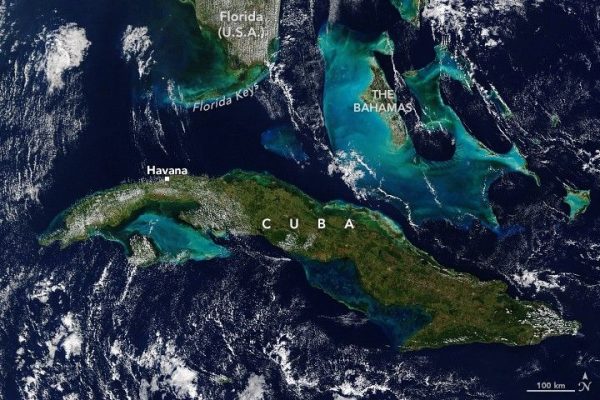
The failure of the U.S. military campaign against Iran could create immense political pressure in Washington for a rapid demonstration of restored American strength. After a costly and embarrassing Mideast campaign that did not achieve declared political objectives, policymakers would likely search for a target that appeared manageable, vulnerable, and geographically convenient. Cuba could quickly emerge as an attractive candidate.
The pathway toward confrontation with Cuba would probably not emerge abruptly. In many respects, the political conditioning process may already be underway. Recent administration rhetoric suggesting that Cuba could become the next target of intensified American pressure, combined with expanded naval deployments and military activity in the Caribbean, has begun normalizing the idea of direct confrontation within both policy and media discourse. Long before any overt military operation, Washington would likely intensify sanctions pressure, expand maritime interdiction activities, increase accusations of regional destabilization, and frame the Cuban government as an unresolved hemispheric security problem.
Cuba – In easy reach?
This escalation psychology could be reinforced by the apparent coercive success against Venezuelan leadership following earlier American strikes and pressure campaigns. Even if Venezuela itself remained unstable afterward, the visible capitulation of political leadership could encourage a dangerous conclusion inside Washington: that nearby adversarial governments in the Caribbean basin are brittle structures vulnerable to concentrated military force. Policymakers could increasingly convince themselves that hostile regional regimes can collapse rapidly once confronted with overwhelming American power. By the time direct military options entered mainstream discussion, much of the psychological and political groundwork for escalation would already have been established.
Military Factors
From a superficial military perspective, the logic would appear compelling. Cuba lies only ninety miles from Florida. The United States possesses overwhelming naval and air superiority. The Cuban economy is fragile, its military equipment largely obsolete, and its strategic isolation considerable. Compared to the immense logistical and geopolitical complexity of Middle Eastern operations, Cuba could appear to offer the prospect of a rapid and highly visible victory close to home. That apparent simplicity is what would make such an operation strategically dangerous.
Military planners often conceptualize force as a localized and controllable application of power. In reality, modern geopolitical systems behave less like isolated battlefields and more like stressed structural materials. The impact does not remain localized. Once armed force is applied, fractures propagate outward through hidden stress lines, producing cascading failures far removed from the original point of contact.
A Cuba intervention would likely begin as a limited coercive operation intended to restore credibility and demonstrate hemispheric dominance. It could easily evolve into a far larger military, political, economic, and diplomatic crisis than those initiating it anticipated. The danger would lie in the illusion that its consequences could remain limited.
Escalation Logic of Intervention
The operational logic of intervention would likely evolve incrementally. Initial coercive measures intended to demonstrate resolve would create pressure for enforcement. Enforcement failures would generate demands for expanded strikes. Infrastructure disruption and regime destabilization would increase the risk of internal disorder, producing arguments for security deployments and stabilization operations. What began as a limited demonstration campaign could gradually evolve into an open-ended counterinsurgency and occupation burden.
The campaign would likely begin with naval deployments, sanctions intensification, cyber attacks, and exclusion-zone enforcement around Cuban waters. The stated purpose would be coercive pressure rather than invasion. Yet coercive campaigns rarely remain static. Once political leadership publicly commits itself to visible success, pressure emerges for escalating measures capable of producing decisive results.
The next stage would likely involve extensive suppression of Cuban air defenses, strikes against military infrastructure, communications systems, ports, airfields, and command facilities. The United States would almost certainly achieve rapid air and naval dominance. This initial military success could itself become politically destabilizing by creating the perception that the operation was proceeding easily and cheaply. That apparent success would create the conditions for the next escalation step.
From Coercion to Occupation
Airborne and amphibious entry operations would likely follow. Airfields, ports, and strategic facilities would need to be secured to support sustained operations. Marine and airborne forces could probably establish lodgments relatively quickly given overwhelming American superiority in precision strike, ISR, and mobility assets.
Yet this would represent a profound transition in the character of the war. The operation would no longer consist merely of coercive strikes or demonstrations of force. The United States would now possess physical responsibility for territory, infrastructure, civilians, transportation networks, ports, communications systems, and urban populations. Military intervention would begin transforming into an occupation operation.
The seizure of major cities would magnify this transformation. Havana alone contains more than two million people and represents the political, economic, and administrative center of the island. Santiago de Cuba and other major urban centers would present similar stabilization burdens on smaller scales. Capturing modern cities is easier than governing them. Modern warfare repeatedly demonstrates that conventional military collapse does not necessarily produce political submission or social stability.
This is the central strategic illusion underlying supposedly “easy wars.” Defeating organized resistance is often far easier than establishing durable political control afterward.
The Cuban Resistance Problem
Many Americans instinctively imagine Cuba through the lens of Grenada or Panama: a small Caribbean state vulnerable to rapid military defeat. That analogy is deeply misleading. Cuba’s military weakness in conventional terms obscures the extent to which its defense system was historically designed for territorial resistance and prolonged political survival rather than battlefield parity with the United States. Cuban doctrine emphasized what it termed the “War of All the People,” a territorial defense model integrating regular military forces, reserves, militia structures, internal security organizations, and distributed mobilization systems.
Cuban militia in 1959
The Revolutionary Armed Forces were never intended to defeat an American invasion conventionally. Their purpose was to complicate occupation, fragment resistance, disperse military pressure, and impose continuing political and operational costs on a foreign power attempting long-term control of the island. Even if organized Cuban military resistance collapsed rapidly, the stabilization problem could become extremely difficult.
The Stabilization Burden
Cuba possesses a population of roughly eleven million people spread across a large, geographically elongated island with thousands of kilometers of coastline, multiple urban concentrations, mountainous regions, and substantial transportation infrastructure. Havana alone could absorb enormous security resources. Urban security operations are manpower intensive because they require checkpoints, infrastructure protection, patrol networks, intelligence penetration, riot control capacity, and rapid reaction forces.
Foreign occupation also changes political identity structures in unpredictable ways. Anti-government sentiment does not automatically translate into support for foreign military control. Nationalist resistance frequently emerges even among populations deeply dissatisfied with their own governments. The United States could therefore face not a unified ideological resistance movement, but a diffuse combination of nationalist hostility, sabotage, decentralized armed resistance, passive noncooperation, criminal opportunism, and insurgent regeneration.
These forms of resistance need not threaten outright military defeat to become strategically concerning. The American experience in Afghanistan demonstrated how even relatively low-intensity insurgency can steadily impose casualties, financial costs, political exhaustion, reputational damage, and demands for expanding troop commitments over time despite overwhelming conventional military superiority.
The stabilization burden is dynamic because military success itself creates expanding obligations. Ports must be secured; airfields protected; roads patrolled; power systems defended; food distribution maintained; communications networks restored; government functions reconstructed; civilian unrest suppressed; and refugee flows controlled.Each success creates new responsibilities. Each responsibility generates additional force requirements. The progression from coercive demonstration to occupation burden would likely produce steadily expanding manpower requirements at every stage of the campaign.
Even under relatively optimistic assumptions, sustained control of an island nation the size of Cuba could potentially require force commitments measured not in a few brigades, but in the hundreds of thousands once urban security, infrastructure protection, coastal control, counterinsurgency operations, logistics, and rotational requirements were fully incorporated. At that point, the supposedly “easy” war would have evolved into a major occupation campaign.
Regional Blowback
A Cuba intervention would not occur in a political vacuum. It would reactivate some of the deepest historical anxieties in Latin America regarding American interventionism, hemispheric dominance, and sovereignty. Governments throughout Latin America need not support the Cuban regime to oppose American military intervention against it. The issue is not ideological alignment with Havana. The issue is the normalization of coercive regional intervention.
For decades the United States has attempted to distance itself rhetorically from the overt interventionist traditions associated with earlier eras of hemispheric politics. A military operation against Cuba would immediately revive historical memories of gunboat diplomacy, regime manipulation, covert action, unilateral sanctions enforcement, and American-backed regime change operations throughout the hemisphere.
The political repercussions could spread rapidly throughout the hemisphere. Left-wing parties would frame the intervention as proof that American imperial doctrine had merely been temporarily suspended rather than abandoned. Nationalist movements across the ideological spectrum could converge around fears of renewed hemispheric interventionism. Governments attempting to maintain cooperative relations with Washington would face growing domestic pressure to distance themselves publicly from the operation.
The Organization of American States could become deeply divided. Regional trade and security cooperation initiatives might begin fragmenting under political strain. Anti-American demonstrations would likely spread throughout major Latin American cities. Even governments privately hostile to Cuba could conclude that open support for intervention would be politically unsustainable domestically.
Migration pressure could further destabilize the regional environment. Large refugee outflows toward Florida and neighboring Caribbean states would create simultaneous humanitarian, logistical, and political pressures. Even limited maritime migration crises can rapidly consume coast guard, law enforcement, and emergency management resources while intensifying domestic political tensions within the United States and throughout the region.
Instead of demonstrating hemispheric dominance, a U.S. invasion of Cuba could trigger hemispheric turmoil on a scale not seen in decades.
Global Geopolitical Impact
The global consequences could prove equally damaging. The United States simultaneously attempts to position itself as defender of sovereignty, guarantor of rules-based order, and opponent of coercive territorial politics. A Cuba intervention would contradict that narrative. This contradiction would become especially severe in the context of American policy regarding Ukraine, Taiwan, territorial sovereignty, and opposition to aggressive military coercion. Russia and China would gain major propaganda opportunities by portraying the intervention as evidence that Washington applies international norms selectively according to strategic convenience.
American allies could become increasingly uncomfortable with the precedent being established. European governments already struggling with political polarization and anti-war sentiment could face growing domestic criticism regarding continued alignment with Washington. NATO cohesion might weaken under renewed accusations that the alliance system primarily functions as a vehicle for American geopolitical power projection.
China could emerge as the largest long-term strategic beneficiary of the crisis. Beijing could exploit the intervention diplomatically by presenting itself as a defender of sovereignty and non-intervention while simultaneously expanding economic, intelligence, and political influence throughout Latin America. At the same time, the normalization of overt American hemispheric coercion would weaken Washington’s ability to criticize comparable regional pressure elsewhere. Once the United States openly reasserted sphere-of-influence politics through force, Chinese leadership could increasingly justify more aggressive policies toward Taiwan and other regional states as parallel exercises in strategic necessity and regional security enforcement.
An operation intended to restore American credibility after strategic embarrassment elsewhere could instead deepen perceptions of inconsistency, overreach, and declining strategic discipline, further weakening the global standing of the United States.
USS Nimitz – recently deployed to the Caribbean
Conclusion
A military attack on Cuba may appear deceptively manageable to U.S. leaders. The island is geographically close, economically fragile, and militarily weak compared to the overwhelming power of the United States. After a failed confrontation in the Mideast and an apparently successful coercive precedent in Venezuela, the temptation of a rapid nearby victory could become politically irresistible.
Yet this apparent simplicity conceals serious danger. The risks of a Cuba intervention would not lie in the challenge of defeating the Cuban military. The United States would almost certainly achieve rapid conventional military dominance. The danger would emerge afterward, as the fractures generated by the intervention propagated outward through military, political, and diplomatic systems that policymakers only partially control.
An intervention justified as a limited demonstration of restored American credibility could evolve into a prolonged occupation burden demanding escalating troop commitments and continuous political support. Moreover, the intervention could destabilize relations throughout Latin America, intensify anti-American nationalism, fracture regional cooperation structures, and damage U.S. global legitimacy at a time when Washington seeks to portray itself as the defender of international order.
Modern geopolitical systems do not respond to military force cleanly. They behave more like stressed materials under sudden impact. Once armed force is applied, fractures spread outward through hidden fault lines, generating cascading failures far removed from the original point of contact. A war against Cuba that initially appears to promise an easy victory could ultimately evolve into a military quagmire, a regional political crisis, and a geopolitical defeat.
