


This is Naked Capitalism fundraising week. 1310 donors have already invested in our efforts to combat corruption and predatory conduct, particularly in the financial realm. Please join us and participate via our donation page, which shows how to give via check, credit card, debit card, PayPal, Clover, or Wise. Read about why we’re doing this fundraiser, what we’ve accomplished in the last year, and our current goal: more original reporting.
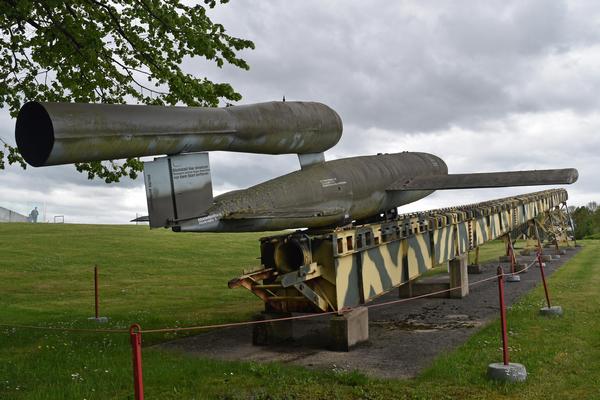
In 1944, Nazi Germany began launching V-1 flying bombs against Britain. These inexpensive, pilotless aircraft carried large explosive payloads toward predetermined destinations, allowing Germany to sustain aerial bombardment without risking pilots or committing conventional bombers to each attack.
More than eighty years later, Russia has introduced a remarkably similar weapon. The Geran-5 is another expendable, jet-powered flying bomb designed to deliver an explosive payload over considerable distances at a fraction of the cost of a sophisticated cruise missile. Its cruciform shape, straightforward mission, and broadly comparable speed would have been immediately recognizable to the V-1’s designers.
German V-1, the first cruise missile
The resemblance is functional rather than genealogical. The Geran-5 is not a modified V-1. Yet the two weapons embody the same industrial proposition: manufacture large numbers of sufficiently capable flying bombs rather than maximize the performance of each unit. Beneath their superficial similarity lies a profound technological transformation. Modern navigation, digital flight control, and programmable routing allow the Geran-5 to attack targets precisely rather than merely bombard a metropolitan area. Eighty years of technological development have made an inexpensive flying bomb substantially more effective.
Russian Geran-5 – New and improved
But if defensive anti-aircraft technology has also advanced, why has the flying bomb not become obsolete? The answer lies in the complex interaction of offensive production, defensive coverage, interception costs, and the ability to repair or replace what successful attacks destroy. This article examines these factors and their operational implications for the war in Ukraine.
Two Flying Bombs, Eighty Years Apart
The V-1 was an exercise in wartime engineering economy. Its pulsejet engine had few moving parts and could be manufactured relatively cheaply, although it was noisy, inefficient, and mechanically crude. A simple gyroscopic autopilot maintained heading and altitude, while a small nose-mounted propeller drove an air-log mechanism that measured approximate distance traveled. At the preset distance, the guidance system commanded the weapon to descend. The resulting aircraft was essentially a disposable delivery system for a large explosive charge. Weighing more than two metric tons, the V-1 carried a warhead of approximately 850 kilograms and had an operational range of roughly 210–250 kilometers, sufficient to reach London from occupied France.
The Geran-5 follows the same philosophy with a radically different technological foundation. Its reported turbojet propulsion, modern materials, electronics, and manufacturing methods permit a considerably smaller aircraft. Ukrainian intelligence estimates indicate a maximum takeoff weight of approximately 850 kilograms, a warhead of around 90 kilograms, and a range approaching 950 kilometers.
Several relationships stand out. The Geran-5 weighs less than half as much as the V-1 and carries approximately one-tenth its explosive payload, yet its reported range is nearly four times greater. Improvements in propulsion, aerodynamics, fuel efficiency, and guidance have dramatically altered the relationship between weight, payload, and range.
Speed, however, has changed surprisingly little. Like the V-1, the Geran-5 occupies a speed regime accessible to conventional aircraft and ground-based air defenses. Its survival depends less on aerodynamic performance than on the operational demands it imposes on the defensive system.
The reduction in warhead weight does not imply a corresponding reduction in military utility. The V-1 needed a large explosive charge partly because its primitive guidance could deliver a weapon toward a city-sized target area but not reliably against a particular installation.
Targeting accuracy is where eighty years of technological development have produced the most consequential change. Satellite navigation, inertial sensors, digital flight control, and programmable electronics have become inexpensive enough to incorporate into an expendable aircraft. A relatively cheap flying bomb can follow waypoints, vary its approach direction, and navigate toward a selected target without the elaborate guidance equipment once associated with costly cruise missiles.
The result is a fundamental change in the relationship between explosive power and useful destructive effect. The V-1 was primarily an area-bombardment weapon. A modern flying bomb can deliver a much smaller explosive charge against a designated installation with far greater precision. What matters is no longer simply how much explosive reaches the target area, but what it actually hits.
Programmable routing creates another important difference. The V-1 approached Britain from known launch areas along comparatively predictable courses. The Geran-5’s reported range permits attacks across much of Ukraine, while waypoint navigation allows approaches from directions quite different from the shortest route between launch point and target. The defender must therefore protect not merely the target but a potentially large collection of approaches to it.
Earlier propeller-driven Geran variants already demonstrated the military value of combining inexpensive aircraft with modern navigation. The Geran-5 adds another important variable: speed. Ukraine has invested heavily in countering slower propeller-driven drones with mobile firing groups, electronic warfare, antiaircraft weapons, and increasingly sophisticated interceptor drones. Inexpensive interceptor drones in particular offer the prospect of defeating mass-produced attackers without expending much more costly surface-to-air missiles.
A faster incoming aircraft changes this equation. It reduces the interval between detection and arrival and increases the speed, acceleration, endurance, and guidance performance required of a pursuing interceptor. Increasing those capabilities can increase the interceptor’s cost and complexity, eroding the favorable economics that made it attractive against slower Gerans.
Jet propulsion is not an unqualified advantage. It introduces different fuel-consumption, acoustic, thermal, and manufacturing characteristics, while the aircraft remains vulnerable to suitable defensive weapons. Its operational value ultimately depends on reliability, production cost, range, targeting performance, and actual interception results.
What eighty years bought was therefore not a revolutionary flying machine. Speed remains in roughly the same class, the aircraft remains vulnerable, and the basic mission is familiar. The revolution occurred largely in the inexpensive electronics guiding the airframe. Precision navigation, programmable routing, and digital flight control transformed an indiscriminate flying bomb into a precision weapon, while jet propulsion now imposes another round of adaptation on the defender. Eighty years have not made the flying bomb obsolete. They have made it far more efficient at imposing demands on defensive systems.
The V-1 Defense
Britain’s experience with the V-1 demonstrates both the effectiveness of integrated air defense and the concentration of resources required to achieve high interception rates against a weapon that flew predictable routes and could not maneuver intelligently. When the V-1 campaign began in June 1944, Britain already possessed one of the world’s most sophisticated integrated air-defense systems. Radar stations, fighter-control organizations, antiaircraft artillery, and extensive communications networks had been developed during the Battle of Britain.
Nevertheless, the V-1 presented a different problem from conventional bombers. Flying at roughly 600 kilometers per hour, it was fast enough to challenge many contemporary fighters and difficult for antiaircraft gunners to engage. Its small size and relatively low altitude further complicated interception. Unlike a bomber, it carried no crew, required no return flight, and could be launched repeatedly without exposing trained airmen to combat.
Britain initially employed fighter aircraft, antiaircraft guns, and barrage balloons. Fighters intercepted V-1s over the Channel and southeastern England, sometimes using the hazardous expedient of flying alongside them and disturbing their airflow to upset their gyroscopic autopilots. Antiaircraft batteries provided concentrated fire, while barrage balloons supplemented the defenses along selected approaches. The initial arrangement proved inefficient. Fighters and guns sometimes operated in overlapping areas, creating risks of friendly fire and restricting engagement opportunities. The defenses were subsequently reorganized, with gun batteries concentrated in a coastal belt and fighter operations assigned more clearly defined areas.
Technological improvements accompanied the reorganization. Radar-directed fire control, improved gun-laying equipment, and proximity-fuzed ammunition substantially increased antiaircraft effectiveness. Proximity fuzes allowed shells to detonate near their targets rather than requiring direct hits or precisely timed explosions. The results were impressive. Approximately 3,957 of the 7,488 V-1s that crossed the coast were destroyed by defensive action, an interception rate of about 53 percent. Fighters and antiaircraft guns each accounted for nearly half of the kills, with barrage balloons contributing a much smaller share. Following the reorganization and technological improvements, coastal gun defenses achieved much higher local interception rates, exceeding 90 percent under particularly favorable conditions.
But these results depended on unusually favorable geography. The V-1s approached from a relatively restricted launch area, and London was their principal target. Their limited guidance made their routes reasonably predictable. Britain could therefore concentrate substantial defensive resources along anticipated approaches rather than distribute them across the country. The coastline provided a particularly advantageous defensive barrier. Incoming weapons could be detected and engaged before reaching densely populated areas, while clearly separated fighter and gun zones reduced interference between defensive systems. Radar-directed batteries could concentrate their fire against targets approaching through comparatively narrow corridors.
Britain devoted enormous resources to countering the V-1s. Fighters, radar installations, gun batteries, ammunition, trained personnel, communications, and logistical support were assembled into a defensive organization specifically designed to defeat the flying-bomb campaign. Ukraine faces a greater challenge in defending against Russian jet drones.
Why Ukraine Cannot Build a Comprehensive Cruise Missile Defense
Britain’s V-1 defense succeeded in large part because geography and the weapon’s limitations permitted defensive resources to be concentrated. Ukraine faces a fundamentally different problem. Its critical infrastructure is widely dispersed, while modern flying bombs can follow programmed waypoints and approach selected targets from different directions. A narrow defensive concentration analogous to Britain’s coastal gun belt would therefore cause the Russian attack drones to navigate around the defensive position.
Ukraine must protect cities, industrial installations, power facilities, transportation infrastructure, military bases, and logistics centers across a large territory. The problem is not finding a weapon capable of destroying a Geran-5. Several can do that. The much more difficult problem is providing enough interception capability over enough territory at a sustainable cost.
Ukraine can counter jet drones through electronic warfare or destroy them directly with ground-based guns, manned aircraft, and interceptor drones. Electronic warfare can disrupt navigation and other electronic functions and has become an important element of Ukraine’s defenses against earlier Gerans. But its effectiveness depends on the attacker’s guidance architecture and counter-countermeasures, while autonomous inertial navigation can allow a weapon to continue toward its target when satellite navigation is unavailable. Each defensive method solves part of the problem while imposing other difficulties.
Gun-Based Defense
Automatic anti-aircraft cannon provide perhaps the most straightforward answer to the unfavorable economics of using sophisticated surface-to-air missiles against inexpensive flying bombs. Radar-directed gunfire can provide a comparatively more efficient means of destroying suitable targets. Ukraine’s German-made Gepards illustrate both the attraction and limitation of this approach. Germany has supplied 60 of these self-propelled antiaircraft guns, armed with twin 35 mm cannon. They have proved valuable against Russian drones, but their short engagement range makes protection of large areas difficult.
German Gepard anti-aircraft cannon – too few to matter?
Consider Kyiv alone. Its administrative area encompasses approximately 836 square kilometers, while the metropolitan region extends much farther. A nominal five-kilometer engagement radius produces a circular footprint of only about 79 square kilometers. Practical coverage is smaller because firing range does not equal assured interception range: terrain, approach direction, reaction time, target speed, simultaneous attacks, ammunition availability, and engagement geometry all matter.
Protecting a metropolitan region tens of kilometers across consequently requires many overlapping gun positions. Extending comparable protection to other cities, industrial centers, generating facilities, transportation nodes, military installations, and logistics infrastructure multiplies the requirement.
Nor can Ukraine simply acquire hundreds more Gepards. Production ended decades ago, so Germany’s contribution has depended on recovering and refurbishing existing vehicles, while specialized 35 mm ammunition production has had to be reestablished. Modern systems such as Skynex and Skyranger can perform similar missions but cannot immediately be manufactured and deployed in the numbers comprehensive geographic coverage would require. Gun-based defense therefore presents a paradox. It can provide an economical means of destroying inexpensive flying bombs, but its short reach makes widespread coverage enormously expensive. The cannon rounds may be cheap. The geographic coverage is not.
Aircraft
Fighter aircraft offer greater mobility than anti-aircraft artillery and can be directed toward incoming weapons across broad areas. But operating radius is not the same as defensive coverage. Interception requires an aircraft to be airborne or able to launch quickly, supplied with timely tracking information, and able to reach an intercept position before the target passes.
Maintaining such coverage during geographically dispersed attacks requires multiple aircraft airborne, with others refueling, rearming, undergoing maintenance, or changing crews. The Geran-5 further reduces the useful response radius by shortening the interval between detection and arrival. A fighter capable of easily overtaking the drone may nevertheless be too distant to intercept it in time.
Ukraine’s circumstances impose additional constraints. Its combat aircraft are scarce assets required for air defense, strike, and other missions, while their bases are themselves recurring targets of Russian missiles and drones. Aircraft must therefore be dispersed, protected, maintained, fueled, armed, and supported by surveillance, communications, and command systems. The infrastructure supporting an aerial defensive screen is itself part of the target system.
There is also an industrial constraint that does not apply to Ukraine’s rapidly expanding drone industry. Ukraine does not currently manufacture modern combat aircraft. Fighter losses must therefore be replaced from foreign inventories, and even surviving aircraft depend on an extensive international maintenance and supply system.
The F-16 illustrates the problem. Ukraine has received only several dozen aircraft, while some have already been lost. Some are required for training, and Zelenskyy recently stated that around half of Ukraine’s F-16s spend extended periods in Europe undergoing maintenance and repair. The pool immediately available for interception missions is consequently much smaller than the nominal number delivered.
Although F-16s can destroy Geran-5s, every interception sortie consumes flight hours and maintenance capacity from a scarce fighter force that Ukraine cannot replace through domestic production. The defender is using a difficult-to-replace high-performance aircraft to hunt a mass-produced expendable weapon. The economics of missile interception compound the problem. Current U.S. procurement budgets put AIM-9X Sidewinder acquisition costs in the several-hundred-thousand-dollar range per weapon, substantially above the estimated cost of a Geran-5. An F-16 firing a Sidewinder can therefore expend substantially more on the interceptor alone than Russia expended on the aircraft being destroyed, before considering the cost of the fighter sortie and supporting infrastructure. Ukrainian pilots have also attacked jet drones with their F-16s’ cannon, avoiding expenditure of costly air-to-air missiles but accepting the attendant risk of collision with debris.
Ukraine’s fighter aircraft provide drone interception capability without providing an operational solution. The relevant constraint is not whether an F-16 can destroy a Geran-5. It is that the size of the available fighter aircraft force is insufficient to match the scale of the jet drone threat.
Interceptor Drones
Interceptor drones potentially offer a more attractive compromise. They can be considerably less expensive than manned aircraft while covering a larger area than a gun emplacement. Against slower propeller-driven Shahed/Geran variants, Ukraine has increasingly used them as part of a layered defense.
The concept is appealing because it can restore favorable economics to the defender. Instead of launching a sophisticated surface-to-air missile against an inexpensive attack drone, the defender launches another relatively inexpensive aircraft. But interception is fundamentally a problem of geometry and time. The defensive drone must receive sufficiently accurate targeting information, launch from a suitable location, accelerate to interception speed, acquire the target, and complete the engagement before the opportunity disappears. The Geran-5 compresses this sequence: its higher speed reduces the engagement window and may exceed the pursuit capability of interceptors designed for slower propeller-driven Gerans.
The obvious response is to build faster interceptors. But greater speed, acceleration, endurance, sensing, and guidance tend to increase propulsion requirements, complexity, and cost. The defender can therefore find itself climbing the same technological ladder as the attacker: each improvement in the attack aircraft forces a corresponding improvement in the aircraft intended to destroy it.
Nor do interceptor drones eliminate the coverage problem. They must be positioned close enough to likely flight paths to reach incoming targets within the available engagement window. National coverage consequently requires not merely large inventories of interceptors but a distributed network of launch sites, sensors, communications, operators, maintenance facilities, and replacement stocks.
The Coverage Problem
The three approaches confront different versions of the same constraint. Guns offer inexpensive engagements but protect small areas. Manned aircraft provide mobility but require scarce platforms and extensive support. Interceptor drones potentially combine favorable economics with greater reach, but depend on performance, positioning, detection, and a distributed launch architecture. Faster attack aircraft increase the demands on all three.
Surface-to-air missiles add another defensive layer and remain indispensable against demanding targets, but routine use of expensive missiles against mass-produced flying bombs creates its own inventory and economic problems. Detection does not eliminate these limitations. An incoming aircraft must still pass within the engagement envelope of an available defensive weapon. Low-altitude flight can restrict radar visibility, while higher speed reduces the time available to organize an engagement.
Effective national drone defense therefore requires geographically distributed sensors, electronic-warfare systems, firing or launch units, personnel, communications, ammunition, interceptors, and maintenance and replenishment logistics. Russia can choose the timing, scale, routes, and targets of its attacks; Ukraine must maintain defensive readiness across a much larger collection of possible targets.
This is the fundamental difference from Britain’s V-1 defense. Britain could concentrate defensive capability along predictable approaches to a principal target. Modern navigation allows an attacker to exploit precisely such geographic concentration. The attacker can concentrate weapons. The defender must distribute protection. For each weapon the attacker manufactures, the defender must provide a much more widely distributed system capable of finding and destroying it. This geographic asymmetry dictates the cost arithmetic of drone interception.
The Economics of Attrition
Mass precision-drone attack introduces a second asymmetry. A defender may intercept many incoming weapons and still suffer substantial damage, while the attacker can remain economically competitive despite losing most of its drones in each strike.
Consider a simplified comparison between the Geran-5 and Russia’s Iskander ballistic missile. A precise production cost for the Geran-5 is not publicly available, but its known components permit a useful order-of-magnitude estimate. Ukrainian intelligence identifies its Chinese Telefly TF-TJ2000A turbojet, along with relatively inexpensive commercial and dual-use navigation, communications, and flight-control electronics. Adding the carbon-fiber and metal airframe, 90-kilogram warhead, fuel system, actuators, launch equipment, assembly, and testing makes a unit cost on the order of $100,000 plausible.
Leaked Russian procurement documents reportedly priced a 2025 trial batch of 18 longer-range 9M723-2 Iskander-M variants at approximately 221 million rubles, or about $2.5 million per missile. Using that figure solely as an order-of-magnitude comparison, the same expenditure would purchase roughly 25 Geran-5s at the rough $100,000 working estimate used here. At these assumed prices, Russia could theoretically manufacture approximately 25 Geran-5s for the price of one Iskander. The weapons are not operationally interchangeable: an Iskander is much faster, carries a substantially larger warhead, and can attack targets for which a small flying bomb would be inadequate. The comparison applies principally to fixed targets against which the Geran-5’s payload and precision are sufficient. The question is how many of those 25 weapons survive at different interception rates.
Even at a 90 percent interception rate, the assumed $2.5 million expenditure statistically produces 2.5 surviving Gerans. At 95 percent, it produces an average of 1.25. Only at approximately 96 percent interception does Russia’s assumed expenditure per surviving Geran reach the assumed price of an Iskander.
This is not a true economic break-even point. The weapons differ substantially in destructive power and penetration capability, and some Gerans that penetrate the defenses will miss, malfunction, or inflict little damage. Conversely, a small warhead striking vulnerable equipment may cause losses many times greater than the aircraft’s cost. The calculation simply illustrates how high defensive attrition must become before mass-produced flying bombs cease to provide inexpensive opportunities for successful penetration.
Defensive expenditure matters as well. Sophisticated surface-to-air missiles may destroy inexpensive drones reliably but impose unfavorable cost ratios when used repeatedly. Guns, electronic warfare, and interceptor drones can improve the economics where they are effective. But this calculation describes only one raid. The larger contest consists of repeated launches, interception, damage, repair, and replacement. Viewed over time, drone warfare becomes an industrial attrition problem. The offensive process can be represented as a sequence:
Production → Launches → Reliability → Interception → Leakers → Effective hits → Damage → Restoration
Not every manufactured weapon will be launched, every launched weapon function correctly, every functioning weapon penetrate the defenses, or every surviving weapon inflict significant damage. A simplified expression for the expected number of effective hits is:
H = L × (1 − f) × (1 − p) × (1 − q)
where L represents weapons launched, f the fraction lost through non-defensive failures, p the interception probability among functioning weapons, and q the probability that a surviving weapon fails to achieve an effective hit.
For illustration, suppose 1,000 weapons are launched, 5 percent fail independently of defensive action, 90 percent of the functioning weapons are intercepted, and 20 percent of the survivors fail to achieve an effective hit. The result is approximately 76 successful attacks. These are illustrative assumptions, not estimates of actual Geran-5 performance. They demonstrate how high interception rates can still permit consequential damage when attack volume is sufficiently large.
The defender has a corresponding industrial process: acquisition or manufacture of defensive equipment, geographic deployment, detection, engagement, ammunition expenditure, maintenance, and replenishment. But interception determines only how many attacks get through. Strategic effect depends on what they destroy and how quickly the lost capacity can be restored.
Let D represent the rate at which attacks destroy or degrade functional capacity, and R the rate at which that capacity is restored through repair, replacement, substitution, or new construction. The net rate of degradation is:
G = D − R
If destruction persistently exceeds restoration, functional capacity declines. If restoration equals or exceeds destruction, the defender can stabilize or recover despite continuing attacks. Restoration rates vary enormously. An electrical distribution line may be repaired relatively quickly, while a destroyed generating unit, refinery, or major industrial installation may require specialized equipment and lead times of months or years. Even softer targets such as warehouses, fuel facilities, distribution centers, and transportation assets can become important attrition targets when repeated destruction outruns reconstruction.
These systems are also interconnected. Damage to electricity generation can reduce industrial output; transportation disruption can delay replacement equipment; and losses affecting manufacturing and logistics can impair replenishment of defensive resources. Sustained attacks may therefore reduce both existing capacity and the ability to restore it.
The opposing processes remain dynamic. Improved interception, dispersion, hardening, redundancy, imported equipment, and rapid repair can reduce damage or increase restoration. Greater attack production, improved penetration, and successful attacks against critical infrastructure can increase degradation.
The decisive question is therefore not whether the defender can destroy an impressive percentage of incoming weapons. It is whether the attacker’s production and penetration system can impose effective damage faster than the defender’s protection and restoration system can absorb and repair it. The attacker must sustain destruction. The defender must sustain protection and restoration. The outcome of the attrition contest depends on which industrial system can sustain the more favorable rate differential.
What the Attrition Equation Says About Ukraine
The attrition equation provides a framework for evaluating Russia’s evolving aerial offensive. Public information is insufficient to calculate the opposing rates of destruction and restoration precisely, but several developments indicate that the balance has become unfavorable for Ukraine.
Jet-powered Gerans. Ukraine has developed increasingly effective methods for intercepting the older propeller-driven Shahed/Geran family. High interception rates have been achieved using anti-aircraft machine guns and inexpensive interceptor drones. Jet propulsion has disrupted that adaptation by reducing engagement time, increasing target altitude, and exceeding the pursuit capabilities of many existing low-cost interceptors. The faster jet-powered Gerans have proved substantially more difficult for these systems to engage, forcing greater reliance on combat aircraft and anti-aircraft cannons, while Ukrainian manufacturers race to develop faster interceptors. Ukraine has demonstrated successful interceptions, but has not yet established a comprehensive, scalable solution.
Asymmetry of offensive industrial capability. Ukraine has fielded an impressive long-range drone force, and its attacks on Russian oil refineries have caused substantial damage, interrupted production, and imposed significant economic costs. Nevertheless, the offensive systems are not symmetrical. Russia combines large-scale drone production with cruise missiles, ballistic missiles, and guided aerial bombs, employing different weapons against different target categories while developing successive generations of inexpensive attack aircraft. Ukraine has demonstrated technological ingenuity and considerable offensive reach but not a comparable capacity for sustained, nationwide industrial attrition against Russia.
FAB glide-bombs. Russia has already demonstrated the effectiveness of combining inexpensive conventional weapons with relatively simple precision guidance. FAB-series bombs fitted with glide and correction kits permit aircraft to release conventional bombs from stand-off distances that make the launching aircraft substantially more difficult for Ukrainian air defenses to engage. Despite Ukrainian countermeasures, Russia continues to employ FABs on an enormous scale. According to Ukraine’s Defense Ministry, Russian aircraft dropped 8,766 guided aerial bombs during August 2026 alone, the highest monthly total of the war.
Increasing destruction of commercial infrastructure. Russian attacks have increasingly struck fuel facilities, warehouses, distribution centers, commercial facilities, and transportation assets. These generally lack the protection of hardened military installations but can impose substantial economic and logistical losses when destroyed repeatedly. In September, Ukrainian businessman Ruslan Shostak reported that the country had lost approximately 2.1 million square meters of major warehouse space, including some 900,000 square meters during 2026. The United Nations separately documented a sharp increase in attacks against major Ukrainian food, retail, and logistics companies during August, recording at least 32 attacks against facilities belonging to six major companies, compared with 11 in July.
The warehouse figures provide a particularly useful illustration of the destruction-restoration equation. Ukraine reportedly entered the full-scale war with approximately 4.2 million square meters of Class A and B warehouse space. Since then, approximately 2.1 million square meters have been destroyed while about 800,000 square meters have been newly constructed. New construction has therefore replaced only about 38 percent of the capacity destroyed. This is a concrete example of the condition represented by D > R: destruction exceeding restoration.
Taken together, these indicators suggest that Ukraine has not yet developed a scalable means of neutralizing Russia’s evolving inexpensive precision-attack system. Faster jet drones have challenged established interception methods; Russia retains a broader offensive weapons system; the FAB campaign demonstrates a parallel unresolved defensive problem; and infrastructure losses provide evidence that successful attacks are producing cumulative effects.
Important countervailing resources remain. Ukraine continues to innovate rapidly, its deep-strike campaign imposes substantial costs on Russia, and foreign assistance expands the resources available for defense and reconstruction. Nevertheless, the observable indicators presently point toward a Russian offensive system evolving faster than Ukraine’s ability to neutralize it comprehensively. The question is no longer whether Ukraine can destroy incoming flying bombs. It is whether Ukraine can prevent Russia from imposing cumulative losses faster than they can be repaired or replaced.
Conclusion
The resemblance between the V-1 and the Geran-5 is remarkable, but the most important differences are invisible. Eighty years of technological development have equipped the inexpensive flying bomb with precision navigation, programmable routing, extended range, and the ability to attack selected targets precisely rather than bombard a general area. The Geran-5’s speed challenges defensive systems developed against slower propeller-driven drones. Ukraine must adapt to this threat while simultaneously confronting Russia’s cruise and ballistic missiles and glide bombs.
The deeper problem is systemic. Modern defenses can destroy the Geran-5, but doing so effectively requires an extensive deployment of geographically distributed sensors, electronic warfare, guns, interceptor drones, aircraft, missiles, personnel, ammunition, and supporting infrastructure. Russia can concentrate inexpensive weapons against selected targets; Ukraine must maintain costly protection across a much larger set of possible targets.
The resulting contest is one of industrial attrition. Ukraine’s deep-strike campaign has imposed substantial costs on Russia, but it has not established offensive symmetry. Meanwhile, accumulating destruction of Ukrainian commercial and logistical infrastructure raises the question of whether restoration can keep pace with sustained attack.
The V-1 failed to achieve its intended strategic result. Its modern counterpart, the Geran-5, may prove more consequential because inexpensive guidance technology has greatly increased what a mass-produced flying bomb can accomplish. The V-1 was a strategically unsuccessful weapon of mass bombardment. The Geran-5 has become a potent weapon of attrition warfare.
