


Jacob Hawk leaned over the plastic fencing to get Vivek Ramaswamy’s attention as the Republican candidate for Ohio governor moved down the line shaking hands at the Ohio University branch campus in Chillicothe, six days before the midterm elections. Hawk held onto Ramaswamy’s hand and started trying to tell him everything he was dealing with, everything he wanted the Republican candidates gathered there to help him with.
Hawk, 39, told him that he was a self-employed landscaper who was having a hard time with the high cost of fuel. He told him that he was raising three young kids from two different moms, mostly on his own. He told him of his worries for his 9-year-old son, who was autistic and underweight and suffered from a two-year delay in brain development.
Ramaswamy, a biotech billionaire, nodded and offered some token reassurance and moved down the line, toward the arena where he would soon be appearing with President Donald Trump and Sen. Jon Husted and the rest of the Republican slate in a state that Trump had won by 11 percentage points two years ago, and which the party had dominated during the era of Trump. I had been at many Republican events in the state over that time, including a rally in an airplane hangar outside Dayton in March 2016, where a giant crowd had roared as Trump’s jet had rolled into view and where he had declared that he had come to save Ohio. “Our jobs are being sucked away,” he said then. “It’s unbelievable what’s happening.”
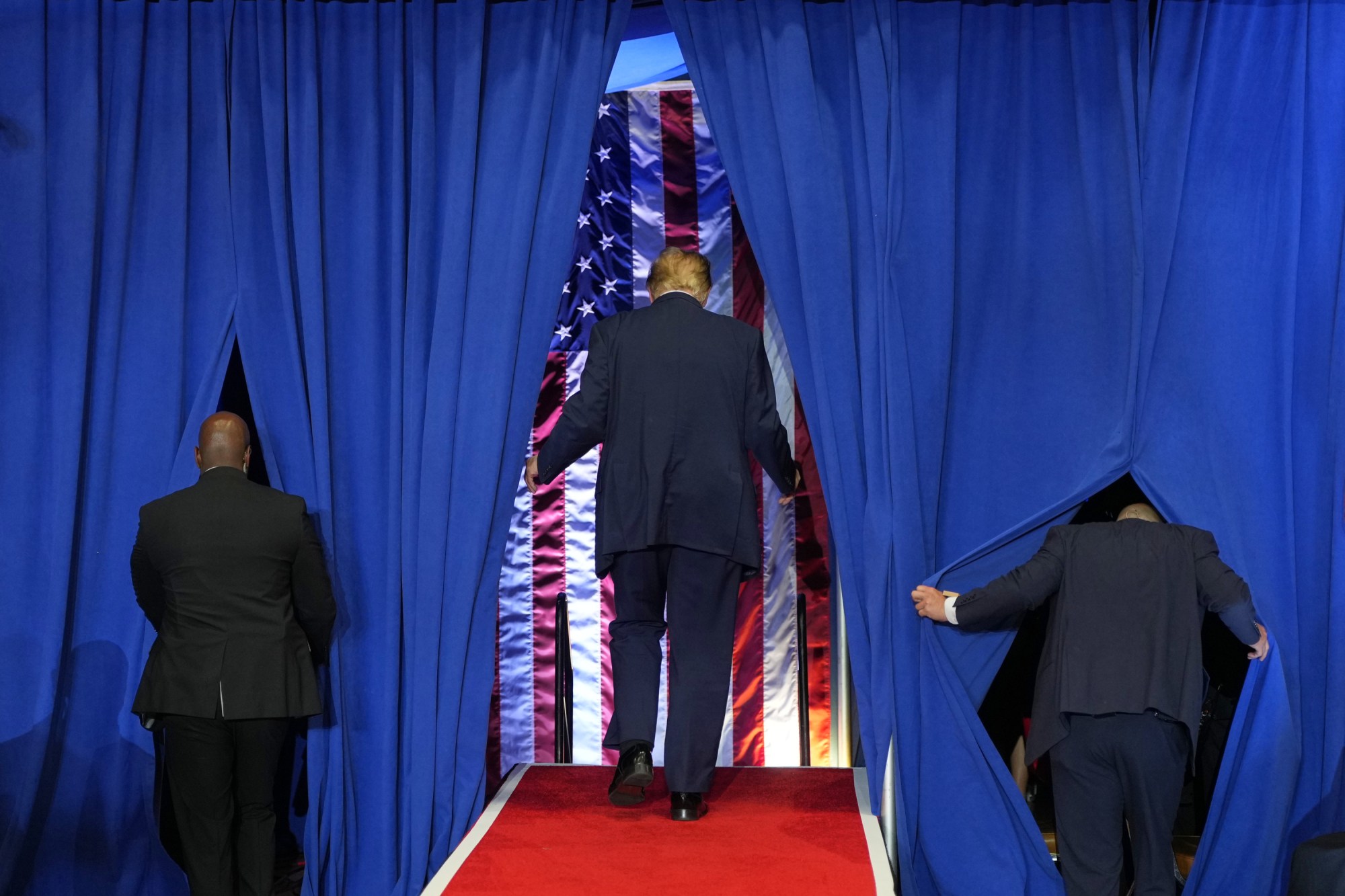
This event was different. Ten years had passed, and gone was the fierce bravado of Trump the conquering hero, bristling with retribution and promises. This rally was populated largely by the same sort of voters who had been particularly drawn to Trump all along, working-class Midwesterners who had not been engaged in politics before he came on the scene. But there were fewer of them — the campaign had chosen an arena that held only 2,000 — and their devotion had been subsumed by uncertainty. They were still with Trump, but they weren’t sure how to reconcile their own difficulties with the fact that he was the president during this trying time.
Take gas prices, which “are beating the hell out of me,” Hawk told me. He was trying his best not to hold them against Trump and his decision to go to war against Iran, instead faulting Congress for limiting domestic oil drilling. “The president has to go find oil in another country because Congress won’t let him find it in our country,” he said, overlooking the fact that Trump’s party has controlled both houses of Congress during his second term.
Nearby, Debbie Shock, a 57-year-old mail carrier, blamed the high fuel costs on “the stock exchange, the markets — they’re the ones that control it.” “We have oil right here in the U.S.,” she said. “Why are we buying it from other countries to begin with?”
Shock fit a profile I had gotten to know well in 2016: an Obama-Trump voter. She was loyal to Trump — “I like the man. Nobody’s perfect, you know what I mean?” — and told me she would never go back to Democrats now. Why not? I asked. “They’re covering up the child molestation,” she said. What did she mean by that? “I’ve heard stories about the sex trafficking. The Clintons are involved in it, Disney World, you know, all that.”
It would be easy to ridicule such murky talk, yet it was not much less coherent than what soon emerged on the arena stage, which was streamed on a large screen for the few hundred of us who were out on the lawn outside the arena. Trump has never been known for structured oratory, but it is hard to overstate the extent to which his digressive style has advanced since 2016, and to convey how surreal it is to experience firsthand, as the reality of what presidential communication has come to in 2026.
The rally opened with the customary introductory video of late-era Trump, an explicitly messianic framing: “God said, ‘I need someone who will be strong and courageous,’” the voice-over intones. “So God made Trump.”
Thus introduced, Trump opened his remarks with a lengthy disquisition on Husted’s body, which had newly become part of his routine. “I looked at Jon and studied his physique,” he cooed, after referring to his recent comments on Husted’s “ass.” “I studied the feet, the legs, the shoulders. I tapped him on the shoulder, and it was like hitting a piece of steel.”
When a protester inside the arena started shouting something — those of us outside couldn’t hear what — and was removed, Trump bid him good riddance: “Now he goes home and his boyfriend gets upset with him.”
There were protesters outside, too, and things were starting to heat up between them and the supporters. “What are you talking about, ‘boyfriend?’” shouted one protester, a young man. “He was just talking about Jon Husted’s ass! That’s not gay??”
A supporter in front of me, a bearded man in his 50s, stewed as he watched the protesters. “You’re going to see someone dropping like a bad habit,” he growled, as he started to move toward them, before being held back by the woman who was with him.
A moment later, Trump had moved on to Jeffrey Epstein, saying that the Democrats had protected him for years. “I threw Jeffrey Epstein the hell out of Mar-a-Lago,” he declared. “I was the one who was totally exonerated from him. But they use it, because that’s what they do. They’re sick, weak people.”
This set off a new round of shouting outside, as cries of “pedophiles!” flew back and forth.
Suddenly, one Trump supporter near me rushed hard at a protester and knocked him to the ground, his head landing with such a thud on the blacktop that I initially thought it might be a suppressed gunshot. Dozens of officers swarmed to the spot. Cameras flashed.
A few moments later, a couple other protesters, also young men, began railing against the war against Iran. “We’re going to be the ones sent off to die for Israel,” one shouted. “‘America First,’ and you want me to die in the Middle East?”
Trump touched on the war — “they’re getting beaten very badly” — but spent far more time on his home renovations. “The White House has to be beautiful outside, it needs that exterior plaster. The bricks were falling, the stone was broken, the monuments were coming off, the beautiful windows were cracked, it looked terrible, and I fixed it very inexpensively, and now it’s more beautiful than ever,” he said. “And President Obama, who doesn’t understand cleanliness, who doesn’t understand broken cracked stone and sidewalks, who doesn’t understand that having asphalt going to your main entrance is not the right thing, we’d like to have granite and marble we’d like to have it look nice, you don’t use asphalt, you use asphalt for your streets. …”
On the ramble went. To the Haitians in nearby Springfield: “The town went from no crime to high crime,” but “they’re being moved out.” To a riff on Ramaswamy’s ad featuring his opponent Amy Acton’s mother calling her a liar, in apparent reference to Acton’s having accused her stepfather of raping her when she was 12, as he was subsequently charged with doing. The ad had met with widespread opprobrium, but Trump defended Ramaswamy. “The mother said that Amy Acton, the daughter, is a liar, that she is no good. … How the hell is that his problem?” To “O Canada, which has been ripping us off for years,” and Somalia, “which isn’t even a country,” and “transgender mutilization,” and his plan to rename the Strait of Hormuz for himself.
Finally, Trump ceded the stage to Husted and Ramaswamy. But by then, the lawn had emptied out as people drifted home, Jacob Hawk among them. A vendor was shouting out discount prices on his MAGA merchandise. “$10 special on hats! All the hats are $10! These are normally $25 hats. That’s a good hat for $10.”
The next day, the full Republican slate of statewide candidates appeared, sans Trump, at a small pep rally inside a former Delphi auto-parts factory in Vandalia, outside Dayton. It is an enormous building that employed more than 100 prior to its closing in 2009 and is now being used as a warehouse by a company that sells air conditioners, employing only 10 or so; Delphi announcements still remained on the bulletin boards, adding a ghostly feel.
The setting was an unintentional reminder of what Ohio has been through. Between 2000 and 2025, the state lost 300,000 manufacturing jobs, a devastation that had made it highly susceptible to Trump’s message in 2016. But Republicans have been in charge of the state since 2010, and so it was the task of the candidates gathered there, with an audience of just a few dozen, to cast the state as being on an upswing. Complicating this challenge is the fact that so much of the state’s recent growth has been concentrated in the Columbus area: countless data centers, defense contractor Anduril, a massive Intel plant under construction.
The bigger challenge, though, was the nationwide pall that hung over the event: the reality of stubbornly high inflation and high gas prices, the latter a direct consequence of Trump’s decision to go to war with Iran. He had stood against costly foreign entanglements when he ran in 2016, in opposition to his party’s recent record, and carried that same banner again in 2024. But another aspect of his political persona had prevailed: a heedless swagger that, in this case, had been fanned by Israeli Prime Minister Benjamin Netanyahu and Defense Secretary Pete Hegseth. It had led him into this drawn-out conflict that has already cost U.S. taxpayers more than $47 billion.
And it had left a long row of Republican candidates standing in this giant building stacked high with made-in-China air conditioners all but pleading the small assemblage to save them from the political climate. “You can’t give up,” Husted said. “This is a Republican state, and the only way Democrats can win is if Republicans don’t vote.”
Five days later, I was in York County, Pennsylvania, which Trump had won by 25 points in 2024, and which was home to one of four Republican-held House districts targeted by Democrats. I chose to go to a precinct on the outskirts of York, thinking it would offer a diverse cross-section, in between more Democratic York proper and more Republican rural areas. But over 90 minutes of conversations, I didn’t encounter a Republican voter until I was about to call it a day.
The first person I spoke with, Bill, a 52-year-old state government employee who asked that I not use his last name for fear of losing his job, had voted for Trump three times. He hardly considered himself MAGA but was drawn in 2016 to Trump’s “drain the swamp” rhetoric and his disavowal of the war in Iraq. He voted for him again in 2020 and 2024 because he didn’t think much of Joe Biden and Kamala Harris.
But on this day, Bill was coming to vote against his Republican representative, Scott Perry, because he was too “Trump adjacent.” Bill had finally had enough of Trump, especially when it came to all the revelations of self-dealing involving his family and cronies. “I will not be falling for him again,” he told me. “Drain the swamp, no wars. … It was all a lie.”
He said he couldn’t understand how Trump had gone from America First to seemingly letting the country’s foreign policy be dictated by Israel. He said that he was voting for the Democrats mainly just for the sake of “gridlock,” as deliberate blockage. “Someone’s got to stop this,” he said. “It’s getting out of control.”
Each Democratic voter I spoke with after that was coming with their own motivation for voting against the Republican slate, like the cast of “Murder on the Orient Express.”
For Annie (who also asked that I not use her last name), it was for Trump’s social-welfare cuts, which had cost her and her disabled husband $300 per month in SNAP benefits and nearly cost them their Medicaid coverage.
For Desiree Edmonds, an elementary school teacher, it was high inflation, which was translating into anxiety among the working-class children in her classroom.
For Mark Castillo, a 19-year-old ironworker, it was for the sky-high cost of diesel.
For Jacqueline Jimenez, a native Puerto Rican who worked as a home-health aide, it was for the excessive harshness of ICE arrests.
For Shiri Kramer, a warehouse worker, it was for the general meanness emanating from the administration, which made her think of her grandfather, a Jewish American who had extended mercy to German POWs during World War II. “My grandfather would be writhing right now,” she said. “Nothing happening in our country is OK.”
By night’s end, Republicans had lost this Pennsylvania district by 10 points, as well as the other three in the state and more than 40 nationwide. They had lost at least seven Senate seats, even in states where Democrats hadn’t prevailed in decades — Kansas, Texas, South Carolina. Incredibly, even Mississippi was on the verge. In Ohio, Republicans lost the race for Senate and governor — only one of the seven statewide candidates on stage at the warehouse emerged a victor — as well as two Republican-held House seats, a stark reversal in a state that had seemed to be trending away from Democrats for good. In all, Democrats flipped five governorships and up to 12 state legislative chambers. The Democratic popular-vote margin in congressional races nationwide was 13 percentage points — nearly double the Republican margin in their own wave years of 2010 and 1994, and approaching the scale of the historic Democratic rout in the post-Watergate election of 1974.
The particularly stunning loss of the South Carolina seat brought to mind a warning issued in May 2016 by Lindsey Graham, whose death this July left the seat vacant. “If we nominate Trump, we will get destroyed…….and we will deserve it,” Graham tweeted in 2016. For years, the Republican Party had avoided the catastrophic reckoning he warned of — through Trump’s narrow win in 2016, through the Jan. 6, 2021, assault on the Capitol, through Biden’s fateful insistence on running for reelection at age 81 in 2024. Along the way, much of the party, including Graham himself, had accommodated itself to Trump. One way of looking at the 2026 results was that the warning had finally come true. The reckoning had been delayed by a decade, but it had gathered more force over time, like a boulder rolling downhill.
There was a hint of such a reckoning in the words that Bill, the three-time Trump voter, left me with in York. After he returned from voting, he bade me farewell with a parting regret.
“You see what’s going on,” he said, “and you’re like, ‘What the hell did I do?’”
