


Part the First: How Do You Identify a Vanity Institution? Last week we discussed an alternative medicine clinic in Switzerland in which several patients died after alternative therapies. These clinics are, of course, everywhere, and sometimes they are difficult to identify. Jonathan Jarry has written The Parallel World of Fakery for the McGill Office of Science and Society. This article is something of a one-stop shop (with links). As he puts it, “Vanity institutions look like the real deal. They are built by people who couldn’t (or more charitably wouldn’t) make it in real ones.” Harsh, but true.
Jarry begins with a brief discussion of the Flexner Report of 1910, through which Abraham Flexner changed the practice of medicine in North America. Proprietary medical schools were closed and medical education changed, more than 99% for the better. The report was, alas, also a monument to the ugly eugenics running rampant a hundred years ago. but the standardization of medical education to include the scientific foundations of medicine was necessary. Jonathan Jarry has also written about the Flexner Report here in The Book Natural Healers Really Hate. But the natural healers have regained some influence and continue to expand their reach. From The Parallel World:
To this day, practitioners of so-called alternative medicine denounce the Flexner Report as a witch hunt: validating pharmaceutical-oriented medicine and crushing “natural” healing practices.
But these practices—often based on prescientific beliefs about divine energy and invisible blockages—never went away. When the Internet gained in popularity, a worrisome phenomenon arose. If these spine-cracking, herb-prescribing, energy-manipulating disciples weren’t allowed to practice medicine, if their studies were so weak that no serious academic journal wanted them, if they couldn’t get their remedies approved as drugs, they would build parallel systems that they controlled.
Dr. Joseph Mercola was one of the first to harness the promises of the early Internet and set up shop on the Web, allowing him to bypass traditional channels and speak directly to potential customers. He could falsely tell them that vaccines were toxic and that the supplements he sold were a better investment than any pharmaceutical drug.
This mimicry of real institutions is now all around us. There are pseudoacademic conferences, predatory journals, would-be clinics, sham professional associations and official-sounding medical boards. Podcasts and video platforms have allowed these people free reign in doling out dangerous health advice without suffering any consequences. The rise of AI makes it easy to bypass the difficult work they are trying to emulate and to wear one more hat, that of journalist.
Welcome to the mirror world of vanity institutions.
These “institutions” are very good at what they do. They do, however, in the inside tend to look like the laboratories seen on television in successful shows such as CSI: Miami. No laboratory in real life has ever come close to that. We have also discussed sham scientific societies that can mislead researchers who should know better:
Anyone can create a group with a dignified name to give the impression of legitimacy. Scour the Internet and you too will find the American College for Advancement in Medicine and the Academy of Integrative Health and Medicine. They are exercises in mimicry.
Having a website is one thing. How do you meet in person to continue the charade? Much like real researchers, pseudoscientists attend conferences—only theirs are stripped of their rigour, promoting instead conspiracy theories and bogus ideas. Robert F. Kennedy Jr’s Make America Healthy Again movement has its own recurring conferences, the so-called MAHA Summits. Flipping through the program, it all sounds legit, with sessions called “Psychedelic Medicine: The Next Frontier” and “Prevention, Early Detection, and a New Future for Cancer.” The goal is to look rigorous and authoritative while actually promoting misinformation.
And so it goes. A parallel development has poisoned the scientific literature. The first online journals, e.g., BMC, are now about twenty-five years old (my second graduate student got a “cover” illustration in BMC Cell Biology). They are holding their on as legitimate journals even though they “exist” in a virtual world. These 300 open access journals now have competition with thousands of similar sounding titles that are pay-to-publish-anything if you can come up with the money. Predatory journals, and conferences, are the bane of good science, but they look like the real thing but they are not. This will not end well, anywhere. Too many publications, too many grant proposals written by what the Current Administration in the United States calls Super Intelligence. I would have predicted Golden Intelligence.
Fake doctors, pseudoscientists, and would-be journalists desperately want to be seen as the real deal, yet they refuse to do the hard work that comes with these professions. So, they build parallel systems that approximate the ones they want to join, like children simplifying castles with sand and a bucket. Oversimplification, after all, is a major hallmark of pseudoscience. Feeling persecuted by institutions, these people have no choice but to build hollow versions of them in which they can thrive without criticism.
Friction is good, but pseudoscientists don’t want it. Large language models like Claude and ChatGPT give them the illusion of wisdom without any of the friction required to achieve it. It’s a shortcut, one peppered with selective evidence and outright hallucinations. The goal is not to be right but to earn respectability by cutting corners.
What is the answer? I don’t have one, other than what Jonathan Jarry concludes with:
In the wake of Abraham Flexner’s report, medical education became more standardized in North America. But what he called “medical sects”—meaning natural healing practices not based in evidence—never disappeared. They waited until we were engulfed in a tsunami of information to build shams that could more easily fool the average person.
Be careful out there. Super Intelligence is coming for your money, your science, and your health.
Part the Second: Cancer Vaccines that Work. As real scientists continue their hard work despite current disruption across the board by MAHA influencers at the highest levels, we have good news on cancer vaccines for glioblastoma and melanoma.
Glioblastoma is a terminal disease. A recently published study provides hope as described in Adjuvant personalized multivalent neoantigen DNA vaccination for MGMT unmethylated glioblastoma: a phase 1 trial (open access). From the Abstract:
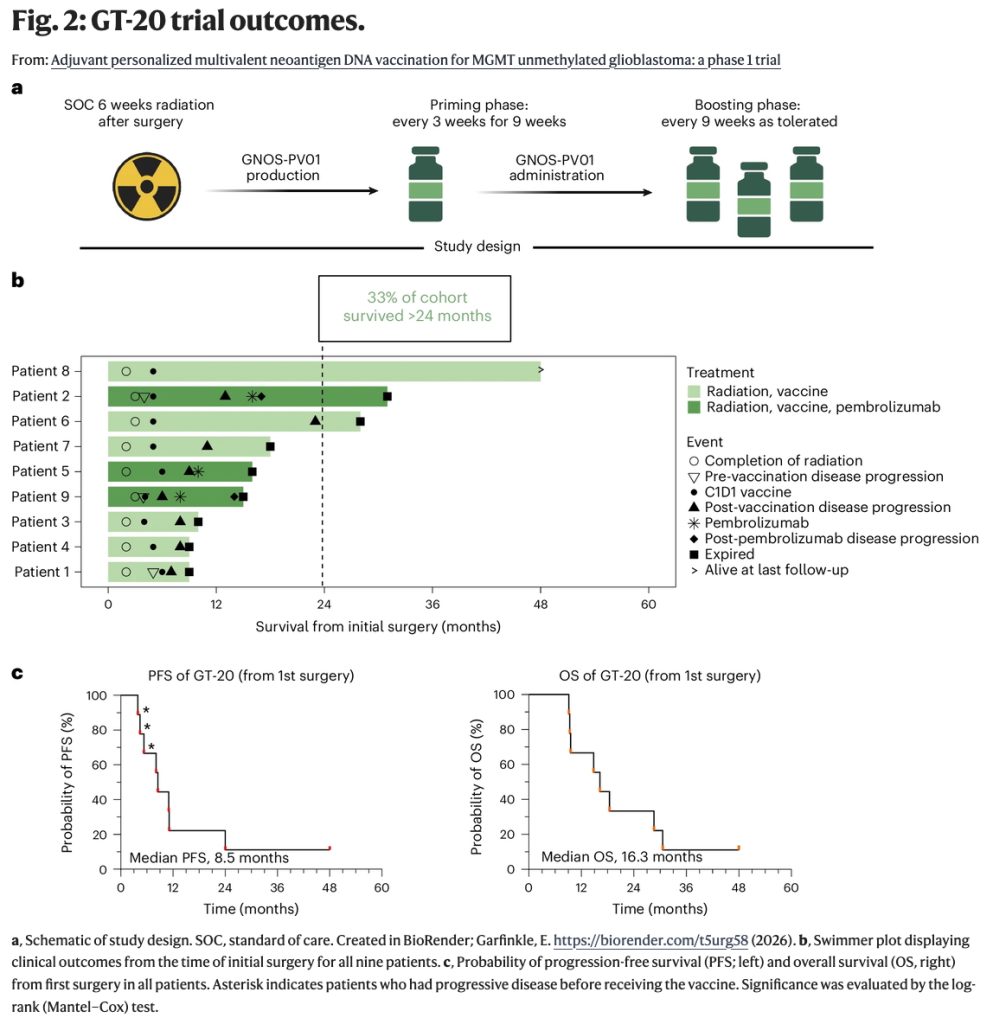
Glioblastoma is a fatal disease with a median prognosis of 12–18 months. Recent studies have shown encouraging results using neoantigen-based vaccines to stimulate glioblastoma-directed immune responses, but overall immunogenicity has been low. Here, we report the results of…a phase 1 clinical trial (GT-20) to evaluate the safety and feasibility (primary endpoints) as well as immunogenicity and preliminary clinical activity (secondary endpoints) of GNOS-PV01 monotherapy, a DNA-based personalized therapeutic cancer vaccine administered following surgical resection and radiation for patients with MGMT unmethylated glioblastoma. The GT-20 study vaccinated nine patients, using up to 40 neoantigens per patient (range, 17–40) without causing any serious adverse events, unexpected toxicities or dose-limiting toxicities. The vaccine induced activation and expansion of circulating peripheral T cells in all evaluated patients, except one who was being treated with dexamethasone…Median progression-free survival was 8.5 months, median overall survival was 16.3 months and survival at 24 months was 33%, including one long-term survivor still alive 4 years from the time of initial surgery. This study met the pre-specified endpoints and supports the use of GNOS-PV01 as a potentially impactful component of glioblastoma immunotherapy. ClinicalTrials.gov: NCT04015700.
That is a lot, but it can be summarized as follows:
The patients’ tumors were surgically removed.
Up to 40 unique neoantigens were identified from the individual tumors.
A DNA vaccine was prepared using these neoantigens and the patients were vaccinated with their own personalized vaccine.
Survival times after treatment (surgery, radiation, vaccination, pembrolizumab/Keytruda) were measured.
A neoantigen is a protein produced by the tumor that is not encoded in the normal human genome. These can be used to elicit a response from the patient’s immune system. In the best case, the vaccine prevents tumor cells from growing and can cure the cancer. A picture is worth the proverbial thousand words. This figure summarizes the results:
Median progression-free survival increased by about 100% across the trial. Three patients lived for more than two years. Patient 8 is still alive after four years. This is a remarkable outcome for glioblastoma. Although the number of patients in the trial was small, the outcomes are clear. Personalized neoantigen vaccines against glioblastoma can work. The next step in this research will be to figure out why the treatment worked in some patients but not others. This treatment is both safe and effective, representing an incremental improvement of treatment for one of the deadliest of cancers. As we have discussed before “incremental” science can be the death knell in a review of a biomedical grant proposal. But virtually all advances in biology are incremental. This research also takes time and resources. The study has been published years after it began. We can only hope that this research meets the priorities of the current administration. If it does, there is every reason to believe that for many patients in the future, a diagnosis of glioblastoma will not be terminal.
Part the Third: An mRNA Vaccine Against Melanoma. Melanoma is a tumor of melanocytes. These are found in skin but they are not epidermal cells. Instead they are neuroendocrine cells that produce melanin. While most melanoma is associated with skin, it is can also arise elsewhere, including the eye. A full report awaits publication but the preliminary account was published in Nature last week, Moderna mRNA vaccine almost halves the risk of skin cancer returning:
A personalized mRNA vaccine reduced the risk of skin cancer returning or the recipient dying by 42% when used alongside an immunotherapy drug, according to long-awaited results for what could become the first approved mRNA vaccine for cancer.
Oncologists regard a risk reduction of 10% as substantial, says Kristen Radford, an immunotherapist at Mater Research in Brisbane. A risk reduction of more than 40% “would send many researchers over the Moon”, adds Seth Cheetham, a geneticist at the University of Queensland in Brisbane, Australia.
The personalized vaccine, called intismeran, is not designed to prevent skin cancer, or melanoma, from developing in the first place, but to stop it returning in people who have already undergone surgery to remove tumours.
…
The intismeran trial enrolled 1,137 people with moderate to advanced melanoma across 157 centres. Participants were randomly assigned to receive either a tailor-made vaccine (intismeran) alongside the immunotherapy drug pembrolizumab — which is already used to treat melanoma — or pembrolizumab plus an inactive placebo. Trial leader Georgina Long, an oncologist at Melanoma Institute Australia in Sydney, says participants have so far been followed for around 25 months and will continue to be monitored for several years to determine whether the vaccine improves overall survival. She adds that the therapy did not result in any major harmful side effects.
Roughly 15 years ago, people with advanced melanoma typically survived for only months. Today, nearly 55% are effectively cured with targeted drugs or immunotherapies, says Long. The combination of intismeran and pembrolizumab is designed for people whose cancer could return after surgery and who do not respond to immunotherapy alone, she says.
Unlike the much more common basal cell carcinoma, which is a skin cancer that is invasive and destructive but does not spread (as I know from too much personal experience) melanoma usually kills because it metastasizes. This mRNA vaccine basically stops spread of the primary tumor. It does not work in all patients, and cancers have a way of mutating their way around therapy, but this advance is astonishing. Forty years ago, pioneers in cancer immunotherapy could “cure” malignant melanoma is certain patients, but they were hitting the target with a blindfold covering their eyes. Now, scientists and oncologists know what to aim at and how to deliver the projectile.
Of course, in this case the projectile is released by an mRNA vaccine. The current Secretary of Health and Human Services in Bethesda, Maryland, is “against” mRNA vaccines, because reasons. I wonder though. With that artificial tan he sports after a lifetime sailing off Hyannis Port, RFKJr is a prime candidate for melanoma. I suppose somewhere down the line he would refuse this personalized cancer vaccine on principle as a treatment for melanoma. As for myself, I spent my younger years in the sun using coconut oil, which probably has an SPF of minus-1000, instead of sunscreen that did not exist back then. I look forward to this intervention becoming the standard of care.
Part the Fourth: Sasquatch Is Not Real. Who knew? According to the McGill Office of Science and Society, Bigfoot Has Always Been a Hoax. But this first part I did not know:
In 1957, the government of British Columbia was preparing to celebrate the 100th anniversary of the province, and the council for the town of Harrison Hot Springs had an idea: why not revive the half-forgotten legend of Sasquatch and organize a hunt for the creature? This bold idea triggered international news coverage. Soon, the Sasquatch hunt brought in more tourism dollars than anything the B.C. government had ever funded to attract travelers.
Then, there was the fraud. Large footprints near Bluff Creek, California, were reported by a construction contractor, who was later revealed to have been a prankster. After he died, his family showed the large wooden feet he had strapped on to create the prints.
As for the infamous Patterson-Gimlin film (the star of the show appears at ~2:40), what is made clear in Capturing Bigfoot is that this is a story about money: who needed it and what they were ready to do to keep it flowing.
This cannot be true! Next thing you know Piltdown Man (Wikipedia) was also a hoax. I have been to the Bigfoot Museum between Ellijay and Blue Ridge in the North Georgia mountains, where the true story of Bigfoot is presented in all its glory. He did not live only in the mountains out west. There have been sightings all over North America.
So, I guess they were just making it up? Well, come to think of it, this would not be much different from the Democrat’s course of action if, after the most consequential election in living memory, they choose Hakeem Jeffries as Speaker of the House of Representatives and Chuck Schumer as Senate Majority Leader.
Thank you for reading! And to everyone who voted, no matter which candidate you picked, thank you! It is time to return some sanity to our politics. Oh, and: Go, Mississippi and Alaska! You can do this! Stay safe out there and buckle up. Things are likely to get interesting. See you next week.
