


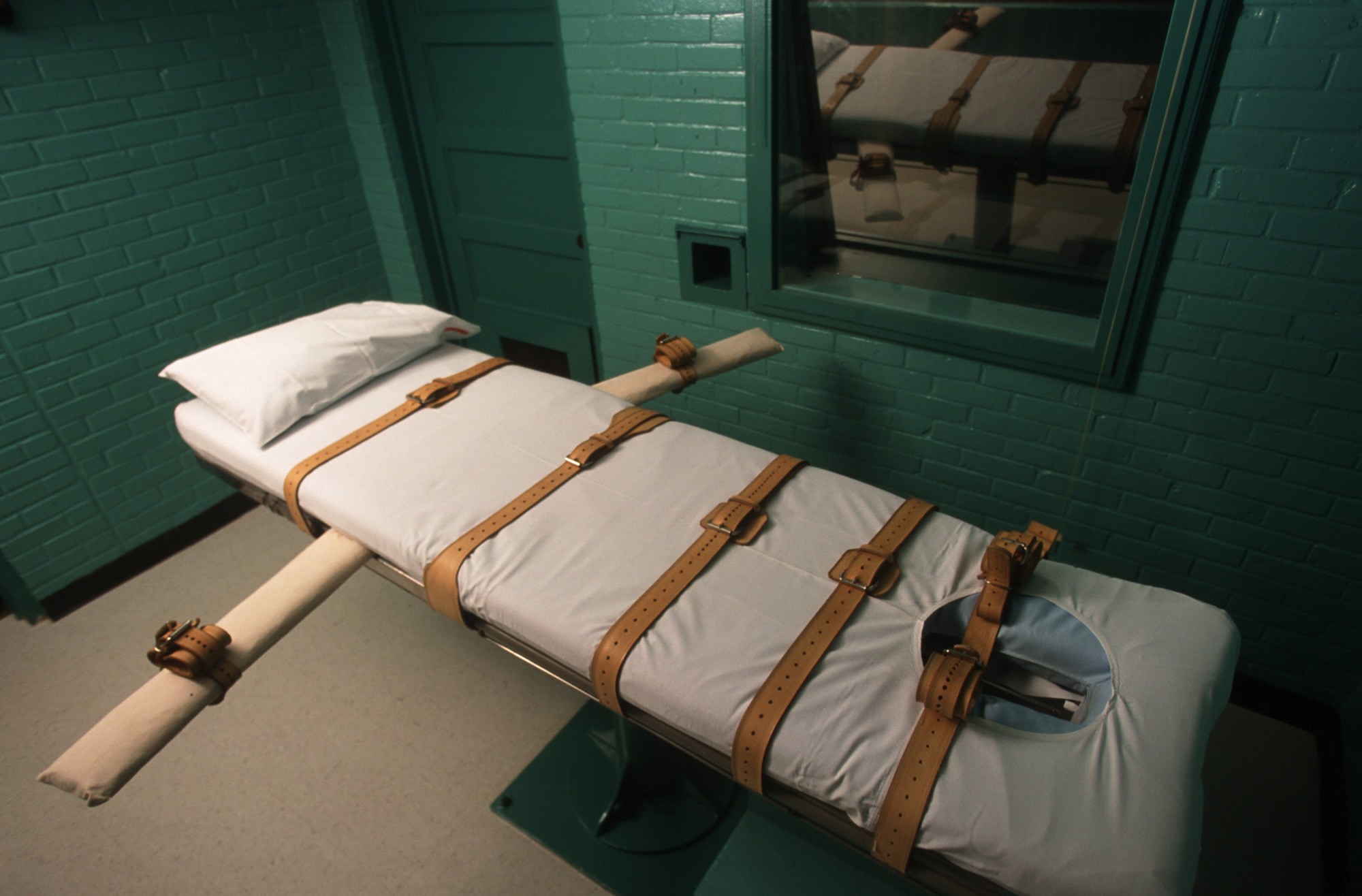
Reporting Highlights
Agonizing Procedures: Many aging death row prisoners have medical problems that can complicate efforts to kill them, including cancer, blood disorders and heart problems.
Competency Questions: Several states have faced questions about the competence of their execution teams as major medical organizations have opposed participating in the procedures.
Shielded by Secrecy: State laws generally hide the names of execution teams and information about the drugs, making it difficult to ensure the procedures are effective and humane.
These highlights were written by the reporters and editors who worked on this story.
Over the course of two hours, witnesses watched and listened as Christa Pike cried, whimpered and snored through Tennessee’s attempt to execute her. By the end of it, executioners had given her two doses of the state’s lethal injection drugs. Her arms were swollen and blistered, and one had turned purple, her attorneys said. And she was still alive, marking what legal experts say is the first time a prisoner in the U.S. has survived one dose — let alone two — of lethal injection drugs.
Even if the outcome was unprecedented, what went wrong was not. Pike’s was the third Tennessee execution in 14 months to go awry. But as a reporter who has covered death row for nearly a decade and witnessed several executions, I know the state is not alone. The factors behind the breakdowns in Tennessee have popped up again and again across the country — and show how easily another botched execution could occur, even as soon as the ones planned Wednesday in Texas and next week in Florida.
Here’s what we know about Tennessee’s attempt to execute Pike: The procedure started more than nine hours late, delayed by last-minute legal fights. Then, inside the death house, executioners struggled to find a vein, jabbing Pike with at least seven needles, according to her lawyers, one of whom watched in dismay. As the caustic barbiturate finally started flowing into the IV lines, Pike did not fall into sedation quickly. Instead, witnesses said, she sang with her spiritual adviser. Then she said her arm felt like it was about to burst open. “Does this happen like that?” she asked.
Like Pike, many aging death row prisoners have medical problems that can complicate efforts to kill them, potentially turning what are supposed to be relatively quick deaths into agonizing, drawn-out procedures. Even when prisoners are healthy, several states have faced questions about the competence of their execution teams, as both the American Medical Association and American Nurses Association have strongly opposed their members taking part in death penalty procedures. And death penalty states across the country shroud their executions in such secrecy that it is often difficult or impossible to confirm the age, source or sterility of the drugs.
“The types of failures that went into this botch happen all the time,” said Robert Dunham, director of the Death Penalty Policy Project. “There is nothing in the execution process that states are incapable of getting wrong.”
The Tennessee Department of Correction declined to comment, though hours after the attempted execution the agency said in a statement that it had “followed every step” of the state’s established protocol, which “has been consistently effective.” On Saturday, the head of the agency resigned. Meanwhile, Gov. Bill Lee said in a statement that he had ordered “a comprehensive, third-party review to determine exactly what occurred” and that the execution previously scheduled for December would no longer take place this year. His office didn’t respond to a request for comment.
On Friday, Pike’s lawyers filed a motion asking a court to order the agency to preserve any evidence related to the state’s failed effort to kill their client. In a statement, they said the filing “details the serious complications that occurred during the execution attempt, many of which Christa and her attorneys had warned the State and the courts about months earlier.”
Pike remains critically ill in the hospital, they said, where she is on a ventilator, intubated and unconscious.
Unhealthy Prisoners
By the time the Tennessee Department of Correction strapped her to the gurney last week, Pike had been on death row for 30 years. She had been sentenced to death for the 1995 murder of 19-year-old Colleen Slemmer, a fellow Job Corps student in Knoxville. Pike was 18 at the time and, like many people on death row, had a history of mental illness and childhood sexual abuse.
Now 50 years old, Pike has faced an array of health problems, which her legal team had repeatedly warned could lead to a bungled execution. During a three-day hearing in August, Pike’s attorneys argued that her small veins and a blood disorder would make it harder and more painful to put in the IV lines to administer the lethal dose. The Tennessee Supreme Court did not agree, calling their arguments “speculative” and rejecting their request for a stay.
Tennessee’s execution protocol relies on pentobarbital, a caustic barbiturate that slows down breathing and has been used to treat seizures, sedate people before surgery and euthanize animals. But its use in putting to death humans has drawn scrutiny. After relying on the drug for all 13 federal executions during the first Trump administration, the Justice Department under President Joe Biden said there was too much uncertainty about whether it would cause “unnecessary pain and suffering” and decided to stop using it “unless and until that uncertainty is resolved.” This year, President Donald Trump’s DOJ reversed course and readopted its use.
Despite supply difficulties and repeated lawsuits from death row prisoners arguing that using pentobarbital is cruel and unusual, several states still use it, including Georgia, Missouri, South Carolina and Texas, where I witnessed five executions in the late 2010s as a reporter for the Houston Chronicle. Four of the condemned prisoners said the drug burned. Two said they could taste it. One said he could “hear it going through the vein.” But all of them stopped moving within minutes and were declared dead in under an hour.
Tennessee prison officials have not offered an explanation as to why Pike’s attempted execution was so drastically different. Initially, Pike’s attorneys and several death penalty experts raised the possibility that the drugs may have been too old or degraded to work as intended. Yet in Friday’s legal filings, Pike’s lawyers focused on the way the drug was administered, saying it was “abundantly clear” that Tennessee prison officials either didn’t know that the IV lines were out of place or didn’t realize her veins had been so badly damaged that the highly alkaline liquid started leaking out into the surrounding tissue of her arm. Joel Zivot, a professor of anesthesiology in Atlanta and one of Pike’s medical experts, said that meant there wasn’t enough of the drug in her bloodstream at once to kill her. “It just got into her arms, and most of it stopped there,” he said.
Like Pike, many people on death rows nationwide have significant health problems often compounded by old age. As the appeals process has drawn out, condemned prisoners are spending longer awaiting execution. People put to death in 1988 had spent an average of less than seven years on death row, federal data shows. By 2023, the most recent year with data, that figure had ballooned to more than 23 years. That means more people reaching the execution chamber are old, ill, worn down by decades of poor prison medical care and potentially harder to put to death. One analysis, by the nonprofit human rights group Reprieve, found that the odds of a botched lethal injection increased 6% on average with each additional year of age. Some of the most notorious failed executions of the past decade involved prisoners whose bodies were failing them.
In 2017, Ohio halted the execution of Alva Campbell after the execution team couldn’t find a usable vein. His attorneys had warned in legal filings beforehand that his medical problems — including lung cancer, COPD, prostate cancer and pneumonia — could make for an exceptionally painful execution. The 69-year-old died on his own in prison three months later. The following year, Alabama failed to kill 61-year-old Doyle Hamm, a terminally ill cancer patient. Executioners spent more than two hours trying to find a vein, possibly puncturing his bladder before giving up. He died three years later from cancer complications. And in 2024, Idaho called off the execution of 73-year-old Thomas Creech after trying to find a vein for nearly an hour. He’s still alive and on death row.
Last year, Tennessee put to death Byron Black, a 69-year-old with dementia and congestive heart failure who used a wheelchair and had a defibrillator implanted in his chest. The defense team warned the device could cause painful shocks and prolong the execution, but Tennessee’s highest court refused to intervene and prison officials left it on. After the drugs started flowing, witnesses said Black lifted his head up, groaned and said, “It’s hurting so bad.”
Defense attorneys worry similar problems could surface again as soon as next week, when the state of Florida plans to execute William Lee Thompson for a 1976 murder in Miami-Dade County. Since August, the 74-year-old — who has dementia and does not always remember that he is facing execution — has suffered from sepsis, pneumonia, blood clots in his lungs, a severe sacral wound and an array of other debilitating conditions. Bri Lacy, the lead attorney on Thompson’s case, told ProPublica her client is also malnourished and dehydrated, which could make it even harder for executioners to access his “hard, fragile veins.” She said Thompson had been in an outside hospital until the night before Gov. Ron DeSantis signed a warrant for his execution, after which prison officials put him in death watch, the section for people with scheduled executions.
Last week, DeSantis issued an executive order temporarily staying the execution and requiring that Thompson be evaluated by a panel of three psychiatrists to determine whether he is competent to be executed. The results are still outstanding. DeSantis and the Florida Department of Corrections did not immediately respond to a request for comment.
“Unscrupulous Actors”
If the prisoner’s health is not a problem, sometimes the execution team is.
In May, Tennessee tried to execute Tony Carruthers, who’d been sent to death row in connection with a 1994 triple murder for which he has long maintained his innocence. Executioners jabbed his hands and feet more than a dozen times trying to find a working vein, according to Maria DeLiberato, senior counsel at the American Civil Liberty Union’s Capital Punishment Project, a member of his defense team who was there as a witness. Eventually, a physician — who DeLiberato said had introduced himself as Dr. Mark Fowler — decided to try placing a central line, an invasive procedure that involves puncturing the neck, chest or groin to insert a deep IV near the heart.
DeLiberato objected, saying Fowler wasn’t qualified. Less than a year earlier, he’d admitted in a deposition that he didn’t have hospital privileges and hadn’t placed a central line in about 12 years. “His hands were shaking, and it appeared to me he didn’t know what he was doing,” DeLiberato told ProPublica. By the time Fowler gave up trying to put one in Carruthers, DiLiberato could hear her client moaning and see blood oozing out of his puncture wounds. After more than an hour, the governor called off the execution and gave Carruthers a one-year reprieve.
“Placing a central line is like riding a bicycle. You don’t forget,” Fowler said in a text message to ProPublica. “My hands were not shaking and the process requires deliberation. I stopped because it was uncomfortable for Carruthers.” He added that his lack of hospital privileges was “irrelevant.”
It’s not clear whether Fowler took part in Pike’s attempted execution last week. Though he previously told local media that he would, neither the state nor the defense team confirmed his participation. He declined to comment on the matter to ProPublica.
After the failed attempt to execute Carruthers, several dozen Tennessee doctors and nurses wrote to the governor urging a moratorium on the death penalty. They said medical providers who take part in executions “are those willing to set aside their professional ethics” and that bungled executions “are the predictable result of working with such unscrupulous actors.”
For years, the physician overseeing executions in Missouri was a surgeon who’d been disciplined by the state board and sued about 20 times for malpractice, he estimated in a deposition, according to the St. Louis Post-Dispatch. At least five of those cases ended in settlements, and one ended in a court judgment that he appealed and lost, the paper reported. In court testimony in the mid-2000s, he admitted that he sometimes confused names of different drugs and said he’d decided on his own to halve the amount of anesthetic given to condemned prisoners. A court eventually banned him from taking part in executions in Missouri — though federal officials later put him on the execution team at the federal death chamber in Indiana. He did not respond to phone calls and an email seeking a comment.
After Oklahoma executed Clayton Lockett in 2014 in a drawn-out and bloody procedure, a paramedic involved later testified that it took a long time because “Black people have smaller veins than white people.”
Death penalty experts compared what happened last week in Tennessee to a 2006 Florida execution, where the first dose of drugs failed to kill 55-year-old Ángel Díaz. He struggled for about half an hour, and executioners eventually dosed him a second time. It turned out the needles had gone through his veins and the drugs had seeped into the surrounding tissue, leaving footlong burns on his arms. An investigation found the state hadn’t provided adequate training or followed its own protocols, and the lead executioner later testified he had “no medical training and no qualifications.” Following a short moratorium, the state revised its procedures and resumed executions in 2008.
Shrouded in Secrecy
Cases like these come to light largely by accident. Secrecy laws generally shield the names of execution team members, so it’s almost impossible to know whether they have a troubled history.
Secrecy laws likewise conceal information about the drugs themselves, as well as their effects. Maya Foa, who heads up Reprieve, said that states have “gotten more secretive over time” and that some hide aspects of executions that could shed light on the effects of lethal injection drugs. Some states do not allow witnesses to watch the placement of the IV lines, and in Florida, she said, officials “tape [prisoners’] fingers so you can’t see if they’re wiggling or still conscious.”
Various states withhold everything from the supplier name to sterility testing results to purchase dates — all of which could help determine if the drugs have degraded or become tainted. When executions go badly, that lack of information can make it difficult to know whether the age of the drugs or inadequate testing could have played a role.
Tennessee’s record gives little reason for confidence. In 2022, citing a “technical oversight,” the governor called off the execution of Oscar Smith, then paused future executions and ordered an investigation that ultimately found the state hadn’t been testing its death drugs for bacterial toxins as required by its own rules. After a three-year hiatus, the state resumed executions last year.
It’s not clear how old the drugs were that Tennessee used in Pike’s execution, though records obtained by ProPublica suggest the state purchased some earlier this year. An email from the corrections department to the state comptroller, turned over in response to a public records request regarding payments for lethal injection drugs, showed that the prison agency spent $650,000 this year on execution-related expenses. Legal experts said it’s still not clear where the drug supplies came from, when they were made or even whether they were manufactured by a pharmaceutical company or mixed in a compounding pharmacy.
Prisoners across the country have repeatedly sued over this kind of secrecy, demanding to know more about the drugs used to kill them. Right now, that’s happening in Tennessee, where six condemned men are suing for information about the age, origin and expiration dates of the state’s pentobarbital supplies. One of the lawyers involved in the lawsuit — Kit Thomas, a deputy chief in the Middle District of Tennessee’s federal public defender office — said state officials have resisted providing basic details such as whether the drug was manufactured by a pharmaceutical company or mixed in a compounding pharmacy. The case is ongoing. The state attorney general did not offer a comment on the lawsuit.
“Without public accountability or transparency,” Thomas said, “we should expect to see more people strapped to gurneys and tortured for hours at a time.”
That is what Jamaal Howard’s attorneys fear could happen Wednesday in Texas. The 46-year-old is scheduled for execution in connection with the May 2000 shooting of a convenience store clerk in Hardin County. On Saturday, his legal team asked Gov. Greg Abbott for a 30-day reprieve — not because their client is innocent, but because they want more information about the drugs Texas plans to use. In the past, the state has routinely turned over testing results and other records. But in recent months, that’s changed — and after the botched execution in Tennessee, Howard’s attorneys say they want more proof the drugs are still good. “We expect [the Texas Department of Criminal Justice] will assure you that its drugs are sound,” Don Bailey and Jeff Newberry wrote. “Tennessee gave the same assurance.”
Abbott’s office didn’t immediately respond to requests for comment. Amanda Hernandez, a Texas prison spokesperson, said the state has successfully put to death more than 600 people since 1976 and “stands ready to carry out the execution scheduled for Oct. 7.”
