


Eve is here. Many mainstream reports have described how Asian countries, especially India and the Philippines, are in a world of scarring as a result of the energy and soon-to-come food crisis caused by the Iran war. Satyajit Das provides data on the exposures of leading companies and policy options should things get serious. Needless to say, they’re not great.
Satyajit Das is a former banker and author of numerous technical works and several popular titles on derivatives. “Traders, Guns & Money: Knowns and Unknowns in the Dazzling World of Derivatives” (2006 and 2010), “Extreme Money: The Masters of the Universe and the Cult of Risk” (2011), and “A Banquet of Consequence – Reloaded” (2016 and 2021). His latest book is about ecotourism – Wild Quests: Journeys into Ecotourism and the Future for Animals (2024). This is an extended version of an article published in the print edition of The New Indian Express on May 29, 2026.
As the Iran war highlights, reliable access to cheap energy is essential to modern economies and societies, at least for the time being. Shocks divide the world into countries that have oil and those that do not. In addition to rising energy prices, shortages of petrochemical-based chemicals will affect agriculture, mining, plastics, textiles, semiconductors, and construction. Even if the conflict ends with a durable agreement, the impact is likely to be severe, given that it will take months or years to restore normalcy.
Europe and Japan, already affected by Russia’s decision to cut off gas supplies, are also affected. However, the major impact will be felt throughout oil-poor South and East Asia.
The extent of the damage will be determined by existing vulnerabilities, such as insufficient foreign exchange reserves, poor public finances, trade imbalances, high levels of debt, especially borrowings denominated in foreign currencies, dependence on foreign capital, a narrow industrial base, and inadequate contingency plans. The table below shows some key important statistics.
Note: All figures primarily refer to 2025.
For energy importers, supply disruptions can occur through several channels. Import costs flow into the economy and rise. The most direct manifestation of this is the expansion of the current account deficit.
Given the far-reaching impact of transportation costs, prices will rise across the board. Rising input costs for a company affect its profitability and ultimately its viability. As the prices of essential goods rise, the reduction in surplus income reduces consumption, creating unemployment and slowing the economy. Tax revenues fall and welfare spending hurts government budgets. This is often exacerbated by vote-buying subsidies for remittances to alleviate fuel and cost-of-living pressures.
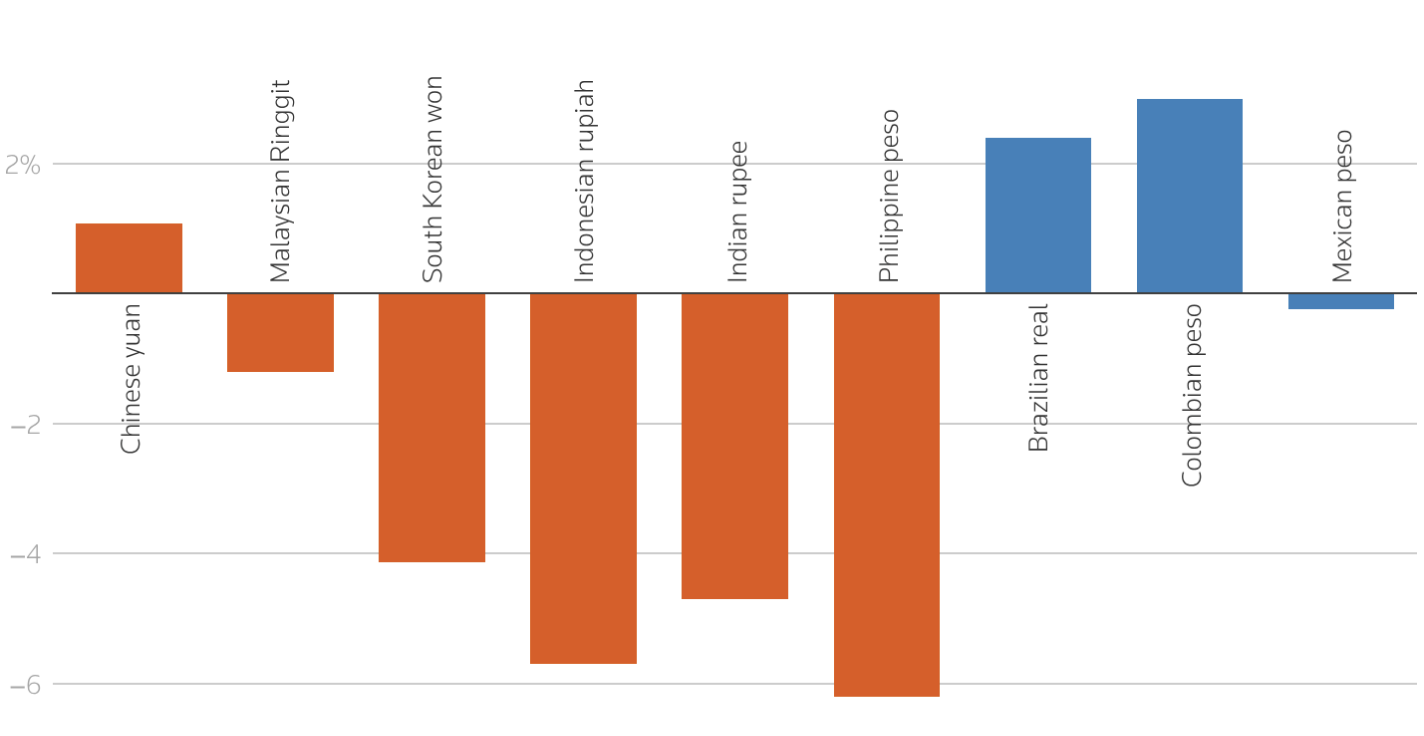
On the financial front, the most obvious signs are currency depreciation and falling asset prices. Asian currencies have depreciated by 5-6% since the start of the Iran war. Asian stock markets, at least those without exposure to semiconductor stocks such as South Korea and Taiwan, have failed. Asset market volatility is very high.
Source: https://www.reuters.com/world/asia-pacific/global-markets-war-graphic-2026-05-27/
Foreign investment inflows typically slow. Portfolio investors in stocks and bonds exit as the value of their assets in terms of the base currency declines. The decline in direct investment reflects a deteriorating outlook. Banks are facing an increase in non-performing loans and a decline in loan demand due to the economic downturn. If you rely on foreign borrowing to supplement your domestic deposits, your financing availability will be affected.
Inflation puts pressure on interest rates, further slowing the economy and exacerbating economic and financial stress. The current crisis is a textbook example of how oil shocks affect the economy. Other factors, such as Trump’s currently ignored economic wars such as tariffs, trade restrictions and sanctions, will also exacerbate the problem. The risk of economic and financial crisis is now increasing in many of the affected countries.
What should I do? As an Irish farmer instructed a traveler, “You don’t want to start here!”
The classic policy prescription is to devalue the currency to force the necessary adjustments. An alternative is to intervene in the foreign exchange market and at the same time use higher short-term interest rates to support the exchange rate. The most extreme measures would be for governments to restrict capital movements and optionally implement price and income controls. Each has advantages and disadvantages.
Assuming that normal laws of supply and demand apply, a weaker currency should, in theory, have the effect of reducing imports by discouraging purchases. At the same time, exports should also be promoted. It often forces necessary adjustments in living standards, especially on vulnerable and low-income groups.
In practice, its effectiveness depends on several factors, especially the elasticity of demand for a country’s exports and imports. If imports are essential, such as energy, and cannot be substituted or the cost cannot be passed on, purchases from abroad may not be reduced. Improvements in export volumes depend on the type of product and the sensitivity of demand to price. It also depends on competition and substitutes. If your competitors have better products or try to match your price, quantity may not respond. This is especially problematic when the entire emerging market complex is affected and all countries want to devalue their currencies at the same time, reducing the ability of a single country to devalue its currency. A further issue is the global nature of the economic slowdown across developed countries such as the United States and Europe, which will reduce demand for exports at the heart of Asian economies.
Currency devaluations also increase inflation through higher import costs, unless they destroy demand leading to a sharp decline in economic growth. A weaker currency could accelerate capital flight as investors fear losses. This creates unfavorable behavior in which importers accelerate purchases and exporters delay the conversion of incoming foreign currency. Foreign currency borrowers without comparable returns to provide a natural hedge face increased debt. Emerging market companies often take advantage of lower interest rates than domestic funds and are exposed to currency risk.
Interventions in money markets rarely work. There is a risk of depleting the foreign exchange reserves needed to finance commercial imports and short-term debt. Historically, success requires cooperation among major central banks, as in the 1985 Plaza Accord that devalued the dollar. Central banks in emerging countries have a poor track record. During the 1997 Asian market crisis, Thailand, Indonesia, and Malaysia failed in their attempts to protect their currencies, which were pegged to the dollar, and significantly depleted their foreign exchange reserves. In general, such interventions are unlikely to be successful if foreign currency-denominated debt or investments exceed reserves.
To stem the decline in their currencies, the central banks of India, Indonesia, and the Philippines have repeatedly intervened in foreign exchange markets by drawing down foreign exchange reserves, but the effects have been limited.
Capital controls require exchange rate management and restrictions on foreign currency inflows and outflows. They can manage crises and maintain economic sovereignty over exchange rates, interest rates, inflation, and the banking system. In the long run, capital controls will discourage overseas investment, as investors fear losing their freedom to repatriate their funds. It often leads to black markets in currencies and workarounds that emphasize their effectiveness.
In a market-based system, it is difficult to protect the economy from external events, especially the scale of the Iran war. Underdeveloped domestic capital markets limit domestic capital supplies and risk management tools, impairing the country’s ability to absorb shocks.
Many emerging market countries are also woefully unprepared. Assuming there are no disruptions to the supply chain, buffer stocks and stockpiles are woefully low. The economic structures of both countries remain narrow, and there has been little progress in diversifying their industrial bases. Despite a history of energy dependence and turbulence, efforts to increase energy independence through conservation measures and the search for alternative energy sources have been limited. Investment in renewable energy such as solar, wind, hydropower and biofuels remains insufficient. There are even few emergency plans to rapidly expand alternative fossil fuels such as coal. In contrast, China’s future plans are focused on building significant strategic oil reserves and renewable energy supplies, which currently account for up to 40% of total power generation and more than 50% of total installed power capacity.
Governments have encouraged people to think magically and to believe that policymakers will protect them from such events. Subsidies, transfers, and price controls are popular in elections, but do not address the core issues.
Like Aesop’s locust, energy-starved countries wasted a summer of abundant supplies and now face a harsh winter.
Satyajit Das June 2026
© 2026 Satyajit Das All Rights Reserved
