


Given that Jensen defenders have been depicting Jensen Huang as essential to Nvidia’s so-called circular financing, the “Bank of Nvidia” needs to be rebranded as the “Bank of Jensen.”
A new Wall Street Journal story provides much more detail on a scheme we covered briefly in our earlier Nvidia coverage. Nvidia had solicited Wall Street heavyweights like Blackstone, KKR and Brookfield to provide $500 million in funding to Nvidia customers. An October Reuters report described how the program was not getting off the ground due to an unbridgeable gap between the level of financial support the money mavens wanted and what Nvidia provided.
The new Journal story has a lot more insider-y detail than the October Reuters account did. While that makes for a more entertaining read, the focus on the gossip (admittedly, reporter finds) has the effect of obscuring the bigger story architecture. As we pointed out earlier, Nvidia was suffering a big drop in market share that had started in 2023,1 hence the eagerness to sell GPUs to Chinese buyers. The article describes how Jensen was concerned about the fall in Nvidia’s multiple and wanted to gin up more financing from outside parties to goose it back up. That is a tacit admission that he was seeking more leverage to create the appearance of better performance. Leverage both amplifies profits and losses.
It may also be that Jensen realized he was approaching the limits of what he could do with his circular financing gimmicks. Even very deep tech pockets like Amazon were open about increasingly needing to use debt to fund AI capex.2 It is hardly a secret that across the industry, planned expenditures even once cash-rich tech giants exceed what they could fund out of their own cash flow and funds on hand, since AI is still a very long way from being a sensible economic proposition.
The Journal story also describes how Jensen was getting resistance for some of his financing ideas from then CFO, now interim CEO Colette Kriss. It would not be surprising if it emerged that some of Jensen’s transactions were not papered up properly (there have already been ample reports of him dong deals on a handshake) and that auditors may have started clearing their throats.
It is also surprising to sees a supposedly business-savvy media outlet seem shocked, shocked that a briefly noised-up funding scheme with Big Names attached to it did not materialize. Admittedly, this one got a bit more profile than some other too-clever ideas due to Jensen making lots of noise to goose Nvidia stock and perhaps also out of the naive belief that media amplification would pressure the money mavens to deliver. Recall that I repeatedly warned readers that the oft-mentioned Ukraine reconstruction fund, with fundraising led by BlackRock, was an obvious entry in hall of hollow mandates. The big tell was that BlackRock was merely an advisor and had committed no funds.
The short version of the breathless Wall Street Journal story is that Jensen Huang’s sense of manhood was offended in June when he learned that Apollo and Blackstone publicized in June that they were providing $35 billion of funding for Nvidia competitor Broadcom for chips for Anthropic. Nvidia and six Wall Street titans announced $500 billion program in August. That has not gotten done. One of the reason stated is that Huang would not provide anywhere near as much in the way of guarantees as Broadcom had. Aside from that being an issue in and of itsellf, vastly bigger program would likely require even better terms.
From the Journal in Wall Street Pledged to Mobilize $500 Billion for Nvidia—but Hasn’t Put Up a Dime. You can see “pledged” is a stretch; the text even states “But the promise was short on substance.”
This idea appears only to have gotten to the pitch outline stage, and was not even commemorated in a non-binding memorandum of understanding. Admittedly, the Journal’s earlier reporting in August indicated otherwise. First from that article, Nvidia, Wall Street Firms Strike AI Financing Deal Targeting $500 Billion:
Nvidia reached deals with some of Wall Street’s largest firms aimed at raising massive amounts of capital to help the chip maker’s customers finance the cost of computing power.
The chip maker has signed agreements to partner with Apollo Global Management, Blackstone, BlackRock, Brookfield Asset Management, Goldman Sachs, and KKR, to establish “compute financing platforms,” the companies announced Monday. The firms aim to deploy over $500 billion of outside capital in the coming years.
The firms said the platforms will create pools of capital at “attractive rates” for Nvidia customers.
“These financing platforms will help customers access scarce compute at scale and build the AI factories that will power every industry and country in the age of AI,” Nvidia CEO Jensen Huang said.
Apollo and Blackstone earlier this year struck a deal with Broadcom to set up a similar financing platform for the chip maker’s customers. The platform will offer financing to companies like Anthropic to pay for computing power from chips developed by Broadcom, including Google’s processing units.
This all sounds extremely fuzzy. Importantly, the story does not identify any firm as the equivalent of a lead manager to herd the other cats.
The August article showed investors were not convinced:
Nvidia’s stock ended Monday down nearly 3% after the Financial Times earlier reported the deal.
The underlying Financial Times story also said Nvidia said it had signed a memorandum of understanding.3
As we indicated in our earlier post, the skeptics were soon proven correct. It was in October that Reuters reported in Nvidia’s bet that its chips can finance the AI boom gets a Wall Street reality check that this program was stuck on the runway. The money quote from that account:
Nvidia’s plan, announced with financiers including Blackstone, Apollo and KKR in August, had envisioned using chips as collateral with limited guarantee in order to allow AI developers a way to facilitate their access to Nvidia’s compute. The strategy was seen as an expensive but necessary way to create a financing market similar to that used in the leasing of aircraft.
Nvidia has said that some of the deals could have no more than a 25% residual value guarantee, saying the initiative is designed to address concerns around circular financing.
This was seen as offering less support than other recent AI financing deals, raising expectations among some on Wall Street that Nvidia would need to get more creative
Now to the Journal’s new piece:
In August, he [Huang] got pledges from several firms—Apollo, Blackstone, BlackRock, Brookfield, Goldman Sachs and KKR—to mobilize an astounding sum: $500 billion.
The announcement created the splash Huang wanted…
The wave of money was supposed to help Nvidia’s startup customers—from OpenAI and Anthropic to smaller, weaker ones—finance the chips they needed to buy, keeping Nvidia’s sales humming well into the future. They were seeking to turn chip financing into a standardized asset class.
Let’s stop here. This idea is ridiculous on its face. If Nvidia or Broadcom had been engaged in somewhat standard financing, they could easily have sold those loans to a private credit fund or a CLO. The fact that, as far as I can tell, that has or has not much happened says that either these borrowings would be viewed at too poor in quality (as in BBB or worse if rated) so as to be sold at the par value of the loan.
The alternative would be some sort of secured financing, as in selling payments made on GPUs or even GPUs themselves as collateral. But GPUs are too short-lived for that. Their value falls when newer, more powerful GPUs are released.
Even though the Braodcom funding did get done, it required a very large residual value guarantee, one that Nvidia was not prepared to match. Such a large guarantee means from a credit perspective that the borrowing is not stand-alone, but both the end borrower and the guarantor’s creditworthiness need to be evaluate.
Back to the Journal:
But the promise was short on substance. To date, no capital has actually been deployed, according to people familiar with the matter. And investors are increasingly skeptical that the program will reach its lofty ambitions now that Huang has been ousted over a sex and suspected spy scandal that has engulfed Nvidia.
Nvidia had already begun to rein in the backstops and guarantees it uses to grease lending, partly under the skepticism of finance chief Colette Kress, who has now become the interim CEO. Those guarantees are crucial to Wall Street’s willingness to finance the chips, and Kress on Tuesday signaled to investors that the company will be disciplined in the deals it supports….
Frustrated that Nvidia’s valuation multiple was dropping at the start of the year despite jaw-dropping profit, Huang began to focus on levers he could pull, people familiar with his thinking said.
Yet Huang seemed resistant to the premise that investors were increasingly punishing Nvidia for too much in the way of financial backstops to companies in its ecosphere. The Journal later notes:
The Wall Street Journal reported that Nvidia was considering providing a $250 billion backstop for an OpenAI data center in Ohio. The next day, Nvidia shares fell by 5%, wiping out $250 billion in market value.
The market’s negative reaction prompted Nvidia to rework its deal and cut its initial financial commitment to OpenAI in half, the Journal reported. News Corp, owner of The Wall Street Journal, has a content-licensing partnership with OpenAI.
So the big bright idea was that getting big Wall Street names involved would reassure equity investors:
Nvidia was concerned the market would think it was taking on too much risk and it wanted to signal that other investors were ready to help finance chips.
The ballyhooed deal was a napkin doodle:
The half-trillion-dollar memorandum of understanding the firms signed was just a few pages that specified a fundraising target, the profile of target customers and that Nvidia would consider providing credit backstops on a case-by-case basis, people familiar with the matter said. The investment firms involved aren’t committed to actually raising any money, and the $500 billion figure isn’t meaningful, the people said.
The idea behind the agreement was to signal that financing will be available, and get major Wall Street partners thinking about how to solve a complex issue, the people said.
Analysts applauded the company’s ability to move itself out of the center of financing its customers. But they were quick to note the aspirational nature of the firms’ agreement to work together on raising $500 billion “over time.”…
Huang was not willing to give what had become market terms for this sort of scheme:
Huang said in August that the credit support Nvidia was willing to provide would top out at 25% of the cost of a project. That is a lower level of backing than rivals agreed to. Broadcom provided a residual-value guarantee for about 85% of Project Big Sky, the $35 billion financing for Anthropic announced in June. For Project North Star, a $63 billion follow-up financing, Broadcom’s residual-value guarantee covered a little under three-quarters of the transaction.
Credit markets have grown more skeptical of AI-linked borrowers with low credit ratings since early August, and investors have been pushing for a larger than 25% residual value guarantee to get comfortable with lending, people familiar with the matter said, a potential roadblock if Nvidia is pulling back support.
The comments on the article were overwhelmingly negative, with many invoking dot-com vendor funding crashouts like Lucent and JDS-Uniphase. Admittedly, those comparisons did elicit some pushback, with the argument being that Nvidia has vastly more cash flow and vendor financing is not in and of itself suspect. This was the most liked comment:
Chris Petruzzi
“to help Nvidia’s startup customers—from OpenAI and Anthropic to smaller, weaker ones—finance the chips” This whole story sounds more like a shell game every day. Depending on how it is meaured, between 45% and 60% of the value of the US stock market is related to AI.
If much of Nvidia’s revenue is Paul borrowing from Peter who was promised by Wall Street to lend money to Paul, and Wall Street is not willing to do that, this could turn into a nightmare dwarfing the dot com collapse of 2001.
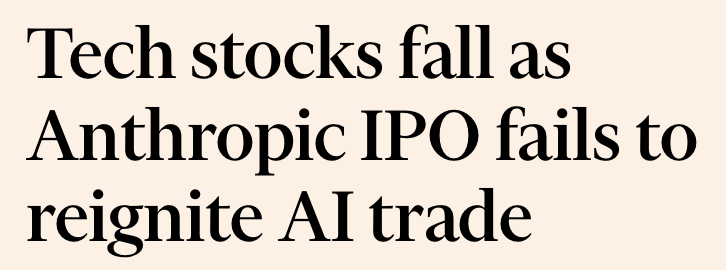
This so-far failed financing scheme story comes against a backdrop of uncheery news that suggests a big undertow despite the headline-dominating success of the Anthropic IPO:
Tomorrow (friday Nov 20) may be the big one. SoftBank, which was one of the leading companies propping generative AI (aside from Nvidia) is down 14.36% on the Japanese market.
expect aftershocks in the U.S. in the morning
OpenAI’s IPO is probably imperiled.
SoftBank may not survive.
— Gary Marcus (@GaryMarcus) November 20, 2026
And in terms of the general mood in AI-land, a writeup from Ipek Ozkardeskaya, Senior Analyst at Swissquote from a daily e-mail (emphasis original). Keep in mind in reading this that an aim in new share sales is to price and stabilize it so that at the end of the first trading day, the stock closes at 15% over the offering price. So up 17% would be a good but not even remotely exceptional outcome. By contrast, down to a mere 11% gain overnight for such a large and celebrated IPO is not a good look.
I am left with mixed feelings following Anthropic’s historic debut on Nasdaq yesterday. The stock opened at $111.50, some 34% above its IPO price of $83 per share, and quickly climbed to around $115 before giving back much of its early gain. Anthropic ended its first day of trading at $97.17, up 17.1% from its IPO price, but kept falling in after-hours trading, leaving it roughly 11% above the offer price on news that Apple is working on its own AI agent. That’s how being a public company looks like..
The big takeaway is that the enthusiasm did not last long. Nasdaq futures jumped ahead of the US open, but the Nasdaq-100 ended the session down 2.2% in a sharp reversal. The hyperscalers fell sharply as well, including Microsoft, Alphabet and Amazon (losses there were nearly 2%, 3% and 4% respectively).
The mood in Asian markets is subdued this morning. The Kospi is down around 5%. The MSCI Emerging Markets Index is hovering around 20% below its June peak, the threshold for a technical bear market – tech makes up nearly 42% of the index, with TSMC, Samsung Electronics, SK Hynix and MediaTek alone accounting for just over 30%. Hong Kong’s Hang Seng has also stepped into the bear-market territory on the back of some discouraging quarterly results, and of course one mounting worries about the fresh chip exports from the US amid the Jensen Huang love-with-a-spy affair.
So here we are. The wake of Anthropic’s IPO is quite rough. The blockbuster debut couldn’t sweep those worries under the rug. The AI buildout still needs vast amounts of funding just as financing costs are rising and signs of credit stress are emerging. A slowdown in circular financing or tighter export restrictions could also slow the pace of AI expansion.
The lead story at the Financial Times:
And the opener to Ozkardeskaya’s note the day before:
Nope, the magic did not last. Nvidia gave back its post-earnings gains and closed down nearly 3%, despite blockbuster earnings and strong guidance the night before. Jensen Huang’s departure still leaves investors wondering whether Nvidia can sustain its growth.
As we have said before, a lot of plates are in the air and they look to be wobbling. But the flip side is that one of the oldest sayings in equity-land is that stocks climb a wall of worry. But with AI growth now unquestionably dependent on credit and that continuing to get more costly and scarce, AI growth seems destined to slow soon, and likely considerably too. Stay tuned.
_____
1 From JP Morgan:
2 Some of Amazon’s recent AI-related debt financings:
From Wall Street 24/7 in March: hyperscalers-back-to-the-debt-well/” rel=”nofollow”>AI’s Coming Trillion-Dollar Hangover: Amazon Leads Hyperscalers Back to the Debt Well
From Yahoo in June: Amazon Takes On $17.5B In Fresh Debt To Supercharge AI Expansion
From Bloomberg in October: Amazon Taps $80 Billion Supplier Loan Facility to Help Fund AI
3. From the pink paper in Wall Street giants partner with Nvidia on $500bn AI financing deal
The world’s largest financial groups are working with Nvidia to assemble a funding package of more than $500bn for AI infrastructure development, in one of Wall Street’s most ambitious lending efforts to date.
A consortium of groups including Apollo Global, Blackstone, BlackRock, Brookfield Asset Management, Goldman Sachs and KKR is entering a partnership with Nvidia to invest in the AI build-out.
Shares in the chipmaker fell about 1.1 per cent on Monday after the FT first reported on the arrangement, erasing nearly $60bn in market capitalisation. The stock ended the day 2.9 per cent lower.
Nvidia said on Monday afternoon that it has signed memorandums of understanding with the six Wall Street firms to “mobilise over $500bn of third-party capital for the build-out of AI infrastructure over time”.
Under the deal, which is still subject to final agreement, the firms will create dedicated pools of capital to finance Nvidia’s AI ambitions “at attractive rates for Nvidia customers”.
Again, there is no indication that any of the six firms was a lead agent.
