


Yves here. Get a cup of coffee. Even by Joseph Busby’s high standards, his article on neutrality is persuasive and important. Busby argues that neutral nations play an intrinsically valuable role, and one that typically is also prosperity-enhancing. He goes through important historical and current case studies, particularly Austria ,and contrasts that with the sorry fate of Ukraine and what is happening to neutrality apostates Finland and Sweden.
By Joseph Busby, the Founder and Director of Reality-Based Analysis Group (RBAG, rbag.at), an independent geopolitical analysis firm founded in Vienna in 2017 and affiliated with the Association for the Promotion of International Development and Stability (APIDS, apids.at). Originally published at the Reality-Based Analysis Group website
I. Neutral Ground
In a multipolar world, the decision by states large and small to opt for neutrality rather than twentieth-century-style bloc alliance and allegiance systems is critical for world peace. Historically, neutrality serves countries well, assisting in their enrichment, and keeping them out of wars. It kept Switzerland and Sweden out of two world wars, filled the vaults of Portugal with gold during the Second World War, and bought Austria its freedom and the departure of four conquering and occupying armies. It made Vienna and Helsinki trusted locations where greater powers could negotiate and possibly prevent military conflict or misunderstanding. Unlike Switzerland’s Alps, neutrality is not a perfect shield and when in the line of fire, neutral countries can be overrun. Norway attempted to stay out of World War Two as well, and was attacked by both Allies and Axis powers alike. Eight decades later, the issue of potential Ukrainian neutrality, twice rejected, remains part of ongoing negotiations taking place primarily on the battlefield. For most states, especially those not adjacent to great power conflict, neutrality works.
In Austria, this is part of the national character, and is often presented as a moral virtue differentiating Austrians and their nation from other, lesser, states that would engage in bloc politics or military alliances. This is dangerous thinking because neutrality is not a virtue, it is a practice, an act, and a choice. Austrian neutrality has been a tremendous contribution to the world, not least to Austria itself, whose grand façades and magnificent avenues were in large part rebuilt with money earned by being the meeting place for the great powers. Indeed, Vienna is home to an extraordinary number of international organizations, including the United Nations, OSCE, IAEA, OPEC, and countless others. Neutrality is enshrined in the Austrian constitution, celebrated last week on National Day, 26 October, and it is visibly slipping, both here and elsewhere. This October, Austria expelled four Russian diplomats under suspicion of activities incompatible with their declared status. Yet, an alleged Ukrainian government plot to assassinate a former prosecutor has resulted in diplomatic silence. No western diplomats have ever been expelled from Austria. But former Austrian Foreign Minister Karin Kneissl was hounded out of the country for the crime of being sympathetic to the Russian Federation, specifically for dancing with Vladimir Putin at her wedding. A neutrality enshrined in law but slipping in practice loses its value and a hollowed-out neutrality becomes worthless. In September 2025, in response to a proposal by Ukrainian President Zelensky to meet Vladimir Putin in Vienna, Moscow declared that it no longer considered Austria to be neutral in practice. Indeed, no negotiations regarding ending the conflicts in either Ukraine or Iran have taken place in Austria.
Multipolarity and neutrality have gone hand-in-hand for centuries. Perhaps the last durable multipolar world order began in Vienna, in the aftermath of the Napoleonic wars. Europe was free of a general war for nearly a century following the 1815 Congress of Vienna, which took seriously the legitimate interests of all the major powers of the continent and officially recognized the permanent neutrality of Switzerland. Multipolar eras do not guarantee peace. They have also brought the two most devastating World Wars in human history. The peace of 1815 was only broken when the continent organized into blocs, trading negotiation for military alliances. During the Cold War, the value of neutral ground was self-evident as it provided the location and ability for the two great blocs to meet, in a city they once jointly administered. During the unipolar era, neutrality was viewed by some in the West as a relic and even as somewhat insulting; with only one hegemonic power, neutrality was deemed as quaint and old-fashioned as Vienna’s historic cafes.
But the unipolar era is over and in a world of multiple poles, multiple superpowers, and military contests for regional influence spanning multiple continents, the need for neutral ground is more important than perhaps ever before. In a time of uncertainty, and all epochs of major global reorganization are inherently uncertain, neutral ground where potential combatants can meet in good faith to avoid war, or warring parties can meet to end them, is vitally necessary. Much of the world, outside of Western Europe, understands this well and refuses to choose sides or adhere to military blocs. But in Europe, the traditionally neutral states are being pulled by the United States and the European Union to abandon their historic neutrality, at once removing vital uncontested ground, and unnecessarily increasing political and military tensions. In the past few years, Sweden and Finland have both joined NATO, without a popular vote on the policy; Switzerland has opted to join in European Union sanctions against the Russian Federation, and Austria has been practicing its neutrality inconsistently.
II. Self-Interest
The first thing to understand is that states choose policies because they understand them to be in their own best interest; no state ever chooses its own policies for the benefit of other states over its own. So why is it in a nation’s best interest to proactively declare and practice neutrality? There are four major tangible benefits, none of which involve morality or being inherently better than non-neutral states. The first is economic. A neutral state can afford to take a longer view, sell goods to all parties, and in times of war or crisis, the price of these goods can skyrocket, filling the coffers of the neutral state for the benefit of its people. This is what Portugal did during the Second World War. It is why Swiss banks are known worldwide.
The second benefit is power. A small and neutral state has something everyone needs, sometimes a natural resource, or a port, or airfield useful for all sides; sometimes a place for all sides to meet either secretly or openly. The third benefit is influence. Neutral capitals are the natural destination for international organizations seeking to project their nonalignment by virtue of their address. Those organizations bring countless workers, visitors, diplomats, events, and money. Vienna is the visible archetype for this advantage, with tiny Austria wielding more influence globally due to the benefits of its neutrality than the vast Austro-Hungarian Empire ever did. Which brings us to the fourth benefit: survival. The Habsburg Empire was not neutral and is no more; Austria’s embrace of neutrality in 1955 purchased its independence and marked the rebirth of the nation, overtly emphasizing its nonaligned stance to become the trusted partner for all comers in the center of Europe. For a state located between rival powers, neutrality is often the only solution which can avoid invasion. If not embraced, as shown in part by the ongoing conflict in Ukraine, war and devastation may follow.
Neutrality is not moral abstention; it is a moral act. It is not declaring both sides equally bad and standing outside the fray. It is practicing the art of peacekeeping, peacemaking, negotiating. It is expensive, difficult, proactive, and, as noted above, profitable. Active neutrality is keeping respectful relations open with all parties, especially warring parties, and earning their trust. With very few exceptions, this cannot be done by aligned parties, even though the telephone call from the leadership of Norway and Finland to Russian President Putin last week was an admirable attempt.
Neutrality is not necessarily the moral high ground either, as history has shown that neutral states have had no difficulties in profiting from war, accepting looted gold, and engaging in horrific forced labor and worse in truly brutal colonial policies. In times of war they are the magnets for refugees, as shown vividly in Lisbon during World War Two, and Vienna in 2022. And they are always hotbeds of spies, for in the locations where the most important decisions are discussed, all sides attempt to gain advantage.
In a multipolar world, the case for neutrality is that it is in the best interest of a nation. It keeps nations out of wars, it removes the tripwires of entanglement which spark regional and global conflict. It does not preclude membership in international organizations (Vienna hosts one of the United Nations’ headquarters), but it precludes military alliances or blocs. While obvious during war, even during peace states cannot always control their fate and are sometimes subject to the demands or actions of greater powers. This is what happened to Salazar’s Portugal, when it abandoned its neutrality in 1949, pressured by the United States to become a founding member of NATO. Until its collapse, the Soviet Union kept Austria out of the European Community. Both Russia and the United States (along with the European Union) have exerted tremendous pressure on both Switzerland and Serbia since 2022, coinciding with Ukraine’s failure to take a neutral position and thus falling into the trap which is consuming it by war. To better understand how neutrality has worked in practice, both its costs and benefits, it is instructive to view two cases: Portugal during the Second World War, the last great conflict of the old multipolar era, and Austria from the Cold War through today before assessing what has happened to neutrality since the beginning of the war in Ukraine. Viewing neutrality from the perspectives of wartime Lisbon, post-war Vienna, and today allows an understanding of how it really works and why it is more important now than at any time since the end of the Cold War.
III. Dr. Salazar’s Wolfram
Wolfram, better known today as tungsten, is one of the critical strategic minerals in much of the modern world’s technology, from weapons to phones to the chips which power the looming AI behemoths. In wartime Portugal the word meant the ore itself, wolframite, from which tungsten is extracted. Wolfram hardens steel, which makes ammunition stronger, military armor harder to pierce, and guns hardier. It was, and remains, critical for the machinery of war, never more so than during the Second World War, a uniquely mass-mechanized conflict. The hills of Beira, in Portugal, were Europe’s greatest supply of wolfram during the war, and both Germany and the Allies were desperate for it. The leader of neutral Portugal, Dr. António de Oliveira Salazar, who had been Prime Minister since the year before Hitler took power, sold wolfram to both sides.
Between 1940 and 1944 Portugal exported 14,000 tons of wolfram to Britain and approximately 6,200 tons to Nazi Germany. The percentages skewed towards the Allies not due to any political sympathies (Salazar was a fascist, after all), but because Britain paid more. Portugal granted separate and changing quotas to each nation, both of which owned and operated wolfram mines and export companies throughout the war. The interior of the country was temporarily transformed, with approximately 100,000 Portuguese working in the wolfram mining industry. In an economic form of warfare, the British and Americans also purchased wolfram not only out of need, but out of a desire to keep it from the formidable Nazi armaments production masterminded by Albert Speer. In a war economy, with rivals bidding on a critical mineral, the market price of wolfram rose 1,700 percent in fifteen months, with the Bank of Portugal estimating that the average price of wolfram in 1942 was thirty-two times higher than it had been before war began. International politics also influenced Salazar, including both the Allied attack on the Portuguese colony of East Timor (today’s Timor-Leste) and the looming Allied invasion of Normandy which would become D-Day. In advance of that event, Salazar negotiated an embargo on wolfram export and production on 5 June 1944, although he insisted that contracts with Germany be fulfilled to the letter.
The Windfall
Salazar’s wolfram windfall was paid for primarily in two ways: gold and credit, and a great deal of both. The Portuguese also profited from a special wartime tax on all tungsten exports. By the end of the war, Britain owed Portugal approximately 80 million pounds sterling (4.5 billion pounds in today’s equivalent). Regarding gold, in the beginning of 1939, Portugal’s gold reserves were 63.4 tons; by October 1945 they were 356.5 tons, much of which had come from Nazi Germany. Nazi gold is the stuff of dark legend, and much of it ended up in Portugal. Portugal was paid in part by the German Reichsbank, and intense disputes arose (after the war) regarding how much of it had been looted by the Nazi war machine, either from invaded states, or more morbidly, from their murdered citizens. Investigations by interested parties varied wildly in their findings of how much of Portugal’s gold was initially stolen, ranging from 38 tons to almost 122 tons. At the end of the war, the Allies requested Portugal repatriate 45 tons; Salazar offered 4, with a deal not finally concluded until 1958. Forty years later, a 1998 Portuguese inquiry determined that Portugal could not be accused of knowingly having received any looted gold at all. Much of that gold remains in Portugal’s reserves, the fourteenth largest in the world at c. 383 tons, a great deal of which was paid by Nazi Germany.
After the fall of France, Belgium, and the Netherlands, Lisbon became Europe’s principal free major mainland port on the Atlantic coast and thus was a magnet for the continent’s refugees, especially Jewish refugees, desperate for passage to the Americas. Officially unwelcome to the Salazar government, between 40,000 and 50,000 refugees flooded Lisbon in 1940 and 1941, earning the city the moniker “the waiting room of Europe.” Alongside German diplomats, Gestapo and Abwehr officers, and the Jewish and American relief organizations trying to help them, these dispossessed masses sought, and sometimes failed, to obtain entry visas and tickets for seats on the Pan American Clipper seaplane to New York City or berths on the Serpa Pinto to Philadelphia or Rio de Janeiro. Neutrality attracts more than just money.
The war was good for Portugal. In 1940 they hosted an Expo showcasing the “Portuguese World”; in 1942 they opened a new airport in Lisbon and in 1944 a new national stadium. But the gold remained primarily in the country’s reserves rather than in modernizing the nation. Britain’s 80 million pound debt, on the other hand, was converted in August 1945 into a long-term loan with many caveats and controls put in place by the British. The Portuguese spent approximately five million of them and sought to convert 40 million more into US dollars in a deal with the United States. The Americans refused, starkly noting that the Marshall Plan’s administrators would not accept debt in exchange for dollars.
The Azores: The Prize and Price of Neutrality
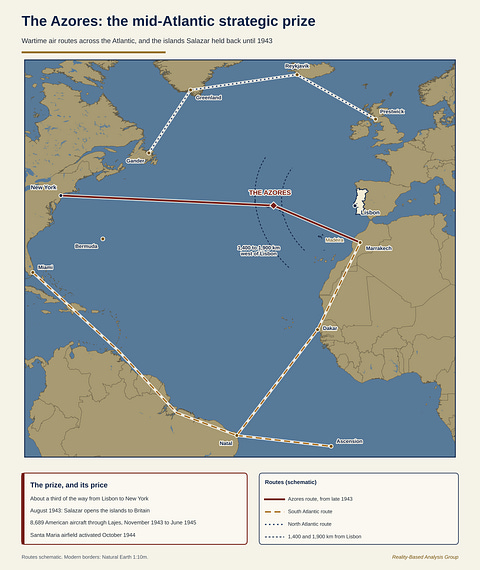
Other than Bermuda, the only land in the middle of the North Atlantic consists of a series of islands, the Azores, which are Portuguese sovereign territory. The Azores island chain stretches for 600 km, between 1,400 and 1,900 km west of Lisbon – nearly a third of the way to New York City. The greatest range of the heavy bombers of the Second World War was between 3,000 km and 4,600 km (1,850-2,850 miles). This made trans-Atlantic air travel necessarily “circuitous.” Flights destined to North Africa left Florida, flying to the Caribbean and onwards to Brazil, crossing the Atlantic’s narrowest point to French-controlled Dakar, Senegal, or Ascension Island, then up into North Africa and beyond. Flights to Britain refueled in Newfoundland, Greenland, and Iceland. Westward flights on both trajectories faced significant headwinds. Warships, too, needed refueling for the long crossing.
These technological limitations made the Azores, especially the Lajes airfield on the island of Terceira, an irresistible target for both Axis and Allies, both of whom drew up military plans to seize control of the island chain. In November 1940, Hitler himself directed that “the problem of occupying Madeira and the Azores should be considered,” and the Nazi Operations Felix and Isabella included plans to occupy the Iberian Peninsula and establish bases in the Azores should the British gain a foothold there. Roosevelt too, in May of 1941 (prior to the United States’ entry into the war), ordered a plan for an invasion and seizure of the islands, as did the British. Salazar, deeply concerned about a potential German invasion and occupation of the Portuguese mainland, kept the islands completely closed to the armed forces of either side… until the tide of the war had definitively turned against the Germans.
By August 1943, the Nazi war machine had lost the largest tank battle in history, the Battle of Kursk, after being turned back at the gates of Moscow and suffering crushing defeat in Stalingrad. The Axis had been expelled from North Africa, the Allies had invaded Sicily, and Mussolini had been ousted and arrested. Only now did Salazar agree to the British invocation of the six-century-old “Anglo-Portuguese Alliance” allowing British access to the airfields and harbors of the Azores, including Lajes airfield. The impact was immediate, as was the stern German reprimand, although Salazar’s timing ensured that the reprisal was only verbal; the Wehrmacht no longer had the power to physically punish Portugal. Royal Air Force bombers began hunting U-boats from Lajes, and North Atlantic shipping losses continued to decrease as a result of their efficiency. The Americans were allowed access in December 1943 and refueling in Lajes, and later in a second, secret base on Santa Maria island, cut flying time between the United States and North Africa (the gateway into Europe) by nearly half (from 70 hours to 40). Almost 9,000 American aircraft passed through the Lajes airbase by the summer of 1945, 1,200 of which were heavy bombers.
What did Salazar demand in return? Explicit guarantees for the protection of the Portuguese empire, which would ultimately last longer than that of any other European power, ending only in 1999 with the reversion of Macau to China. The United States pledged that it had “no designs on the territory of Portugal and its possessions” and agreed to the restoration of “full Portuguese sovereignty” of occupied “Portuguese Timor” (today’s Timor-Leste). Salazar used Portugal’s neutral status to hold critically important geographical territory until allowing its use not only failed to threaten his country, but gained him the promise of protection for his empire. It is hard to find a better example of parlaying a small nation’s neutral status in such a delicate yet productive manner. The results of the agreement long outlasted the war. With the Allied bases established in the Azores serving as “crucial air bridges between Europe and North America,” the creators of the NATO alliance eyed Portugal as an obvious choice for initial membership. To ensure the protection of his regime and its empire, Salazar reluctantly agreed to have Portugal abandon its neutrality to become a founding member of NATO. This leverage mattered when later inquiries focused on the return of looted Nazi gold and again when President Kennedy pressed for a United Nations inquiry into Portuguese activities in Angola – neither went anywhere, in large part due to Portuguese participation in NATO. From 1962 onwards, the United States began abstaining on UN resolutions against Portuguese colonialism.
Six years after a stroke removed Salazar from power, the 1974 Carnation Revolution ended fascism in Portugal along with its imperial wars, although portions of its empire would remain Portuguese for another quarter-century. Portuguese neutrality allowed the vast enrichment of the state through the sale of wolfram to Allies and Axis alike, allowed the balancing of both powers, and the avoidance of Norway’s fate, until the tide of war had turned sufficiently for Portugal to align with the winning Allies, leveraging their geography for the protection of their empire. Ultimately, trading that neutrality to join NATO bought the fascist regime the breathing space to run itself and its empire with minimal western interference until the Portuguese themselves earned their own freedom through peaceful revolution.
IV. Neutrality: The Price of Austrian Freedom
Between 1945 and 1955 Austria was not free; its capital Vienna was occupied, supervised, and patrolled by four conquering armies, from the United States, France, Britain, and the Soviet Union. Strategically located along what would later be called the “Iron Curtain” and stretching from Soviet satellite states of Czechoslovakia and Hungary to Italy, Switzerland, Germany, and non-aligned Yugoslavia, post-war Austria was contested ground. The price for its freedom and independence was “permanent neutrality of the kind practiced by Switzerland.” The State Treaty was signed on 15 May 1955 and on 26 October 1955, the Austrian parliament passed the Federal Constitutional Law on Neutrality in which it declared that it would permit no foreign military bases on Austrian soil and would “never” join “any military alliances.” 26 October is celebrated to this day as Austria’s National Day.
The declaration alone was not sufficient. The Soviet Union required Austrian repurchase of 150 million US dollars of industries the Soviets had seized after the war as German assets, the provision of a million tons of crude oil each year for a decade, and a further two million US dollars for the assets of the Danube Shipping Company. Austria met all terms, although the oil obligation was later reduced. Moscow also considered any Austrian association with the European Economic Community to be a breach of neutrality, and Austria did not join the successor European Union until 1995, three years after the dissolution of the Soviet Union.
The Benefits
Despite the devastation of Vienna during the Second World War, just over eighty years ago, Austria is one of the wealthiest nations on the planet. In the immediate aftermath of defeat, Austrian personal income had dropped to less than half of that in the rest of Western Europe. Five years later income had climbed to approximately 80% of that of Western Europe, and had recovered to pre-war levels. This was due overwhelmingly to the Marshall Plan, which in Austria was the fourth highest amount allocated per capita anywhere. The Marshall Plan ended in 1952 and slightly more than two decades later, in 1973, Austria had reached the average level of wealth in Western Europe. Neutrality is a key reason why. Starting in 1955, it gave Austria advantages most other European nations did not and Austria converted each of these into money: trade with both Eastern and Western Europe; a liberal banking industry; a home for international organizations and their employees, and a safe and nonaligned location where the great power blocs could meet on equal footing.
Trade with Eastern Europe included trade with the entirety of the vast Soviet Union which stretched all the way to the Pacific Ocean. Neutrality allowed Austria to trade with the entire Soviet bloc without the same hindrances and suspicions faced by other states outside the “Iron Curtain.” By the mid-1960s, approximately one-sixth of all Austrian exports were destined there. In 1968, ÖMV, the Austrian state-owned oil company, signed the first gas contract between a Western European country and the Soviet Union, with gas arriving at the vast Baumgarten gas hub east of Vienna. Russian gas flowed there until the end of 2024, when deliveries were ceased by Russian giant Gazprom, due to a payment dispute; the contract was terminated. Given uncertainties regarding the overland transit of Russian gas through Ukraine, shipments have not resumed and new EU regulations as of January 2026 make any new contracts for Russian gas illegal for EU member states.
The second monetary advantage of Austrian neutrality was equally obvious: the ability for Austrian banks to lend to Eastern Europe. Today, approximately one-third of all Austrian bank lending is to Central, Eastern and Southeastern Europe. Two-thirds of Austrian bank Erste Group’s 2025 net profit came from banks outside of Austria. But Raiffeisen Bank is the clearest example. Active throughout Eastern Europe, including Ukraine and Russia, Raiffeisen has remained active and operational in Russia throughout the conflict in Ukraine. Its Russian operations provided more than half of its profit in 2022 and almost half in 2023, which led to pressure from both the United States and the European Central Bank to curtail Russian lending. To date, Raiffeisen remains active in Russia; but the seven billion euros it has earned since the start of the war are currently unable to be repatriated to Austria, due to various legal limitations, yet it continues to work and earn. Austrian bankers have learned to be patient and seven billion euros is worth waiting for. At the very least, it is seven billion reasons for the neutral state to keep positive channels open with Moscow. Neutrality, sometimes, has its own momentum and motives.
The third advantage was the ability to host international organizations in a nonaligned and neutral location. Since 1955, Vienna has become the third (of four) headquarters for the United Nations and hosts more than fifty different international organizations, from the International Atomic Energy Agency to the OPEC Fund and everything in between. The UN complex on the Danube riverfront, opened in 1979, is leased to the United Nations at the symbolic rate of 7 euro cents a year (originally one Austrian schilling per annum). While the UN rent is symbolic, Austria’s income is not. The Austrian Foreign Ministry stated in 2024 that international organizations provided 1.7 billion euros to Austria’s economy in the prior year, providing 16,000 full-time jobs, and adding 785 million euros in tax revenue, all overwhelmingly in Vienna.
The fourth benefit was the value of neutral ground as a meeting place of the great rival powers. Vienna figured prominently as the premier neutral venue for high-stakes meetings throughout the Cold War. Kennedy and Khrushchev met in Vienna in June 1961. The first strategic arms limitation talks (SALT) moved to Vienna in 1970 after opening in Helsinki, alternating between the two neutral capitals. The SALT II treaty was signed in the Hofburg, on Vienna’s Ringstrasse, in June 1979 and talks between NATO and the Warsaw Pact on conventional force reduction took place in Vienna for fifteen straight years, ending only in 1989. Few other nations, and no non-neutral ones, can match this history during the Cold War, and it was only made possible by Austria’s neutral status. So critical was this status to Austria’s identity that its government often refers to itself as “a bridge builder.”
When the Wall fell and the Cold War faded into history, a unipolar world emerged and the hegemonic West felt less pressed to negotiate in any venue, neutral or not. After the dissolution of the Soviet Union, Austria was free to join the European Union, which it did in 1995 along with Sweden and Finland. This bound Austria into a political and economic bloc but it maintained its constitutionally mandated military neutrality, as it refused to join NATO or any other military alliance. International organizations still operated in Vienna, and neutral ground was critical for negotiations between smaller, regional powers, and with the occasional great power negotiation, including the 2015 Iran nuclear agreement. Still, the business of neutrality had much less importance on the world stage, as the hegemon overwhelmingly did as it would. Thus, in the unipolar era, the very idea of neutrality became slightly quaint, old-fashioned, outdated, and very much frowned upon by the United States and NATO. But the unipolar moment is over.
V. Ukraine: Neutrality Denied
As the dissolution of the Soviet Union approached, Ukraine was well aware of its strategic location as a buffer state between Russia and the West. Indeed, the very name “Ukraine” means “borderland.” Its leaders knew Austria’s history of neutrality and declared their intention to follow the same path. On 16 July 1990, the soon-to-be independent nation issued the “Declaration of State Sovereignty” which “solemnly declares its intention of becoming a permanently neutral state that does not participate in military blocs and adheres to three nuclear-free principles: not to accept, not to produce and not to purchase nuclear weapons.” At the time of the collapse of the Soviet Union, approximately 1,900 strategic nuclear warheads were located in what had suddenly become sovereign Ukrainian territory. These warheads were not Ukrainian and were never under Ukrainian command and control. The weapons were Soviet and the launch authority and all of its complexities lay in Russia. The Budapest Memorandum, signed by the Russian Federation, Ukraine, the United States, and the United Kingdom, was part of the arrangement for the return of those warheads in exchange for political assurances regarding Ukraine’s territorial integrity. Despite many political arguments to the contrary, the Budapest Memorandum is not and never was a binding treaty and at most it demanded political “assurances” (and in the Russian and Ukrainian version “guarantees”), not arms and armies.
For the next twenty years, Ukrainian neutrality remained politically popular yet legally aspirational, although at various times the nation’s leadership tilted sharply westward, with Presidents Kuchma in 2002 and 2003 and Yushchenko in 2008 both declaring Ukrainian membership in NATO as official state policy. The 2008 NATO summit in Bucharest brought matters to a head when US President George W. Bush declared publicly, in a press conference in Kiev with Ukrainian President Yushchenko, on his way to the summit, that the United States strongly supported Ukrainian membership in NATO and that Russia did not get a veto in the decision. The summit’s joint declaration on 3 April was unambiguous, declaring that Ukraine and Georgia “will become members of NATO.” Russian President Putin flew to the conference that day and on 4 April he stated Russia’s position equally clearly: “The appearance on our borders of a powerful military bloc… will be considered by Russia as a direct threat to our country’s security.” The Ukrainian people wanted no part of this, and less than one quarter of the population favored NATO membership by June 2010. In the following month, the Ukrainian parliament, the Verkhovna Rada, passed the “Principles of Domestic and Foreign Policy” enshrining Ukrainian neutrality into law. After twenty years of intention, Ukraine was now legally a “European non-bloc state” pursuing “non-participation in military-political alliances” while maintaining a “constructive partnership” with NATO. Georgia took another course of action and swiftly lost a war with the Russian Federation as a result. Georgia remains outside of NATO.
Ukrainian neutrality lasted until the coup d’état at Maidan in February 2014 when the elected government was overthrown and a pro-Western one installed. Violence and oppression against the ethnic Russian population began immediately, especially in the Donbas and Odesa, and public musings regarding the eviction of Russian forces from the Crimean naval base in Sevastopol began circulating publicly. Russia also acted swiftly, annexing Crimea in a near bloodless operation and providing support to the militias fighting in the eastern part of the country. The Verkhovna Rada officially repealed Ukrainian neutrality in December 2014. Then-Prime Minister of Russia Dmitry Medvedev described the action as “an application to enter NATO, turning Ukraine into a potential military opponent of Russia.” As years passed and tensions and violence continued in the eastern portion of the country, the Ukrainian government moved ever closer to NATO, and by February 2019, the goal of joining NATO and the EU was officially added to the Ukrainian constitution. In December 2021, in a last-ditch effort to avert the expansion of the war which is now consuming Ukraine, Russia sent Washington a draft treaty requiring the United States to “deny accession to the [NATO] Alliance to the States of the former Union of Soviet Socialist Republics.” The West did not respond favorably. Speaking to the European Parliament in September 2023, NATO Secretary General Jens Stoltenberg said Putin had “sent a draft treaty that they wanted NATO to sign… to promise no more NATO enlargement. Of course we didn’t sign that… So he went to war to prevent NATO, more NATO, close to his borders.” Neutrality would have prevented the war.
The Ephemeral Solution
Russian forces entered Ukraine on 24 February 2022, swiftly approaching the capital before halting of their own accord. The Ukrainians sought peace and both sides met for a series of peace negotiations in Belarus in February and then Istanbul in March, after which the Russian forces outside the capital withdrew as a goodwill gesture. On 16 March Russian negotiator Vladimir Medinsky stated “Ukraine is offering an Austrian or Swedish version of a neutral demilitarized state.” Less than two weeks later, the Ukrainian delegation itself proposed to “fix its current status as a non-bloc and non-nuclear state in the form of permanent neutrality.” A joint draft document was agreed upon, initialed by both sides and slated for further refinement and negotiation. Ukraine’s chief negotiator, David Arakhamia, stated that Russia was “willing to end the war if we took on neutrality.” Ukraine’s Western backers, however, were not.
There was to be no further refinement in 2022, as then-Prime Minister of the United Kingdom Boris Johnson, with US President Joe Biden’s backing, flew to Kiev and emphasized that neutrality and peace were not in either Ukraine’s or the West’s interests and that they should fight on. Economist Jeffrey Sachs further explained that “the US and UK talked Ukraine out of signing the agreement” and that Joe Biden “scuttled the near-agreement between Russia and Ukraine at Istanbul in the spring of 2022 which would have ended the war.” US Defense Secretary Lloyd Austin stated that the West wanted “to see Russia weakened to the degree that it cannot do the kinds of things that it has done in invading Ukraine.” The US Helsinki Commission, part of the United States government, began openly discussing the “decolonization” (in effect, the breaking up) of the Russian Federation as a “moral and strategic imperative.” The West offered to flood Ukraine with money, arms, intelligence support, and the opportunity for Ukrainian President Zelensky to be the man who destroyed Russia. Zelensky, who had been elected on a peace platform, took the bait and the neutrality which would have saved perhaps a million of his countrymen and hundreds of billions of euros of damage to his nation was discarded in favor of war. In October 2026, he ruled out, yet again, the option of Ukrainian neutrality. As a moral crime, his decision ranks among modern history’s worst. Never has there been a clearer or more tragic example in history of what neutrality could have prevented.
VI. The Ukraine War and Europe’s Neutral States
The conflict in Ukraine which exploded into war in February 2022 demonstrated, almost instantly, the limitations of unipolar hegemony. While the West pushed for global condemnation and isolating sanctions against Russia, it only succeeded in the former, when 141 members of the United Nations General Assembly voted to condemn Russian “aggression.” Criticism is a fairly low-cost action; imposing sanctions is something else altogether. Those states which imposed sanctions against Russia in response to its actions in the war represented approximately one-sixth of humanity, roughly the same as India’s population. India did not participate; nor did China, Turkey, the Gulf States, Brazil, or most of the rest of the world. Unipolar demands for global Russophobia were answered primarily by NATO and EU states as well as some of the Asian allies of the United States. As the intervening years have demonstrated, much of the rest of the world has quietly increased and improved its relations with the Russian Federation, even as the war grinds on.
This should have been the moment recognized by Europe’s neutral states for their resurgence in importance as a neutral meeting place between the United States and NATO and Russia and its allies. Instead, the four states each abandoned the core principles of neutrality which had set them apart from their neighbors. Sweden and Finland abandoned neutrality altogether, without a vote from their populations, joining NATO, and from Russia’s perspective, becoming active co-belligerents in the conflict. Switzerland and Austria did not, but they did participate in Western sanctions, which was enough for Kremlin spokesman Dmitry Peskov to declare that Russia no longer considered either nation as neutral.
Switzerland and Austria
The Swiss moved quickly, on 28 February 2022, less than a week after Russian troops entered Ukrainian territory, by adopting the European Union’s sanction packages against Russia. Days later, the Russian government put Switzerland on its list of “unfriendly countries.” Six months later, with Ukrainian permission, Switzerland offered to represent Ukrainian interests in Russia. Russia refused, noting that while that role was often played by neutral powers, Switzerland “had unfortunately lost its status of a neutral state.” Peskov made the same comment regarding Austria and for the same reason. Due to the decision of the Austrian state to participate in the Western sanctions, the Russian Federation no longer considered Austria to be “de facto neutral.”
The West punished Switzerland as well, for insufficient cooperation with the Western war machine. Swiss law forbids the passing of Swiss weapons to countries at war and Bern blocked the resale of 96 Swiss-owned German Leopard tanks destined for Ukraine. In response, the Dutch parliament decided to stop purchasing Swiss arms altogether and the Germans dropped the Swiss from a number of arms contracts. The impact was notable and Swiss arms exports fell by 27 percent in 2023 and a further 5 percent in 2024.
The Swiss reputation for peace talks took a visible decline, once it was perceived as having chosen a side. In June 2024, at the request of the Ukrainian government, Switzerland hosted a “Summit on Peace in Ukraine.” Russia was not even invited. China refused to participate and no BRICS nation agreed to sign the final declaration. The gesture did not go unnoticed in the West, however, and arms sales soared afterwards, primarily to Germany, with exports increasing by 43 percent in 2025. In September 2026, Swiss voters finally had a chance to weigh in on the issue of neutrality and they firmly rejected the inclusion of a strict neutrality, which would ban sanctions, in their constitution by a margin of 70 to 30. In effect, the Swiss opted for the Western arms market and its money over their two-hundred-and-seven-year history of neutrality. Traditional Swiss neutrality, at least in Moscow’s opinion, was no more.
Serbia: Neutrality as Hedge
Serbia wields its neutrality in a manner reminiscent of wartime Portugal. It uses it as a hedge between Russia, its Slavic kin, and the West, which surrounds it, courts it, and sometimes, attacks it. In 2007, eight years after the NATO bombing of Yugoslavia, and two months before Kosovo declared itself independent, Serbia declared itself neutral. It refuses to participate in any sanctions against Russia, yet the now defeated government of Aleksandar Vučić was caught providing ammunition to Ukraine, a move described by Russia’s foreign intelligence service, the SVR, as “a stab in the back.” The Vučić government was defeated in an historic election on 25 October 2026 by a student-led movement. That movement has already declared that Serbia “will retain its principled position of not imposing restrictive measures on the Russian Federation.” Expect the ammunition supply to end and the Slavic kinship to be reinforced. Serbian neutrality will hold.
Finland and Sweden: Abandonment of Principle
Finland and Sweden both applied to join NATO on 18 May 2022, without either population having the chance to vote in a referendum on the matter. Finland joined in April 2023, Sweden eleven months later, ending what NATO’s secretary general triumphantly derided as “200 years of non-alignment.” Where the Swedes would not take sides against Nazi Germany, they did against the Russian Federation.
Why did they do it? Sweden has not fought a war since the time of Napoleon. Finland recovered from World War Two to model itself as a safe and neutral ground, home to great power negotiators, with the European Union’s longest border with Russia and an economy which earned billions of euros a year in cross-border trade. The short answer is propaganda. For thirty years, pressure from the Western powers to cooperate with joint military exercises during the unipolar era blunted the strict requirements of neutrality. A barrage of anti-Russian messaging swept Europe from the media outlets and political podiums of the West all broadcasting the threat of a “full-scale Russian invasion” which may not stop until Putin seized Lisbon (despite no such threat emanating from the Russian President or State). This message was no different in Sweden and Finland, and, coupled with the pressure from NATO and the United States as well as the momentum of the prior thirty years of “cooperation,” it made the decision easier to swallow. Simply put, the Finns and Swedes were sold not only a false threat but a false analysis: Ukraine was not vulnerable to attack because it was outside NATO; Sweden and Finland were too and they were never at risk; Ukraine was attacked because it threatened to join NATO, crossing a very well-established Russian red line. Worse, joining NATO, and thus the war in Ukraine against Russia, has made both nations targets for Russian retribution.
Scandinavian Escalation
Finland closed its entire border with Russia at the end of November 2023 and it remains closed. Finnish President Stubb made it clear: Finland had chosen sides and would “never again be in the gray area.” Economically, the border region of South Karelia has lost approximately one million euros every day in revenue from Russian visitors ever since. Finnish exports to Russia fell from 5% of total exports to 0.4%. More ominously, President Putin responded to Finland’s joining of NATO by re-establishing the Leningrad Military District, Russia’s once defunct military command for the northwest of the nation. The war is no longer far away. GPS interference in Finnish aviation has risen over tenfold since 2023, primarily along Finland’s eastern border. Explosive Ukrainian drones launched from parts unknown and aimed at Russian ports began falling within Finnish territory; no casualties have been reported yet, although a drone alert on 15 May 2026 briefly closed Helsinki airport. High above the earth, in October 2026, a specialized Russian military satellite, the Kosmos 2612, approached a Finnish-American radar satellite in orbit. Satellite ICEYE-X36, operated by a commercial company contracted to supply intelligence to the Ukrainian defense ministry, was deliberately approached by Kosmos 2612, which was reported to have closed to within 26 meters of the other satellite. Kosmos 2612 is an “inspector satellite,” widely believed to be designed to disable or destroy enemy satellites. This was a shot across the bow, not only to Finland, but to other NATO nations whose satellites are used to aid in attacks against Russia or Russian interests… and that includes Elon Musk’s Starlink system and the US Pentagon’s classified Starshield version, among others.
Finland has shifted remarkably swiftly from neutrality to militarization. It has declared that it will spend at least three percent of its GDP on defense by 2029; it has removed itself from the treaty banning anti-personnel landmines; and reserved the right to call on military reservists up to the age of 65. Perhaps most ominously, the Finnish parliament voted in June 2026 by a margin of over two to one to lift the legal ban on hosting foreign nuclear weapons on its territory. At roughly the same time, European Commission President Ursula von der Leyen was given a televised tour of the vast nuclear bunker, Merihaka, under Helsinki, and briefed on Finland’s existing network of 50,500 underground shelters, sufficient to hold 85% of Finland’s population of 5.6 million people. Finland’s nuclear bunkers were held up as something for the rest of Europe to emulate. Its former neutrality was not.
Sweden has followed a similar path, with its government overtly warning Swedes that “there could be war in Sweden” and sending every Swedish home a preparatory brochure for war entitled “If Crisis or War Comes.” Russian officials have responded firmly to the actions of both nations, with Foreign Ministry spokeswoman Maria Zakharova promising that countermeasures “will be taken in a timely and effective manner.” The Russian Ambassador to Sweden warned that both Sweden and Finland, as members of a “hostile bloc,” “will become a legitimate target for Russian retaliatory measures.” Deputy Chairman of Russia’s Security Council Dmitry Medvedev emphasized the point, stating that both nations had already “automatically become targets for [Russian] armed forces.”
Limited Outreach
By abandoning its neutrality, Finland gave up its ability to serve as a nonaligned mediator and Helsinki’s ability to host neutral talks. The European Union’s foreign policy chief Kaja Kallas declared that “Europe will never be a neutral mediator between Russia and Ukraine” and in June 2026 when the EU did wish for someone to speak with Moscow, Stubb ruled himself out. Yet four months later, without any EU mandate, he, along with Norwegian Prime Minister Jonas Gahr Støre, jointly telephoned Russian President Putin, the first such call by any of Ukraine’s European “allies” since July 2025. Stubb and Støre spoke only for Finland and Norway, not the EU, ostensibly to pass on a diplomatic message from Ukraine. The leader of NATO member Finland can pass on a message but can no longer engage in mediation between two warring sides. President Putin took the call, but the Kremlin’s account of it indicates that it did not change Russian negotiating positions. The Russians continue to maintain that peace requires that Russia’s “legitimate interests” be “fully and unconditionally taken into account.” Alas, having abandoned their historic neutrality, neither Sweden nor Finland is in a position to take this into account or to help Russia find common ground with its adversaries, whom they have joined.
VII. Austria’s Shrinking Neutrality
In March 2022, Austrian neutrality was still held up as the standard for nations such as Ukraine to attempt to emulate. By 2026, however, Russia no longer considered Austria to be “de facto neutral” and the justification for its reasoning goes beyond Austrian participation in Western sanctions against the Russian Federation. Perhaps the current Austrian Federal Minister for European and International Affairs herself, Beate Meinl-Reisinger, explained it best with a controversial yet apparently official take on Austrian neutrality. In May 2026 she stated: “Austria was never politically neutral. Within Europe there is no neutrality, only solidarity.” Per Meinl-Reisinger, Austrian “neutrality” is a strict legal minimum: no foreign bases or military alliances. Austria did not always view itself this way, or operate accordingly, and certainly not during the Cold War. However, since the advent of the unipolar world order, Austria has unmistakably leaned westward politically. One example is how it treats foreign espionage. Vienna is a city of spies and sometimes they are caught in the act. Since 2020, Austria has expelled at least 20 Russian diplomats on the grounds of behavior incompatible with their duties (shorthand for espionage), four of whom were expelled in October 2026. There are no records of any diplomats from any western country having been expelled from Austria since 1955. Aware of this imbalance, the Russian Federation has drawn down its presence across Vienna by almost one-quarter since the outbreak of the war in Ukraine. Further, Austria is drafting a law designating foreign espionage against the European Union and international organizations an Austrian crime, even if no spying has been attempted or directed at Austria.
Austria still benefits from its neutrality in significant ways. The international organizations remain in Vienna. Wealth still pours in, as was visibly evident in the influx of Ukraine’s oligarch class in the spring of 2022; the innumerable Ukrainian-registered luxury cars on the streets of Vienna’s leafiest districts are a daily reminder. Critically, neutrality keeps Austria out of other nations’ wars, including the many conflicts of the United States. In 2003, in the buildup to the United States invasion of Iraq, the Austrian government refused to allow American troops to transit Austria via rail from Germany to Italy without a United Nations mandate. Yet in April 2023, it allowed a train of Italian weapons to cross Austria, technically “en route to Poland” but publicly acknowledged by the Italian government as destined for Ukraine. The transit was politically controversial within Austria, and government apologists claimed that EU law forbade Austrian interference due to the EU’s “common foreign policy,” a direct blow against Austrian neutrality.
Austria has not directly armed Ukraine and has abstained from all EU decisions regarding the purchase of weaponry for the Ukrainian state. This is more than can be said for Austrian conduct regarding the wars the United States is fighting on behalf of Israel. In April 2026, despite claims from the Austrian Ministry of Defense that it had refused “some” American requests to use Austrian airspace for military flights, it allowed at least two American military aircraft to transit from Britain to the Souda Bay NATO base in Crete, on the condition that their reconnaissance sensors were “turned off” whilst over Austria. This is a political compromise under pressure, not the practice of neutrality. Regarding the state of Israel and its ongoing ethnic cleansing and genocide in Gaza, Austria remains one of the few states which refused, in October 2023, to vote for the United Nations General Assembly’s call for a humanitarian truce in Gaza or to support a ceasefire later that year. Complicity in the Holocaust plays a tangible role in Austria’s relations with the Jewish State, but the preservation of foreign innocent life does not appear to be a motivating factor in Austrian foreign policy.
VIII. Filling the Gap
In September 2025, when the Kremlin rejected both Austria and Switzerland as venues for any potential talks between Presidents Putin and Zelensky due to both nations being “no longer de facto neutral,” it was a direct challenge to Austrian Chancellor Christian Stocker’s claim of Vienna having a “long tradition as a place of dialogue.” Ultimately, talks were held in Turkey, Saudi Arabia, and the United Arab Emirates, none of which are neutral and none of which produced peace (although prisoner exchanges were facilitated).
Vienna’s neutrality was not in question regarding Iran or the United States, and technical talks between both nations, which had begun in Oman and held the potential to prevent the war, were slated to continue in the Austrian capital on 2 March 2026. Mont Blanc pens had been purchased for the signing ceremonies. Instead, on the last day of February, the United States and Israel attacked the Islamic Republic. The head of the Iranian negotiating team, Foreign Minister Abbas Araghchi, narrowly survived the strike which assassinated Supreme Leader Ayatollah Ali Khamenei. Other members of the Iranian negotiating team were later targeted for assassination as well. The talks were cancelled.
In the Gulf, only Oman practices neutrality in the Austrian sense. Oman has refused to participate in the war against Iran or in the associated conflict between Saudi Arabia and Yemen’s Ansar Allah (known in the West as the Houthis). Oman mediated five rounds of American and Iranian nuclear talks in 2025 after more than a decade of working on the issue. Not unlike neutral Serbia and wartime Portugal, it has faced significant military pressure from both sides. After the initial attack on Iran, and the activation of Iran’s mosaic defense system, units independently attacked Omani territory and interests, an action later disavowed by Iranian leadership. When Oman refused to reject Iranian plans to co-administer shipping through the Strait of Hormuz, Trump publicly stated that Oman would “behave… or else we will have to blow them up.” Oman held its ground and has not yet been “blown up” by the Americans.
Peskov’s dismissal of Austrian and Swiss neutrality was not Russia’s final word on the matter, and, unlike Sweden and Finland, the two mountain nations have not abandoned neutrality completely. Indeed, merely five months after his comments, a Russian delegation met with American and Ukrainian negotiators in Geneva. After the United States and Iran famously met for their first direct, albeit notoriously unsuccessful, negotiations in Islamabad, in April 2026, the next round was held in Switzerland in June. Russia and Ukraine are scheduled to meet this month in Abu Dhabi. Vienna continues to offer itself as a venue for negotiations to end either conflict.
IX. The Better Bargain
In a multipolar world, neutrality is the best policy for states large or small. Despite appearances or claims to the contrary, it is not and never has been the moral high ground. Portugal’s wartime double-dealing; Austria’s purchase of its independence; Switzerland’s banking wealth – all show the benefits and self-interest of a policy of neutrality. Neutrality brings outsized importance to nations and it almost always brings peace, or at least keeps a nation out of another’s war. As the tragic case of Ukraine in the current war so vividly demonstrates, abandoning neutrality or its pursuit can lead to utter destruction. Alas, this is not a lesson Finland or Sweden has taken from the war and Finland now finds itself on a potential front line with the largest nuclear power in the world.
The unipolar era is a matter of history, and along with it the outdated concept of neutrality as a relic. In the past five years alone, two separate wars have needed neutral ground in which to meet, in which to attempt to staunch the killing and find a way to peace. The world needs more of this, not less. States that hedge can host talks, and they will, not least for the influence it brings them. What they cannot offer is ground that both sides trust because it belongs to no side at all. Only neutrality, strictly practiced, can provide that. It needs countries like Austria, Switzerland, Oman, Serbia, Ireland, and more to fully embrace strict neutrality, abandon bloc military policies and sanctions regimes, and set themselves up for success and for peace. Neutrality is a tried, tested, and true path to prosperity, influence, and ultimately, peace. It is the best choice in the multipolar era. For all of us.
