


Despite continuing US threat display, particularly moving yet more refueling tankers to the Middle East, Trump as we suggested is engaged in yet another mini TACO by saying he would continue to negotiate, when despite Qatar and Pakistani mediator happy talk,1 Iran has not budged an inch. In fact, Supreme Leader Khamenei met for the first time with military leaders and told them to expand the target list geographically. Stanislav Kravpvnik in a new talk with Nima observed that that means US aircraft carriers, Diego Garcia, the UK base in Cyprus and even Turkiye airbases are now on the menu.
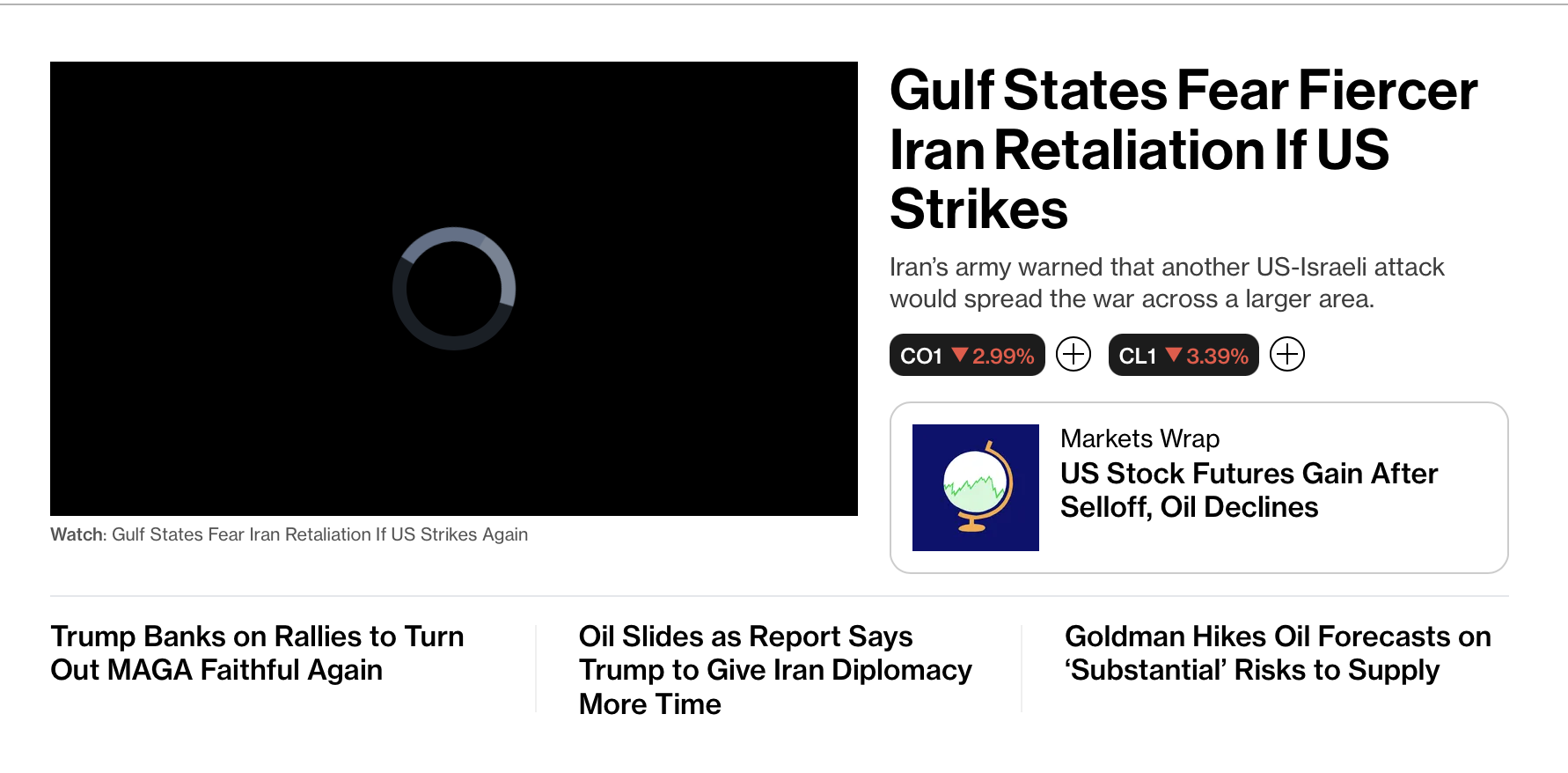
But Mr. Market has reverted to its optimistic form, with oil prices falling and stock prices perking up. As you can see from Bloomberg’s landing page, investors are taking cheer despite Gulf State fears and Goldman warnings:
Of course, the latest Trump negotiation ploy may be US deception or market-goosing right before the midterms, or Trump seeking to buy a little time for the Israel leadership to sort itself out. But Trump has repeatedly walked right up to the edge of starting attacks and pulled back, including in September, mere hours before a “go live” time for Ansar Allah strikes. It’s called TACO for a reason.
However, Tucker Carlson’s contacts are passing on alarming reports that Trump is considering a nuclear strike on Pickaxe Mountain and is set to decide by November 7:
Under pressure from Israeli prime minister Benjamin Netanyahu, the Trump administration may be within days of launching a nuclear strike on Iran. The target would be Pickax Mountain in central Iran, where Israeli intelligence claims the Iranian government has restarted its nuclear enrichment program. No conventional weapon in the American arsenal can penetrate 300 feet of solid granite to destroy the tunnels where enrichment is supposedly taking place. The only military option is a nuclear strike. Netanyahu has been pushing hard for one. “Bibi calls Trump about it every day,” says an informed observer.
Netanyahu is cornered and desperate. After last week’s election results, he can’t form a government unless Trump intervenes directly in Israeli politics and brokers a deal with other parties that gives Netanyahu 61 seats in the Knesset. Otherwise, he is out as prime minister and on his way to ignominy, investigations and possibly jail. Netanyahu must stay close to Trump. He needs this war.
To that end, he’s applied maximum pressure to his closest allies in the administration, including Secretary of Defense Pete Hegseth and CENTCOM commander Brad Cooper. Both oppose a negotiated settlement to the war they’ve so grievously mismanaged; both are pushing to restart major combat operations. Secretary of State Marco Rubio and CIA director John Ratcliffe are also following Netanyahu’s lead, as are leaders of the Democratic Party. In a recent meeting on the subject, former president Barack Obama said he opposes the current Iran peace deal being drafted in Doha.
The rest of America’s longtime allies in the Middle East are terrified by the prospect of more war….. Gulf economies are teetering. So are global energy and fertilizer markets. They won’t recover soon. Globally, there are a total of about 850 supertankers used to transport oil from producers to the rest of the world. In October alone, 11 of them were badly damaged in Hormuz. At this pace, a global depression is imminent. A nuclear strike would radically accelerate the destruction. Fallout from a ground explosion at Pickax Mountain would contaminate the Persian Gulf, poisoning the water supply for 100 million people.
And those are just some of the immediate consequences for the region. The rest of the world is every bit as exposed. No country other than the United States has ever used a nuclear weapon in war. Some would like to….After the first nuclear strike, World War Three is inevitable. That war would be short and final.
We’ve been sleepwalking toward this moment for months. Since February, the administration has quietly rewritten America’s nuclear doctrine to make first use of so-called “battlefield nukes” easier and therefore more likely. No one in Washington in either party seems bothered by this. Now we’re on the brink of it.
Close observers say Trump is likely to decide by next weekend whether or not to use nuclear weapons. That would be November 7….— Tucker Carlson (@TuckerCarlson) November 2, 2026
So we’ll use this pause to look at the pace of deterioration in AI funding. It’s hard to know how long this Wile E. Coyote phase, of it being widely acknowledge that AI investment will never pay off in financial terms, yet asset price levels remaining lofty even factoring in the recent corrections. There was a ton more conviction in the dot-com era, with tons of people who should have known better accepting eyeballs as a valuation metric. A hard end seems baked in for 2027 and 2028 at the very outside, given subprime-like “take or pay” provisions. See Groundbreaker in The Teaser Period: Why the AI Boom Is Hitting a Reset Wall for the gory details.
Let’s first turn to the fact that the US economy is not as robust at the 3Q initial release of 3.4% growth would have you believe. First, the GDP deflator was lowered to 2.2% from 6.1% in 2Q. The consensus expectation for that input was 3.2% so this looks sus. Inventory build was about 1.6% of the 3.4% total, so unless end demand picks up, this will wind up reducing sales in future quarters. And that’s before getting to the fact that unsustainable AI capex spend is a major driver of this groaf.
Now to a worsening cause for pause: the accelerating decay in the junk bond market. This matters because investment cycles grind to an end first with borrowings becoming more expensive and harder to get. That process starts with the weakest debtors and works its way up to better credits. Prototypically, stock market declines start about 5 months after interest rate rises, but with big variation in timing.
So the Financial Times story about the very weakest junk bonds crashing is on script, save perhaps for the degree of panic. And the trajectory matters ginormously for AI, since the sector’s insatiable demands mean that even the once-huge cash reserves of tech titans are inadequate to fund the intended buildout, and they must borrow to keep plowing ahead.
A Washington Post headline last week put it bluntly: There’s not enough money in the world to pay for the AI boom. From the body of the article:
Technology companies recently launched a record scramble for cash to pay for data centers, computer chips, and technology and equipment to power artificial intelligence. This boom is so expensive that even Silicon Valley giants are bleeding cash, and companies are now racing one another to collect or borrow other people’s money for the estimated $10 trillion of AI-related spending in coming years.
Three eye-popping figures that emerged on Monday showed the scale of the AI cash grab.
Anthropic, maker of the Claude chatbot, started the clock on what is expected to be the largest initial public offering in history, raking in an estimated $100 billion in stock sales. But the company’s IPO paperwork warned that will just be the down payment necessary to fund the company’s AI ambitions….
The same day, Meta said it would sell up to $95 billion in new stock after disclosing a few days ago that it was struggling to compete with other AI developers asking investors for cash. And less than five months after Elon Musk’s SpaceX held what stands as the current record largest IPO, the AI and rocket company finalized a complex deal to borrow $40 billion to pay for AI computer chips and equipment….
In a widely cited draft research paper last month, Columbia University finance professor Stijn Van Nieuwerburgh estimated that it will cost more than $10 trillion through 2032 to build out AI, including data centers and computer equipment.
Measured as a slice of U.S. economic output, the average yearly AI spending works out to more than the combined national commitments for electrifying American households in the early 20th century, building the interstate highway system, and installing the backbone of the 1990s U.S. dot-com boom, he estimated….
Investors are starting to get picky about which AI companies they’re willing to bankroll. Stock and bond prices have been on a roller coaster in recent weeks, particularly for a class of smaller firms that earn money from renting AI data center computing power to leading AI companies. Investors have balked at IPOs for several of these young but fast-growing data center companies, dubbed neoclouds, or demanded higher interest rates to lend them money.
Like many AI companies, many neoclouds cannot fund their operations without taking on debt or other outside cash…
Market research firm Gartner recently….predicted that 80 percent of neocloud companies could fail or be forced to sell themselves in coming years….
The U.S. economy and financial future of every American — whether they intended to wager on AI or not — are increasingly linked to this giant bet. Companies large and small in the AI industry, on Wall Street, and those leasing office space or selling paint are all becoming dependent on AI spending and the premise behind it: that AI will profoundly reshape work, the U.S. economy and American life in a way that delivers geysers of economic growth, corporate profits and wealth for decades to come.
Paging Ed Zitron.
Now to the Financial Times on junk bond market distress, in Junk debt rout sparks ‘bloodbath’ for credit investors. Mind you, the piece does not directly implicate AI. But Anthropic is rated junk:
🦔Anthropic got a credit rating back in June that only came out this week. Kroll Bond Rating Agency gave it a BB+, the best junk rating you can get and one step below investment grade. The FT says it landed just before Apollo and Blackstone lined up $35 billion to buy chips for Anthropic.
My Take
Kroll didn’t get to see much. Anthropic gave it revenue, run-rate revenue, adjusted operating income and its own forecast, but no free cash flow, so the analysts guessed at that part. I think the grade is generous. Oracle sits one notch higher at BBB- and everyone treats it as a company in trouble. My guess is Moody’s and S&P come in lower once the S-1 shows full results, since adjusted numbers tend to leave out the expensive stuff.
Most of that $35 billion got borrowed at about 5.75%, a low rate for a junk-rated company, because Broadcom agreed to cover lenders if the chips ever have to be sold at a loss. Broadcom is backing about $42 billion more in a newer $60 billion chip package for Anthropic too. Lenders seem fine with that, and so does Apollo, which put part of the first deal into its own annuity company, Athene. I’m less comfortable with it. If Anthropic ever falls behind on those leases, Broadcom ends up holding a mountain of used chips, and I don’t think Broadcom’s stock reflects that risk today.
Hedgie🤗
— Hedgie (@HedgieMarkets) October 16, 2026
…and market maven Jeff Gundlach discussed long from how many big AI bettors like Oracle and SpaceX are trading at junk bond prices. Keep in mind that rating agencies are loath to downgrade, and tend to do so only after Mr. Market has priced the downgrade in.
🦔Anthropic got a credit rating back in June that only came out this week.
Jeffrey Gundlach on AI backed loans: “The market isn’t accepting the ratings being put on these AI businesses.”
“Spreads are widening on lower quality credit. The BBB index is at a price of $65 which is down 18% on just a price basis.”
“The huge issuance by AI and AI adjacent types of business have not been well received by the bond market. They come out at a certain rating that immediately gets questioned by the market.”
He cites recent examples like SpaceX. “SpaceX came in at BBB and immediately widened to a junk bond type of spread. Then, Oracle came out at BBB- which is not being embraced by the market because it’s trading like a single B- company based on the spread that it’s at.”
“This reminds me of the way the market started to behave regarding BBB supreme back in 2006 and 2007 where there’s a little crisis of confidence on how rating agencies in the private credit related areas are leaning on these IG ratings that the market doesn’t think are real.”
“All spreads are widening, even asset backed securities, commercial mortgage backed securities, IG spreads.”
Gundlach believes this is the beginning of a trend, not just a bump in the road.
— UnstructuredCap (@UnstructuredCap) October 29, 2026
After that setup, to the pink paper on the junk market meltdown:
A prolonged rout in the riskiest parts of the global market for junk debt is sending shockwaves through credit markets, driving some of its most active investors to steep losses as lenders lose faith in the world’s most vulnerable corporate borrowers.
Rising global interest rates have exacerbated fears about the ability of heavily indebted companies to deal with AI disruption and high energy prices, while the European market has been hurt further by concerns about France’s fiscal health.
Spooked investors have dumped exposure to the market’s most distressed companies as a result, causing bond and loan prices to plummet for some of the largest high-yield borrowers in Europe and the US. Yields of CCC-rated borrowers — the lowest rung of junk debt — have climbed rapidly to more than 21 per cent in Europe and 18 per cent in the US as prices have plummeted, up from about 16 per cent and 15 per cent at the beginning of the year.
Investors holding the bonds — sometimes on a scale that makes selling out of their positions difficult — have been hit with steep losses.
“It’s a complete bloodbath,” said a portfolio manager at a large US hedge fund. “Everyone is scared of being in the next blow-up . . . being flat is the new up.”…
While the yield investors demand to hold the weakest junk-rated issuers has widened, so has the gap between those companies and their higher-rated junk market peers. In Europe, the difference in yield investors demand for CCC-rated and BB-rated bonds has skyrocketed.
Ahem, that is whistling-past-the-graveyard talk, unless there is good reason to expect interest rates to fall (ex a serious recession or depression) or fairly broad-based economic improvement.
The lead Financial Times op-ed voices similar concerns. From AI mania can’t survive higher interest rates:
When bond yields surged in recent months, analysts just shrugged, saying the AI boom would thrive regardless. This is classic bubble logic. The price of money always matters, and there is good reason to believe that is true now more than ever.
Global debt is at record levels, much of it accumulating on government books. This is good news short term (governments are typically the last fortress to fall) but bad news in the end (governments will be in no position to deliver stimulus or bailouts)…
That sets the stage for a rapid liquidity squeeze. Steeper rates threaten to trap corporations between higher borrowing costs and increasingly wary lenders. As big tech groups turn from cash to debt to fund their multitrillion-dollar data centre build-out, AI-related debt issuance is likely to exceed $600bn in 2026, up 10-fold from 2024.
While interest rates were arguably at similar levels during the 1990s boom, the story arc was very different. Rates today aren’t just high, they’ve risen rapidly in a short period, after nearly 25 years of historically low rates that trained investors to expect endlessly easy money…..
Most investors nonetheless find ways to take comfort amid these tremors. The US stock market looks resilient; default rates remain low. Plenty of credit is still available to fund the frantic AI build-out. But the end of a boom is a process, not a point in time. It takes a while for higher rates to have a systemic impact.
Consider the busts of 2000 and 2008. High rates did eventually deflate those bubbles, affecting the weakest sectors before reaching the broader market and the economy. This process unfolded over several years. Tech stocks took a first big step down in early 2000, but many investors were still piling into tech funds late that year; the bubbly enthusiasm didn’t die out till 2001.
Magical thinking flourishes in a bubble’s final stages. One central myth of the dotcom era was that “enormous” demand for internet products had freed tech firms from ordinary economic forces….
Eerily similar claims can be heard today for AI. Optimists have argued that a few percentage points of interest won’t mean much to companies facing historic gains in value. Or that Fed rate rises measured in mere basis points can’t lower the spending ambition of companies trying to win the AI arms race. Now that higher rates are in fact hitting AI subsectors such as neoclouds, they brush off the notion that a few tens of billions in debt could take the AI complex down…..
Finding scenarios that would reverse this process of erosion caused by higher rates requires more magical thinking….
Unlike past booms, including the late 1990s, money pouring into tech is not lifting other sectors: outside AI, borrowing is weak and investment is falling. It is difficult to see how AI companies can thrive when so many of their potential customers are struggling….
This may be the most transformative tech boom yet, but it’s not big enough to defy the high price of money.
Similarly, on Sunday, the Wall Street Journal’s lead story described rising investor anxiety, demonstrated by trying to lay off risk through credit default swaps. But 2008 showed those counterparties might not be able to make good when the crunch arrives. From AI Investors Are Racing to Get Insurance on the Biggest Market Bet in History:
Wall Street placed a multitrillion-dollar bet on artificial intelligence. Some investors are desperate to take the other side…
The jitters are starting to show up in a number of ways: the yields lenders demand to finance big data-center projects and chip purchases; the plunging stock and bond prices of some AI “neocloud” companies, such as CoreWeave that are borrowing heavily; and steep selloffs from tech darlings including Alphabet and Intel, which just recorded some of their biggest one-day drops ever. The tech-heavy Nasdaq lost 2.9% Friday, capping its worst month since March 2025…
Investors and tech executives alike are turning to options and credit-default swaps for protection.
Put options, which give investors the right to sell stock at a specific price at a future date, are growing in volume. Contracts tied to the neocloud CoreWeave surged to the highest level on record in October and have stayed elevated, Cboe Global Markets data show.
Some of the most popular bets tied to CoreWeave have been put options expiring in 2028, paying out if the shares plunged to $35. The shares hovered at around $55 this week.
Meanwhile, the cost to protect against a debt default in hyperscalers Amazon, Alphabet, Microsoft, Meta and Oracle widened over the past month to the highest levels going back to 2021, according to the bond data provider Solve. “There were no exceptions, suggesting broad market concern about the sector rather than idiosyncratic credit events at individual companies,” said Eugene Grinberg, a co-founder of Solve.
The recalibration in Oracle credit-default spreads was especially stark, widening by more than 1 percentage point.
As we have regularly pointed out, investors may have been unduly conditioned by the 2007-2008 crisis. That had three acute phases, each tamped down for a bit by interventions, before the culmination in the near-death of the global financial system. The epic meltdown resulted from the fact that the riskiest subprime debt exposures had been leverage turbo-charged by credit default swaps packaged prettily into CODs, which then sat disproportionately at systemically-important, fragile financial institutions.
On the one hand, the even-greater magnitude of this mania would suggest another gut-wrenching unwind. But on the other, if the exposures are widely spread and do not greatly impair the critical payment system, we may instead see Japan-style zombification. Quite a few experts reckon that the Japanese joint real estate and stock market bubbles produced even more dodgy debt, compared to GDP, as the later subprime crisis. So size does not necessarily determine velocity of unwind.
But we do seem to be nearing the point where we might have a better grasp of what the implosion will look like.
___
1 Professor Marandi has become dismissive of these efforts as well as a lot of reporting them, particularly from Al Arabiya and Aljazeera, as he discussed long form with Glenn Diesen.
