


The weekend before the US midterm elections featured a big AIPAC-inspired Democratic betrayal in Michigan, plus Trump talk about protecting Elon Musk and his staff from vengeful Dems and some coverage of potential election interference from the administration.
I wasn’t going to write about the elections today, since I’ll be back tomorrow for an election-night live thread, but Yves covered the AI junk bond situation, and a couple of election-related developments caught my attention.
First up, betrayal most foul in the Michigan US Senate race.
Stevens Switches Endorsement to Rogers
I’ve covered the Michigan Senate race multiple times this cycle largely because it featured a hotly contested primary that saw Abdul El-Sayed overcome two pro-Zionist candidates and a massive spending differential.
Well, Israel has continued to be the central dynamic of the race with Democratic US Rep. Haley Stevens, the second-place primary finisher, choosing to switch her endorsement to Republican Mike Rogers over El-Sayed’s refusal to condemn an ad by Rebellion PAC, promoted by Cenk Uygur of The Young Turks.
The reaction from the Zionist establishment of the Democratic Party was intense and remarkable given that they had backed Stevens up until she dropped the mask of party unity and endorsed Rogers.
Here’s Senate Minority Leader Chuck Schumer:
This is a despicable betrayal from Rep. Stevens.
Senate Democrats are united in our support for Abdul El-Sayed, because we know he will fight for the economic interests of working families in Michigan, unlike Mike Rogers, who is a tool of Donald Trump and billionaire donors.
— Chuck Schumer (@chuckschumer) November 1, 2026
And former US Speaker of the House Nancy Pelosi:
Haley Stevens has chosen to dangerously betray Michigan families’ healthcare, freedoms and future with her horrific endorsement of Mike Rogers.
@AbdulElSayed must win — because Michigan and our country deserve better. -NP
— Nancy Pelosi (@TeamPelosi) November 1, 2026
The media coverage of the event has been quite interesting as well, with the New York Times describing “the dispute” as “deeply personal” “between two mercurial millennial politicians of sizable egos quick to take offense.”
The Times did manage to include this paragraph:
…the breach also represents a major fissure coursing through the Democratic Party about what its relationship with Israel and Jewish donors should be. Dr. El-Sayed, if he wins on Tuesday and enters the Senate in January, would be the most anti-Israel U.S. senator since the formation of the Jewish state 78 years ago.
And then got into some of the financial, political, and personal drama surrounding the break:
At the root of the disagreement between Ms. Stevens and Dr. El-Sayed was U.S. policy on Israel. Dr. El-Sayed has emerged as one of the Democratic Party’s leading critics of Israel. Ms. Stevens, who is not Jewish, once said “I see Israel in my dreams” at a Hanukkah service. The American Israel Public Affairs Committee, which supported her in the primary, spent at least $30 million attacking Dr. El-Sayed during the primary and began spending more starting in October.
Ms. Stevens’s fiancé is Jewish and is an AIPAC donor. She said in an interview on Friday that she is considering converting to Judaism.
Michigan reporter Zach Gorchow got considerable attention with his report citing former Michigan Governor Jim Blanchard, who gave the story a “blame the boyfriend” twist:
The former governor, a longtime friend and supporter of the congresswoman, said Stevens was happy and looking forward to going to a church in Detroit on Sunday to campaign alongside her onetime Democratic primary rival for U.S. Senate, Abdul El-Sayed.
Then things got tense. Blanchard, in an interview Sunday with Gongwer News Service following the stunning news of Stevens revoking her endorsement of El-Sayed and instead endorsing Republican Mike Rogers, said Turkish, a longtime Democrat who is Jewish and endorsed Rogers last week over El-Sayed’s views on Israel, began chiding his fiancée, Stevens.
“He was working her over. The way he was saying it was, ‘Everyone is disappointed in you, they did everything they could to help you and then immediately after you lose the primary, you endorsed him,’” said Blanchard, who was governor from 1983-91 and remains an active voice in the Democratic Party.
Blanchard said he pushed back at Turkish on Stevens’ behalf.
“I said, ‘Yeah, because she’s a team player. You have to be gracious. Come on,’” he said.
Turkish was unmoved, Blanchard said.
“He said, ‘I know, but they’re really disappointed in her,’” the former governor recalled.
Blanchard said he then pointed out to Turkish that U.S. Sen. Elissa Slotkin, D-Holly, who is Jewish, is supporting El-Sayed and that Stevens is not Jewish. He questioned how he could hold Stevens to a higher standard than Slotkin.
“He was all distraught,” he said. “He was all strung out about Abdul. I let her know, he’s not a good influence.”
Stevens’ response? “She said, ‘I’m fine,’” Blanchard said.
The Lever’s David Sirota gave the progressive perspective, starting by citing a Substack post he made in August, two days before the primary:
I’m going to write something here that we all know is true but few are willing to just say out loud: There is a non-zero chance that the national Democratic Party, its donors & its media will decide to abandon/sabotage populist anti-establishment Democratic nominees in the upcoming general election.
Many in this corporate faction would rather such nominees lose – even if that means Democrats losing the Senate & governorships – than see these candidates win.
Why? Because if these candidates win, they threaten to change the Democratic Party and make the corporate faction irrelevant.
Then continuing:
Stevens’ endorsement comes days after Trump campaigned in Michigan for Rogers, and Trump is now lauding her. Her gambit is the culmination of a postprimary guerrilla campaign on social media by corporate Democrats like Neera Tanden. They have aimed to undermine El-Sayed with guilt-by-association tactics scandalizing some of his supporters. They are doing this because El-Sayed is running on an agenda that they loathe: anti-corruption, anti-oligarch, anti-war, anti-genocide, pro-Medicare-For-All, and critical of U.S. support for Israel’s far-right regime.
Corporate Democrats’ campaign to undermine El-Sayed had already been successful at one level: As Zohreen Shah reported for The Lever this weekend, even before Stevens’ endorsement of Rogers, many of Stevens’ donors have already flipped to support him.
As I suggested a few months ago, this faction fears El-Sayed not just because his win could help pass the policies they and their donors abhor, but also because he will destroy their relevance. Specifically, his victory would incinerate their arguments about electability that get them platformed in corporate media as alleged political “experts.”
Indeed, if he is victorious, he will prove that the anti-oligarch politics corporate Democrats loathe can win in one of America’s most politically significant swing states. And he isn’t alone: Corporate Democrats are similarly shaken by populists rejecting their neoliberal formula and instead using anti-oligarchy to compete to try to win back red states like Texas, Nebraska, and Florida that corporate Democrats long ago lost to Republicans.
Natasha Lennard at The Intercept adds a history lesson:
We might recall former Sen. Kyrsten Sinema of Arizona, who left the Democratic Party while still in office and notoriously delivered a dramatic thumbs down and curtsy when voting against a raised minimum-wage provision during the height of the Covid pandemic. Sinema and fellow then-Democrat Sen. Joe Manchin of West Virginia also joined with Republicans to effectively tank major voting rights legislation in 2022.
And, of course, there is the entire Senate career of conservative pro-Israel fanatic, Pennsylvania Sen. John Fetterman, who still remains a nominal Democrat. Fetterman offers a consistent master class in dangerous extremism and should be seen as a profound political liability by his own party.
It is, after all, so-called moderates like Stevens who are the radicals. As writer Eoin Higgins noted, an array of Democrats have revealed themselves more willing to see Republicans win than allow the party’s left-wing flank — or, more to the point, criticism of Israel’s genocide — to gain further ground.
And while there is little political agreement between the right and left wings of the Democratic Party on a whole array of issues, defeating Republicans, particularly Donald Trump’s Republican Party, was at least the stated goal of even the most conservative of Democrats.
To so openly fail on even those basic electoral terms should be the very definition of a political liability for a party.
Alright, enough about that, let’s hear from the POTUS.
Trump in Bargaining Mode
The New York Post’s Pod Force One podcast has the inside scoop on Trump’s thinking about protecting Elon Musk:
“They’re just very evil people and they want to arrest Elon Musk. They want to seize his factories, nationalize SpaceX. It’s talk. But if it is talk, we’ll have to protect them.”
…
“If Elon, if anybody said that, I would agree. If we lost the House, the Senate, and the presidency, our country is finished because these are lunatics.”
On pardoning staffers:
Miranda Devine: “Can you preemptively pardon them?”
Donald Trump: “That’s what Biden did. He gave everybody a pardon… It was a corrupt committee. They were all corrupt. He gave everybody a pardon.”
Devine: “Will you do that?”
Trump: “I would if I needed to. Sure.”
Devine: “Everybody who worked for you?”
Trump: “I would not even think about [it]. I’d do it. I did it for J6.”
On a potential third term:
“Well, I’ll go. Yeah… Look, I’d love to run again if I had the chance, but the language is very exacting. I would love to run. They had a poll the other day where I’d beat everybody by so much. I’d love to run, but but it’s fine. You know, we have more than two years left. That’s a long time. You can do a lot in that period of time.”
The whole thing is worth a watch if you can handle seeing the man with his finger on the nuclear button free-associate for a half-hour.
Let’s wrap with some do-gooder hand-wringing about election interference.
The Republicans Won’t Do That, Will They?
ProPublica is doing their due diligence on election interference. Here’s an interesting profile on Trump’s election denial advisor Cleta Mitchell, who began her political career in the 1970s as a pro-ERA Democratic state representative in Oklahoma who was once featured in TIME as a potential presidential aspirant who turned to the right after her oilman second husband went bust in the 1980s:
Mitchell, who holds no formal position in the Trump administration, had been pivotal to Trump’s bid to challenge his loss in 2020, spearheading efforts to prove his claims of fraud and reverse his defeat in court.
After Joe Biden took office, when others abandoned the fight or scoffed as Trump clung to conspiracy theories, Mitchell doubled down, founding a grassroots organization devoted to rewriting election laws and rules to be more restrictive. Members of her group, the Election Integrity Network, were named to vital election-related positions in swing states and, later, in the second Trump administration.
…
Friends and enemies alike credit her with providing much of the administration’s election road map. The White House has turned to those close to her to enact the plan, appointing her associates to help lead the hunt for noncitizens on voter rolls and to reinvestigate 2020 voting irregularities.
…
Her signature legislation — the SAVE Act and its successor, the SAVE America Act — have been blocked by moderate Republicans in the Senate. Election changes she’d hoped the president could push through before the midterms, such as compelling states to turn over confidential voter information to the Justice Department, have been blocked by the courts. And Trump’s mid-July address on elections drew shrugs even from some conservative media.
Critics, including some inside the election-integrity movement, told ProPublica they are worried that Mitchell’s growing frustration is prompting her to press Trump and his allies toward ever more extreme actions. Her lifelong pattern, ProPublica’s reporting shows, has been to escalate conflicts into winner-take-all battles — a pattern playing out now as she tries to shape the midterms.
Most importantly, they track the money backing Mitchell and what she’s doing with it:
“My sole focus has been for the last year and a half, how we as conservatives could build an infrastructure to do hand-to-hand combat with the Left, starting at the local level,” she said on a September 2022 EIN organizing call.
The network served as the centerpiece, providing the boots on the ground, but Mitchell also created an ecosystem to support it, spreading money to allied researchers, law firms and policy shops.
A ProPublica analysis of data from the Campaign Legal Center, a government watchdog nonprofit, shows that between 2021 and 2025, Mitchell helped put more than $70 million into this work. According to tax filings, at least $11 million of that total came from nonprofits she oversaw. Tens of millions more came from the Bradley Foundation, where she served on the board, and the Conservative Partnership Institute, a Trump-aligned think tank where she was a senior legal fellow.
Roughly 30 conservative election-integrity nonprofits were started after 2020. Well over half have received money from Mitchell or have close ties with her, the data shows.
And what has she done with her big ideas and lavish funding? Here’s my attempt to summarize ProPublica’s accounting of her election integrity initiatives:
What Cleta Mitchell and her Election Integrity Network have pushed for
The SAVE Act (2024): documentary proof of citizenship to register to vote, plus Department of Homeland Security database checks to purge noncitizens.
The SAVE America Act (2026): photo ID nationwide and states forced to hand their voter rolls to DHS for noncitizen screening.
Ending the Senate filibuster to pass it, with Network members sent to pressure holdout senators.
A national emergency declaration letting Donald Trump impose the bill’s requirements himself under a critical-infrastructure law.
States turning confidential voter data over to the Justice Department, and DHS searching the rolls for noncitizens.
Immediate action by Commerce Secretary Howard Lutnick on alleged voting-machine vulnerabilities.
Provisions in Trump’s March 25th, 2025, election executive order.
Reopening 2020 in Fulton County, Georgia, including the FBI records seizure and Dan Bishop as prosecutor.
SAVE-style model bills approved through the American Legislative Exchange Council in July 2024.
A Georgia State Election Board rule letting local officials delay certifying results.
Conservatives signing up as poll workers and election-board members across seven swing states, starting in Michigan in 2022.
Funding: more than $70 million into election-related work from 2021 to 2025, including at least $11 million from nonprofits she oversaw, and more than $6 million for SAVE Act advocacy.
What they’ve won
Republican states pulled out of a multistate voter-roll cross-check program in 2023.
Numerous states banned private election grants like Mark Zuckerberg’s 2020 money.
12 states passed laws closely resembling the SAVE Act, and 23 changed procedures to reflect parts of it.
The SAVE Act passed the House in July 2024.
Trump’s March 2025 executive order.
At least 25 administration appointees with close ties to Mitchell, including former Network leader Heather Honey at DHS.
Network chapters grew from 7 in 2022 to at least 26.
Where they’ve failed
Moderate Republican senators have blocked the SAVE America Act and the filibuster change.
Courts blocked large parts of Trump’s executive orders, the demands for confidential voter data, Georgia’s certification rule and Dan Bishop’s Fulton County subpoena.
Ohio Gov. Mike DeWine vetoed the stricter voter ID bill Mitchell pushed.
Now let’s turn our attention to some seemingly less diligent Trump officials.
Hacking the Elections From the Inside?
ProPublica has also covered less competent, but even more ill-intentioned Trump administration election interference efforts:
A few months into President Donald Trump’s second term, political appointees at the Department of Homeland Security made an unusual request of its agency focused on cybersecurity: Secretly acquire a voting machine and hack it.
The appointees wanted the Cybersecurity and Infrastructure Security Agency to procure the machine, examine it and report back the findings so they could be given to the White House, according to two former administration officials with knowledge of the request.
…
The same piece profiles Nick Andersen, acting director of the Cybersecurity and Infrastructure Security Agency, from the perspective of government employees who are clearly not impressed with his work:
…a former cybersecurity adviser to Trump’s White House who had joined CISA a year earlier. Andersen is also a district representative for the Republican Party in Virginia, according to the party’s website. In March, he gave a speech to the Fairfax GOP chapter titled “Fighting Democrat Redistricting.”
Speaking over video in August, the boyish-faced former Marine Corps engineer announced that DHS was preparing to release a plan on how it would work together with state officials to secure the election, according to five people who were present at the video meeting, some of whom shared notes with ProPublica.
Many on the call were stunned at what they perceived as a lack of understanding of election planning. Early voting for the general election was just around the corner. They had spent over a year preparing for the midterms, and there was no more time for ambitious work.
Some peppered Andersen with questions: Where had CISA been when there was still time to make improvements?
Andersen blamed any lapses or perceived breaches in trust on the federal government shutdown in fall 2025, twirling his pen uncomfortably and sipping from a Monster energy drink.
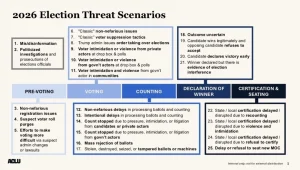
The Bulwark, home of “never Trump” neoconservatives, covered the ACLU’s two-and-a-half-day session in a Philadelphia hotel in April with about 250 people and 25 scenarios. Those scenarios included Trump disputing results, DOJ interference, ICE or National Guard at polls, and Republican congressional leaders refusing to seat Democratic winners. The Supreme Court’s Louisiana v. Callais ruling gutting Section 2 of the Voting Rights Act came down during the session. The article includes this handy graphic:
I’ll wrap up with my attempt to round up actual efforts to impact the elections from the GOP nationally and by GOP state officials here in my home state.
But What Are They Actually Doing?
Quite a bit, actually. Check it out. First, the federal stuff:
And the Texas Republicans have been busy too:
Voters sued Tarrant County after its Republican commissioners voted 3-2 to cut 92 Election Day polling sites, leaving 224. The suit says the cuts fall hardest on Black and Hispanic communities, and that 46 of the closed sites had more than 500 Election Day voters in 2022.
Judge Pat Gallagher refused to restore the sites before November 3rd. County Judge Tim O’Hare and the other supporters cited a projected $1 million in savings.
The cuts closed the polling site at the University of Texas at Arlington and dropped early-voting sites from 50 to 47.
During early voting, Attorney General Ken Paxton’s office sued the Harris County clerk over get-out-the-vote ads it said were aimed at users with “African, Asian and Latino-related interests.” The clerk agreed to pull the ads through Election Day. Paxton, the Republican Senate nominee, isn’t taking part in the case.
With luck, we’ll find out how these efforts pan out for Trump’s GOP sooner rather than later.
Related Posts
