


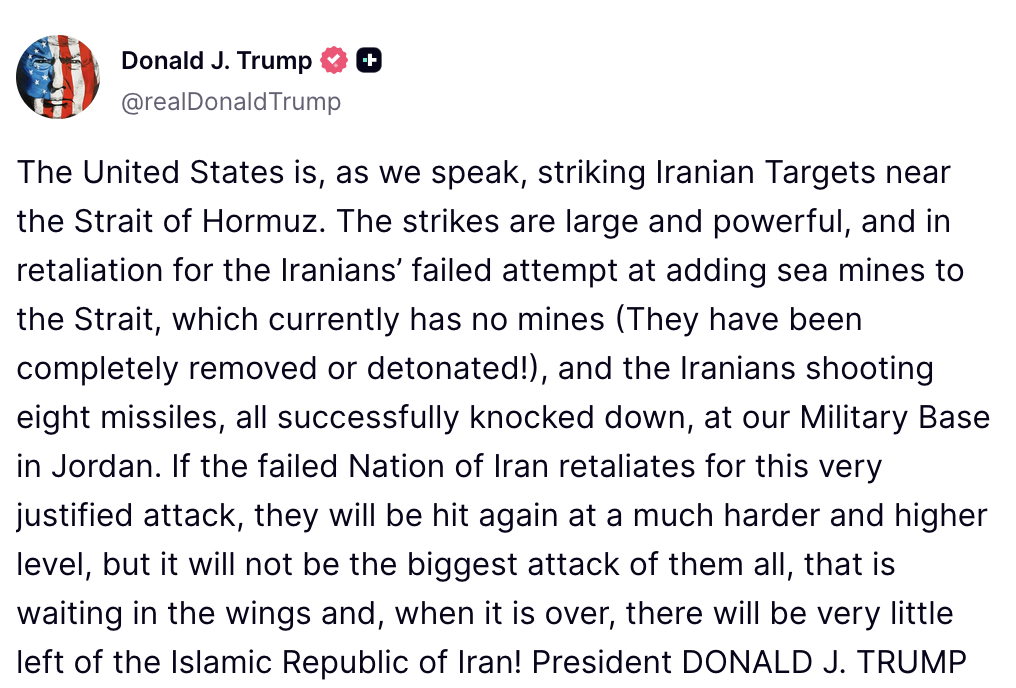
[Today’s Iran war post uncharacteristically launched as final as it can be today]
We said from the outset of the war with Iran that it would be a test to destruction. One of the things that is being destroyed before our eyes is not just the perception that the US military is the dominant fighting force in the world, but also, and in a serious way, its capabilities and power projection. Many experts, whose work we have featured, have described long form that after the first 40 days of this conflict, that the US had run down its stocks of weapons to where they would soon hit critically low levels. Iran has reduced US surveillance capabilities by destroying most (all?) of its expensive and hard to replace radars. AWACS is a backup but those planes are long in tooth and are having to be flown heavily, reducing their meaningful life. MQ Reaper drones were not designed for use in uncontested skies so Iran’s claim to have made its 50th kill in this fresh resumption of exchanges is credible. And that’s before getting to the overextension of the Navy to a breaking point, and the impact of the destruction on US bases not just to naval but also air logistics.
We’ll turn to details of kinetic action shortly but thought it made sense to continue discussing the bigger trajectory first.
Trita Parsi had argued that the US would try to keep the conflict on an even keel through the midterms and not escalate. Iran had the reverse incentives, to hot things up and ideally choke transits through the Strait of Hormuz much harder so as to increase energy prices. But it was the US that decided to throw another punch, likely due to Trump’s inability to behave in what he would see as a passive manner. Trump is not only extremely impatient but also consumed by his need to dominate. Note that the US re-igniting a hot war is a gift to Iran. Iran can take the position with China and other key allies who are keen to prevent more damage to the global that the US force its hand. Keep in mind that Iran has also warned repeatedly that it would retaliate disproportionately.
Robert Pape has provided a fine high level view of the pressures on and choices facing the main players in a new talk on the At the Water’s Edge channel. The headline message, that the Iran has set out to create a no-win situation for the US and Persian Gulf states, is a key strategic point. Pape clarifies that while coercion and punishment campaigns fail, ones of denial, of thwarting the opponent in finding any way to achieve what they would see as a win, is a different manner.
From a lightly-edited machine transcript:
Iran isn’t just playing tit for tat. Iran isn’t just playing uh I’m gonna do two tits for a tat. I’m gonna up the ante on you like in a game of poker here.
Iran is sending a really powerful message especially to the Gulf States, but a generally powerful message, which is you’re in a no-win situation.
If Iran squeezes your oil coming out of the Strait of Hormuz militarily, you can allow Iran to squeeze the oil, in which case you don’t win or you can go along with some retaliation this time with the United States and you don’t win again. …
If you don’t have that winning strategy, that’s what denial is all about. persuading the enemy they are denying them a winning strategy….
A no win scenario where they do they respond one way, they lose. They respond another way, they lose. In other words, a no-win scenario is where it’s lose lose. whatever you do and that is called denial. It is what crushes the hope out of the target government, people, military. You could talk to your blue in the face. This is one of the biggest problems uh Secretary Hegsth has right now. Our military is much of it, maybe not all of it, Admiral Cooper might be different, but much of it, from what I see on the outside is thoroughly persuaded that we’re in a no-win scenario. And they’re looking at these leaders are going, “What are you talking about, boss? What you want me to die for? What exa? What exactly am I do sacrificing my family, my kids, all what exactly am I doing this for?” It’s not they’re not they’re not tough enough to sacrifice. This is where the mistake comes in. We’ve got the toughest people here. This is not about, you know, mano a mano toughness here. Okay, that’s not been the problem.
Pape later turns to how Iran has degraded US operations in theater:
So we start this war and we’ve got 50,000 troops in the Persian Gulf, not just in the Middle East now, in the Persian Gulf. And we got something like 13 bases. It could be 18 depending on how you count the bases.But let’s just go with somewhere around a half dozen bases in the frontline Persian Gulf States.
Well, what’s happened is through the course of this six months is we have been forced to pull those forces back further and further round after round.
At first, they got smashed with missile and drone attacks that weren’t expected. Then it just continues. Those bases themselves are being smashed. So then what happens? Well, we did have naval forces there. And so we pull back the naval forces so that they’re out of missile, out of at least drone range here. So they’re more into the Indian Ocean. So further away. And then what’s happened and just to sort of telescope this so it doesn’t become a long lecture.
We start to pull back even our air power into Jordan. And I believe that in early July, what President Trump was likely talking to Turkey about in this trade with the F-35s, he may have been uh trying to use Incircik, the air base at Incircik here, because again, we’re pulling back further and further.
And it’s not that we’re not able to hit targets any more. It’s that what’s happening is we’re pulling back. We may now even be pulling back further into Europe. And as we pull back that greater distance that means a lot less sorties. It means a lot less power, military brute force, quantitative power to bring to bear. ‘Cuz the reason you want those land bases is so that you can launch multiple sorties a day with your aircraft. And if you’ve got to fly further, just the nature of physics, you reduce the quantity of sorties per day.
However, the military is more and more divided over this war, even with Hegseth engaging in purges, like the fresh one of Dan Driscoll, to quash dissent in the top echelon. They are set to continue:1
DOD COLLAPSE: Dave Fitzgerald, the deputy under secretary of the Army, is expected to resign from his role this week, according to one source familiar with the matter
— The_Real_Fly (@The_Real_Fly) September 1, 2026
And a vector of Hegseth’s actions to secure his flanks that has not gotten the attention it warrants. From ilsm in comments yesterday:
There are two lines of control in the “war” dept! One is the execution, run by military officers. They work for the civilian chain run by Hegseth. In theory.
Seems Hegseth by blocking promotions and assignments, outside the intent of his role, is breaking the twin streams mold.
The effects are TBD. The immense materiel defects in the profit [war] machine demonstrated in Kiev and over Tehran need fixed, usually the civilian side asks the uniforms what they need and go ahead.
The system is worse broken than I saw. I retired from civilian work in 2019, from reserves in 2002!
Things were not “peachy” in 2019!/blockquote>
And in a sign of desperation in defending these bases:
Americans used 80 Patriot missile defense systems to intercept a single Iranian attack.
THIS IS ONE-TENTH OF WHAT THEY HAD LEFT, AND THEY WERE DEFENDING TWO OF THEIR BASES IN JORDAN FROM THE IRANIANS.
Two Patriot batteries, previously transferred to Jordan from Ansbach,… pic.twitter.com/05H5AICpw1
— 𝕊𝕡𝕣𝕚𝕟𝕥𝕖𝕣 𝕻𝕣𝕖𝕤𝕤 (@SprinterPress) September 1, 2026
Israel is getting anxious:
The Jerusalem Post suggests Americans need “a federally administered debt-forgiveness enlistment program…” for the Iran war. pic.twitter.com/DIHnzGbwOq
— Weimar William (@WeimarWillhelm) September 1, 2026
Yet Trump continues to insist that the US is still mighty potent. The first was as the US was launching its new strikes. Note that Trump took a day longer than many expected to deliver on his promised ferocious strikes. This time, Iran shot back in only a bit over an hour; after the earlier drone attack on Larak Island (hard to detect in advance), it took Iran two hours to return fire.
More Trump bloviating. His continued rejection of negotiation is yet another gift to Iran, which is in no mood to engage in performative talks that could allow the US to regroup and resupply. It gives Iran much stronger ground for telling its allies that it needs to make a forceful response.
We’ll turn first to Bloomberg as the voice of investor-oriented mainstream reporting. You can see it is far from cheery:
From the lead story, US-Iran Conflict Intensifies as Trump Downplays Desire for Deal:
The conflict between the US and Iran escalated with American forces carrying out a fresh wave of strikes and Iran saying it had retaliated.
US Central Command said the targets included “air defense sites, radar systems, maritime assets and facilities, mine laying capabilities, and communications sites” associated with the Islamic Revolutionary Guard Corps.
Iran said its forces had launched a “decisive operation” against US bases in the region, firing missiles at an American base in Jordan and at a US military facility in Bahrain…..
The US military also attacked two Iranian tankers under a new “tanker for tanker” policy approved by Trump, Axios reported, citing an American official it did not name. This came about a day after two oil supertankers attempting to exit the strait were hit in quick succession by projectiles, maritime security consultant Marisks said.
Oil prices rose further on news of the strikes, with Brent advancing 2% to about $96.50 a barrel. The increase has pressured bonds, pushing global yields to the highest since 2008, as traders increased bets the Federal Reserve will raise interest rates.
Needless to say, that was a bit thin on what we can tell about the extent and effects of the Iranian counter-attack. From Almaydeen in Iran says struck US Marine base in Jordan with ballistic missiles:
Iranian forces said they carried out separate attacks against US military positions in Jordan and Bahrain, targeting a US Marine Corps base in Jordan with ballistic missiles and US facilities at Sheikh Isa Air Base in Bahrain with another operation.
The Islamic Revolution Guard Corps (IRGC) said it targeted a US Marine Corps base in Jordan known as Camp Titin with ballistic missiles, claiming the strike killed a large number of US forces and destroyed several important facilities and attack helicopters.
Meanwhile, the Iranian Army said it targeted radar installations and US troop gathering points at Sheikh Isa Air Base in Bahrain as part of the 29th phase of Operation Saegheh.
The IRGC said its forces targeted Camp Titin, a facility belonging to the US Marine Corps in Jordan, with ballistic missiles.
According to the IRGC, the strike resulted in the deaths of a large number of US forces stationed at the camp. It also said several important facilities and attack helicopters were destroyed in the attack.
From the IRGC directly:
DropSite picked up the Tasnim account, as in treated it as credible:
🇮🇷🚨BREAKING: A U.S. strike hit a wedding ceremony in Kohstak, a town in Sirik County on Iran’s southern coast, according to Iran’s Tasnim News Agency.
➤ Hormozgan province’s deputy governor for security affairs said a residential home was struck and rescue teams were… pic.twitter.com/H7Gw6gSB9x
— Drop Site (@DropSiteNews) September 1, 2026
And witnesses:
Some corroboration of the IRGC claims of casualties:
Western media has chosen to ignore that this time, the US strikes were on civilian targets. Per Janta Ka Reporter (starting at 1:30), they included a fish factory, a fishing pier, a civilian airpot, and a wedding party.
The wedding party attack is a new bloody flag:
Aljazeera, via a screenshot at 5:00 AM EDT, puts the Iran death count from the new attacks at 18:
The lead story at Bloomberg presents another Trump defeat, that of Bessent’s doomed to fail bond manipulation antics.
Trump’s policies, from tariffs to continuing to run large budget deficits to the impact of this war on energy prices, essential commodities, and food are inflationary. This is not hard to understand save to God Emperor Trump who really does fantasize that he has unlimited power.
On the energy front, Larry Johnson in America’s Diesel Paradox: A Shortage It Is Supplying, Not Suffering contends that the US (as in its energy concerns) is actually benefitting from the diesel squeeze. It’s a detailed argument, so please read the post in full. Some key points:
Start with what a genuine domestic shortage would look like: falling production, rising demand, and inventories drained to cover the gap. The data show almost the opposite.
Using the four-week average immediately before the war as a baseline and comparing it with EIA data through August 21, US distillate production actually rose — from roughly 4.83 to 5.22 million barrels per day. Domestic product supplied, the proxy for consumption, fell — from about 4.20 to 3.80 million barrels per day. Yet inventories kept draining. The reconciling variable is exports. Distillate exports climbed from around 1.10 to 1.80 million barrels per day; jet-fuel exports nearly doubled, from about 222,000 to 405,000. Net of everything, the United States is now shipping abroad on the order of 700,000 to 900,000 additional barrels per day of diesel and jet compared with the pre-war baseline — even as it burns less diesel at home….
What the domestic-shortage framing obscures is the refining margin, and the margin is the whole story. The diesel crack spread — the refiner’s gross margin over crude — has done something in 2026 it had never done before, and it keeps setting new records. It first topped $102 a barrel on August 17, the first triple-digit print in history; then, as the U.S.-Iran war reignited over the weekend of August 30 — a US strike on Larak Island inside the Strait of Hormuz, an Iranian missile-and-drone response against US bases, and a fresh Trump threat against Iran’s main crude-export terminal at Kharg Island — it pushed to a new all-time high above $106 on September 1. Normal is $20 to $40….
Independent trade analysts have reached the identical diagnosis the correspondents did: the world is not short of crude in the traditional sense; it is short of the capacity to refine crude into diesel and jet…
Put the pieces together and the picture inverts. The world genuinely is short of diesel and jet. The United States is not fundamentally short of either crude or refining capability. Its highly utilized refining system has instead become the principal balancing supplier to a starved global product market — running hard, exporting into foreign bids, and consequently draining its own inventories, while American consumers pay prices set by the global scarcity. The consumer bears much of the cost of the shortage; the refining sector captures much of the scarcity rent. Saying “America has a diesel shortage” collapses that distinction. America does not have a diesel-production problem. America is participating in a global diesel shortage — as its arbitrageur of last resort.
Forgive me for any omissions. I have other obligations and will probably not return until after 8:00 AM EDT, so any new news will be in comments.
____
1 Admittedly Fitzgerald may have seen his position as untenable with Driscoll gone. But the original impetus is the Hegseth ousters.
