


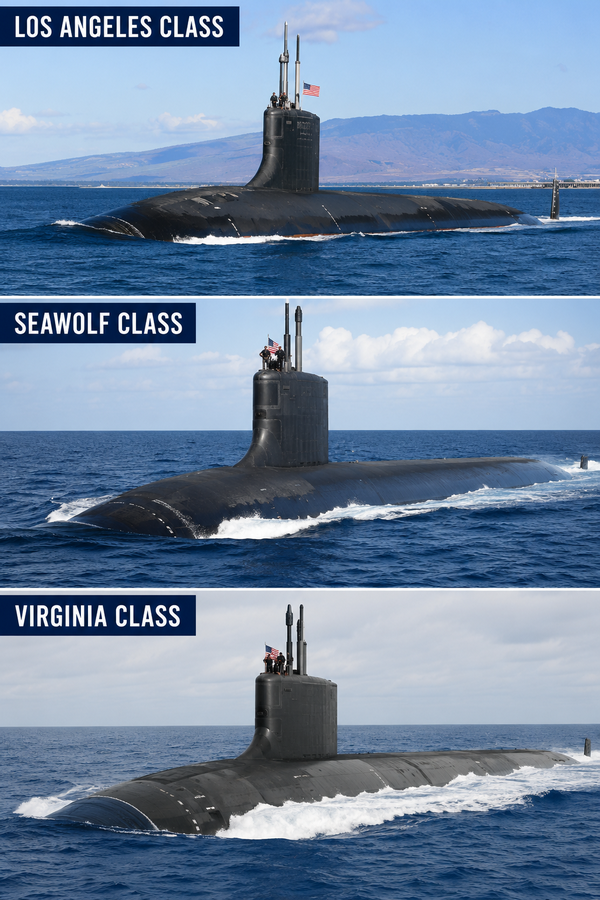
The United States possesses the most formidable submarine force in the world. Its nuclear-powered attack submarines are extraordinarily capable, combining stealth, endurance, sophisticated sensors, long-range guided weapons, and highly trained crews. In a major conflict with China, they would be among the most potent weapons available to the United States. Discussions of a Pacific war therefore routinely assign American submarines prominent roles in destroying Chinese surface ships, attacking logistics, enforcing blockades, conducting intelligence operations, and striking targets ashore.
There are good reasons for this confidence. But there is also a serious accounting problem. Military forces are commonly discussed in terms of inventories: numbers of attack submarines, aircraft carriers, bombers, fighters, destroyers, and missiles. These provide an indispensable starting point for assessing military power. But inventory is not combat power. A weapon can exist without being available, be available without being in position, or be in position without having the appropriate capability.
The distinction between nominal and deployable power becomes particularly important in a prolonged conventional war. A submarine deployed to the Western Pacific cannot simultaneously patrol the North Atlantic. One undergoing overhaul cannot be added to a Taiwan war order of battle merely because it appears in the Navy’s inventory. Torpedoes and cruise missiles expended in combat must be replaced. Damaged boats must be repaired. Crews, tenders, shipyards, weapons stocks, and transit times all become parts of the combat-power equation.
The relevant question is therefore not how many submarines the United States owns, but how much submarine combat power it can concentrate against a particular enemy, in a particular theater, for a particular period while continuing to perform other essential missions. Answering that question requires discounting the fleet from nominal inventory to realistic combat potential.
This exercise is not intended to show that American submarines are ineffective. Their exceptional capabilities make them an especially useful test case. If a weapon considered decisively superior cannot generate sufficient combat power to achieve its assigned strategic objectives, U.S. leaders may seriously misjudge their strategy in a confrontation with China.
The Impressive Silent Service
The U.S. Navy’s submarine force initially presents an intimidating picture. It includes ballistic-missile submarines carrying the sea-based component of the American nuclear deterrent, guided-missile submarines capable of delivering large salvos of conventional cruise missiles, and a substantial force of nuclear-powered attack submarines. The attack boats are the portion most directly relevant to naval warfare in a conflict with China.
U.S. Navy nuclear powered attack submarine classes – silent and deadly hunters
American SSNs possess attributes particularly well suited to a Pacific conflict. Nuclear propulsion gives them enormous cruising endurance. They can travel long distances without refueling, remain submerged for extended periods, and operate independently of vulnerable surface formations. Against a Chinese navy increasingly capable of contesting American surface and air operations near the Asian mainland, submarines offer something extraordinarily valuable: offensive combat power that does not depend upon nearby airfields or large surface ships surviving inside China’s missile envelope.
These advantages help explain why submarines feature so prominently in analyses of a Taiwan conflict. But the headline inventory encourages a subtle analytical mistake. Once a force is described as consisting of dozens of attack submarines, it becomes easy to imagine those boats as a reservoir of combat power available for whichever military problem is under examination. They are not.
The U.S. submarine force is a globally tasked military system rather than an arbitrarily deployable unitary fleet. At any moment, its boats are distributed among deployment, transit, training, maintenance, modernization, certification, repair, and other missions. Some are immediately useful to a Pacific commander. Others might become useful after weeks or months. Still others will remain unavailable regardless of the urgency of the conflict. The first capability discount therefore occurs before a shot is fired.
Inventory Is Not Availability
War plans cannot deploy submarines sitting in shipyards or undergoing repairs. The first discount to the American attack-submarine force is relatively easy to quantify because the maintenance problem is both substantial and well documented. In April 2026, the Congressional Budget Office reported that the Navy possessed 48 nuclear-powered attack submarines. But 33 percent of the force was undergoing or awaiting maintenance. CBO drew the operational consequence directly: with roughly one-third of the fleet unavailable for this reason, the Navy could at best deploy 32 SSNs.
This is not a temporary statistical anomaly. Navy data compiled by the Congressional Research Service show that maintenance has removed roughly one-third of the SSN force from operational readiness for much of the present decade. In FY2021, 18 of 49 SSNs were in depot maintenance or awaiting it, leaving 31 operationally ready. The corresponding figures were 33 of 49 in FY2022, 32 of 48 in FY2023, and 31 of 47 in FY2024. The unavailable share ranged from 33 to 37 percent.
The problem is serious enough that the Chief of Naval Operations’ 2024 Navigation Plan established a goal of reaching 80 percent operational availability for attack submarines by 2027. A 2026 Government Accountability Office review found that maintenance delays remain an important constraint on SSN availability. The four public naval shipyards perform nearly all maintenance on the Navy’s nuclear-powered submarines and aircraft carriers, creating competition for specialized facilities and personnel. SSN maintenance periods have also frequently exceeded their planned duration.
The age structure of the force adds another dimension to the maintenance problem. As of September 2026, the remaining Los Angeles-class boats average more than 33 years since commissioning, while the Virginia class averages only about ten. Nearly the entire surviving Los Angeles cohort has reached or passed 30 years of service. Age does not by itself determine combat readiness, and its effects should not be counted again as a separate percentage discount where they are already reflected in maintenance availability. But the concentration of older boats creates a block-aging problem: maintenance and retirement pressures are not distributed evenly across the nominal SSN inventory.
For our purposes, the operational consequence matters more than the causes. CBO’s April 2026 snapshot provides a particularly useful starting point because it translates nominal inventory directly into deployable strength. Before considering geography, competing missions, deployment cycles, weapons expenditure, battle damage, or enemy action, maintenance reduces 48 nominal attack submarines to a ceiling of approximately 32 potentially deployable boats. First discount: 48 SSNs → approximately 32 potentially deployable SSNs.
Even this figure is generous. “Potentially deployable” does not mean deployed, immediately deployable, or available for a war with China. Those are separate discounts. At this stage, the important point is narrower: maintenance removes approximately one-third of the nominal SSN force before the requirements of a particular war have even been considered.
Deployable Is Not Deployed
Our first discount reduced the nominal force of 48 attack submarines to approximately 32 potentially deployable boats. But “potentially deployable” is still a long way from “available for combat.” Submarines move through a force-generation cycle that alternates deployment with training, certification, intermediate maintenance, and crew recovery.
The Government Accountability Office recently provided a useful description of this cycle for 44 Los Angeles- and Virginia-class attack submarines. GAO describes an 18-month operational cycle consisting of approximately 12 months of training and intermediate maintenance followed by a six-month deployment. A 30-day post-deployment stand-down extends the interval between complete cycles to approximately 19 months. The three Seawolf-class submarines have different mission characteristics and were excluded from GAO’s standard force-generation analysis.
For the submarines governed by this cycle, six deployed months out of approximately 19 represents roughly 32 percent of the complete cycle. Applied as a simple steady-state model to our maintenance-available force of 32 submarines, this produces approximately ten deployed SSNs at any particular time. Actual operations are less tidy. Schedules overlap, deployments can be extended, and crises produce surges. A major war with China would unquestionably cause the Navy to put more submarines to sea. But a surge is a loan from future readiness.
Boats approaching deployment can be sent early, existing deployments extended, training compressed, and maintenance deferred. None of these measures abolishes the underlying requirements. Crews eventually require recovery, deferred maintenance must eventually be performed, and submarines rushed through the force-generation process must later be regenerated. A short war can consume readiness accumulated during peacetime. A prolonged war must reproduce the readiness it consumes.
The relevant measure for sustained conventional warfare is therefore not the maximum number of submarines that could be rushed toward China during the opening phase. It is the force the Navy can repeatedly cycle through combat operations.
Applying the standard deployment ratio to the maintenance-available force produces a rough steady-state output of approximately ten deployed SSNs worldwide. This should not be mistaken for a prediction that only ten American attack submarines would be at sea during a war with China. It is a force-generation baseline rather than a wartime ceiling. The calculation is necessarily approximate because GAO’s standard cycle applies to the Los Angeles- and Virginia-class force and excludes the differently employed Seawolf class. Second discount: approximately 32 potentially deployable SSNs → roughly 10 normally deployed SSNs worldwide.
Those ten are not ten submarines available for China. They are the sustainable output of a globally tasked submarine force. The next question is how much of that output can realistically be allocated to a Western Pacific war.
The Missions Allocation Challenge
Our first two discounts have taken the U.S. attack-submarine force to a steady-state output of roughly ten deployed SSNs worldwide. The temptation is now to move those ten boats onto a map of the Western Pacific and calculate what they could do to the Chinese fleet. That would not be advisable.
The United States operates a global navy. Its attack submarines are not a strategic reserve whose entire purpose is to fight China. The Navy assigns SSNs a broad portfolio of missions: anti-submarine and anti-surface warfare, land attack, intelligence, surveillance and reconnaissance, special operations, mine warfare, and battle-group support. Submarines also perform intelligence missions supporting national rather than exclusively naval requirements.
A war with China would cause these missions to be reprioritized aggressively, but it would not make competing requirements disappear. Russian ballistic-missile and attack submarines would still require monitoring. Intelligence requirements would multiply during a major-power conflict. Other naval formations could continue to require undersea support. U.S. leaders would also have to consider the possibility that a conflict initially confined to China might widen.
This exposes a common weakness in military force comparisons: asset double counting. One strategic argument counts the submarine force against China. Another counts essentially the same submarines against Russia. Others invoke them for carrier protection, intelligence, land attack, or hunting ballistic-missile submarines.
Each claim may be individually plausible. Collectively they are impossible. The same submarine cannot simultaneously hunt Chinese surface ships near Taiwan, monitor Russian submarine activity elsewhere, collect intelligence in another operating area, and protect a carrier strike group thousands of miles away. Assigning a platform to one mission incurs an opportunity cost in every mission it is no longer performing.
Capability can be double counted as well. Submarines belonging to the same nominal category are not equally useful for every task. Geography, weapons loadout, sensors, communications requirements, and tactical circumstances all affect their utility. A boat capable in principle of performing several missions cannot necessarily perform them simultaneously or with equal effectiveness.
Some portion of the deployed SSN force must therefore remain available for requirements other than the principal Chinese battle area. The exact number cannot be determined from public information. A war with China would undoubtedly cause Washington to redirect submarines aggressively toward the Pacific. Missions could be curtailed and risks accepted elsewhere. But those requirements do not disappear. They become strategic risks.
That tradeoff becomes more important in a prolonged war. A short crisis encourages concentration. A long war gives adversaries time to exploit whatever has been left uncovered. This yields a broader principle for assessing military power: a military force should be evaluated against a particular objective only to the extent that it can realistically be allocated to that objective after operational constraints are recognized.
The next discount is geographic. Even after Washington decides which submarines it is willing to commit, those boats must reach their operating areas and generate useful combat time thousands of miles from much of the American support infrastructure.
The Tyranny of Distance
Nuclear propulsion gives American attack submarines extraordinary range, but range should not be confused with presence. A submarine capable of traveling thousands of miles without refueling still has to spend time traveling those miles. This matters because much of the U.S. submarine force is based far from the principal operating areas of a war with China. Guam provides the closest major American submarine base, approximately 1,500 nautical miles from Taiwan. Pearl Harbor is roughly 4,500 nautical miles from Taiwan, while submarines departing San Diego face a journey of approximately 6,500 nautical miles. Atlantic-based boats face still longer transits. The scale of the resulting transit problem is illustrated by the following map, which shows the distance an SSN would cover from Guam in one-day increments at an illustrative cruising speed of 20 knots:
The relevant resource is therefore not simply submarines but combat-submarine time: the portion of submarine availability actually spent performing useful combat missions in the theater. A submarine spending two weeks crossing the Pacific is unavailable for other missions during that period but is not yet generating combat power against China.
Forward deployment mitigates the problem. Guam has become increasingly important to American undersea operations, and by July 2026 four attack submarines were forward deployed there, including USS Minnesota, the first Virginia-class submarine permanently assigned to Guam. Those boats would be exceptionally valuable during the opening phase of a conflict because they could reach Western Pacific operating areas much faster than submarines based in Hawaii or on the continental United States.
But four forward-deployed submarines do not eliminate the geography of a prolonged war. Additional boats would still have to arrive from distant bases, while submarines leaving the combat area for maintenance, repair, or weapons replenishment would surrender combat-submarine time during both outbound and return transit.
The distinction between opening strength and sustainable strength is crucial. In the opening days of a conflict, Washington could concentrate submarines already deployed in the Pacific, accelerate departures by boats approaching deployment, and redirect other SSNs toward the theater. The resulting force could temporarily exceed normal peacetime deployment levels. But sustaining that concentration would require a continuing flow of replacement boats as others exhausted weapons, developed maintenance problems, or completed extended deployments.
Distance therefore operates as a recurring tax rather than a one-time mobilization cost. Consider a submarine that must leave the operating area and return to Guam. At an illustrative 20 knots, a round trip between the vicinity of Taiwan and Guam alone consumes approximately six days before weapons loading, maintenance, crew requirements, or delays are considered. A boat returning to Hawaii or the continental United States would surrender substantially more combat time.
This is why nuclear endurance can be misleading in strategic force comparisons. The reactor may permit a submarine to remain at sea for months, but the submarine still operates within a larger system governed by geography, weapons, maintenance, and logistics. The useful question is not simply how long an SSN can remain submerged, but what fraction of its available time can be converted into combat effects where those effects are required.
The precise geographic discount will vary enormously with basing, mission assignment, operating area, and the course of the war. It should therefore not be assigned a single empirical percentage. But it cannot reasonably be assigned a value of zero. Distance does not prevent American submarines from fighting China. It reduces the rate at which the submarine force can generate and regenerate combat power against China. That distinction becomes still more important once submarines begin firing weapons. Nuclear reactors may provide extraordinary propulsion endurance. Torpedo rooms and missile magazines do not.
The Magazine Depth Limitation
Nuclear propulsion creates an unusual characteristic of American attack submarines: their propulsion endurance greatly exceeds their weapons endurance. An SSN can remain at sea for months, but it cannot fight indefinitely without replenishing its finite magazine.
The distinction matters particularly in a naval campaign. Virginia-class submarines have four 21-inch torpedo tubes, and published estimates indicate a typical load of roughly 20–26 Mk 48 heavyweight torpedoes. Other weapons or payloads carried in the torpedo room can compete for that space. Virginia-class boats also carry Tomahawk cruise missiles in vertical payload tubes, with substantially greater missile capacity on Virginia Payload Module-equipped submarines. But vertical-launch capacity does not increase the number of Mk 48 torpedoes available for anti-submarine and anti-surface warfare.
Twenty or more heavyweight torpedoes constitute formidable firepower, but they are not an unlimited magazine. Actual expenditure would depend upon targets, firing doctrine, engagement conditions, weapon reliability, and the need to retain weapons for self-defense and subsequent engagements. Some targets might require multiple shots. Some weapons might miss or fail to achieve the desired result. A submarine commander would also be unlikely to expend every available torpedo before withdrawing.
The relevant constraint is therefore not simply how many weapons a submarine carries, but how rapidly combat operations consume them. A high-intensity campaign that makes submarines exceptionally effective could also make their magazines the limiting factor in sustained operations.
Once a submarine requires additional torpedoes, nuclear endurance no longer solves the problem. Under current practice, Mk 48 replenishment requires the submarine to withdraw from patrol to a suitable pier or submarine tender where weapons can be loaded. Combat power then depends upon three assets being brought together: the submarine, replacement weapons, and a facility capable of transferring them.
Transfer of MK 48 torpedo to docked submarine
Geography again becomes consequential. Guam is approximately 1,500 nautical miles from Taiwan. At an illustrative 20-knot transit speed, a submarine leaving the vicinity of Taiwan for Guam and returning would spend roughly six days in transit alone. Weapons loading, maintenance, operational preparation, and any delays would extend the interruption. Rearming farther from the theater would impose a still larger penalty.
This converts weapons expenditure into a force-generation problem. A submarine that fires its weapons successfully has not merely reduced the enemy fleet; it may also have begun a countdown toward its own temporary removal from combat. Sustaining submarine pressure therefore requires enough boats to replace those withdrawing for rearmament while others transit back toward the theater.
Rearmament also exposes a vulnerability that the submarine’s celebrated stealth cannot eliminate. At sea, an SSN is extraordinarily difficult to locate and attack. Its support architecture is much less elusive. Guam, submarine tenders, ammunition facilities, piers, maintenance installations, and weapons stockpiles are identifiable assets. Guam itself lies within range of Chinese conventional missile systems.
The enemy therefore does not have to sink an SSN to reduce SSN combat power. Attacking or disrupting the system that rearms and regenerates submarines can produce a similar operational effect by increasing turnaround time and reducing combat-submarine time. The submarine may hide beneath the ocean. Its logistical system cannot.
This creates another discount between the number of submarines theoretically available and the combat power they can sustain. As with geography and mission allocation, the magnitude cannot be predicted precisely. It depends upon weapons expenditure, target availability, tactical success, logistics capacity, and enemy attacks on supporting infrastructure. But again, uncertainty does not justify assigning the discount a value of zero.
Military inventories are stocks. War is a flow problem. The sustainable combat power of the submarine force depends not merely upon how many boats and weapons exist, but upon how rapidly armed submarines can be returned to combat after their magazines are depleted. And even this assumes that every submarine eventually returns.
Attrition and the Replacement Problem
Everything calculated so far assumes that submarines temporarily removed from combat eventually return. A prolonged war introduces a harsher possibility: some will not. American attack submarines are extraordinarily capable and difficult to detect. They would probably be among the most survivable major U.S. combat platforms in a war with China. But survivable does not mean invulnerable. Chinese anti-submarine warfare includes surface ships, submarines, maritime patrol aircraft, helicopters, fixed and deployable sensors, and other surveillance systems. The effectiveness of this capability against modern American SSNs is uncertain and much of the relevant evidence is classified.
We cannot responsibly estimate a predicted submarine attrition rate. But we do not need one to identify the structural problem. Any SSN lost in combat would be removed from the force for a period longer than the likely duration of the war. The United States cannot replace nuclear-powered attack submarines on a wartime timescale. In April 2026, the Congressional Budget Office reported that Virginia-class production had averaged only about 1.1 submarines per year over the preceding two years, well below the Navy’s desired rate of two per year. CBO also reported that it now takes about a decade to build a new submarine. The Navy is simultaneously constructing the Columbia-class ballistic-missile submarine, a program with the highest shipbuilding priority and one that draws upon much of the same specialized nuclear-submarine industrial base.
This makes submarine attrition fundamentally different from weapons expenditure or scheduled maintenance. A torpedo can eventually be replaced. A submarine undergoing maintenance can eventually return to service. A submarine sunk in combat disappears from the available force for the strategic duration of the conflict. Even a low loss rate can therefore become significant in a prolonged war. If the sustainable combat force in the principal theater numbers in the single digits rather than dozens, the loss of one submarine is no longer a small percentage of a 48-boat inventory. It is a substantial fraction of the force actually generating combat effects at that moment.
The asymmetry becomes more important over time. China would also suffer losses, including ships, submarines, aircraft, sensors, and shore infrastructure. The relevant comparison, however, is not simply which side loses more platforms. It is whether each side can regenerate the particular combat capabilities being consumed. A continental power fighting near its industrial base operates under a different replacement and repair problem from an expeditionary naval force whose most valuable platforms require roughly a decade to construct.
None of this means that China could readily find and destroy American attack submarines. That is not the argument. The point is that U.S. submarine losses, if they occur, are essentially irreversible within the relevant wartime horizon. Attrition therefore acts as a ratchet: maintenance losses can return, transit losses of combat time can be recovered, and magazines can be replenished, but a sunk SSN does not regenerate. The submarine force can surge. It can rotate. It can rearm. It cannot regenerate lost submarines.
The adverse scenario developed below does not assume any combat attrition at all. Nor does it assume successful Chinese attacks that substantially disable Guam or other major submarine-support facilities. Those potentially severe effects are left outside the numerical model because assigning percentages to them would create false precision. The resulting adverse estimate should therefore not be interpreted as a worst case. It is a deliberately bounded case in which the submarine force suffers no combat losses and its principal support system remains substantially intact. With those boundaries established, we can assemble the discounts and ask what the nominal 48-submarine inventory may actually represent as sustainable combat power.
Discounting the U.S. Attack Submarine Force
We can combine the constraints described thus far into an illustrative estimate of sustainable submarine combat power in a prolonged conventional war with China. The exercise is not intended to predict exactly how many American attack submarines would be fighting near China on a particular day. Wartime deployments would fluctuate, surges would occur, missions would change, and operational decisions unavailable to the public would affect the result. The purpose is instead to distinguish nominal inventory from sustainable combat power.
The first two discounts have relatively firm empirical foundations. In April 2026, CBO counted 48 SSNs and reported that 33 percent were undergoing or awaiting maintenance, leaving at best 32 deployable. GAO’s force-generation model describes a notional six-month deployment within an approximately 19-month interval between complete operational cycles. Applying that ratio to the maintenance-available force produces roughly ten normally deployed SSNs worldwide. Beyond that point, public data do not permit comparable precision. We therefore use two explicitly illustrative cases.
The favorable case assumes that maintenance performance does not deteriorate under wartime pressure, the normal force-generation cycle can be sustained, 80 percent of deployed SSN capacity can be concentrated against China, geography consumes only 5 percent of the resulting combat capacity, and weapons expenditure and rearmament impose only a further 10 percent penalty.
The adverse case is deliberately restrained. It assumes a 10 percent deterioration in maintenance/readiness beyond the existing maintenance discount, a further 10 percent degradation in force-generation efficiency, only 60 percent of deployed SSN capacity available for the principal China theater after competing missions are considered, a 20 percent geographic penalty, and a 30 percent rearmament and regeneration penalty. Crucially, the adverse case assumes zero combat losses and no major disruption of Guam or other forward-based submarine-support infrastructure. It is therefore not a worst-case estimate.
The table arithmetic shown should not be mistaken for measurement precision that the underlying evidence cannot support. The maintenance figure comes from CBO, and the force-generation ratio is derived from GAO’s notional operational cycle. The subsequent mission, geography, and regeneration percentages are analytical assumptions designed to expose the magnitude of constraints that conventional inventory comparisons frequently omit. They are not Navy estimates.
Nor should the later discounts be understood as perfectly independent variables. Geography affects rearmament time; mission allocation affects where submarines are positioned; maintenance and operational tempo interact. Multiplying the discounts is therefore an illustrative accounting model rather than a claim that each factor can be isolated statistically from the others.
What matters is the scale of the result. Starting with the nominal U.S. attack submarine inventory does not produce anything resembling 48 submarines continuously available for a Western Pacific campaign. The empirically grounded maintenance and deployment-cycle discounts alone reduce the force to roughly ten normally deployed boats worldwide. Once competing missions, geography, and regeneration are recognized, a sustainable theater force in the high single digits becomes entirely plausible. Under favorable assumptions, the model produces approximately seven SSN-equivalents of sustainable combat power against China. Under the adverse assumptions, it produces approximately three.
The term SSN-equivalent is important. These numbers should not be read as predictions that precisely seven or three physical submarines will occupy a particular patrol area. They represent the approximate combat power generated after accounting for the fraction of the nominal force lost to maintenance, force generation, other missions, transit, and regeneration. At any particular moment, the physical number of submarines in theater could be higher or lower.
The adverse case is especially revealing because it does not require catastrophic assumptions. No American submarine is sunk. Guam remains usable. The submarine logistical base suffers no wartime disruption. The model merely assumes that existing readiness problems worsen modestly, competing missions continue, geography matters, and submarines must periodically withdraw to regenerate combat capability.
This is the central accounting problem. Military inventories are stocks. War is a flow problem. The strategic value of the submarine force depends upon the rate at which armed, maintained, properly positioned submarines can be delivered to the fight and returned to it after their combat capacity has been consumed. War is not fought with inventories. It is fought with flows of usable combat power.
Conclusion
The United States possesses the world’s most capable nuclear-powered attack-submarine force. Its boats are quiet, heavily armed, professionally operated, and exceptionally difficult to find. In a war with China they could inflict severe losses on Chinese naval forces. None of that answers the question posed by this article. The strategically relevant question is not whether an American SSN can sink Chinese ships. It is how much submarine combat power the United States can sustainably generate against China during a prolonged conventional war. That requires a different kind of accounting.
In April 2026, CBO counted 48 American attack submarines. Maintenance immediately reduced that force to at most 32 potentially deployable boats. Applying GAO’s notional force-generation cycle reduces the steady-state output to roughly ten normally deployed SSNs worldwide. Those submarines must then be divided among competing missions, moved across enormous distances, supplied with finite weapons, withdrawn periodically for rearmament and maintenance, and supported by a vulnerable logistical infrastructure.
Our illustrative model consequently produces a sustainable combat force of roughly seven SSN-equivalents under favorable assumptions and roughly three under adverse assumptions. The adverse case is not a worst case. It assumes that no American submarine is sunk and that China does not substantially disable Guam or other critical submarine-support facilities. It merely assumes modest deterioration in readiness and force generation, continued competing missions, significant geographic friction, and a greater regeneration burden.
These estimates are not predictions. The actual number of submarines available in a particular phase of a war would fluctuate, perhaps dramatically. The United States could surge submarines toward the Western Pacific at the beginning of a conflict and could temporarily generate considerably more combat power than the steady-state model suggests. But a surge is a loan from future readiness. Extended deployments, deferred maintenance, accelerated training, and concentrated force allocation can increase combat power today by consuming resources that would otherwise generate combat power tomorrow. The longer the war continues, the more difficult it becomes to conceal the underlying arithmetic.
This distinction between inventory and sustainable combat power is not peculiar to submarines. Recent U.S. combat operations against Iran have provided another demonstration of the same principle. Carrier forces can be shifted between theaters, deployments can be extended, tanker and logistics support can sustain distant operations, and large quantities of defensive and offensive munitions can be expended. But these measures consume readiness elsewhere. Ships and aircraft accumulate maintenance requirements, crews remain deployed longer, munitions inventories decline, and forces reassigned to one theater become unavailable in another.
Military power is therefore not simply additive. A carrier moved from the Pacific to the Middle East has not increased American naval power; it has reallocated it. A submarine assigned to hunt Chinese warships cannot simultaneously monitor Russian submarines. A boat transiting from Hawaii is part of the inventory but is not yet generating combat effects near China. An SSN returning to Guam for weapons is still operational but temporarily absent from the fight. A submarine lost in combat remains on the Navy’s historical rolls but cannot be regenerated on a wartime timescale.
This is why nominal force comparisons can be so misleading. They invite analysts to place entire inventories opposite one another as though every platform were simultaneously ready, appropriately armed, geographically positioned, logistically supported, and free of competing commitments. They are not. The error becomes particularly consequential when evaluating a geographically distant great-power war. China would fight close to its principal bases, industrial infrastructure, missile forces, airfields, and repair facilities. The United States would project much of its combat power across the Pacific while simultaneously maintaining global commitments. American submarines partially overcome that disadvantage through nuclear endurance and stealth, but they do not abolish geography or logistics.
Nor does extraordinary tactical capability eliminate the problem of scale. A handful of SSNs might destroy a disproportionate number of Chinese ships. That would make them extremely valuable weapons. It would not necessarily make them sufficient to determine the outcome of a prolonged war involving hundreds of naval vessels, thousands of aircraft and missiles, extensive land-based forces, space and cyber systems, and enormous industrial resources.
Tactical lethality does not guarantee strategic sufficiency.The distinction is especially important because the attack-submarine force is difficult to regenerate. Weapons can be manufactured. Damaged facilities can sometimes be repaired. Deployment schedules can be changed. But a Virginia-class submarine now takes about a decade to build. An SSN sunk during a major war is effectively removed for the duration of that war. The submarine force can surge. It can rotate. It can rearm. It cannot regenerate lost submarines.
None of this establishes that American submarines would fail against China. They could prove devastatingly effective. Chinese anti-submarine warfare could perform poorly. American commanders could achieve favorable exchange ratios. Chinese naval operations could collapse under sustained undersea attack. But the opposite strategic outcome is also possible: a force of extraordinarily capable submarines could destroy many targets yet remain too small, too geographically constrained, or too difficult to regenerate to determine the outcome of the larger conflict. In that circumstance, the submarines would remain tactically formidable while becoming stategically negligible as the war continued.
The United States may possess 48 attack submarines on paper, but maintenance estimates alone reduce the available number to 32. The normal force generation cycle further reduces the steady-state deployed force to roughly ten worldwide. Once competing missions, geography, and regeneration are recognized, sustainable combat power against China plausibly falls into the high single digits—and under adverse but far from catastrophic assumptions, perhaps considerably lower. A single-digit submarine force may still be potent, but the Pacific is a very large battlespace contested by a formidable adversary.
The question remains whether American submarines could defeat the Chinese fleet. An optimistic answer depends on whether enough American submarines can reach the fight, remain in the fight, rearm, regenerate, and return to the fight to contribute decisively to victory. These silent assumptions about the Navy’s silent service should be critically questioned.
