


[Today’s Iran war post launched more or less complete but your humble blogger had to go out. If there are any updates, they will go live by 9:00 AM EDT so please check comments or refresh the page then]
The US has again bitch-slapped Iran during negotiations, this with a new set of strikes near Bandar Abbas, to which the IRGC has ritually responded. Note that Iran has promised a much more damaging response to the attacks Tuesday and the one yesterday. We speculated that may come after the Hajj ends, on May 30. In the meantime, US military experts continue to warn that they expect the US and Israel to resume a full-bore campaign soon. Consistent with that, Israel has ordered all in Southern Lebanon to leave and is executing Gaza-level destruction. Iran has demanded that the cessation of hostilities includes Israel’s operations in Lebanon, so the intensified Zionist war crimes alone make a settlement impossible.
And to add to our list of why there will be no “deal”: It is not just that the US is negotiation and agreement incapable. It is also that Trump has gutted historical national security procedures to the degree that (except so far for deploying nukes), he has become the decider. Trump is too volatile to commit to anything.
Trump also held a cabinet meeting, and in a press conference afterwards, melted down over a list of negotiation terms presented by Iran state broadcaster IRIB that, at least according to what I saw at the time on Twitter, had been presented as where things stood. I did not bother attempting to run down exactly what the Iran source had said because this was clearly false. Some commentators were quick to flag the list as an Iran “ask”. In the same discussion, he also threatened to bomb Oman.1
For the sake of completeness, below is a recap of the outline that generated the latest Trump hissy. I had seen an outline similar to this which many on Twitter were then treating as a bona fide outline of where the negotiations stood. It was obviously a list of Iran positions, some of which would be clearly unacceptable to the US, in particular the highlighted $300 billion+ of reparations.
Iran Demanding $300 BILLION from the U.S.
Iran’s Sate Media, IRIB has updated the terms they say is part of the U.S. and Iran negotiations. The White House has claimed these terms are fake and Trump is even saying No Sanction and No Money for Iran.
Take this all with a grain of… https://t.co/l3xwNPLihe pic.twitter.com/4AGBnvR6kz
— Ryan Rozbiani (@RyanRozbiani) May 27, 2026
The Janta Ka segment below shows clips of Trump rejecting key rumored concessions to Iran, such as releasing frozen assets and lifting sanctions:
I have to take issue with Professor Marandi stating in the same segment in effect saying that what Trump said was not true, that the US had offered many concessions in private.2 This suggests that either the negotiators think they can “deliver” the fabulously mercurial Trump or that the negotiations are yet another deception. Normally, one might think that the epic flip-flopper Trump could simply reverse himself and come up with a “great deal” handwave. But Trump has been very consistent in his demonization of Iran, particularly in depicting them as untrustworthy. To put it more simply, Trump has gone so far out on a limb on the topic of Iran that he can’t crawl back much if at all. And the Zionists would eat him alive if he tried.
For instance, Trump has been consistent in demanding that Iran not ever build a nuclear bomb, which is an obvious pretext for coming back in a year in the sort of “mowing the lawn” strikes. Iran fully intends to prevent them for a much much longer period via imposing a humiliating defeat upon the Great Satan. Recall that mere thought crimes plus conventional missiles are sufficient; in Congressional hearings, Hegseth fell in with the Trump line that Iran’s nuclear weapons capability had been “obliterated” but that Iran was still a danger because it still had “ambitions”:
This is humiliating
Pete Hegseth says Iran’s nuclear facilities were “obliterated” last year and this war is about “ambitions.”
You don’t start a war over an “imminent danger” then redefine it as hypothetical after the fact. pic.twitter.com/vk9hrQasdc
— ADAM (@adamemedia1) April 29, 2026
As we have pointed out, the Anglosphere media has had a marked tendency to focus on positive-seeming developments out of the “negotiations”. So the cautionary tone of a new article in The Hill, Trump’s Iran remarks fail to lift fog of uncertainty over talks, is a departure. From its text:
President Trump spoke at length about Iran during a Cabinet meeting Wednesday — but the upshot was anything but clear…
A third major element of uncertainty is Israel, which continues to strike Lebanon. Reuters reported that Israel hit its northern neighbor with more than 120 airstrikes Tuesday. Iranian negotiators are adamant that any deal to end the war must also encompass the situation in Lebanon. It’s far from sure that Trump, or Israeli Prime Minister Benjamin Netanyahu, will agree.
The most headline-making thing Trump said on the Iran question Wednesday related to American domestic politics. Even then, it was somewhat opaque.
Near the start of the Cabinet meeting, he contended that the leaders of the Islamic Republic “thought they were going to out-wait me, you know. ‘We’ll out-wait him. He’s got the midterms.’ I don’t care about the midterms,” the president insisted.6
And in a fresh talk with Jim Webb, Larry Wilkerson explains that Trump has gutted the old national security decision-making apparatus to put himself (or perhaps Netanyahu through Trump3) in charge:
From Wilkerson in a lightly cleaned-up machine transcript:
The discipline, the the procedures, the statutory process, decision-making process, it is statutory. It was made statutory post World War II because the Congress was too sick and tired of Franklin Delan Roosevelt. I mean, you know, I’m not saying that in a derisive way.
Roosevelt was an eternal president, if you will. And he made most of his decisions inside his coat. He didn’t tell anybody about them. He didn’t broadcast them. They just got executed.
And very few people knew what he was going to do and when he was going to do it. It worked for him because he was a fairly brilliant man and he knew how to work the system…..
Trump doesn’t use a system at all.
There is no system with Trump. The the secretary of state is not a secretary of state. The secretary of state is not the national security adviser. It’s really crude how they make decisions. And the best way I can describe it from what I have learned from the inside is Trump makes the decisions. With this latest one, this horrible war of choice that we’re waging with Iran, I think BB Netanyahu was the principal adviser to him as the New York Times article pointed out. I think that’s true. He was. So this is a real bastardization, if even that’s the right term, of what the national security process, decision-making process ought to be.
Former Lieutenant Colonel Karen Kwaitkowski, in a new talk with Lena Petrova, not only reiterated her view that the US and Israel will soon make large strikes on Iran, but added that she and other military-connected experts think the timing is to start after this weekend, to run two to three weeks.
From a lightly cleaned-up machine transcript:
I’m sure that there’s blackmail involved here.
Trump is not a perfect person by no means. I mean. You know, the Democrats are just insanely crazed about him because he’s such a rotten person, has a bad track record, but it is true. He has done things that he’s ashamed of and he doesn’t want to come out. He’s concerned about his legacy and Israel owns that legacy in their palm of their hand. So when Trump speaks to Israel, then he realizes, well, they’re not going to let me leave. They’re not going to let me leave. So I guess there’s no peace. We’ll stay.
And I think what Trump is going to do, and other people have said this, but I predict it, too, because I have I have a bad feeling. He’s going to wait till the Hajj is over, which will be Saturday. I think that most of the Hajj travelers will be returning home and be out of Saudi Arabia. And there’s two weeks left before the FIFA World Cup starts.
And I think he’s going to blast everything that he thinks he can do at whatever targets he wants to do. And he’ll probably hit infrastructure targets. And of course, Iran will react and you will have water purification hit. You’ll have a lot of damage done.
And then when Trump runs out of weapons, it’ll probably be 3 days just like he thought the first time. Then he will say, “Oh, they’ve called us and they’ve begged us to stop and we’re going to have the deal.”
I do not see how there can be a “deal” even then. The constraint of Zionists and their evangelical Christian allies having undue sway over Trump and Congress will still be operative. Perhaps Trump will pronounce the US as having won, storm off the stage, and offer not much further support to Israel because we lack the means.
In his latest update, Larry Johnson describes how the two sides remain completely at odds on fundamental issues:
Today at a Cabinet meeting, President Trump asserted that Iran is “negotiating on fumes”…
He said that after opening the Cabinet meeting with the claim that a deal is near. Over the weekend, he had declared that his administration and Tehran had “largely negotiated” a settlement, but the negotiations remain in flux. Which is it? Flux, fumes or largely negotiated?…
The key area emanating fumes is the Strait of Hormuz… Trump said: “We’re going to watch over it. We’ll watch over it, but nobody’s going to control it. That’s part of the negotiation that we have.” Iran disagrees, with Iranian officials continuing to insist that management of the strait has nothing to do with the US and would be coordinated with Oman. Oh yeah, almost forgot, Trump also threatened to bomb Oman if it goes along with Iran in controlling traffic passing through the Strait of Hormuz.
As for the broader deal taking shape, under the potential agreement, Trump insisted that Tehran would agree to give up its stockpile of highly enriched uranium — a key Trump demand — in return for sanctions relief, according to two regional officials and one senior Trump administration official. That completely contradicts Iran’s firm position that the enrichment of uranium will not be discussed until the issues of sanction relief, unfreezing Iranian assets and an end to the war against the Palestinians are settled.
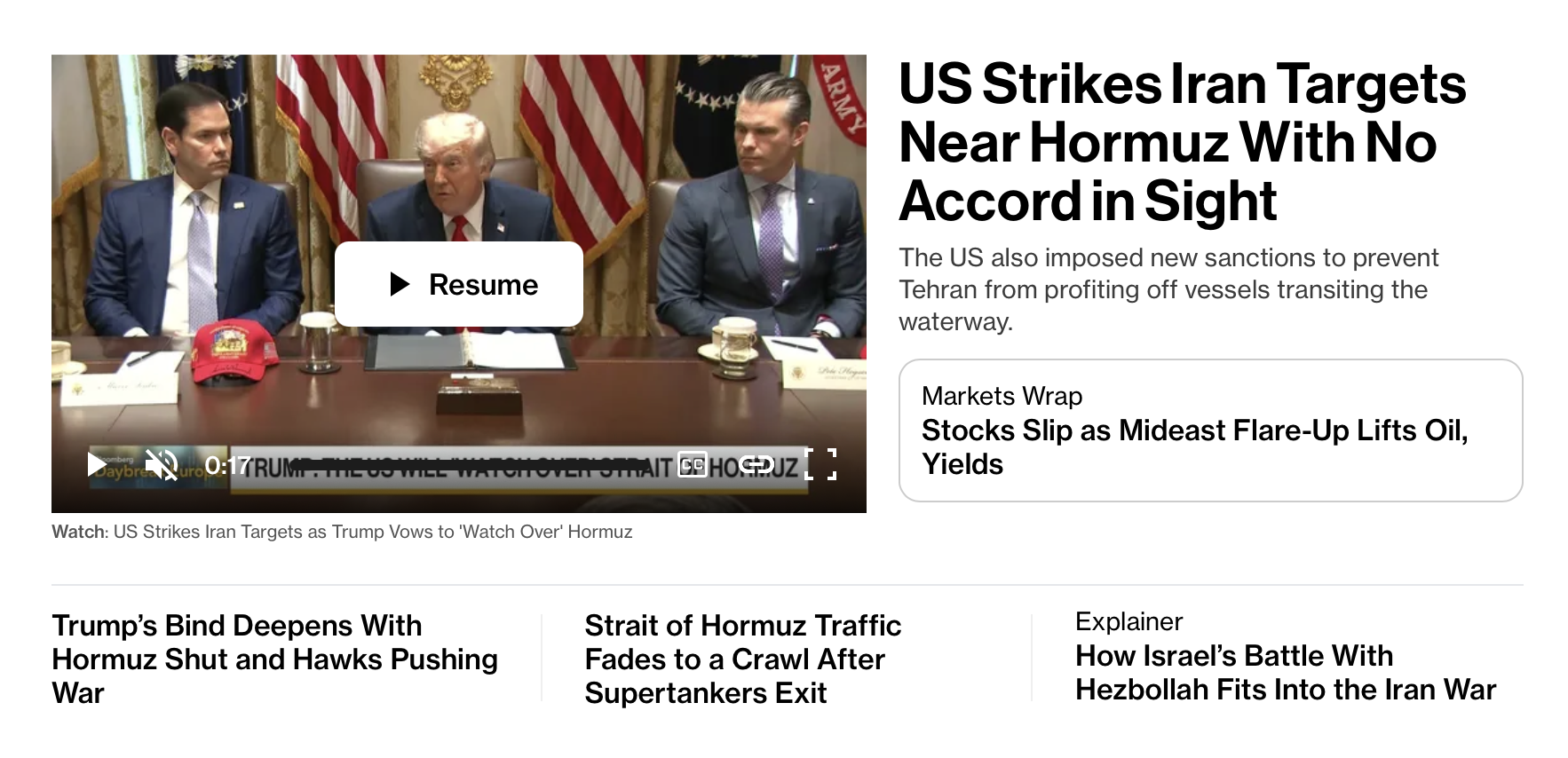
Bloomberg’s landing page is also taking a sober view, but oil prices are still tame compared to where they were when Trump launched his latest “Peace is just around the corner!” campaign:
A bit belatedly, to the kinetic action, starting with the fresh US attack. From Aljazeera’s live feed:
The United States has carried out new strikes on an Iranian military site allegedly posing a threat to US forces and maritime traffic in the Strait of Hormuz, according to news reports.
Iranian media have reported that US forces struck near the Bandar Abbas port, causing no damage or casualties.
BREAKING:
Reuters writes that a senior U.S. official told them the U.S. struck targets in Iran tonight
A military site near Bandar Abbas which threatened U.S. forces and commercial shipping was hit near Bandar Abbas. Iran launched drones at U.S. forces but they were shot down. https://t.co/KgyragKedB
— Visegrád 24 (@visegrad24) May 27, 2026
Megatron later depicted the fresh attack as performative:
BREAKING:
🇺🇸🇮🇷🇰🇼 The Classhes between the US and Iran continue
An American oil tanker attempted to transit the Strait of Hormuz with its radar system turned off earlier tonight but was forced to stop and turn back after warning shots from the IRGC Navy, last night
The U.S.… pic.twitter.com/GA0fC5CwqQ
— Megatron (@Megatron_ron) May 28, 2026
Note Iran has retaliated against the day-prior dustup. From Al Mayadeen in IRGC targets US military base in response to attack on Bandar Abbas:
Iran’s Islamic Revolution Guard Corps (IRGC) issued a stern warning on Thursday following a US military violation and aggression near the Bandar Abbas Airport, stressing that any further aggression “will not go unanswered.”
In a statement released by its public relations office, the IRGC said the US military launched aerial projectiles at a location on the outskirts of Bandar Abbas before dawn. It added that Iran responded by targeting the US air base from which the attack originated at approximately 4:50 am.
The operation comes as a “serious warning,” the IRGC said, adding that the response was intended to demonstrate that any aggression against Iran would be met with retaliation, warning that any repeat attack would provoke “a more decisive response.”…
At the same time, the Kuwaiti military confirmed that “air defense systems are confronting missile and drone attacks.”
Note that the retaliation came very fast but was intended to be at the tit for tat level. That also implies Iran was able to make a pretty speedy damage assessment.
On the economic front, the Administration has sanctioned the Persian Gulf Authority, which will only tighten the tourniquet on Strait of Hormuz traffic. From the Aljazeera live feed briefly describes the Administration sanctions on the new Persian Gulf Authority:
US sanctions on Iran’s strait authority a dilemma for vessels crossing Hormuz
The US has now put sanctions on Iran’s newly founded Persian Gulf Strait Authority.
The authority has been tasked with coordinating a new maritime regime in and around the Strait of Hormuz.
It is responsible for designating the lanes that vessels can pass through.
According to its rules, vessels have to inform the IRGC about their origin, cargo and final destination. It also planned to collect some type of fee, whether a toll or an environmental protection fee, via cryptocurrency.
The US sanctions are, of course, not only going to create a problem for Iran but also for vessels aiming to pass through the strait.
If they do not coordinate with the Persian Gulf Strait Authority, the IRGC is clearly saying they cannot pass.
If they do coordinate with the authority, it could mean they are breaching US sanctions.
It seems likely that the Chinese will order their companies to defy that measure, although at the time this post first went live, that had not happened.
We have provided alarmed tweets describing how Trump has aggressively deployed the Strategic Petroleum Reserve while taking no measures to curb demand, even mild and popular ones like calling for more work at home.5
Douglas Macgregor also discussed this dubious practice. Even though Macgregor is a mixed bag on economic issues (he does not understand that the Federal government cannot involuntarily default on dollar obligations, although it can generate too much inflation), his discussion with Mario Nawfal on this issue is sound:
From a lightly cleaned-up machine transcript:
I mean, if you’re Paul Volcker and you you’re serious about suppressing uh inflation as he was back in the 70s and 80s under Reagan, that means your interest rates should be about 7%….If we were actually to raise rates to seven, we’d crush the economy…
This is what confronts Donald Trump at home. So what’s Donald Trump been doing? Well, he recognizes the war is a huge source of inflation because he cut out, what, 13 million barrels of oil a day by doing what he’s done in the Persian Gulf.
Well, how’s he work? What’s he doing about it? Well, he’s he’s trying to compensate
So he has started to sell oil from our strategic petroleum reserve in order to suppress the cost, keep the cost down, not only domestically in the United States. In fact, last week I was told that he had sold 17.8 million barrels from the Strategic Petroleum Reserve at a price below market rates. This was sufficient to suppress oil prices to $110 a barrel.
The problem is he’s also selling oil below market rates to some of our friends in Asia as a way to try and compensate for the stupidity of having never asked any of our friends in Asia like Japan and Korea and others what they thought of our dumb idea of attacking Iran.
Okay, so what does this mean? Well, this means that probably by the end of July, maybe the beginning of August, we’re going to be hitting rock bottom in the Strategic Petroleum Reserve.
Now, is that the end of the world for us? Not necessarily, but it may be the end of Donald Trump.
Since the SPR releases were intended to and did lower prices, the result is over-consumption relative to underlying oil output, which will accelerate when the US hits the energy cliff. Commodities maven Jeff Currie has said around July 4;6 a freshly-released Brookings study we are excerpting says later in July. From The timing of the impending crude crisis:
Beginning February 28, directly following the U.S. strike on Iran, we estimate that crude oil flows through the Strait of Hormuz are reduced from 15.0 mb/d to 2.5 mb/d, the level at which it remains up to the continuing U.S. blockade starting April 13, at which point flows drop to 1.5 mb/d.3 Permanent buffers, such as increased pipeline oil flows and the previous global supply surplus, replace roughly 6.4 mb/d of lost Hormuz crude flows.
Temporary buffers play a large role in reducing the overall market adjustment, which is the difference between pre-U.S.-strike Hormuz crude flows and buffers, but they also deplete quickly. Russian floating stocks, with an estimated average of 1.6 mb/d buffer beginning March 12, are depleted by the end of April; similarly, Iranian floating stocks, with an estimated average of 1.3 mb/d buffer beginning April 13, are depleted by the end of May. The emergency oil release from IEA members beginning March 11 and depleting by July 9 provides a buffer of 2.5 mb/d. Thus, by the middle of July, the full extent of temporary buffers will have been exhausted, with an overall market adjustment of 7.1 mb/d, roughly 16% of global crude oil trade, needing to be absorbed.
The path of global oil prices so far has closely tracked the evolution of this supply shortfall. Figure 3 plots the dated Brent price, from Bloomberg’s EUCRBRDT Index, together with our estimate for the evolving global supply shortfall. As markets digest headlines, they lengthen or shorten their estimate for the duration of this conflict, increasing or decreasing the size of the shortfall. Our projection for the evolution of the shortfall suggests that oil prices could rise substantially further if the Strait of Hormuz does not reopen by the end of June. For example, based on historical relationships between supply changes and expected market prices (i.e., price elasticities), an expected 10% decline in supply between the start of the war and June suggests Brent crude prices could be $120 a barrel. Once markets expect the temporary buffers will be exhausted, the market price could rise to nearly $150 per barrel based on these elasticities.
And even before getting to the new Persian Gulf Authority sanctions and whether they will have any effect, keep in mind that kinetic action near the Strait of Hormuz will also deter a lot of ship operators.
And the transit level has fallen back from “too low to provide a lot of relief” to “even lower”:
If you click through, you will see that one of the vessels listed under “Project Freedom Route” is classified as “sailing.”
In addition:
When people mention the 2 VLCCs (~4 MMbbl) that recently exited Hormuz, they treat it as an offset to the ongoing supply deficit
Important to remember that Hormuz exits—at this stage—are just another stock draw
Need new empty tankers in to begin restarting shuttered production https://t.co/sldh7btZNE
— Rory Johnston (@Rory_Johnston) May 27, 2026
_____
1 Perhaps we missed it, but despite Iran making clear it has repeatedly made overtures to Oman over joint management of the Strait of Hormuz, we have yet to see any sign that Oman has take the idea up.
2 See:
The IRGC-affiliated Fars News Agency reported that U.S. officials involved in the negotiations sent indirect messages to the Iranian side through intermediaries urging them to “ignore Trump’s tweets,” saying his public statements are “purely for domestic and media consumption”… https://t.co/QHCQZhdXzR
— Drop Site (@DropSiteNews) May 23, 2026
3 In their YouTube talks, both Wilkerson and Douglas Macgregor have been regularly asking who is really in charge of the US….
4 That can be read as confirming increasingly-voiced concerns that there will be no midterms if Trump’s approval ratings are still at bargain-basement levels.
5 Here in much more clearly fuel-stressed Thailand, government workers were told to work from home as much as possible and set their climate controls at higher levels. In a clip that went round the world, TV broadcasters took off their jackets on screen and continued in shirt sleeves to model the desired behavior. While sadly the malls seem as chilled as ever, most of the private offices I have visited do seem less frigid that before (Thai businesses serving farangs typically roll that way).
5 Currie contends that other experts have not made sufficient allowance for the magnitude of “minimum operating reserves” such as fuel that will stay in pipelines, hence his somewhat more dire forecast.
