


[This Iran war post launched before complete because your humble blogger is fuzzy headed as a result of 2x nearly 40 hours of travel in 8 days, which also led to my screwing up as to who was on duty for what yesterday and thus preparing Links (when Conor had been on for that) and not putting up an Iran war post instead. So please forgive this piece for being thin and I anticipate a bit heavy on tweets. The final version should be up by 8:00 AM EST, so if you are an early arrival so please refresh this page then]
The press is giving less attention to the Iran war due to the reduction in kinetic activity. The so-called ceasefire, violated by Israel continuing to pound Lebanon, the US keeping up its only partially effective blockade, and then Iran retaliating by re-imposing restrictions on Strait of Hormuz access, nevertheless has resulted in the US and its allies and Iran not shooting at each other. That of course may be primarily the result of the US and Israel not simply exhausting defensive missiles but even getting low on offensive precision weapons. Hence even as the assembly of materiel and manpower suggests that the US and Israel are still planning to launch a few days of punishing air strikes, insider-leakers and more and more commentators are pointing out that at best, this would result in more self-harm, via unproductive arms depletion, and risks Iran delivering on its promise to end energy production in the Middle East and send the world into a lasting famine while ending modern civilization as we know it.
But a continued impasse and de facto closure of the Strait of Hormuz will also produce famine and deepen the damage to what passes for civilization, from drug shortages to lower chip output to a big drop in air traffic. The last example may not seem as consequential until you consider the knock-on effects to tourism, and with that the survival of hotels and restaurants in destination spots, jobs, and even real estate values.
So the current seeming stasis masks economic pressures building up along many fault lines. And the longer it persists, the worse the eventual earthquake is likely to be.
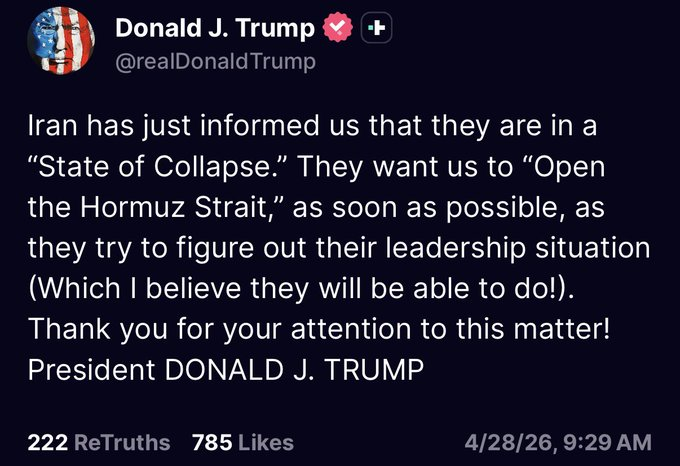
The even greater screechiness from Trump may signal that his lack of good options, yet pressing need to Do Something is weighing even more on him.
An additional factor that may be adding to Trump’s tsuris is that he seems to be losing his magic Mr. Market touch. Oil rose another 1% early Wednesday despite the blather above.
It may be that the media noise about Administration divisions and military worries about another big set of Iran strikes damaging overall preparedness is simply to get Iran off guard. Or Team Trump could be trying to talk Israel out of taking action on its own, which would necessitate the US piling on (yes I know in theory that the US can stop Israel by not providing SIGINT and other goodies, but in practice, the power of the Zionists in the Administration and Congress means the perceived political cost of employing the choke chain is too high).
As much as he might like to (and this would be the least of his bad options) it is inconceivable that Trump would simply toss up his hands and exit, leaving control of the Strait of Hormuz in the hands of Iran (and Oman). That degree of humiliation, and the resulting considerable strengthening of Iran, both geopolitically and economically by being able to export oil freely and collect tolls, is not something the US can swallow. It has to suffer a lot more pain, even if the much of the rest of the world will be first in the firing line.
However, it appears instead that the Trump Administration is doubling down on economic sanctions, despite that backfiring with Russia and not being effective with Iran when the US first cheated on and then withdrew from the JCPOA. Iran may not be as much of an autarky as Russia but it is awfully close.
Bloomberg describes the Trump effort to escalate on the economic front in US Signals No Letup of Naval Blockade as It Aims to Squeeze Iran. We feel compelled to clear our throat and point out that Bloomberg, which has of late become an uncritical amplifier of Administration messaging, fails to point out that the US blockade is mighty leaky. First, ships can hug the coast of Pakistan and India on their way out; the US has not yet and seems not likely to take action in their territorial waters. That means, even when the navy actually does capture a vessel, it is well away from the Middle East. Larry Johnson has pointed out that these abducted ships must be escorted back to a port, tying up already limited capacity. I have not seen great data here; as of mid-month, Lloyd’s List had identified 26 ships that had slipped past the US cordon even as CENTCOM huffily gave a non-denial denial by asserting that they had gotten 29 to turn back. Johnson maintained in a new talk with Pyotr Kurzinthat about 90% of China-bound ships were getting through but did not provide a source.
Now to Bloomberg:
The blockade lies at the heart of the impasse between the US and Iran, with the Islamic Republic insisting it won’t restart negotiations or reopen the Strait of Hormuz as long as the naval restrictions stay in place. Trump says he won’t halt the operation until Iran agrees on a peace deal to end a war that, while now in a ceasefire, began more than two months ago, causing chaos across the Middle East and energy prices to surge.
Let us start with a blindingly obvious point: Iran would not be conditioning negotiations on reversing the blockade if it would suffer unendurable harm by having them persist. Iran would instead be running at top speed to the negotiating table to trade to get the blockade removed. Iran’s conduct says it is confident it can stand whatever pain that produces.
So the idea that the Administration can use the continuation of the blockade as a bludgeon is just silly, or at best aimed at Mr. Market (“Iran won’t be able to hold out much longer, so things will be back to the old normal real soon!”).
But Bloomberg dutifully harps on the idea that Iran will really really suffer because its storage will fill up and it will soon have to turn off oil production! As if that has not already occurred across the rest of the Gulf? We were told then that it would be take some doing to shut them down, that restarting them would take time, and if they were shut for a long time (as in months plus) that could harm output. But with Iran, the message is that well shutdowns = immediate damage. Are we to believe that Iran, which is full of engineers, is less capable of managing its production assets than other states in the region?
But let us indulge the official propaganda. More from Bloomberg:
It’s unclear how much storage and time Iran has left before it would need to close down wells, which may damage them permanently. Analytics firm Kpler estimates it has another 12 to 22 days.
Trump has told his aides to prepare for an extended blockade and that it carries less of a risk for the US than resuming hostilities or walking away from the conflict without a deal that curbs Iran’s nuclear activities.
Larry Johnson’s latest post provided an unadulterated version via quoting Treasury Secretary Scott Bessent:
The Treasury Department, through Economic Fury, has targeted Iran’s international shadow banking infrastructure, access to crypto, shadow fleet, weapons procurement networks, funding for terrorist proxies in the region, and independent Chinese “teapot” refineries that support Iran’s oil trade. These actions have disrupted tens of billions of dollars in revenue that would be used to fund terrorism.
Under President Trump’s’ maximum pressure campaign, Tehran’s inflation has doubled and its currency has rapidly depreciated.
Kharg Island, Iran’s primary oil export terminal, is soon nearing storage capacity, which will force the regime to reduce oil production, resulting in an additional approximately $170 million per day in lost revenue, and causing permanent damage to Iran’s oil infrastructure. Treasury will continue to exert maximum pressure and any person, vessel, or entity facilitating illicit flows to Tehran risks exposure to U.S. sanctions.
Oh, and get a load of the Wall Street Journal in Iranians Feel the Pain as Their Economy Descends Into a Death Spiral. After an anecdata-heavy account, it concedes at the very end:
“Iranians will suffer hardship,” said Mohamed Amersi, an Iran expert and member of the Global Advisory Council of the Wilson Center, a Washington think tank. “But their pain tolerance threshold is higher.”
The mainstream media, as far as I can tell, has also not sufficiently registered that Iran has toughened its terms. Earth to base, this means that Iran feels even more, not less, confident as the Administration is visibly flailing about. Iran has said it is no longer willing to discuss nuclear enrichment (“not now” can be translated to mean “not ever”).
🚨 🇮🇷 Iran will NOT accept any deal that restricts nuclear enrichment.
Tehran will only negotiate:
• End of the war
• Full control over Strait of Hormuz
• War reparations
• Sanctions relief + lifting naval blockade
Nuclear issues to be discussed later in a separate deal. pic.twitter.com/UTRLoy9rFZ
— Ebrahim Zolfaghari (@Irantimes02) April 26, 2026
Weirdly, a lot of pundits, even ones on the Iran beat, are still depicting a more stringent version of the JCPOA (which Iran had offered before the US and Israel attacked Iran) as a face-saving way out for Trump and could conceivably be sold to and in Israel. The fact that that Iran has pulled that issue off the table suggests that Iran, which already knew that talking to the US was both pointless (the US and Israel do not adhere to agreements) as well as risky ot the negotiators, looks now to be trying to carry itself so as to feign being willing to entertain talks for the benefit of economic victims across the globe while taking select concrete steps to make sure they don’t happen, or at least not in person.
And Iran actually is getting more friends. It was just voted in to a key UN post, becoming vice president of the Nuclear Non‑Proliferation Treaty Review Conference. And the backing came not from BRICS (which we have long depicted as over-rated as a geopolitical force, although it could become one eventually) but the old Non-Aligned Movement, which dates to 1961.
This clip is worth watching if nothing else to see the heads of US officials explode.
And as for that US blockade being at best partly effective, it can also be circumvented by simply using other export routes. Iran is ramping up the use of a new a rail link to China. It can’t carry as much oil in total as tankers can, but transit times are much faster:
Larry Wilkerson provided additional salient detail about other export routes open to Iran. Note he is focusing mainly on Iran’s supply needs but the same corridors can be used for exports of various sorts with a bit of investment.
And as far as the ‘Stans go, Tajikistan, Kazakhstan, all those countries that are awash now with the power that China’s magnet has pulled towards the east are going to be right there with them. Not because they were once SSRs of the Soviet Union, but because they see the reality of power shifting. And that reflects you take out your map and look at the Caspian Sea and see how the Caspian Sea is essentially a lake, a huge lake across which Russia can resupply Iran till hell freezes over with no interference because all the countries that are littoral to the Caspian Sea are on their side in this or at least are neutral and not going to interdict the shipping. So you could send everything you wanted to send. It’s a reverse of what we did for the Soviet Union in World War II along the Persian Gulf through Iran and on up into Staling Gro would never have survived if it hadn’t been for that supply chain. Now it’s reversed. It’s reversed in terms of direction and it’s reversed in terms of interested parties. The interested parties are those affiliated with the SEO, with Russia, with BRICS, and are very much, as you just pointed out, on Iran’s side in this conflict for not sentimental reasons, but for very understandable power reasons. They’re on Iran’s side. And the main power reason is the demented power on the other side of the Atlantic that they see now cannot be dealt with. And you’re right, they’ve seen it now for about 12 years. They’ve seen it with Trump, Biden, and Trump.
And as we pointed out yesterday in Links:
🇵🇰Pakistan Has Officially Fooled Trump and the USA.
🇵🇰Pakistan has now opened six corridors with Iran to bypass the U.S. blockade.
🇮🇷More than 3,000 containers are already moving through these routes.
🇮🇷Iran can now connect directly by land to Russia and China and the US… pic.twitter.com/6E8YYi85QI
— World updates (@itswpceo) April 28, 2026
Needless to say, the wags are having none of it:
Iran’s economy will collapse right after Russia’s! https://t.co/WqqdzDrqIS
— Policy Tensor (@policytensor) April 25, 2026
Now to some updates on the economic cost front, first from Michael Shedlock in National Gasoline Prices Hit the Highest Level Since Start of War in Iran:
🚜 The US farm sector is under a diesel and fertilizer cost shock.
– Farm bankruptcies +46% YoY, the third straight annual increase
– 1.9 million farms in America, the lowest ever recorded
– Diesel prices are up +54.4% from a year ago
– 70% of farmers say they can’t afford to… pic.twitter.com/FiEDpTu3PT
— Hedgeye (@Hedgeye) April 29, 2026
We will skip over the furor of the UAE leaving OPEC in May. With no shipments out of the Gulf now, this move has no immediate effect. The UAE apparently wants to pump freely when it can. But that also assumes that there will be a UAE when the conflict ends.
And from Nikkei’s South Asia Watch:
Its [India’s] exporters are largely absorbing the sharp cost escalation in crude-linked inputs as buyers in the U.S. and Europe resist price hikes on current contracts. While they anticipate negotiating raising prices by 15% to 30% for new contracts, there is also the risk of losing clients.
Supply shocks from the Iran war have also impacted the oil and gas units of Reliance Industries, India’s largest conglomerate. Profits for the January-March quarter fell more than 8% year-on-year. Chairman Mukesh Ambani, Asia’s second richest man, cited “unprecedented dislocation in global supply chains.”
Neither are fund managers immune. Venture capital firms in India count the Middle East as one of their largest sources of capital. Now, with the region plunged into chaos, negotiations have slowed, raising concerns that firms seeking fresh inflows may have to scale back operations. These funds are now increasingly wooing investors from Europe and parts of Asia.
Other sightings:
UPDATE: Ryanair CEO warns European airlines may fail if jet fuel prices stay high
🔴 LIVE updates: https://t.co/vnfmfZ7wlw pic.twitter.com/GsAi9f65Li
— Al Jazeera Breaking News (@AJENews) April 28, 2026
For the technically minded:
Stopping for today. Back tomorrow.
