


The U.S. Navy’s current challenges are often described in terms of individual problems, such as shipbuilding delays, maintenance backlogs, operational burdens, and technological disruptions. When looked at individually, each is serious but manageable. Taken together, these suggest broader institutional weaknesses.
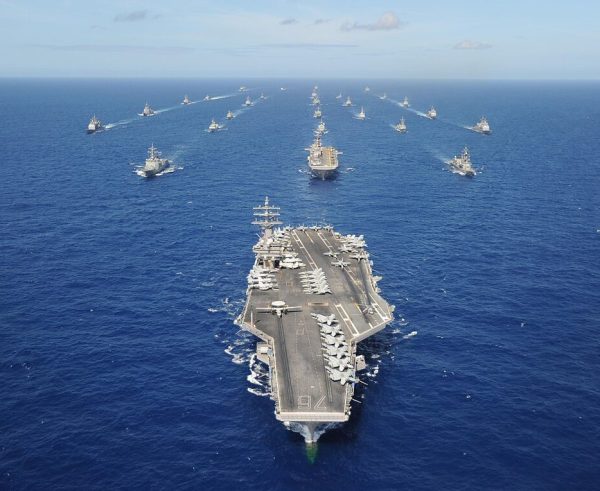
USN Carrier Strike Group – Still ruling the waves?
At the heart of the problem is a closed loop of performance degradation. Limited shipbuilding limits fleet growth. A smaller fleet than needed increases operational tempo, accelerates wear and tear, deepens maintenance backlogs, and increases readiness. Reduced availability shifts the burden to the remaining deployable assets, reinforcing this cycle. This dynamic is not temporary. It’s self-reinforcing.
Attempts to break this loop through force renewal have been hampered by procurement failures that fail to reliably translate investments into scalable combat power. At the same time, attrition of support vessels, increased threats from precision strike systems, and sustained global efforts are increasing pressure on forces already operating at their limits.
The result is a convergence effect in which industrial limitations, delayed regeneration, logistics vulnerabilities, and operational burdens no longer act independently but reinforce each other. This goes beyond just preparation. Reduced redundancy and tighter margins make it harder to absorb adverse incidents, require strategic flexibility agreements, and increase the risk of dispute escalation.
Iran war as a test of ability
Recent combat operations against Iran have severely tested the assumptions underlying U.S. naval power. While wartime performance did not negate the Navy’s enduring strengths, it revealed how structural weaknesses identified in peacetime analysis manifested under operational pressure. Force protection, garrisoning, logistics, and carrier employment all revealed narrower limits of effectiveness than the general principles commonly assumed.
insufficient force protection
The Iran war highlighted that naval defense systems, long considered robust, may be less resilient than doctrine assumes under saturation conditions. Iranian missile and drone attacks focused not only on interception capabilities but also on sensor management, magazine depth, and command reaction time. A key question is whether the Navy’s defense structures can absorb repeated, high-volume precision weapons attacks while still achieving mission objectives. The evidence suggests that the margins are narrower than planning assumptions suggest. The fact that Iran, a medium-sized military power, was able to put naval vessels at risk is a significant sign of its defense deficiencies.
presence of inappropriate force
The conflict also exposed the costs of a thinly distributed presence. Naval power depends not just on the quality of deployed forces, but on sufficient density to absorb shock, maintain a deterrent signal, and shore up threatened theaters without divesting other duties. In the Iran conflict, the navy lacked sufficient amphibious and mine countermeasures capabilities to ensure freedom of navigation in the Strait of Hormuz. The effectiveness of efforts to interdict Iranian shipping may also have been constrained by the lack of sufficient naval combatants in the region.
Logistics is weak
The war with Iran once again demonstrated the neglected truth that naval power is a logistical power. Ongoing operations consume missiles, air storage, repair capacity, fuel, and sea transportation at rates that are often underestimated in peacetime planning. Weaknesses in supply and support architectures magnify any operational problem. This is because attrition in logistics exacerbates attrition at contacts. The Iranian missile threat has restricted naval access to U.S. military bases in the Persian Gulf and restricted replenishment of weapons and other shipping supplies within the theater. Fleet supply ships were insufficient to compensate for the loss of local port supplies.
U.S. Navy fleet supply ships – unassuming but essential ships
Limitations of flagship carriers
Aircraft carrier operations are not obsolete, but have revealed increasing conditions. Its effectiveness will increasingly depend on layered defenses, munitions availability, and permissive modes of operation. Hundreds of thousands of U.S. aircraft carriers remained offshore to avoid Iranian missile and drone attacks, reducing the air wing’s effective attack power. The carrier remains powerful, but its freedom of action may be shrinking even as America’s global strategy relies more heavily on it.
Gap between capabilities and mission
The deficiencies exposed in the war with Iran point to a broader problem that goes beyond wartime contingencies: a widening gap between the navy’s expected mission and the capabilities available to sustain it. This gap is not limited to military structure, but extends to doctrine, industrial capabilities, and strategic initiatives.
expeditionary war
The gap between inherited expeditionary ambitions and the force structures available to support them is widening. While the Navy continues to be organized around global crisis response, distributed presence, attack planning, and amphibious support, fleets are increasingly struggling to sustain these missions simultaneously. The problem is one of abiding strategic ambition in the face of diminishing means. Additionally, the proliferation of precision strike technologies against small states and irregular forces poses new challenges to aging naval platforms and traditional operational doctrine.
please take control
Sea control has returned as a more difficult problem than post-Cold War assumptions. Precision strikes, undersea competition, and dispersed maritime threats have made U.S. sea control an issue rather than a background condition. However, military planning often treats sea control as an inherited norm. Faced with the expansion of other nations’ deep-sea fleets and the calculations of maintaining current models of staffing and deployment, navies will face increasing limits on their ability to accomplish this mission.
Forced playback
At the heart of the Navy’s renewal problems is a deeply flawed procurement cycle. During development, requirements expand and technical ambition often exceeds engineering maturity. Acquisition timelines are often too long to adapt to changing strategic conditions, while program issues prevent production processes from scaling efficiently. Rather than moving predictably from concept to deployable functionality, major programs often enter long cycles of redesign, integration difficulties, schedule delays, and reduced procurement quantities, resulting in higher unit costs and further eroding scale. This dynamic results in more than just inefficiency. It creates regeneration without reliable renewal, and investments sustain replenishment without restoring the force structure at a pace consistent with strategic demands.
nuclear deterrence
Strategic deterrence imposes a second burden that is often underestimated in naval discussions. Recapitalizing the ballistic missile submarine force is essential, but it also consumes industrial and financial capacity that could be used for broader fleet regeneration. Deterrence remains essential, but it strains conventional capabilities. Repeated delays in major submarine programs risk delaying the recapitalization of the ballistic missile submarine fleet and further stressing the foundations of the U.S. nuclear deterrent.
Columbia class ballistic missile submarine – still under construction
The need for institutional reform
The deterioration of the U.S. Navy will not be reversed with ad hoc fixes and patchwork solutions. Overcoming dysfunctional dynamics due to planning and policy failures will require institutional overhauls that address force structure, arms procurement, and military doctrine.
Re-evaluating technology
The Navy’s difficulties demonstrate the need to change the development model that equates technological sophistication with increased effectiveness. Some technologies add critical value. Some impose integration burdens that exceed operational returns. A serious reassessment will distinguish between growth in ability and accumulation of complexity. Technology maturity must be rigorously assessed prior to major manufacturing and deployment decisions.
mission scope review
No military institution can expand its commitments indefinitely while treating force composition as a secondary adjustment variable. Strategic demands must be matched with available means. This requires not only procurement reform, but also a reassessment of the mission scope itself. Navy leadership must be able to resist strategic commitments that the force cannot sustain.
Rebalancing quantity and quality
For decades, the United States has pursued superior capabilities, often at the expense of numerical resilience. But scale has its own strategic value. Presence, redundancy, and attrition persistence cannot be completely engineered by a good platform. In a major naval battle in the Pacific, the United States would face not only China’s vast industrial capabilities but also the strategic risks of force mismatches: munitions attrition, exchange asymmetries, and diminished ability to absorb attrition over time.
Contractor discipline
Procurement failures are not just technical. It’s an institutional thing. A program that absorbs increasing investment while falling short of its capacity represents a governance failure as well as an engineering failure. Restoring Navy effectiveness will require much stronger discipline of contractors, incentives, and acquisition prerequisites. This means tighter control over growing requirements, stronger accountability for chronic cost and schedule overruns, and a procurement structure that rewards reliable and scalable delivery rather than long and overly complex development. The aim is not animosity towards contractors, but rather a restoration of a system in which industrial performance is measured by the combat capabilities it provides, rather than simply by sustained programs. In that sense, procurement governance is not ancillary to naval revitalization. It’s part of the Navy’s rebirth itself.
conclusion
Although the U.S. Navy maintains significant operational capabilities, its ability to create and maintain that capability is becoming increasingly fragile. A change in leadership may change priorities and execution, but it does not address the underlying structural problems. The central question is not the performance of individual programs or commanders, but whether systems operating under increasing constraints can regain their ability to meet strategic requirements. To remain the world’s dominant naval force, the U.S. Navy must undertake fundamental organizational changes. The alternative is gradual downsizing, which could be disastrously defeated if political demands continue to outstrip capacity.
