


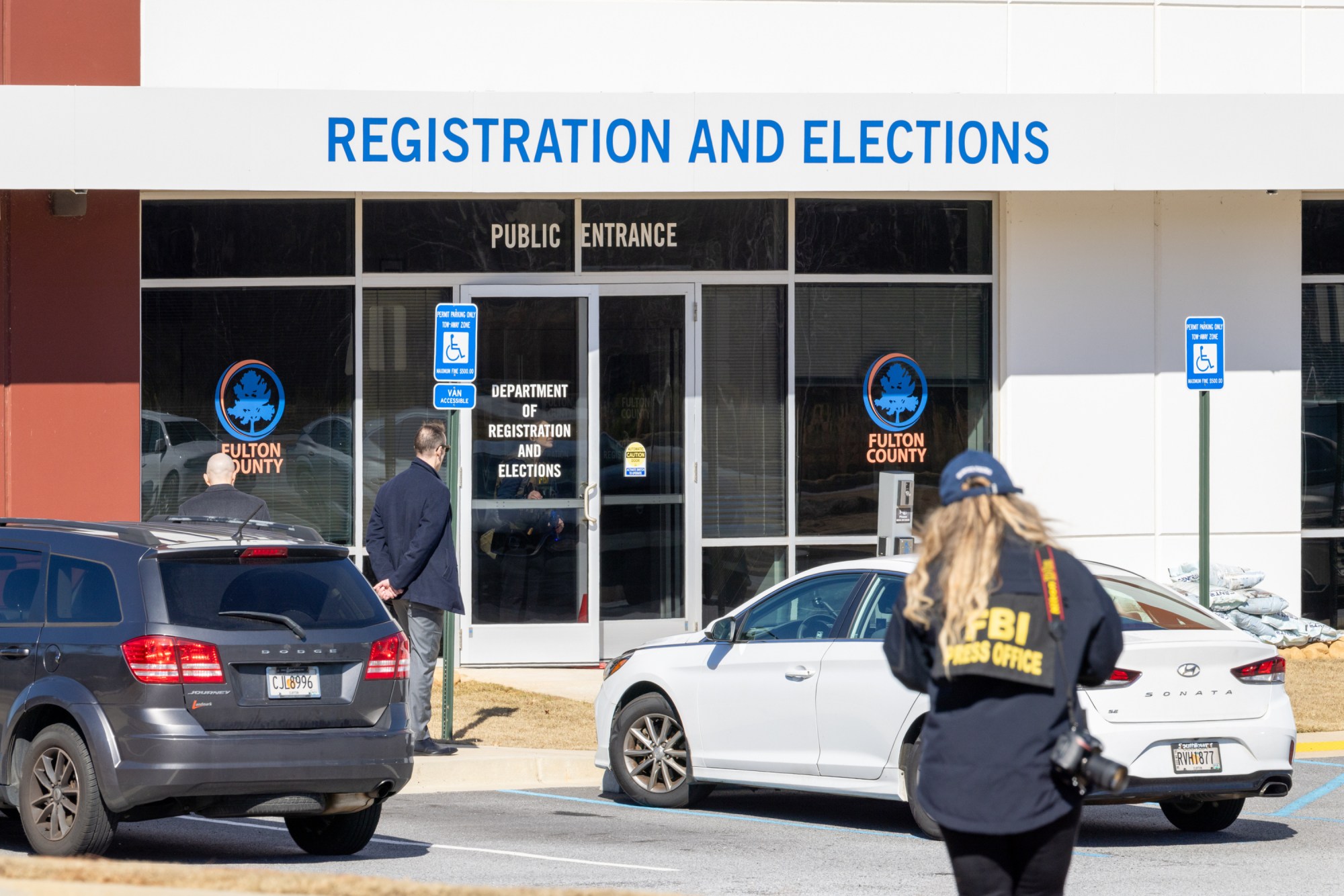
The FBI is considering using artificial intelligence to assess the validity of signatures on tens of thousands of mail-in ballot envelopes seized from Fulton County, Georgia, the latest effort in the Trump administration’s unprecedented review of 2020 voting.
The effort focuses on comparing signatures on ballot envelopes to signatures on other election documents, such as registration forms, according to internal communications reviewed by ProPublica and agency technical experts familiar with the work. President Donald Trump has long claimed, without evidence, that the 2020 election was stolen from him.
In particular, he has repeatedly claimed there was voter fraud in Georgia, which he lost to Joe Biden by just 11,779 votes. In January, the FBI raided Fulton County, a Democratic stronghold, and recovered about 700 boxes of election materials containing about 150,000 mail-in ballots, about 116,000 of which were cast for Biden. President Trump is scheduled to give a speech Thursday about national election security and vulnerabilities in voting machines, but it is unclear whether he will mention the Fulton County investigation.
Signature verification efforts were under discussion as recently as the end of June, but the current status is uncertain. The White House press secretary declined to answer questions from ProPublica and referred inquiries to the FBI. The FBI did not respond to requests for comment.
The effort comes at the same time the FBI ordered the redirection of 260 analysts from field offices across the country to focus on the Fulton County investigation, according to an agency memo reviewed by ProPublica. The New York Times and MS Now previously reported on the memo. MS Now reported that some FBI analysts were fired instead of working on the effort. Their work includes comparing spreadsheets of 175,000 voters to commercial databases to see things like whether a voter is still alive.
The accuracy of signature matching, whether performed by humans or technology, remains debatable.
After analyzing lawsuits and recent election results, experts have expressed serious concerns about how accurately signature matching can identify voter fraud, using techniques such as looking at the size and slant of letters created in different situations.
An FBI technical expert told ProPublica that the agency has the technology to compare images and that signature matching analysis can be “moderately accurate” if you start with a large enough data set.
Ultimately, the technical expert said, the result would be to exceed the threshold set for evidence of fraud, saying, “It’s up to the system builders to define the guidelines.”
Some FBI officials developing the strategy are trying to alleviate political pressure to prove fraud in Fulton County by emphasizing the limitations of broad signature analysis, the people said, arguing that while signature comparisons have been used in individual voter fraud investigations, they have not been done on this scale. But agency leaders are moving forward.
There are serious concerns within the FBI that the test results could reflect political influence, given the administration’s previous efforts to break through longstanding guardrails meant to prevent federal interference in elections. “Everyone thinks we’re going to continue to pursue evidence of fraud, whether we find anything or not,” the official said.
Signature verification sparked controversy during and after the 2020 election and during the COVID-19 pandemic, when more Democrats than Republicans used mail-in voting. Trump promoted false claims that Georgia officials’ failure to verify signatures on mail-in ballots condoned fraud and led to his defeat. “I need to get my signature check in the envelope now,” he wrote on the social media platform Twitter (now known as X) in late November 2020. That’s “far more votes than would be needed to flip” the election for him.
Conservative lawmakers have since pushed for stricter signature-verification laws across the country, including Georgia’s Election Integrity Act of 2021, which they justified by noting that “many electors are concerned about widespread allegations of voter fraud” that include “subjective signature-verification requirements.” The bill replaced signature checks with more stringent forms of verification, such as requiring mail-in voters to submit their driver’s license number or a copy of their license.
Signature matching procedures vary by jurisdiction, but authorities typically determine in a matter of seconds whether a signature on a mail-in ballot envelope is the same as other government records, sometimes relying solely on comparing letter shapes and proportions. Research has shown that signatures can change over time as people age or experience health events such as strokes, and that signatures created in different situations can differ, such as when a signature is carefully made in a government office or quickly sent to a mail-in ballot envelope at home.
Research and studies by journalism organizations have shown that signature matching leads to disproportionately high rates of ballot rejection for a variety of reasons, including people of color, as well as newcomers, young people, the elderly, political independents, and people with disabilities. Signature matching efforts may disqualify more legitimate ballots than illegal ones. A political scientist who testified as an expert witness in a lawsuit challenging Ohio’s signature matching law in 2020 said his analysis suggested that 32 legitimate ballots were blocked by all illegal ballots.
“Signatures are one of the most difficult forensic sciences, and I don’t think AI can do this,” said Linton Mohamed, former president of the American Association of Interrogator Document Examiners, a professional association for forensic document examiners. “Unlike DNA or fingerprints, signatures vary.”
A 2009 report by the National Academy of Sciences examining the state of forensic medicine stated that “the scientific basis for handwriting comparisons needs to be strengthened.”
Defenders of signature verification argue that computer analysis is becoming increasingly accurate and provides a practical and necessary check against fraud. But even they caution that the technology is only as good as the people using it.
Signature verification technology is now so good that it “makes your head explode,” said David Gerber, senior vice president at Parascript, a company that sells such technology to banks and dozens of other organizations that conduct elections. However, he suggests that trained human experts should still be prepared to review about 10% of cases as a check on the machine. Signature verification in elections, he said, “requires the right technology with the right people managing the process. Both are equally important. I don’t care how good the technology is if you have bad people running a bad process.”
Using AI to verify signatures on ballot envelopes is a relatively new field, according to most experts consulted by ProPublica and FBI technical experts. The technology expert said the agency discussed how to adopt it with experts across the government and considered whether to use commercial products like those sold by OpenAI and Anthropic. “This is a new and novel approach” for the agency, the official said, which is one reason “they’re looking into it.”
Experts in signature verification technology, including Gerber and Mohamed, said it’s unlikely that unspecialized AI software could perform such a task with sufficient precision.
Experts said that while AI systems could likely offer some advantages over humans, their accuracy will ultimately depend on the quality and quantity of comparable signatures. Internal communications reviewed by ProPublica show that the FBI’s analysis will only compare signatures on voter registration forms and ballot envelopes, but experts say the limited sample greatly increases the chance of discrepancies. However, the source said the analysis could also incorporate additional records such as signatures on driver’s licenses. Certified professionals and reliable computer systems for industries such as banks typically compare large numbers of signatures.
Max Palmer, a professor at Boston University who studies signature verification on mail-in ballots, said there is “a lot of noise” in the materials the FBI has. “I don’t know if there’s enough information or signals to make improvements.”
Conservative activists have long lobbied for scrutiny of Fulton County’s 2020 mail-in ballots, alleging in a report that local election officials “deliberately” ignored signature verification procedures. Their claims helped lead to the seizure of ballots by the FBI in January, ProPublica reported.
A report by the Center for State Unity and Democracy, an independent watchdog group and nonprofit organization that protects election integrity, concluded that activists’ claims about signature matching and other irregularities were false.
