


The craziness just keeps coming. On Saturday, NATO-Ukraine drones hit a Russian military cargo ship in the Gulf of Finland, followed by further drone attacks on Kaliningrad. The Estonian foreign minister and prime minister declared that the ship attack is a consequence of Russia’s actions, and according to Prime Minister Kristen Michal, Estonia must be prepared for Ukraine to continue attacking Russian ships in the Baltic Sea. He is effectively declaring open war on Russian shipping in the Baltic. If the drones were indeed launched from Ukraine they would have at least had to pass through EU airspace—if they weren’t launched from EU countries.
On Sunday a Russian Navy corvette was sank offshore of Benghazi, Libya by sea drones. A Russian cargo ship was also hit. Where NATO-Ukraine launched the drones from remain unclear, with some reports saying Turkish-controlled Libya and others claiming Albania. Both are of course denying any involvement.
The Europeans are practically begging Russia to include them more directly in the war.
Perhaps they’ll get their wish soon. The EU warmongers were already rejoicing over the US midterms, the thinking being that the Democrats will help lead Europe into war sooner rather than later. It’s worth taking a step back for a moment to review the insanity for posterity’s sake.
German finance minister and co-leader of the country’s Social Democrats Lars Klingbeil said “authoritarian forces” were defeated in the US and that Germany would reach out to the US to stop Russian aggression.
The foreign minister from Berlin Johann Wadephul said he was optimistic that more “support” for Ukraine will be forthcoming from the US.
The EU high representative for foreign policy, Kaja Kallas, unsurprisingly, saw in the election a hope that the new Congress will strengthen transatlantic unity and “support” for Ukraine, presumably reversing Trump’s insufficient devotion to the Ukrainian cause, which she criticized earlier.
What is this other than self-destructive fanaticism?
There are doubts over how sincere the Trump administration has been in its Russia talks, and even if it was truly in pursuit of peace and the US were agreement-capable, a lasting peace would be incredibly difficult and time-consuming to achieve. Yet the Europeans want none of it.
They demand a continuation of a war that is decimating their own economies. They are supporting the wholesale destruction of Ukraine, complete with untold human suffering and which is almost certain to lead to a major humanitarian refugee crisis in the near future, which will further destabilize EU nations. They are determined to throw away more money, mortgaging their nations futures in the process, and ultimately, due to a steadfast refusal to even consider Russia’s security concerns, they are inviting war to their doorsteps. Judging by their rhetoric, they welcome it.
And they’re willing to give the Americans anything to get their support (more on that below). It truly is remarkable.
When these Europeans pop the champagne over the Democrats supporting Ukraine what they are cheering is the potential destruction of their own countries. That is what a conflict with Russia would entail, and that is what they are marching towards with their “support” for Ukraine.
So plainly put, what we are dealing with here is crazy people.
Yet there is still a reluctance to accept that fact. Here’s the China state organ The Global Times on the European warmongers’ celebrations over the midterms:
But this illusion is precisely Europe’s fatal weakness and the root of the various predicaments it faces today. Even if the White House changes hands and the Democrats return to power, will things really be better for Europe? No. Don’t forget that it was during the Biden administration that the Ukraine crisis was exploited to create conflict, causing Europe to “bleed” and then turning around to “drain” Europe. The hegemonic nature and extreme selfishness of Washington’s foreign policy have never changed with the rotation of parties. Europe, unable to see this clearly, will only find its list of protection fees growing longer and longer, and the imbalance in its external economic and security power will only become more severe.
Beijing, of course, wants the EU nations to look out for their own national interests. To do so would mean the EU becoming the western part of an interconnected Eurasia. The Global Times bemoans the EU failure to see clearly, but here it is Beijing refusing to accept reality.
The leaders in the EU care not about national interest; they don’t care about China or anyone else’s offers of win-win deals; they don’t care about anything other than Ukraine and defeating Russia.
Betting the Farm
Where has this path led the EU so far? The bloc citizens are taking the brunt of the pain for two wars—one the ruling class wants and one they apparently no longer do.
European Commission President Ursula von der Leyen originally spoke of a “democratic transition” in Tehran.
German Chancellor Freidrich Merz originally praised Israel for doing the West’s “dirty work,” and declared that when the US bombs schoolgirls that it’s “no time to lecture our allies on international law.”
Both now lament how much that war is costing the EU—a hundred billion euros-plus on the fuel cost spike alone. Part of the calculus by these European statesmen was that support for the Iran war would keep Trump onside against Russia, but they apparently now regret that decision.
They now hold out hope that the Democrats will at least give equal weight to both losing efforts.
Meanwhile, all the EU nations will have to do is keep giving to Washington—and that means its citizens continuing to sacrifice. We featured a post yesterday on the rising “deaths of despair” in Europe. One might think that representative democracies would be laser focused on addressing such dire public health threats. Instead here’s a partial list of what European governments have been—or haven’t been— working on in an endless bid for more American support.
Denmark just recently finalized the Greenland deal that hands the US more long-term military control and exclusive rights to its resources.
Earlier in the year as Washington’s Greenland push gathered speed, European policymakers reportedly awoke to the reality that dependence on US LNG brings with it significant geopolitical risks.
The EU commissioner for energy and housing Dan Jørgensen called the threats to Greenland a “clear wake-up call.” The EU went looking for alternative LNG suppliers in Canada, the Middle East, and North Africa with Merz and a delegation of German industry executives leading the charge.
How’d that work out? Not great. Here’s Reuters in a piece from earlier this month:
US LNG exports climbed to their second-highest monthly level on record in October as producers boosted output to capture strong European demand and multi-year-high natural gas prices, according to LSEG data.
Exports to Europe rose to 6.89 million metric tons in October, up nearly 1 million tons from 5.91 MT in September, LSEG ship-tracking data showed.
The increase reflected Europe’s need to secure supplies ahead of winter and the narrowing price gap between Europe and Asia.
The European TTF benchmark and the Asian JKM benchmark both averaged about $28 per million British thermal units in October, sharply above September levels and among the highest prices since the energy crisis that followed Russia’s invasion of Ukraine in 2022.
About that need to secure supplies ahead of winter…
Good Morning from Germany, where cold weather is eating into already depleted gas reserves as winter barely gets going. Storage is just 56.6% full compared w/roughly 88% on avg for this time of year (2020–25)–the lowest seasonal level since at least 2020. European gas futures jumped as much as 8.6% to €96/MWh as forecasts turned sharply colder: Northwest Europe could face temperatures 5–8°C below normal in early December. A long winter ahead.
— Holger Zschaepitz (@Schuldensuehner) November 23, 2026
What does it all mean for the lowly European citizen?
On Wednesday, a flash estimate from Eurostat, the EU’s statistics office, put Eurozone inflation at 4% in October, a three-year high. The Commission expects EU inflation to peak above 4% around the turn of the year and only return to 2.3% in 2028, but that prediction is based upon the belief that the US midterm elections reduced the likelihood of renewed strikes on Iran—which readers know is not necessarily the case.
Meanwhile, borrowing costs are rising and about the only borrowing EU governments want to do is for war with Russia.
The tech front is similar to the energy one.
Earlier this year during the Greenland takeover push, there was a lot of noise about Europe’s efforts to ditch US software in favor of sovereign tech, yet there has been minimal action. From Wired:
…the European Commission launched its official long-term plans to rely less on US technology. The European Parliament has switched the default search engine on its devices from Google to the French alternative Qwant. Thousands of workers in the French government are using its own open-source office software—dubbed LaSuite—as officials aim to “break free” from dependence on American tech firms. An open-source documents offering from more than a dozen European tech companies, called Euro-Office, is due to launch imminently. Cities across the Netherlands, France, and Germany are all moving away from Microsoft Office and Google Docs.
Sounds promising, except that despite such moves, “US-based firms continue to dominate almost every layer of Europe’s digital stack,” says a European Parliament report. That means Silicon Valley-Washington remains embedded in EU cybersecurity, cloud computing, mobile operating systems, etc., which creates a dependence on the US the same way the LNG shipments do.
From the Hertie School:
US Big Tech’s market dominance has created structural advantages for the incumbents and high barriers to entry, and for the EU to build its own options it must give its regulatory power more muscle, especially in evolving digital markets, ensure substantive compliance and improve the enforcement structure of its digital rulebook.
This isn’t happening.
Enforcement against the big six —five American and one Chinese companies that shape how Europeans communicate, do business, consume information and engage in public discourse— is purely performative, according to the European Consumer Organisation.
Recall that the US threatened the EU earlier this year over its efforts to regulate American big tech, so it’s unsurprising that EU leadership, focused solely on its long war against Russia, is unserious about independence from American tech.
The minimal efforts to begin a move away from American tech dominance were touted as a response to the so-called unique Trump threat, and there’s no guarantee they will continue with the president weakened by the midterms or post 2028 election.
Elsewhere, the US is pressuring Germany to pay more for pharmaceuticals so that, in theory, Americans can pay less. Berlin has yet to acquiesce, but it wouldn’t be surprising if it does—likely in an attempt to gain more Washington “support” for Ukraine. Paying more for drugs would be a tough sell in Germany where government healthcare spending is already being cut significantly. If Berlin gives in to Washington’s demands, it’s almost certain the additional costs would have to be shouldered by the citizens as the government has other priorities:
By 2030, €152 billion of Germany’s annual new borrowing (70% of total) will finance military spending under the defence exemption from the debt brake. Defence-related borrowing increases interest expenditure, reducing the space available for other spending in the core budget. https://t.co/deH3qBlmkJ
— Philipp Heimberger (@heimbergecon) November 16, 2026
It’s been 12 years since Assistant Secretary of State Victoria Nuland, under the Democrat Obama administration, spelled out the US position quite clearly in Kiev with her F-the-EU comment.
It’s been four years since this under a Democrat administration:
So of course the EU crazies now celebrate the return of the Democrats to support this madness.
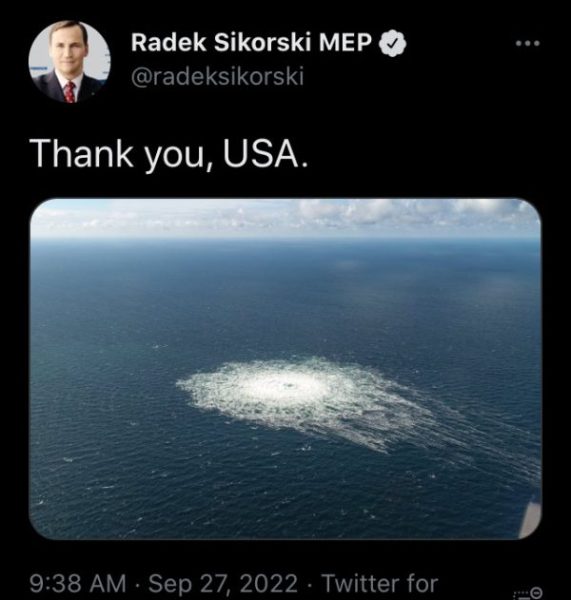
By the way, Anne Applebaum, wife of Polish Minister of Foreign Affairs Radosław Tomasz “Radek” Sikorski, is now making comments like this:
a…notable exchange
Tim Miller asks if Europe is considering military escalation against Russia
Applebaum says leaders are discussing it privately but the public isn’t “ready” (yet!)
“Unfortunately…there’d have to be an event that convinced people it was really necessary” https://t.co/8LuLgNld8y
— Alex JER-dun (@alexjordanATL) November 20, 2026
And so even as the US encourages the destruction of Europe, the EU ruling class thanks Washington for its assistance in the undertaking. War is always insane, but you could perhaps try to make some sense of the EU eagerness to become vassals were it the year 1940 and, like the UK desperate for American support, it was willing to sign over just about anything to help guarantee victory. Alas, we’re a long ways away from the US being the world’s dominant industrial power and its involvement guaranteeing anything but more misery and destruction.
If Europe were serious about industrial muscle in preparation for conflict, it would need to be going hat in hand to Beijing, but of course that wouldn’t work even if the EU tried. We see the Chinese viewpoint in the Global Times piece above: that the EU “handle relations with other countries in a normal posture.”
Unfortunately, that train has left the station.
And so the European ruling class drifts on into catastrophe (for their countries, not necessarily for them personally) suspended in unreality.
They exist in the past. They make their own reality. And they refuse to entertain a future that is different from the one they demand. All key ingredients for a disaster that is getting closer by the day.
