


In the immediate aftermath of the election, the Democratic Party is divided over whether to stand pat behind its incumbent congressional leadership or shake things up.
Yves has already spoken out on these races in her introduction to Medea Benjamin’s “10 Reasons Hakeem Jeffries Should Not Be the Next Speaker of the House :
I spoke to a Democratic-party connected political maven over the weekend whether he thought Chuck Schumer and Hakeem Jeffries would survive leadership contests. He thought they would but was not highly confident. His reasons for thinking Jeffries would become Speaker of the House were not just that AIPAC still had clout but also that Jeffries was a darling of the arms-makers.
That says to me that a strong push from voters to get them out is called for. Readers in House districts where Democrats won need to make noise early and often that Jeffries, who got more AIPAC money than any other Congresscritter, must go.
She also encouraged readers to sign the petition opposing Jeffries and calling their congress critter if in a Democratic House district.
I concur.
But let’s look at the nitty gritty of the power struggle starting with the US Senate.
Schumer Might Have a Challenger
No sooner was it clear that the Democrats would have a majority in the US Senate than Schumer’s stated openness (“we’ll see if he’s willing to change his ways”) to work with Trump was drawing heat on social media:
Oh, Chuck, to even suggest in theory that Trump might change his ways to work with you and the Democrats is patently absurd. Please find a successor who is living in the same reality as all of us out here begging for action and accountability. https://t.co/GcirN5eT3B
— Sarrah Bellus (@sarrah_bellus) November 3, 2026
Schumer expressed confidence to DC media the next day, telling The Hill, “I’ll be reelected as majority leader.”
The Atlantic piled on, crediting Schumer as “the architect of a historic landslide” (despite his woeful record in the primaries and some blaming him for close Dem losses in Florida, Louisiana, and Alabama).
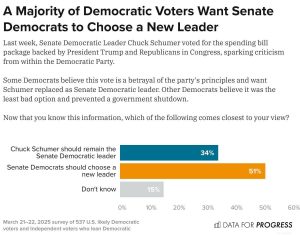
But polling like this wasn’t helping his cause:
Neither did the outspoken opposition of The Daily Show’s Jon Stewart.
But several incoming freshmen immediately called for different leadership including Troy Jackson (ME), Abdul El-Sayed (MI), Juliana Stratton (IL) and Peggy Flanagan (MN) (per Democracy Now) and Hamilton (KS) (USA TODAY). Plus Andrews (SC).
Then incumbent (and centrist) MI Senator Elissa Slotkin “refused to rule out a leadership bid,” per Politico.
As did Chris Van Hollen (MD) telling CNN:
“There should be no coronation of the next Democratic leader,” Van Hollen said. “I’ve said very clearly that we need to have a discussion in the Democratic caucus, we need to understand what the Democrats are going to do with this new responsibility and these new powers, and nobody should get a blank check without a full understanding of the caucus as to where we’re going to go.”
Last night, Decision Desk put out this handy infographic:
More ominously, CT Senator Richard Blumenthal came out this morning and said “we need a conversation about leadership.”
🚨NEWS: @SenBlumenthal declines to endorse @SenSchumer as the next Senate Majority Leader
Blumenthal just told reporters: “We need a conversation about leadership going forward because we need new energy and ideas” https://t.co/KJ5im9ZHwo
— John Craven (@johncraven1) November 9, 2026
TIME magazine summed up the battle lines a few days ago and noted that the mainstream liberal group Indivisible is opposing Schumer:
Schumer only needs a bare majority of his caucus to move from minority leader to majority leader—not a majority of the voting chamber as is needed to become House Speaker. And other members of the caucus are longtime Schumer allies. Many owe him favors related to his running Senate Democrats’ campaign arm with a vise-like grip for the last two decades. Raising billions for party candidates—either directly or indirectly through campaign committees and an aligned super PAC—gives him plenty of chits to call in.
Schumer allies are not sweating the criticism from the party’s base, or even the dissent coming from candidates who are about to become his colleagues. He landed major recruiting coups in North Carolina, Ohio, and Iowa—all Democratic pickups that helped the party secure a majority. Other wins in Maine, Michigan, and Kansas padded the party’s margins. Votes were still being counted in races in Mississippi and Alaska that could further expand Democrats’ power.
Indivisible, the liberal group that emerged from the ashes of Hillary Clinton’s failed 2016 presidential bid, became one of the first organizations this week to openly call for Schumer to step aside or be deposed. “Yesterday, voters made it very clear that they want a new generation of Democratic fighters,” the group posted this week. “We need a Leader in the Senate who is capable of leading that fight. It’s time for Senate Democrats to choose new leadership.” Other progressive groups have put out similar statements. None have a Senate Democrat volunteering for the position.
Meanwhile, Schumer’s ethical lapses have been getting news in the alt-media:
And Van Hollen has upped the ante:
NEW: Sen. Chris Van Hollen is now open to a run against Senate Minority Leader Chuck Schumer
Van Hollen has “received an outpouring of calls and is now in active listening mode,” according to a person familiar w/ his thinking around leadership
“The door is not shut,” the person added
Van Hollen is a leading progressive & has said he needs commitments from Schumer before agreeing to support him for another term as leader. The Maryland Democrat has also been eyeing a presidential run
— Laura Weiss (@LauraEWeiss16) November 9, 2026
Politico’s Playbook newsletter had more:
Chuck Schumer is facing rumbling unrest of his own. A movement to draft Sen. Chris Van Hollen (D-Md.) to become Senate majority leader is underway and gaining steam, according to two people close to the situation and granted anonymity to discuss sensitive political maneuvering.
Ezra Levin, the co-executive director of Indivisible, is among those leading the efforts, and was in touch with Van Hollen as recently as Sunday. “He has not sought the position, but he has also not closed the door to the position,” Levin told Playbook. “And I think if there is sufficient public demand, that not only would he possibly get in the race, but I think he could win.” A person familiar with the senator’s thinking told Playbook he’s “received an outpouring of calls and is now in active listening mode. The door is not shut.”
I should also mention that neither Bernie Sanders (VT) nor Elizabeth Warren (MS) have pledged to back Schumer, and Jon Ossoff (GA) has been weasely as well.
The Case Against Both Schumer and Jeffries
John Ross & Alex Skopic at Current Affairs argued it as well as anyone in their piece “Democrats’ Victory Will Be Wasted Without New Leadership“:
In the past, we’ve seen similar moments of optimism—most notably, when Barack Obama became president in 2008—that ultimately led to little real change. So it’s critically important that we look at Tuesday’s results, not as a victory, but the start of the real fight. If Democrats don’t deliver the things Americans want—an end to the war on Iran, a lower cost of living, real consequences for the Trump administration’s crimes and corruption—their good fortune will be short-lived, and the far-right will come roaring back, just as it did after the failures of the Biden administration. Which means that, as we look ahead to 2027, it has become more urgent than ever to remove Chuck Schumer and Hakeem Jeffries from the Democratic leadership.
Counting the House
Jeffries, if anything more loathsome than Schumer, having met with Jared Kushner in August to discuss “potential areas of common ground,” probably has an easier path to election as Speaker of the House.
But that hasn’t stopped the grassroots from complaining about him, per Axios:
Democratic House members and members-elect are being bombarded with phone calls and emails urging them not to elect Minority Leader Hakeem Jeffries (D-N.Y.) as speaker, more than a dozen lawmakers and aides tell Axios.
The calls point to a fundamental disconnect between House Democrats — most of whom are likely to vote for Jeffries — and at least a portion of their grassroots base.
An incoming House Democrat told Axios they are “getting inundated” and have received “about 150” calls since the election urging them not to vote for Jeffries.
A senior House Democrat said they received “over 500” calls in the last two days, telling Axios they also got asked about it in-person at a Chamber of Commerce meeting in their district.
“I think our numbers are higher” than 500, said another House Democrat. “It’s our No. 1 issue, and it’s not close.”
A petition opposing Jeffries and Schumer’s return to leadership has drawn over 1 million signups. Jeffries supporters call it an “astroturfed pay-to-play scheme to sow division and lie about Leader Jeffries.”
But Newsweek listed reps who have openly questioned whether they’ll support Jeffries or not: Claire Valdez (NY-7), Darializa Avila Chevalier (NY-13), Melat Kiros (CO-1) and William Lawrence (MI-7).
But progressive leaders like Alexandria Ocasio-Cortez (NY-14) and Greg Casar (TX-35) are strong in support of Jeffries and it seems unlikely he’ll lose this time.
Matt Stoller Makes the Case FOR Jeffries
This is a useful and insightful exercise from Stoller on Twitter:
Dem members of Congress and base voters see Hakeem Jeffries very differently. I’ll try to make the case *for* Jeffries, from the perspective of members. Ironically, they like him for the same reason voters don’t, which is that he’s nice and passive. He’s NOT Pelosi.
Pelosi was a control freak, she tracked everything and bossed around the caucus with detail-oriented savviness. To give you a specific example, Pelosi made sure that only a few members could have staff with classified clearances, while most could not. That was a mechanism to ensure that just a few Dems would be able to make key decisions on national security.
She also was the Democrat who took over from the GOP Congress first elected in 1994. Gingrich (and his side kick Tom Delay) had taken apart a bunch of important Dem-leaning institutions to run Congress, centralizing control in the hands of leadership and corporate think tanks. That was the ‘K Street Project.’ It was a Strong Speaker model.
Pelosi had the chance to undo those changes, but she doubled down on the Strong Speaker approach. It wouldn’t be a return to the Office of Technology Assessment and powerful caucuses, it would be the Wall Street-funded Center for American Progress and Congressional leadership in charge. She was a pro-choice Gingrich. Subsequent GOP leaders basically kept this arrangement in place, with Trump operating as the de facto latest strong speaker.
If she liked you, you could do anything. If she didn’t. you got virtually nothing. She was in charge. When committees selected new members, Pelosi had a big say. When legislation needed to be finalized, that was Pelosi’s call and her advisors choosing which lobbyists to listen to. She raised money, she allocated favors, handed out metaphorical parking spots. She knew everything.
The upside is that Pelosi could whip close votes, and could rule the House. She was able to save the ACA when Obama was ready to give up on it, because of her centralized control of the House. She governed. In some ways, she sort of saved the Obama administration. If you liked the direction she wanted to go, you were happy. If you didn’t, you were not. But there were a few significant institutional downsides.
The Democratic Party suffered because Pelosi was a God-awful communicator. Just utter trash. She sounded entitled, she stuttered, she gave wandering obnoxious speeches, and couldn’t articulate any coherent goals. To have someone that bad as the party front-person, and then to have the rest of the caucus admiring her, well, it made the party look bad.
On an ‘office politics’ level, the House was a miserable place where a few people made decisions, and all other elected Dems outside of leadership were merely ornamental. Talented House Democrats often jumped at other job opportunities, because the House was a waste of their talents.
On a substantive level, what it meant is that legislation could only be as good as Pelosi’s people could make it. A San Francisco out of touch rich lady, and her advisors, were the ones structuring policy. Pelosi cut out much of the caucus, which means she cut out much of the country. That dramatically reduced the quality of what the House was doing.
On a party level, Pelosi’s iron-fisted approach meant that no new leaders could emerge. Rather than embracing, say, the Squad, Pelosi went to war with them. That’s not to say the Squad was good, just that Pelosi didn’t create space for them to do their thing, whatever that might have been. The result was that there were no dynamic young Democratic leaders in the House, which should have been a talent pool for new people and ideas. Instead the House was a slightly younger nursing home than the Senate.
And Jeffries? Like Pelosi, Jeffries is a very communicator. So to outsiders, he seems similar. But he’s completely different as a House leader. He doesn’t track very much, he doesn’t know what is happening in every corner of the caucus, and he doesn’t have strong views. He won’t set a direction. He’ll listen, he will act if there’s a consensus, but otherwise will sort of let things play out. You can talk to him about your concerns, he’ll listen and be sympathetic. No one is worried about crossing Jeffries.
The downsides to Jeffries are pretty clear. He’s widely disliked as a speaker, he makes the Democratic Party look bad because he clearly doesn’t have a view of how to govern. He likes Israel and big money, but he’ll do populist things if pushed. He proposed no agenda for the 2026 election, so there’s no obvious specific mandate. Do something about ‘affordability,’ sure, but what? He also won’t be able to manage the House. He won’t be able to whip close votes, he won’t set a direction, and the committee chairs or caucuses will likely run the place. When he speaks publicly, he’ll lack the credibility to speak for the caucus. He won’t be able to negotiate with Trump one on one, Trump will just go around him to other groups of Dems. It’ll be chaos.
He’s also not creative. Like Pelosi, he isn’t going to reverse the Gingrich changes that ripped out the institutional capacity of the House. But he won’t be strong enough to manage the centralized control that implies.
The upside is the same as the downside. Chaos. The House Democrats are going to have to set the agenda themselves, through organizing, committee hearings, and pure hustle. An entrepreneurial member or set of members working together on something will be able to get a real hearing for what they want. New leaders could emerge. There will be bitter fights between and among caucuses. Members could demand real structural changes to how Congress works and make it functional again, and Jeffries would probably eventually go along.
I don’t know that members have thought through exactly why they like Jeffries or these dynamics. Certainly the newly elected class has different views, they never experienced Pelosi’s management and they don’t know Jeffries. Still, when I see Jeffries speak, I am not convinced he speaks *for* the Democratic caucus. I don’t think anyone does. And that’s good, we need all of those new members from Trump-y districts to have the space to find their voice.
AOC has also offered an explanation:
AOC: “Right now both of these races are uncontested — don’t be mad at me, I’m just reporting the facts.”
Rep. @AOC clearly explains the speaker vote process, says nobody is challenging @RepJeffries and anyone who does would likely be banished to obscure committees.
(If Jeffries is that vindictive it seems like even more of a reason someone should challenge him 😕)
— The Tennessee Holler (@TheTNHoller) November 9, 2026
Related Posts
