


Part the First: A Day in the Life of the Working Class. When members of the Professional Managerial Class speak of the working class, seldom do they know what they are talking about. This is news only to said denizens of the PMC. While I am a paid-up member of the PMC now, I worked for an extended period after high school in a heavy chemical plant (where the highest paying union wage was about $180,000 per year adjusted for inflation) that is now long gone to parts unknown, leaving behind a large Superfund site. I learned a lot from those men, and they were all men in those days. Joseph Palange, a firefighter and concrete worker illustrates one lesson, that of the birddog, whom members of the PMC seem to think is the typical worker on a construction site or in a manufacturing plant. I learned quickly how to spot my “coworker” who spent more time and energy avoiding a job instead of just doing it. For example, I worked with this guy, while at the age of 17 and 18 learning to ignore him until the work really had to get done, which is the only time he moved:
He was famous for contorting the half hour we had for lunch—innovatively finding ways to double it. He would make an important personal call at 12:30, suggest he make a run to the supply shop at 11:30, head to the tool trailer at 11:40 only to never return, or sometimes simply feign negligence as if he had lost track of time. That ostensible negligence with which he watched the clock as it approached 12:30 was a tricky game though. He’d lose the excuse if the boss caught him and, like any other spent munition, would have to wait until a new one was manufactured. It can’t be the case that you’re accidentally late returning from lunch every time the superintendent shows up. He had to be seen working at 12:31 a few times first.
Worst of all was that working with him necessitated constantly babysitting his expectations because he seldom wanted to do what the work required. Thus, he fought me incessantly on every detail—all of which were essentially non-negotiable. Had I given in on any of them I would have gotten it worse from those in charge of us. “You don’t let a man like Tommy Keough direct the work,” I had been told once when he wore me down. It was as if every detail of the work was putting the man out. It was like asking someone to pick you up from the airport ten times a day. He huffed and berated my decision making and claimed I had no idea what I was doing. Even so it was mostly bluster, and he talked and worked with a smile on his face. The man loved me, and for all his faults I loved him too. When we were up against it and you could genuinely feel the weight of how important the work was and how tight time was, Tommy always came through for me. And over the years—and over 2x4s and whaler loops, and turnbuckles, and the magical substance that is hydraulic cement—I learned about the man.
The only difference between Tommy Keough and his biosimilars among the people I have worked with since I was in my early twenties is that Tommy always could be counted on in a pinch. Which leads to Mr. Palange’s conclusion:
I do not blame the populists from either party who romanticize the working class. Steve Bannon has likely never got stuck digging a ditch alone because the guys who are supposed to help him are smoking crystal meth in a porta-john. I doubt that Bernie Sanders has ever waited half an hour only to realize that the new guy isn’t showing up for day two. I don’t expect elite ideologues to get it, I just wish they’d stop flattening the problems of the working class into neat and tidy stories that serve their political projects. Because none of it is simple, and the fixes are not obvious. You cannot open enough mills and mines to solve the fallen nature of man, and sometimes it is those fallen men who step up when you need it most.
And it could be that as the AI revolution destroys PMC jobs up and down the scale (it might just happen), those who know what it is like to pour concrete or clean out an oil storage tank or tote two flasks of mercury at a time, 92 pounds each for proper balance, will find themselves once again in demand. Worse things could happen.
Part the Second: Is There Any Hope Humans Will Grasp Climate Change? A very good friend of mine has told me that he does not “believe in” anthropogenic global warming (AGW) because he doesn’t see how humans can affect something as big as the climate. I have asked him about the Montreal Protocol and the ozone hole but he is resistant. It is hard for people to think of something as big as the climate. The philosopher Timothy Morton of Rice University, who is inscrutable to me most of the time, has used “hyperobject” as the term for those things we can’t grasp because they are so large in space and time. This I can understand, for the most part.
A recent article from the McGill Office for Science and Society asks, How to You Squeeze Climate Change Inside the Human Brain? Good question:
The loudest alarm blaring all over the world right now is that of climate change—but the brains of many seem to have habituated to it.
Climate experts find themselves trapped in irony: they can predict disastrous consequences for the planet we live on, yet most people’s eyes glaze over when reading the resulting headlines. We keep scrolling and living our lives. Forests get broiled by apocalyptic infernos, turning our skies red and ravaging entire towns, and we keep scrolling. Summers become human barbecues, with more and more of us dying of heat, and we keep scrolling. Our world has become less hospitable and we seem apathetic to it.
Where does climate apathy come from? Researchers have attempted to answer this question using highly artificial experiments. The most promising of these studies shows us that how we present the alarming data we have can make a difference.
The human mind focuses on “the urgency of now,” as in food, shelter, and perhaps reproduction. But climate change is a “tomorrow problem.” True until it isn’t. And it is difficult to look at the news on any given day – raging forest fires and floods that happen “once a century” ever few years – and not see that something is happening. On a more mundane level, where I live now is no longer “above the gnat line” and the plant regions specified by the USDA are moving north in at a perceptible pace. But still, “it’s just the weather.”
There’s also the fact that climate change is an amorphous problem. A predator is flesh and blood: it can be avoided or, if necessary, fought off. But climate change can’t be physically tackled; it can’t be seen with the naked eye; and its isolated manifestations—a blaze here, a tsunami there—are not easily blamed on it. There have always been forest fires and destructive waves. What changes is the intensity, the frequency, the range, but these changes over time may not register inside the brain.
There is a distressing essay (pdf) from 1995 that illustrates this using fish. The number and diversity of fish in a body of water can collapse over a long enough period of time without fishers noticing. It’s not that they don’t have eyes; it’s that when they retire, the number of fish is down from when they started, but the next generation of fishers doesn’t know. To them, this lower number is normal. They have never experienced what the lake looked like fifty years earlier.
The essay’s writer, Daniel Pauly, called it “shifting baselines syndrome.” The first time you enter an ecosystem sets the baseline for you as to what is normal; if change is slow enough, it won’t seem drastic. For Vox, David Roberts summarized it this way: “No generation experiences the totality of the loss.” The kind of major air pollution we are experiencing in summer due to forests burning is new to us; to babies born now, it will be expected. Little by little, our species gets accustomed to a worsening situation without ever fully perceiving the change. We are, in effect, boiling frogs.
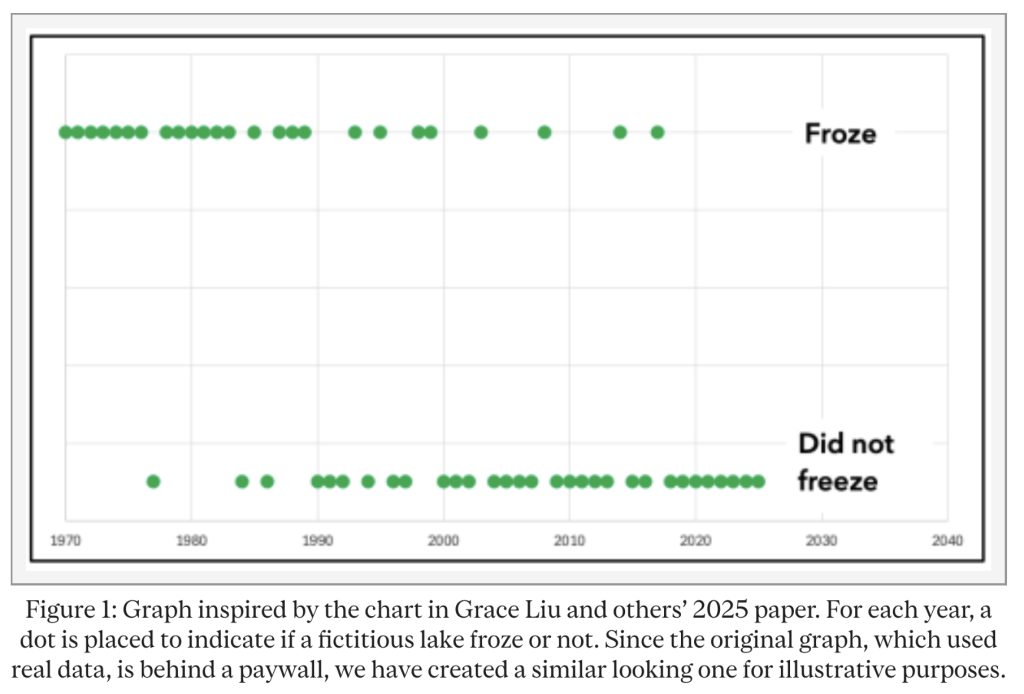
Is this a matter of human perception? Of course, it is. And there are ways to improve our perception. In my work, when I see someone present data in a table, alarms go off: What are they trying to hide? Unless there is a dose-response curve or array of some kind, the human mind will not perceive the change, such as this illustration:
That the lake stopped freezing just about every year between 1990 and 2000 is obvious to all but the most obtuse. It’s not just the weather, after the year 2000. And only the most obtuse will deny the cause of this phenomenon. The tobacco industry fought against the obvious truth that smoking causes lung cancer for more than twenty years after the first demonstration of this fact using statistics during the British Doctor’s Study. In that large cohort of British physicians not everyone who got lung cancer was a smoker. But of those who were so stricken, 90% of them had been or were smokers. No, correlation does not prove causation. But in this case, doctors who smoked more were more likely to get lung cancer, so the dose-response curve was present. We now know the mechanism. We also know the mechanism of AGW: Releasing into the atmosphere in a few hundred years that was sequestered over several hundred million years. This is not difficult. And the scientists and engineers in Big Oil knew this more than fifty years ago (if you go there, please ignore the repeated typo caused by my malpractice in the use of Microsoft Word).
Part the Third: Amyloid Hypothesis of Alzheimer’s Disease in the News. Fair is fair. The former president of Stanford is entitled to make his case. We have discussed the amyloid hypothesis and problems with some of this research on AD several times here. One of the latest stories is that of Marc Tessier-Lavigne, who has been an AD researcher who more recently served as president of Stanford. He resigned that position three years ago due to uncertainty about research for which he was responsible more going back to 2009. STAT News has an article up in which Dr. Tessier Lavigne disputes the findings, originally published by Stanford student Theo Baker in the Stanford Daily and later in his book How to Rule the World: An Education in Power at Stanford University. This is likely to drag out, but this may be yet another massive ding in the amyloid hypothesis of AD. In my view, the key to the story lies here:
Baker, who was a Stanford freshman in the fall of 2022, wrote a series of stories for the Daily detailing concerns related to around a dozen studies co-authored by Tessier-Lavigne. Some of these papers contained images manipulated in ways scientific sleuths said were unlikely to be honest errors. Baker’s coverage spurred Stanford’s board to investigate the matter with the help of a law firm and a panel of outside scientists. His reporting also prompted an internal review (pdf) by Genentech.
While neither investigation uncovered evidence Tessier-Lavigne had committed research misconduct or covered up fraud, the report commissioned by Stanford confirmed that at least four studies in which he’d played a leading role contained doctored results and found that he failed to “decisively and forthrightly” correct errors. Tessier-Lavigne announced his resignation the same day the report came out, stating that discussions about the findings might affect his ability to lead.
The investigation and its aftermath have fueled lasting conversations about the conduct of elite science (Running a lab is a full-time job!). Just last year, President Trump’s science adviser referenced Tessier-Lavigne’s story and the 2009 study as a “painful episode” that illustrates how academics have strayed from producing “gold-standard” science.
Did the “invisible college” of AD researchers have their suspicions about the work? Having been a scientific worker or scientist since the mid-1970s, my spidey sense says, “Yes.” And Dr. Tessier-Lavigne confirms this:
While the Stanford investigation determined that the fraud allegations appeared to be mistaken, it found that the Nature paper had some image duplications and biostatistical errors, and that the quality of the work “fell below accepted scientific practices, let alone Dr. Tessier-Lavigne’s self-described standard of scientific excellence.” The panel also said his choice to publish additional studies rather than correct or retract the original paper fell within standard practice but was “suboptimal,” a finding he told STAT he agrees with.
“I believe the Alzheimer’s community and the developmental neurobiology communities, which follow these things, most certainly knew about the corrections I provided in the follow-on papers,” he said. “It would have been beneficial to less specialized audiences to append a correction to the original paper, too. So I think with hindsight I would have done that.”
How and why did this happen? I know I sound like a broken record, but American biomedical science went off the rails with passage of the Bayh-Dole Act of 1980, after which the goals of academic science became to make bank and cash out quickly with a unicorn instead of make discoveries and see where they led. And this irresistible imperative has given the Current Administration one more excuse to prattle on about “gold-standard science.” American science is unlikely to recover. Sometimes it seems good to be old. But only sometimes. There is still too much to get done!
Parting shot: Apologies for this somewhat truncated Coffee Break, but life intervenes. Here is another story from STAT that sums up our current predicament very well. The mother of a daughter with cystic fibrosis commented on new policies that are likely to have the shade of Trofim Lysenko cast a shadow over American science and this might affect advances that all of us will depend on, eventually. Her comment was stricken from the record because she noted that the daughter of the Director of the Office of Management and Budget has benefitted from the same drug cocktail:
Federal agencies have discretion in what comments they post to regulations.gov, the public-facing website that hosts the dockets for proposals. Generally, comments won’t be posted if they are wholly irrelevant to the proposed rule, if they contain obscenities or threats, or if they include information that should not be released publicly (like individuals disclosing their Social Security numbers or companies disclosing proprietary information). But that process typically occurs before comments are posted.
That Vought’s child has cystic fibrosis, and has benefited from Trikafta, has long been public knowledge. In 2014, Vought and his wife, Mary, themselves wrote on a conservative news site that their second child, Porter Louise, had been diagnosed with the disease. “Because of Porter, our hearts break for sick children and their families in a new way,” they wrote. In 2022, Mary Vought went on a podcast saying that her daughter had been on the “breakthrough medication” for several months. “It is very, very, very hopeful,” she said of her daughter’s health.
“It’s very weird because there’s no legal implication to those 0 being on or off of regulations.gov,” said Stuart Shapiro, dean of the Rutgers School of Planning and Public Policy and a former OMB official who has written about the role public comments play in shaping regulation. “There’s no reason to do it, unless it was offensive to the head of OMB there, which I suspect it might have [been].” Adding more confusion to the matter, there are still some comments on the docket that mention Vought and Trikafta.
And so it goes. Thank you for reading! See you next week as we head into September and the end of a long hot summer in the Northern Hemisphere. Remember, no white shoes after Labor Day, or so said my grandmother who was born in 1910 and had an excellent sense of style.
Part the Fourth added in proof: Something that came in over the transom this morning. A British cardiologist and his wife took £50 million from a pharmaceutical company whose drug they endorsed. And Big Medicine and Big Science still wonder why people tend to not trust them:
A British cardiologist and former president of the European Society of Cardiology (ESC) has been judged by the ESC to have committed severe misconduct after a Danish TV documentary reported that he had been involved in drawing up guidelines for the use of the heart drug ivabradine (Corlanor, Procoralan) while profiting from lucrative contracts with the drug’s maker.
Between 2006 and 2015, Kim Fox, emeritus professor of clinical cardiology at the National Heart and Lung Institute, Imperial College London, and his wife Karen Summers, a former drug industry executive, received more than £50m as co-directors of the UK based contract research organisation Heart Research. This company was involved in running at least three clinical trials of ivabradine, made by French drug company Servier, that were published in the same period.
This reminds me of the case of the late conservative darling Sir Roger Scruton (some of whose books are challenging in the good way) who was on the take for Big Tobacco.
The stupid, it burns.
