


Yves here. Readers were very receptive to and impressed by the first post by Joseph Busby of Reality Based Analysis Group, on Understanding Iranian Victory. If you didn’t have the time to read it when it went live, perhaps you can find the time to give it the attention it warrants over the weekend. Joseph has a fine eye for hot topics, well technically cold ones given Russia and the Arctic. And with the sudden visit of the CIA’s John Ratcliffe to the Kremlin, where Putin pointedly did not see him, the Trump Team looks out to try to muscle Russia over Ukraine, NATO, Iran….perhaps even other matters. But this article illustrates how Russia’s position continues to strengthen, here by controlling an important, climate-change-opened naval passage.
By Joseph Busby, the founder and director of Reality-Based Analysis Group (RBAG), an independent geopolitical analysis firm founded in Vienna in 2017 and affiliated with the Association for the Promotion of International Development and Stability (APIDS, apids.at). Originally published at the Reality-Based Analysis Group website
I. The Beta Test
In mid-August 2026, as world headlines swirled around the expanding crises of the closure of the Strait of Hormuz and the partial closure of the Bab el-Mandeb strait in the Red Sea, a new maritime chokepoint was quietly opened, wholly owned and operated by the Russian Federation: the Northern Sea Route (NSR). Almost a century in the making, running along Russia’s Arctic coast, and cleared by a fleet of nuclear-powered icebreakers, the Northern Sea Route officially opened for business on 15 August, as the first international customer set sail from China en route to Britain. Rosatom, the Russian state-owned nuclear corporation, controls and administers the NSR, and it authorized eight initial voyages, all of them Chinese, for the first planned season of the route. Ships have made the route before, one at a time; what is new is that the route is now offered on a regular schedule, shifting it from ad hoc passage to a maritime chokepoint.
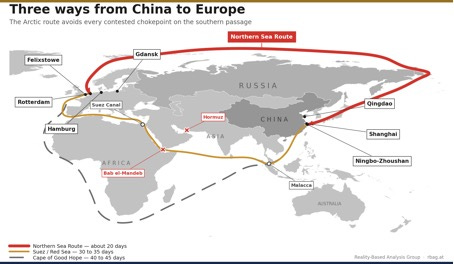
It is a consequential development. The shipping between China and Europe is the largest in the world, with China as Hamburg’s largest trading partner. In Rotterdam, Europe’s largest port, approximately 25% of the containers originate in China. These ports, as well as those in Gdansk, Poland, and Felixstowe in the UK, are the destinations for the initial eight Chinese voyages passing through the NSR. These are not symbolic trips; they are a test run on China’s most important trade route, and if sustainable, the NSR promises to revolutionize Chinese trade with Europe. Until this summer, the primary path was for a container ship to leave China from Ningbo or Shanghai, sail south through the South China Sea, west through the first chokepoint, the Strait of Malacca, across the Indian Ocean, north through the second chokepoint, the Bab el-Mandeb, into the Red Sea, through the third chokepoint, the Suez Canal, through the Mediterranean Sea and the Strait of Gibraltar, up the European coast into port. The journey typically took between thirty and forty days and involved three chokepoints, two of which are now contested. The insecurity in the Red Sea with the partial closure of the Bab el-Mandeb has already led to many shippers simply opting to take the long way around the African continent, sailing around the Cape of Good Hope, adding another ten to fourteen days to the journey, as well as three and a half thousand nautical miles and the fuel it takes to traverse it. The NSR avoids all of this, involves none of the contested chokepoints, and reduces the transit time from up to eight weeks down to twenty days.
The three routings between China and northern Europe. The Arctic passage avoids Malacca, the Bab el-Mandeb and Suez entirely.
And there is another change in the wind. Since the close of the Second World War, throughout the Cold War and the Unipolar Era, transit through maritime chokepoints was taken as a right with very few maritime chokepoints (primarily the canals) involving a price for passage. As we have demonstrated elsewhere (“The Monetization of Multipolarity”) one feature of the multipolar era is the monetization of geography, and the assertion of control of maritime chokepoints such as, inter alia, the Strait of Hormuz and the Bab el-Mandeb. Access is now no longer necessarily a function of who can afford to pay; it has become a function of who a shipper is and whether or not they are allied or aligned with the chokepoint’s country. Access has become political. Ansar Allah (known in the West as “the Houthis”) has declared a blockade on all Israeli and Saudi ships as well as any that would come from either nation’s ports. Iran has declared that no Israeli or United States vessels shall cross the Strait of Hormuz. Chinese and Russian ships have been allowed to pass through the Strait, as have ships from other nations uninvolved in the conflict, such as India. There are dozens of reports of ships broadcasting to the Persian Gulf Strait Authority (PGSA), the official Iranian body administering the Strait of Hormuz, that they are Chinese, most notably ships with English names. Whether these vessels are interdicted by the “blockade” imposed by the United States is a separate matter, one of war and peace; it further emphasizes the uncertainty of transiting the region at all. The European Union has advised all ships of US, Israeli, or Saudi origin to stay out of the Red Sea and the Gulf of Aden altogether.
Russia currently makes no such demand for political allegiance for usage of the NSR. Indeed, at the June 2026 Saint Petersburg International Economic Forum (SPIEF), Igor Sechin, the head of Russia’s state oil company, Rosneft, explicitly marketed the route as an open alternative to the crises in the Middle East. Shippers took note, especially in east Asia, where Japan and South Korea stand alongside China as among the most impacted by the chokepoint closures. The route sells itself: twenty days from China to Europe, no blockades, no wars, no war risk premiums creating underwriting uncertainty. Just a single passage with one owner and operator, one issuer of permits, and one unique nuclear-powered fleet of icebreakers to ensure passage remains open.
The timing is extraordinary. For over a century, Russia, and the Soviet Union before it, have worked on creating a sea passage across the roof of the world. Crossing through twenty-eight designated sections, over five thousand kilometers, the NSR has been explicitly designed for Chinese-Russian cooperation for a decade. In 2017, Chinese President Xi Jinping himself, while visiting Moscow, suggested naming the route the “Ice Silk Road,” one name it is marketed under today. One year later, China declared itself a “near-Arctic State,” raising the ire of the United States which, typically, responded to China’s foresight with mockery rather than action, with then-Secretary of State Mike Pompeo declaring in 2019 that there were only two types of states, “Arctic States and non-Arctic States,” and that claiming otherwise entitled China to “exactly nothing.” The Russians, on the other hand, took action, appointing Rosatom operator of the route in 2018, issuing the permit regime in 2020, inaugurating test runs between Murmansk and Kamchatka in 2022, almost tripling their ports along the route from four to eleven, and, critically, launching four new nuclear-powered icebreakers between 2020 and 2024. Less than a decade after the declaration of the Ice Silk Road, Chinese ships are transiting it under Russian escort.
The United States did more than mock China. It officially rejected Russian ownership of the passage, claiming that the Vilkitsky Strait and others are “international straits” not Russian territory. The Russian government disagrees, considering the NSR a single corridor through Russia’s own inland seas, territorial waters, and its exclusive economic zone, all governed under the same laws, same rules, and same Rosatom administration. This is the US position on all straits it wants open, irrespective of whether or not they are in territorial waters; it made the same objection against Canada regarding the Northwest Passage and against Iran in the Strait of Hormuz. In none of these have the Americans demonstrated an ability to change the fact that these straits are indeed effectively owned and operated by the countries that control the territories in which they lie.
II. The Fleet
Icebreaking is a unique challenge and the route Russia offers is routinely covered with up to three meters of solid ice. Breaking it requires a specific design delivering sustained force, over a significant period of time, and requires more power than diesel-powered ships can provide without refueling. The solution is nuclear and the Soviet Union built the first nuclear-powered surface ship in the world, the icebreaker Lenin, in 1959. From that beginning, Russia’s fleet has grown along with its technology, and today, alongside a fleet of thirty-four diesel-powered icebreakers, its nuclear fleet stands at eight, four of late Soviet design and four of the groundbreaking “Project 22220” class, the Arktika in 2020, Sibir in 2021, Ural in 2022, and Yakutia in 2024. These ships are unique in the world, with the ability to traverse both the deep sea and shallow coastal estuaries. This year is the first time all eight ships have been deployed on the same route simultaneously. Three more ships of the same class are under construction. This timing reveals another aspect of the multipolar world worth emphasizing: for almost a century Russia and the Soviet Union worked aspects of the Northern Sea Route with a fleet of ageing diesel ships and nuclear-powered ships whose hulls could not service both coastal and deep-sea water. Since President Xi Jinping’s 2017 Moscow declaration of the Ice Silk Road, Russian innovation and technology, which had led to the development, production, and deployment of the Project 22220 class nuclear icebreakers, changed passage through the NSR from a possibility to a product and created a viable maritime chokepoint where once there was merely the promise of one.
No other nation on Earth possesses a single nuclear icebreaker. The United States fields two non-nuclear icebreakers, one built a half-century ago and the other in 2000. It purchased a third, secondhand vessel last year and ordered three more ships, projected for delivery in 2030 at a cost of approximately five billion dollars. A common misconception is that only Russia can bend the steel in the way necessary to build these ships. President Putin himself clarified the record on Navy Day, 27 July 2026, when he described Russia’s competitive advantage as one of timing as well as capacity. He explained that other “high tech countries” could build nuclear icebreakers, but that it would take years, if not decades, to do so. His statement understates the challenge faced by the United States: the men who built the last heavy icebreaker in the United States did so fifty years ago and their experience and expertise left the workplace when they retired. Thus, in 2025, when the United States ordered its newest icebreaker, it turned to Finland, as does almost everyone else: eighty percent of the world’s icebreakers are built in Finland and none of them are nuclear.
Russian shipbuilding has not been immune to current events and the war in Ukraine has drastically slowed the pace of delivery from one ship a year to one every three years. Part of this is due to the destruction of critical factories and the increased costs of various components. The war has delayed the completion of the latest class of nuclear icebreaker, the Rossiya, until 2030. This ship, part of the planned expansion of the fleet to between fifteen and seventeen icebreakers, a seventy-thousand ton behemoth, is powered by two nuclear reactors, enabling it to break through up to four meters of solid ice, and wide enough to allow wider container ships to follow in its wake. This is the class of ships that will turn the now commercial seasonal route into a dependable year-round guaranteed passage. As President Putin stated, other nations may indeed build a similar fleet someday, but Russia’s is operating and expanding right now. No other nation can open a new maritime chokepoint; Russia just did.
III. The Ice Silk Road
The Chinese moniker “Ice Silk Road” applied to a uniquely Russian chokepoint is an example of the ever-deepening close relations between both superpowers. Including Russia’s NSR as part of their Belt and Road Initiative (BRI), even if only rhetorically, highlights the importance of connectivity corridors between the great powers and also emphasizes their non-Western nature. For here the United States is not relevant; payment is published in rubles, accepted in renminbi, and US dollars are uninvolved. It is yet another step in the steady dedollarization of the global economy; not by damaging the US Dollar, but by rendering it irrelevant. The route is not anti-Western, as Rosneft head Igor Sechin emphasized in Saint Petersburg; it is open to all customers, irrespective of alliance. South Korea noticed the advantages as well as everyone else, and purchased a ship in order to take advantage of it. South Korea’s first voyage on the NSR, along the Ice Silk Road, is with the newly renamed PanStar Acro; Rosatom granted its permit and it is due to depart Busan, South Korea, in late August, for several ports of call in northern Europe before heading back home.
China’s massive Belt and Road Initiative, throughout its various incarnations, is fundamentally a project of connectivity, making Chinese goods, services, and influence present and compelling in all four corners of the world. As the multipolar era solidifies, so do relations between the poles, and China and Russia continue to strengthen their ties. Just as Russia used the Power of Siberia pipelines and turned to China as a purchaser of its energy after western sanctions and weapons eliminated the transit (via NordStream) or purchase of Russian energy, China is turning to Russia to make use of the NSR to counter the instability in transiting the chokepoints of west Asia. And only Russia can provide what China needs: reliable transport to maintain and expand their flow of commerce from mainland China to the European market. Without the customers, the route loses its purpose; without the route, the commerce is threatened by the geopolitical winds of the day, the chokepoint politics, and underwriting war-risk price shocks. Together, much as the Chinese name for the Russian route implies, the NSR is a synergistic example of multipolar partnership.
This partnership also defangs some of the economic weapons the West has wielded against Russia, specifically sanctions. Russia’s flagship Arctic energy project is the “Arctic LNG 2,” a massive liquid natural gas facility designed to cool and deliver twenty million tons of LNG onto tankers on the Ob Bay, in northwestern Siberia. Western sanctions caused delivery to halt completely for nearly two years. However, since August 2025, shipments have resumed, forty-one of them, all to the same port of Beihai in southern China. A second port, specifically designed for the NSR, is being finalized in the more northern city of Longkou, and is due to open this October. It only makes economic sense because of the NSR. The sanctions on Arctic LNG 2 have not gone away; Russian and Chinese cooperation along the NSR has rendered them irrelevant. Nothing about this route requires a US Dollar; it is conducted in either yuan (renminbi) or rubles and is cleared entirely through non-Western systems. Merely five years ago, in 2021, only one-quarter of Russian-Chinese trade was conducted in local currency; now it is approximately 99%. Western attempts to isolate Russia have backfired: two of the great poles in the multipolar world continue to gravitate towards one another, and the NSR, from its usage to its payment architecture, to its unofficial Chinese “Ice Silk Road” naming, all exemplify what may be perhaps the most powerful burgeoning partnership on the planet.
IV. Greenland
One of the most misunderstood aspects of US President Trump’s second term is his serious claim that Greenland should be controlled by, if not part of, the United States rather than remain part of Denmark (let alone pursue independence). The United States has expressed interest in Greenland for over 150 years, with attempts to purchase it in both 1867 and 1946. Trump himself has repeatedly brought up the topic since 2018. His justification, however, has changed over the years, evolving from a desire for more real estate, to access to critical minerals, to the Chinese and Russian use of the NSR. At the July 2026 NATO summit in Ankara, Türkiye, he stated that Greenland was “surrounded by Chinese and Russian ships,” implying a clear threat to US sovereignty if not safety.
The United States is already an Arctic State, as Pompeo pointed out, and the closest distance between the United States and Russia is in the Arctic, between the islands of Big and Little Diomede, separated by the International Date Line and less than four kilometers of ocean. They are in the middle of the Bering Strait, where the gap between Alaska and Asian Russia eventually widens to 82 kilometers. The NSR passes through the Bering Strait, uncontestable by any nation, and continues to Europe, using the North Sea, nowhere nearing Greenland at any point. So why is President Trump interested in Greenland and how does this involve the NSR?
The Northern Sea Route runs some 5,600 km from the Kara Strait to the Bering Strait, along a single country’s coast.
There are three reasons. First, the standard explanation for America’s interest has been to secure access to critically important strategic rare earth minerals, upon which the United States’ military arsenal depends, and its current territory does not sufficiently provide. Greenland has been proven to hold at least the eighth-largest reserves in the world, specifically of neodymium, praseodymium, dysprosium, terbium, plus yttrium and gadolinium. These are the elements required for the permanent magnets found in electric vehicle motors, wind turbine generators, guided missiles, jet engines and more. Greenland law strictly limits or prohibits their extraction; American jurisdiction would not. The United States is serious about these minerals, but its actions are the topic of a separate analysis.
The second reason is Greenland’s strategic location. One end of the “GIUK Gap,” the Greenland, Iceland, and United Kingdom dominated neighborhood where Russian submarines and warships enter and exit the North Atlantic, Greenland hosts part of the archipelago of United States military bases scattered across the world. One of the most important is the Pituffik radar installation, trained on the pole watching for missiles. This interest, too, will not dissipate.
The third is an Arctic passage, although it is not the Ice Silk Road. Climate scientists theorize that in coming years, should patterns continue, ice floes in the far north will shift and the retreating ice would open a passage between Svalbard in Norway to Greenland. Should this be the case, Greenland would be at one end of yet another Arctic maritime chokepoint corridor, completely avoiding the NSR. But this is a claim on an unproven theory which may take decades to come to fruition, if it ever does. Meanwhile, no American fleet of nuclear-powered icebreakers is even under consideration. It is significantly easier and faster to make a claim on a weaker ally’s territory than it is to usher an appropriate fleet into reality. One fits easily within an election cycle; projections for the other have never been made public, if they exist at all.
This is the same approach, for many of the same reasons, that President Trump has applied to Canada. There too, the Arctic coastline provides sovereign access to the passageway across the top of the world. What it does not do is provide nearly a century of development, expertise, a permitting regime, and a unique fleet able to break and clear three meters of solid sea ice with an escort of commercial container ships trailing in their wake. Reaching for Greenland and Canada is the wrong response to the Northern Sea Route, as the route is not an accident of geography easily replicated. It is the combination of geography, technology, initiative, and history, all of which is Russian.
V. The Precedent
The NSR, the Ice Silk Road, has launched, and its first scheduled and timetabled commercial season is underway. It is already gaining new nicknames, such as “The Arctic Express.” It is in the beta-testing stage, small by design, as kinks are worked out, problems are uncovered and resolved, systems fine-tuned. Its inaugural season could not have been timed better, with geopolitical developments hindering or preventing passage through Suez, Hormuz, the Bab el-Mandeb, all making even more timely and compelling the shortened passage time, and the single owner, permitter, operator, insurer. In the same season that the world witnessed Tehran close a strait and other nations contemplate monetizing, and therefore complicating, their own, Russia is the only nation which opened one. Russia’s Arctic route exists, it works, and with the arrival in the coming years of newer more powerful icebreakers, it will be functioning year-round, on schedule. Faster than the alternatives, and free from war risk premium pricing, the NSR’s commercial draw is already attracting attention and pulling allies such as South Korea gently away from the United States’ orbit and further into Russia’s. Russia has made it clear that unlike the Strait of Hormuz or the Bab el-Mandeb, this passage is open to one and all, irrespective of country of origin or political alignment… at least, for now.
