


Between May 16 and 17 of this year, Ukraine launched approximately 1,500 long-range drones into Russia, demonstrating a growing capability to strike sensitive targets. This evolution of drone usage from tactical battlefield weapon to strategic strike capability has important implications for the course of the Ukraine war and for future military conflicts. Long-range drone warfare is transforming escalation from a sequence of discrete and legible steps into a process of continuous adjustment. Because drone strikes can be expanded incrementally in range, frequency, payload, and target selection, escalation increasingly resembles movement along a smooth ramp rather than climbing a traditional escalation ladder. The result is a growing danger of military miscalculation as escalation thresholds become increasingly uncertain.
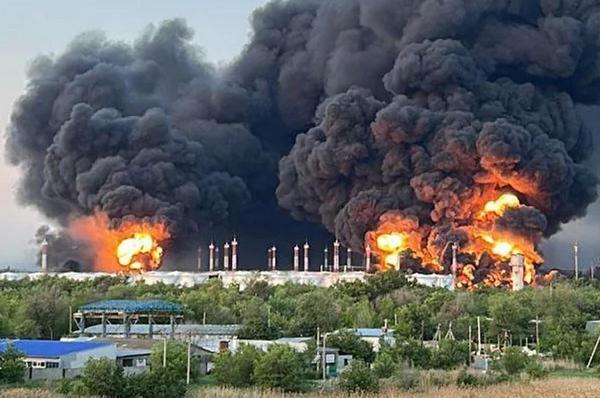
Aftermath of drone strike on Russian fuel depot
Incremental Escalation
Western debate over supplying Ukraine with long-range strike capability initially centered on the transfer of complete and highly recognizable weapons systems such as ATACMS, Storm Shadow, Taurus, and, in more speculative discussions, Tomahawk-class capabilities. These systems carried significant escalatory sensitivity because they represented overt and politically legible extensions of NATO deep-strike capacity. The concern was not merely technical range, but strategic symbolism: direct transfer of such weapons could be interpreted by Moscow as a visible crossing of a red line against enabling systematic strikes deep inside Russian territory. As a result, debates surrounding these systems were often framed in terms of explicit authorization thresholds, range restrictions, and fears of direct NATO entanglement.
Over time, however, the architecture of enablement began to shift. Rather than relying exclusively on transfer of complete strategic strike systems, Ukraine and its supporters increasingly moved toward a distributed model built around modular drone technology, decentralized assembly, commercial and dual-use components, satellite integration, software adaptation, targeting support, and dispersed manufacturing ecosystems. In this model, the strategic capability emerged incrementally through aggregation rather than through delivery of a single iconic weapons platform. Final assembly could occur locally and across multiple smaller facilities rather than within a few vulnerable centralized production sites. This distributed structure was more resilient against suppression and allowed deep-strike capability to expand without the same politically visible escalation signatures associated with direct transfer of complete NATO missile systems.
From the perspective of Ukraine’s supporters, the distributed enablement strategy offered several advantages simultaneously. It reduced vulnerability to Russian interdiction by decentralizing production and assembly, lowered the political visibility of escalation, and preserved a degree of formal separation between NATO governments and Ukrainian deep-strike operations. The resulting ambiguity allowed supporting states to argue that they were assisting Ukraine’s domestic defense industry rather than directly supplying strategic offensive weapons. Yet this distinction may appear progressively less meaningful from Moscow’s perspective as increasingly sophisticated long-range strikes penetrate deeper into Russian territory using capabilities that depend heavily on Western components, intelligence, navigation systems, software, and logistical ecosystems. Russia is likely to evaluate the situation less according to legal distinctions than according to operational outcomes.
The Strategic Threat
Ukraine’s growing ability to strike high-value targets deep inside Russia poses a number of increasingly serious strategic problems. Although Russia possesses highly capable layered air defense systems, including advanced long-range interceptors and point-defense networks, even sophisticated air defense architectures face severe difficulties when attempting to defend a vast national territory against persistent and distributed drone attack. Air defense resources are finite, geographically constrained, and subject to continual allocation tradeoffs. Protecting one category of infrastructure necessarily reduces protection elsewhere.
With the aid of Western intelligence, satellite reconnaissance, communications support, and targeting resources, Ukraine can increasingly direct deep strikes against vulnerable points within Russia’s strategic infrastructure. Strike patterns can be shifted continuously, forcing Russian defenses into a reactive posture. Low-cost drones can also be launched in sufficient numbers to saturate local defenses, particularly when attacks combine multiple vectors, varying flight paths, and repeated probing operations intended to identify defensive gaps.
Recent Ukrainian attacks have demonstrated the growing reach and adaptability of this strategy. Drone strikes have repeatedly targeted Russian oil refineries, fuel depots, aviation facilities, air defense sites, and industrial infrastructure hundreds of kilometers from the battlefield. Facilities associated with fuel production and refining have proven particularly vulnerable because they combine economic importance, operational military relevance, and physical fragility. Even temporary disruption of refinery operations can create logistical strain, increase repair burdens, and force Russia to redistribute air defense assets away from other critical targets.
Russian strategic aviation infrastructure has also become increasingly exposed. Ukrainian long-range strikes against airbases associated with bomber operations and support facilities have demonstrated that rear-area sanctuary can no longer be assumed. Even when material damage remains limited, repeated penetration of defended airspace imposes psychological, operational, and political costs by forcing continual reassessment of defensive posture and infrastructure vulnerability.
The cumulative effect extends beyond direct physical destruction. Distributed deep-strike campaigns create persistent uncertainty across a broad strategic rear area. Industrial facilities, transportation networks, logistics hubs, and energy infrastructure must all devote increasing resources toward protection, redundancy, repair, and operational adaptation. The strategic burden therefore emerges not only from successful strikes, but from the constant requirement to defend against future attacks whose timing, direction, and concentration remain unpredictable.
The political and psychological effects may be equally important. Successful Ukrainian strikes deep inside Russia sustain Western perceptions that Ukraine remains operationally viable and strategically innovative despite the grinding attritional character of the broader war. These operations reinforce political support for continued military aid while simultaneously bolstering Ukrainian morale through demonstrations that Russia’s strategic depth is not invulnerable. At the same time, repeated penetration of Russian rear areas may increase internal political pressure on the Kremlin to restore deterrence credibility through progressively stronger retaliatory measures.
The Interdiction Problem
Ukraine’s distributed drone enablement strategy creates a severe interdiction problem for Russia. Transfer or production of complete strike weapons could theoretically be disrupted through the identification and destruction of major depots, fixed launch systems, centralized production facilities, or large military formations. Distributed drone warfare radically alters this equation.
Ukraine’s western logistical interface with NATO now extends across an enormous and highly fragmented frontier system. The Poland–Ukraine border alone stretches for more than 500 kilometers and contains numerous active road and rail crossing points supporting continuous civilian and commercial traffic. Additional supply access exists through Romania, Slovakia, and Hungary. The result is not a single supply corridor, but a broad logistical membrane spanning multiple NATO states. This creates an interdiction environment of exceptional complexity. Drone components can be transported incrementally through ordinary commercial logistics networks rather than through visibly military supply convoys. Guidance electronics, optics, engines, batteries, machine tools, software systems, communications equipment, and composite materials often possess legitimate civilian applications, making selective interdiction extraordinarily difficult.
The distributed nature of assembly further complicates the problem. A modern long-range drone capability no longer requires a single large manufacturing complex vulnerable to conventional strike operations. Components can be dispersed across numerous workshops, subcontractors, and assembly sites, allowing production capacity to regenerate even after successful attacks on individual facilities. As a result, effective interdiction would increasingly require Russia to contemplate strikes not only against key Ukrainian targets, but against the broader logistical ecosystem enabling the flow of components and technical support. This creates a dangerous escalation dynamic. The more successful distributed enablement becomes, the more the distinction between the battlefield and the NATO rear area begins to erode.
Assembly of Ukrainian Flamingo long-range strike drone
Escalation Threshold Opacity
One of the most destabilizing characteristics of distributed drone warfare is the growing opacity surrounding actual escalation thresholds. Traditional escalation frameworks relied on politically visible threshold events such as mobilization, strategic bombing campaigns, or transfer of major weapons systems. Distributed drone enablement blurs these distinctions by allowing strategic strike capability to emerge incrementally through dispersed technological ecosystems.
From the Western perspective, these distinctions preserve formal separation between NATO governments and Ukrainian operational control. From Moscow’s perspective, however, the distinction between “Ukrainian-made” and “NATO-enabled” systems may appear increasingly artificial if the strategic effects are functionally identical. The danger is not merely uncertainty about where the red lines are located, but that prolonged ambiguity encourages continuous probing behavior. If repeated incremental escalation produces no immediate catastrophic response, decision-makers may incorrectly infer that future escalation will remain equally manageable even when actual retaliatory thresholds remain uncertain, adaptive, or deliberately undisclosed.
Potential Russian Escalation
Russia is unlikely to remain passive in the face of expanding deep-strike campaigns against its strategic rear areas. Potential responses could range from broader mobilization and expanded targeting doctrine to attacks on NATO reconnaissance systems and logistical infrastructure, possibly culminating in strategic nuclear signaling. The danger lies not merely in any single response, but in the cumulative escalation logic linking them together in pursuit of escalation dominance.
Conclusion
The expansion of NATO-enabled Ukrainian deep-strike capability may be pushing the war toward a dangerously unstable phase. Drone warfare has transformed battlefield tactics in Ukraine, but it has also begun eroding some of the assumptions that once constrained escalation between major powers. Long-range drone campaigns allow pressure to increase smoothly and continuously in range, frequency, payload, and target selection, replacing the visible rungs of the traditional escalation ladder with a more ambiguous escalation ramp. This creates a dangerous strategic psychology. Because escalation can occur incrementally and without dramatic threshold events, decision-makers may infer from prior restraint that future escalation will also remain controllable. Yet the actual retaliatory limits involved may be misunderstood by both sides.
The distributed enablement model adopted by Ukraine’s supporters further complicates this dynamic. By providing strategic strike capability through decentralized supply chains, modular components, software integration, targeting support, and dispersed assembly, NATO states avoided the direct transfer of long-range weapons while enabling increasingly capable deep-strike operations. From Moscow’s perspective, however, this distinction may become less meaningful as the strikes become more damaging. The greatest danger may not be deliberate pursuit of wider war by either side. It may instead arise from the cumulative logic of incremental escalation itself. Gradual escalation can obscure proximity to retaliatory thresholds until after they have already been crossed. The danger is not merely provoking a caged bear, but mistaking the strength of the cage.
