


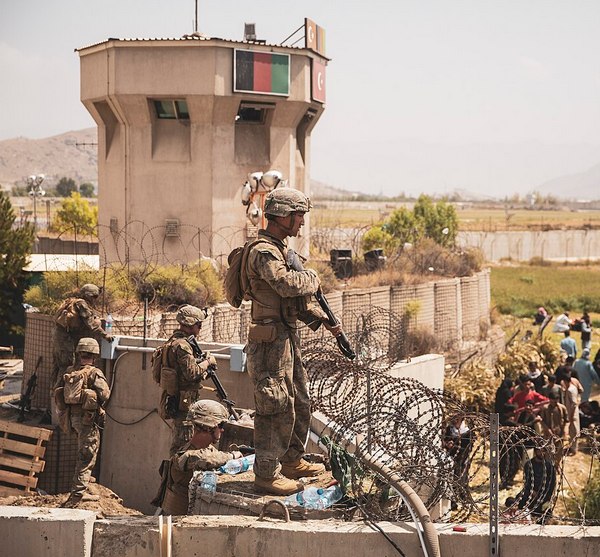
The collapse of the American-backed government in Afghanistan in August 2021 brought a humiliating conclusion to the longest war in United States history. After twenty years of military operations, expenditures measured in trillions of dollars, and immense human suffering, the Taliban returned to power with astonishing speed. The Afghan security forces, painstakingly equipped and trained by the United States and its allies, disintegrated as the government they were supposed to defend collapsed. The final evacuation from Kabul became an indelible image of strategic failure.
Inglorious U.S. exit from Afghanistan – Kabul airport, 20 August, 2021
The defeat was unmistakable. Its consequences for the American national security establishment were considerably less apparent. Senior military commanders moved into prominent government, corporate, and policy positions. The institutions that had planned, justified, financed, and sustained the war retained their authority and influence. Despite extensive acknowledgment of mistakes and misjudgments, the underlying machinery of American military power remained substantially intact.
Afghanistan thus presents a problem more disturbing than the failure of a particular intervention. How could an undertaking of such duration and expense persist despite mounting evidence that its strategic objectives were not being achieved? And why did its collapse produce so little fundamental reconsideration of the institutions responsible for conducting and supporting it?
In literature, ghosts haunt the living because something remains unresolved. The ghost of the Afghanistan war is not merely the memory of a disastrous campaign. It is the unresolved problem of a national security establishment remarkably resistant to the corrective lessons of its own failures. The war ended, but the institutional conditions that sustained it have not.
Failure Beyond Dispute
The American intervention in Afghanistan began in October 2001 with a limited strategic objective: destroy al-Qaeda’s operational sanctuary and prevent Afghanistan from serving as a base for further attacks against the United States. The initial campaign rapidly displaced the Taliban government and disrupted al-Qaeda’s presence. These were substantial military achievements, but they did not establish a durable political order capable of preventing the return of hostile forces.
Over the following two decades, the mission expanded to encompass counterinsurgency, state-building, military reconstruction, economic development, and political transformation. The United States and its allies sought to create an Afghan government and security establishment capable of surviving without indefinite foreign support. Successive administrations modified their methods, troop levels, and timetables, but Afghan institutions remained critically dependent on American financing, logistics, intelligence, airpower, and contractors.
The scale of the undertaking was extraordinary. More than 2,400 American service members died, tens of thousands were wounded, and Afghan military personnel and civilians suffered vastly greater losses. Brown University’s Costs of War project estimated the total U.S. financial cost at approximately $2.3 trillion, including military operations, related expenditures, veterans’ care, and interest on war-related borrowing. At its peak, approximately 100,000 American troops were deployed in Afghanistan. Yet the political and military structures built at such expense collapsed on August 15, 2021, before the American withdrawal was complete.
The intervention nevertheless achieved some important results. Al-Qaeda’s original sanctuary was disrupted, terrorist networks faced sustained pressure, and millions of Afghans gained access to education, healthcare, and other services. But these accomplishments did not fulfill the expanded strategic objective of establishing a sustainable Afghan government capable of maintaining security without indefinite American assistance.
After twenty years of extraordinary military and financial effort, the Taliban regained control of Afghanistan. The more consequential question is why the American national security establishment remained committed to the undertaking despite mounting evidence that its strategic objectives were not being achieved.
A Failed War for a Counterfeit Strategy
The transformation of the Afghanistan intervention from a limited counterterrorism operation into a twenty-year military commitment reflected a fundamental defect in its strategic framework. The Global War on Terrorism (GWOT) became an organizing principle of American national security policy, but terrorism is a method of political violence, not a unified adversary with a common command structure, territorial base, or set of objectives. Declaring war on terrorism identified a category of hostile activity without establishing the conditions under which the conflict could be considered concluded.
Once the Taliban government had been overthrown and al-Qaeda’s original infrastructure dispersed, the American mission lacked a clearly defined terminal condition. Preventing the reestablishment of terrorist sanctuaries became intertwined with defeating the Taliban, constructing a viable Afghan state, developing democratic institutions, and transforming the country’s political and social order. Each undertaking generated additional requirements, while shortcomings in one area justified continued efforts in others.
This expansion created a self-reinforcing strategic dependency. The Afghan government could not survive without effective security forces; those forces depended on extensive American assistance; and withdrawal threatened to undo the political achievements used to justify the intervention. The inability to establish sustainable Afghan institutions consequently became an argument for prolonging the effort to establish them. Evidence of failure became a rationale for continuation.
The intervention also exhibited strategic iatrogenesis: measures intended to suppress a threat contributed to its persistence. Foreign occupation, civilian casualties, abusive local security practices, and association with a government widely perceived as corrupt or dependent on outsiders furnished grievances the Taliban could exploit for recruitment and political legitimacy. The Taliban retained its own ideological commitments and external sources of support, but American operations could simultaneously weaken insurgent forces tactically and contribute to conditions sustaining resistance strategically.
The GWOT framework obscured this contradiction. Military operations could be evaluated by enemies killed, territory secured, Afghan forces trained, and resources expended, while their contribution to a durable political settlement remained uncertain. The counterfeit strategy made the criteria for success sufficiently indefinite that acknowledgment of failure could be repeatedly deferred.
Orthodoxy and Heresy
The Global War on Terrorism acquired a political authority that extended well beyond its dubious value as a strategic framework. Following the September 11 attacks, preventing another terrorist catastrophe became an overriding national security imperative. Policies justified as necessary to avert such an attack enjoyed a powerful presumption of legitimacy, while proposals to reduce military commitments could be portrayed as accepting intolerable risks. The burden of proof fell disproportionately on those questioning continued intervention.
The prevailing argument was that withdrawal from Afghanistan would permit the Taliban to regain power, restore a sanctuary for international terrorism, and expose the United States to another September 11. These possibilities could not be dismissed, but neither did they establish that indefinite military intervention was necessary or sufficient to prevent them. The distinction between a conceivable danger and a sound strategy for managing it became obscured.
The Obama administration’s deliberations in 2009 illustrate the power of this orthodoxy. President Obama inherited a deteriorating campaign and undertook an extensive strategic review. Vice President Joseph Biden and other officials favored a narrower counterterrorism mission, while senior military commanders advocated expanded counterinsurgency operations. General Stanley McChrystal warned that the campaign risked failure without additional forces. Obama ultimately authorized a surge of 30,000 troops while announcing that their withdrawal would begin in July 2011.
Alternatives were considered, but the debate centered largely on competing methods of achieving American objectives within Afghanistan. Whether additional forces, different tactics, and accelerated development of Afghan institutions could reverse the deteriorating situation received greater attention than the fundamental question of whether military intervention could establish a durable Afghan political order. The possibility that the undertaking itself was strategically unsound remained difficult to translate into acceptable policy.
The prevailing orthodoxy could accommodate disappointing results without surrendering its assumptions. Military setbacks could be attributed to insufficient forces, inadequate time, or political constraints. Continued Afghan dependence on American assistance demonstrated the need for further training and support. These explanations might contain elements of truth, but collectively they made the strategy resistant to disconfirmation. Failure became evidence that prescribed measures had not been applied adequately rather than grounds for questioning their effectiveness.
This pattern did not require unanimity or deliberate misrepresentation. The campaign was repeatedly contested within government and the wider policy community. Nevertheless, continued engagement was generally treated as the responsible response to uncertainty, while disengagement carried immediate political risks. Successive administrations could revise operational plans, replace commanders, and announce new timetables without fundamentally reconsidering the commitment itself. Orthodoxy permitted adaptation while constraining the range of acceptable strategic choices.
War Power Has No Reverse Gear
The persistence of the Afghanistan campaign cannot be explained solely by strategic misconceptions or political reluctance to acknowledge failure. It also reflected the institutional structure of the American War Power ecosystem. The organizations responsible for conducting, supplying, financing, and legitimizing the war possessed different responsibilities and incentives, but their convergent activities sustained an undertaking whose strategic purpose remained unfulfilled.
Military commanders sought to accomplish assigned missions, protect their forces, and maintain operational effectiveness. Intelligence agencies worked to disrupt terrorist networks, while civilian agencies pursued reconstruction and governance. Defense contractors supplied equipment, logistics, security, and technical services. Congressional representatives supported military expenditures that served national security objectives while benefiting constituents and local economies. Each institution could fulfill its assigned responsibilities without establishing that the overall campaign was capable of achieving a sustainable political settlement.
This was fractional rationality operating on an extraordinary scale. Decisions that made sense within specialized institutional domains did not necessarily contribute to a coherent strategic outcome. Commanders could improve operational performance without altering the political conditions sustaining the insurgency. Contractors could fulfill procurement agreements regardless of their contribution to long-term security. Reconstruction agencies could complete projects that Afghan institutions lacked the resources to maintain. Success within the component organizations was not equivalent to success for the enterprise as a whole.
Financial incentives reinforced this divergence. The war generated an immense market for military equipment, construction, logistics, private security, and technical services. Contractors were compensated for providing goods and services, not for securing a durable political outcome. Although modern military operations depend on commercial suppliers, this arrangement separated commercial success from strategic success. An unsuccessful campaign could sustain profitable activity, while its termination eliminated substantial revenue.
Government institutions faced their own incentives. Continued engagement sustained missions, appropriations, organizational responsibilities, and professional opportunities. For political leaders, withdrawal risked an immediate and visible setback for which they could be held responsible, while continuation dispersed costs across future budgets and administrations. Another attempt to improve the situation was often politically easier than acknowledging that the undertaking might be incapable of achieving its objectives.
Even operational improvements could weaken pressures for strategic reconsideration. Force protection, medical evacuation, intelligence, and precision operations helped limit American casualties. These were genuine accomplishments, but the comparatively low American death toll, relative to the war’s duration, also reduced the domestic political pressure that greater losses might have generated. The vastly greater costs borne by Afghans exerted less direct influence on American decisions. Protecting American forces more effectively did not establish that the war was improving American security.
The circulation of personnel among military commands, government agencies, defense firms, consulting organizations, and policy institutions further reinforced continuity. Such movement preserved expertise but could also perpetuate prevailing assumptions. The same professional community that developed and administered military policy remained influential in interpreting its results.
No conspiracy was required. Participants could act conscientiously, disagree over tactics, and sincerely regret the accumulating losses. The difficulty was that responsibility for the aggregate strategic outcome remained diffuse, while individual organizations retained incentives to continue their assigned activities. The War Power ecosystem exhibited a form of institutional failure immunity: the capacity to preserve authority, resources, and governing assumptions despite strategic outcomes that should compel fundamental reconsideration.
The campaign’s final collapse exposed another dimension of institutional dysfunction. After twenty years of intelligence collection, military assistance, and repeated assessments of Afghan capabilities, the American national security establishment failed to anticipate the speed with which the government and its security forces would disintegrate. Although warnings of possible collapse existed, contingency preparations did not adequately address the prospect of Kabul falling before the American withdrawal was complete. The prolonged campaign appears to have produced a form of strategic numbness: repeated setbacks had become so familiar that the system was poorly prepared to recognize and respond to an abrupt, catastrophic deterioration.
War Power thus operated as an institutional ratchet. Setbacks generated demands for additional resources and revised tactics; improvements encouraged confidence that success was approaching. The machinery could accelerate and reorganize, but it had no reliable reverse gear. As the withdrawal approached completion, the Afghan state disintegrated, and the campaign ended in a chaotic and humiliating evacuation.
The Alchemy of Defeat
Military defeat does not necessarily discredit the strategic assumptions that produced it. An unsuccessful campaign can instead be reinterpreted as evidence that the original strategy was sound but inadequately executed. Insufficient resources, political interference, and premature withdrawal become explanations that preserve confidence in the underlying enterprise.
The American experience in Vietnam established a familiar pattern. Following the collapse of South Vietnam in 1975, explanations emphasized restrictions on military operations, declining domestic support, and the withdrawal of American assistance. Some of these factors genuinely affected the conflict. Yet arguments that greater military freedom or continued support could have produced victory also diverted attention from a more fundamental question: whether American military power could establish a durable political order in South Vietnam at an acceptable cost.
A similar interpretive struggle followed the collapse of the Afghan government in August 2021. Critics argued that maintaining a relatively small American military presence could have prevented the Taliban’s return to power. Others emphasized the abandonment of Afghan partners, diminished American credibility, and failures in executing the withdrawal. These criticisms raised legitimate questions, but they did not resolve the strategic problem that preceded withdrawal: after twenty years of assistance, the Afghan government remained unable to defend itself without substantial foreign support.
Continued American assistance might indeed have prevented an immediate collapse. American airpower, intelligence, logistics, and contractors remained indispensable to Afghan security forces. But preventing collapse through continued intervention was not equivalent to establishing a sustainable Afghan state. If twenty years were insufficient, why would another five, ten, or twenty have produced a different result? The claim that additional time would eventually have achieved strategic success requires a plausible explanation of how the underlying political and institutional deficiencies would have been overcome.
This is the alchemy of defeat: the failure of a prolonged military intervention becomes evidence that it should have continued. Responsibility shifts from the strategic design of the undertaking to the political decision to terminate it. A strategy that failed in practice is preserved in retrospect as a strategy abandoned too soon.
Such interpretations need not involve deliberate deception. Policymakers and military officers may sincerely believe that different decisions would have produced better results. The analytical defect arises when explanations of how a defeat occurred substitute for examination of why the larger undertaking failed. Vietnam and Afghanistan differed substantially, but both generated arguments that emphasized constraints on military power rather than limitations in what military power could accomplish. When defeat can be explained without reconsidering the premises that sustained the war, the lessons drawn from failure may reinforce rather than correct the system’s characteristic behavior.
Regrets Only
The fall of Kabul produced an outpouring of retrospective criticism. Military commanders, policymakers, journalists, and national security analysts acknowledged mistaken assumptions, flawed decisions, and immense human costs. Investigations documented unrealistic objectives, misleading assessments of progress, and the construction of institutions that could not survive without American support. The national security establishment appeared prepared to acknowledge the war’s failure.
Acknowledgment, however, is not accountability. Institutions can recognize errors without changing the incentives, decision-making procedures, and governing assumptions that produced them. Retrospective criticism can even help restore institutional credibility by demonstrating apparent candor while leaving the underlying structure intact.
Carter Malkasian’s 2026 Foreign Affairs retrospective, “The Afghanistan Reckoning: Forever Wars and the Costs of Collective Forgetting,” illustrates the limitations of this approach. Malkasian, a historian of the conflict, former senior civilian adviser to the chairman of the Joint Chiefs of Staff, and faculty member at the National War College, identifies serious failures of judgment, exaggerated threat assessments, and institutional biases. Yet his prescriptions principally concern improving the methods and judgments of existing institutions rather than reforming the institutional system to improve its collective strategic effectiveness. Better intelligence, more realistic assessments, and sounder decisions may improve institutional performance without correcting the systemic dysfunctions that produce strategic failure.
Personal regret among senior officials may be genuine without producing consequences proportionate to the enterprise’s failure. Responsibility was distributed across successive administrations, military commands, intelligence agencies, Congress, and civilian institutions. No individual controlled the entire undertaking, but this diffusion of responsibility also made collective accountability elusive.
The result is a ritual of institutional contrition devoid of problem recognition. Participants acknowledge the tragedy, honor the sacrifices, and solemnly resolve that the mistakes must never be repeated. Yet the institutional mechanisms responsible for perpetuating unsuccessful campaigns remain largely unacknowledged and undisturbed. The danger is not that the national security establishment has forgotten Afghanistan, but that it can remember the war’s outcome while preserving the conditions that could produce another such failure.
Collective Failure and Career Success
The professional career trajectories of senior American commanders illustrate the continuity of the War Power establishment despite the Afghanistan debacle. David Petraeus commanded coalition forces in Afghanistan in 2010–2011, subsequently directed the Central Intelligence Agency, and later joined the investment firm KKR. Joseph Dunford commanded U.S. and NATO forces in Afghanistan in 2013–2014, served as Chairman of the Joint Chiefs of Staff from 2015 to 2019, and became chief executive officer of the Center for Strategic and International Studies (CSIS) in May 2026. Mark Milley, who also held senior command responsibilities in Afghanistan, served as Army Chief of Staff from 2015 to 2019 and succeeded Dunford as Chairman of the Joint Chiefs, serving from 2019 to 2023. Other commanders moved into defense industry management, corporate boards, consulting, and policy institutions.
These careers do not establish individual responsibility for the war’s outcome or imply that subsequent appointments were undeserved. Most of the senior appointments cited preceded the final collapse in 2021. Nevertheless, experience acquired during the campaign remained a qualification for influential positions, even as the assumptions and decisions underlying the intervention became increasingly questionable. The pattern raises a fundamental institutional question: How could professional evaluation and career advancement remain so disconnected from the strategic failure of the undertaking?
Institutional continuity extended well beyond individual careers. The Department of Defense, intelligence agencies, defense contractors, congressional committees, and national security policy institutions retained their central roles in assessing threats, developing capabilities, allocating resources, and legitimizing strategic doctrines. Withdrawal ended Afghanistan-specific operations and expenditures, but did not fundamentally alter the relationships through which American military policy was formulated and implemented.
Afghanistan did produce changes. Counterterrorism operations were reorganized, defense planning shifted toward competition with China and Russia, and military services revised aspects of their doctrines and procurement priorities. The Special Inspector General for Afghanistan Reconstruction documented extensive failures, while congressional investigations and independent assessments established a substantial record for future policymakers. These developments, however, were principally adaptations within the existing institutional framework rather than reconsideration of the framework itself.
A military establishment can redirect resources from counterinsurgency toward great-power competition without changing its assumptions about the relationship between military capability and national security. Defense contractors can produce different weapons without altering procurement incentives. Policy institutions can abandon discredited arguments for nation-building while continuing to regard expanding military capabilities as the principal response to international insecurity. The missions change, but the institutional relationships and measures of success remain familiar.
The persistence of these institutions is not inherently dysfunctional. The United States requires armed forces, intelligence capabilities, defense industries, and competent strategic analysis. The relevant question is whether Afghanistan produced reforms proportionate to the deficiencies it revealed: mechanisms for testing strategic assumptions, evaluating aggregate outcomes, identifying counterproductive interventions, and terminating commitments whose objectives have become unattainable. Perhaps the most extraordinary feature of the Afghanistan debacle was the imperturbability of the American national security establishment in its aftermath. An undertaking of immense duration, expense, and human cost ended in humiliating strategic collapse, yet the institutions responsible for sustaining it emerged with their authority, resources, and influence substantially intact.
Conclusion
The Afghanistan war ended in 2021, but the institutional problems it exposed remain unresolved. The danger is not necessarily another Afghanistan, but another costly failed military undertaking governed by faulty assumptions and perverse institutional incentives. Political leadership cannot easily overcome the inertia of institutions that frame threats, define acceptable policy options, and shape and sustain military campaigns.
The 2026 conflict with Iran offers a contemporary test of this proposition. President Donald Trump returned to office after campaigning against prolonged foreign wars, yet in February his administration joined Israel in initiating military operations against Iran. Nearly nine months later, the conflict remains unresolved. Its circumstances differ substantially from Afghanistan, and its ultimate outcome cannot yet be determined. Nevertheless, the conflict raises important questions about the capacity of the American national security establishment to formulate attainable strategic objectives, assess progress toward their achievement, and recognize when military operations are failing to serve them
Exorcising the ghost of Afghanistan will require more than improved military planning or solemn remembrance of past sacrifices. It will require institutional arrangements capable of challenging the governing assumptions of War Power and developing credible alternatives to its methods. Without such institutional transformation, the ghosts of America’s failed wars will continue to gather, haunting a national security establishment that remembers its defeats but fails to correct the conditions that produced them.
