


Weapons of terror from the depths
Russia plans to deploy submarine-launched, nuclear-powered stealth drones that can travel thousands of kilometers beneath the waves and detonate off the coast of coastal cities. This is the new threat posed by Russia’s underwater nuclear weapon “Poseidon” (also known as Status 6 or NATO’s “Canion”). According to open source reports, Poseidon is designed to operate at depth, high speed, and long range to attack the coastlines of the United States and its allies, bypassing missile defenses. This article examines the impact of Russia’s Poseidon weapon on the balance of nuclear terrorism.
poseidon nuclear torpedo
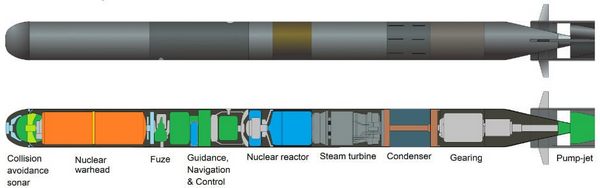
Poseidon is often described as a torpedo, but it is much larger than existing torpedoes. It is approximately 80 feet long and 5 to 7 feet wide. The enormous power of the nuclear propulsion system will allow it to reach underwater speeds of approximately 160 miles per hour, making it faster than existing submarines and conventional torpedoes. Poseidon carries an estimated 1-2 megaton nuclear warhead, approximately 50 times more powerful than the Hiroshima and Nagasaki bombs. Russia has just commissioned Khabarovsk, the first of its new nuclear submarines carrying the Poseidon. Khabarovsk can carry six Poseidons and can fire them at targets thousands of kilometers away. Poseidon is scheduled to enter service after completing additional sea trials.
Massive destruction and deadly aftermath
When a Poseidon nuclear warhead explodes near a port city, the port infrastructure is completely destroyed and the port becomes unusable for a long time. Although an underwater explosion would cause less extensive physical damage to a coastal city than an airborne explosion, the radioactive fallout would pose a serious long-term contamination problem, as the target city would be drained and partially flooded by radioactive water and debris displaced by the nuclear explosion. Analysts deny claims that Poseidon’s warhead could cause a “tsunami,” but the shower of radioactive fallout would still cause major damage and render large metropolitan areas uninhabitable for long periods of time.
Fallout on land settles quickly and loses most of its danger within two weeks, but radioactive contamination from underwater explosions remains dangerous much longer. When a nuclear explosive device detonates in seawater, the fission products bind to fine salt crystals and suspended sediment rather than to heavier soil particles. These microscopic particles are transported by tides and ocean currents and continue to move, continually re-colonizing shorelines, docks, and the bottom of harbors. Long-lived isotopes such as cesium-137 and strontium-90 become trapped in mud and marine life, causing chronic rather than episodic pollution. The result is a self-regenerating radioactive hazard that, once purified, is never forgotten. It must be isolated, dredged and monitored for decades.
Decontaminating coastal cities after a shallow, multi-megaton offshore explosion would be extremely difficult, time-consuming, and expensive. Radioactive seawater and contaminated sediments can be left behind by wave and tidal action. The cleanup will not be a one-time cleanup, but a long-term operation of isolation, repeated cleaning, targeted demolition, dredging of “hot” sediment, and safe disposal of large amounts of contaminated material.
Although emergency triage may be completed in days or weeks, major restoration of functionality at major port facilities may take months, and complete restoration or safe reuse of all severely affected waterfront areas may take years or decades. Decontamination would be extremely expensive. Estimates for major port cities range from tens of billions of dollars to low hundreds of billions of dollars, and this does not include the broader economic damage caused by loss of commerce, long-term health monitoring, and political and social costs. This makes Poseidon a devastating threat.
Why is defense technically and logistically difficult?
The cost of defense against Poseidon weapons is determined by several technical and logistical factors. Its nuclear propulsion system gives this weapon extraordinary speed, range, and payload capabilities. Poseidon also benefits from the submarine’s inherent stealth characteristics, with its design optimized to reduce acoustic detection. Due to its extremely long range, a single Poseidon can threaten many coastal targets over a wide distance, requiring defenders to cover entire coastal zones, chokepoints, and undersea corridors with sensor networks and counterforces. Simply put, the cost of Poseidon’s attacks is much lower than the cost of defending against it.
Expensive defense-in-depth requirements
In the absence of existing defenses against Poseidon, the United States will need to create an entirely new high-end undersea detection and interception architecture. A realistic package for a single major port, including undersea sensor fields, mobile ASW/unmanned systems, dedicated command and control nodes, and an interception layer (torpedoes and defensive UUVs) would likely cost in the region of $5 billion per city over 10 years, including operations and maintenance. Expanding this to about 20 economically important U.S. coastal cities would push the 10-year bill into the $100-140 billion range, and that’s before accounting for national research and development, testing, and program management. In other words, Russia could impose a triple-digit billion defense burden on the United States by fielding a relatively small number of exotic underwater weapons.
submarine detection network
tethered torpedo mine
The need for new arms control
The emergence of Poseidon is further evidence of a return to the nuclear arms race that characterized the Cold War. The US missile defense buildup has put pressure on Russia to develop unusual systems like Poseidon to maintain strategic retaliatory power. In this dynamic, one state’s defense investment prompts another state to invest in specialized delivery systems, which in turn forces further defense spending. Arms control agreements are the only way to avoid the endless increase in defense spending and the risk of nuclear war caused by an arms race.
A treaty banning Poseidon-type underwater nuclear weapons would have clear benefits for both powers. For the United States, it would eliminate difficult-to-detect, high-level threats to densely populated coastlines and save the United States significant costs in developing and maintaining a national underwater detection and defense network. For Russia, it would trade strategic stability, budget relief, and international legitimacy as a responsible actor in shaping the next generation of arms control norms for an expensive, technologically demanding, niche program. Both would reduce the risk of accidents, environmental pollution, and crisis miscalculations while retaining the freedom to pursue traditional unmanned undersea technology. In short, each gains stability, predictability, and economic efficiency by outlawing a class of weapons that promises nothing but security concerns and catastrophic defense spending.
conclusion
Given the cost asymmetries, the technical difficulties of defense, and the strategic destabilization posed by weapons like Poseidon, a reasonable response is to limit or eliminate such systems through arms control. The only sustainable path forward is negotiations that limit the implementation of these new undersea strategic systems. This would establish a verification regime, restore transparency, and recommit to the nuclear risk reduction framework to restore strategic stability. Without a return to nuclear arms control, the world will face new terrorist weapons like Poseidon, and the chances of averting catastrophe will diminish.
