


Whatever one might say about the 2026 World Cup, it has been eventful. Controversial, yes, downright dystopian at times, and quite possibly rigged, but eventful.
This will be my last article on the 2026 World Cup (though I am planning to do a post on the massive growth of sports gambling in the US), so all you non-football fans can breath a sigh of relief.
On Wednesday night (European time), Argentina treated the world to a display of both the most sublime and some of the most ignoble aspects of its particular brand of football. That included, inevitably, plenty of “shithousery”, a British slang term — rooted deeply in football culture — that denotes the deliberate use of the “dark arts,” wily gamesmanship, and underhanded tactics to goad opponents, waste time, and gain an unfair advantage.
My native England, for its part, did what it always does on the biggest stage (even with a German coach pulling the strings): it bottled it.
After going up one-nil in the early minutes of the second half, England decided to defend for 30 minutes against one of the world’s most attacking teams without any kind of counter-attacking outlet. Both the coach and the team gave Messi, arguably the world’s best ever footballer, and his teammates, all of them late-goal specialists, license to launch wave after wave of attack.
As the football analyst Adam Cleary points out, England’s defeat is primarily the result of “some of the most damaging late-game substitutions I have ever seen at this level”. After scoring their goal, England had just 12% of possession against Argentina’s 88%. That is apparently the lowest rate by a team to be winning for at least 10 minutes in any World Cup game in the last 60 years.
The whole farce brought to my mind these three lines from Pink Floyd’s “Time”:
Hanging on in quiet desperation is the English way,
The time is gone, the song is over, thought I’d something more to say,
Home, Home again…
This is part of a recurring theme for the country’s long-suffering fans…
🏴 England after taking a 1-0 lead in knockout heartbreakers:
🆚 Argentina (WC SF) → 1 shot on target
🆚 Italy (Euros Final) → 0 shots on target
🆚 Croatia (WC SF) → 0 shots on target
😩 Same script, different final. When will it change? pic.twitter.com/g6VTR3nxuf
— FIFA World Cup Stats (@alimo_philip) July 16, 2026
In other words, the English team, and particularly its German manager, have only themselves to blame for the final result. Having said that, on the whole the referees did appear to give Argentina the rub of the green — not for the first time this tournament.
Anything Goes…
In the third minute of the match, the Argentine midfielder Enzo Fernández set the tone by applying a closed fist to the back of Elliot Anderson’s neck, for which he was not even awarded a yellow card, let alone a red.
As some commenters have pointed out, back-of-the-head punches, or rabbit punches, are illegal in boxing, MMA and across all combat sports due to the potential to cause severe and irreversible injuries. In this instance, however, the foul didn’t even warrant a yellow card. Or a VAR check. Minutes later, the same player cut off an England counter with a trip on the edge of the area. Again, no sanction. Fernández would go on to score Argentina’s equaliser.
I’ve played MMA for quite a while now. And a back of the head hit (called a rabbit punch) is illegal even in combat sports. Not in football apparently. https://t.co/IaemR2GP8p
— Nabaarun Barooah (@BarooahNabaarun) July 16, 2026
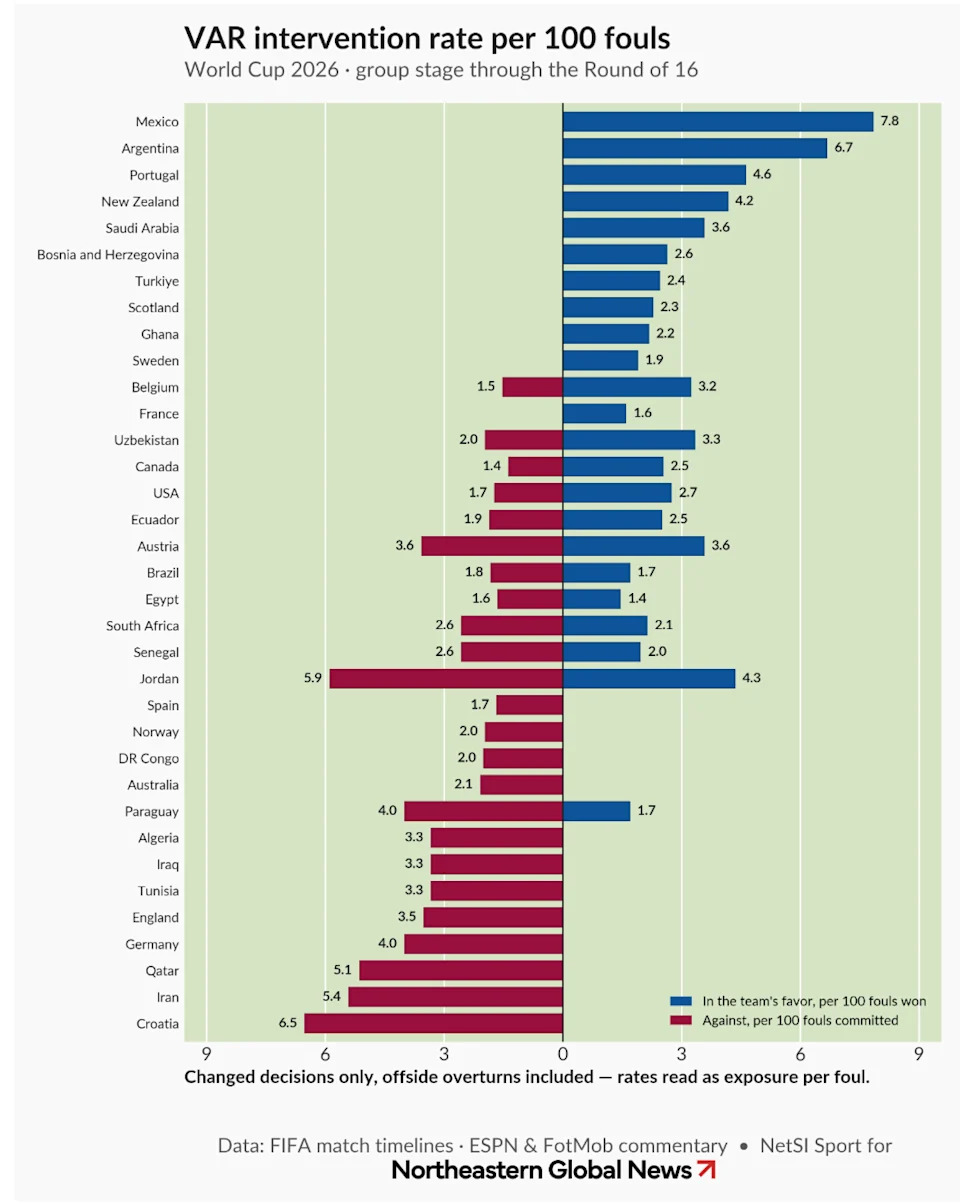
This has been a general trend throughout this edition of the World Cup. Argentina has committed the highest number of fouls — fouls that are largely committed in midfield that inevitably break the rhythm of their opponents’ play — but it is still yet to receive a single red card. As far as I can recall, it also has not conceded a single penalty. It has also had the highest number of opponents’ goals disallowed.
Argentina also saw the second highest number of favourable VAR interventions through the round of 16, behind co-host Mexico, and is among just 10 countries to have not received an unfavourable VAR intervention despite making it all the way to the final.
Granted, there is always a subjective element to the interpretation and application of the rules of football and there’s no way of definitively proving that foul play is at work. But when the referees are not interested in even using VAR to check Argentina’s fouls, something seems amiss. As Yahoo Sports notes, “of all the teams that reached the quarterfinals, only Argentina didn’t have a single foul committed be reviewed by VAR, while also having the most fouls in its favour reviewed by a wide margin.”
Even in Argentina’s first game, against Algeria, Messi stepped on an opponent’s Achille’s tendon with his studs up. Such an offence is often a straight red but in Messi’s case, there was no card shown or a VAR check given. As many have posited, there is simply no way FIFA would allow the biggest star of world football and US soccer to face a one or two-match ban at the very start of the tournament; it would be a marketing disaster.
To Messi fans claiming Egypt wasn’t robbed: the injustice started in Argentina’s very first match. Messi’s challenge on Algeria’s Aïssa Mandi looked like a straight red, yet it wasn’t even called a foul. No VAR. No accountability. Algeria complained to FIFA. Nothing changed.
And… pic.twitter.com/nB2LkqgL9r
— Dr Ahmad Rehan Khan (@AhmadRehanKhan) July 8, 2026
The most controversial decision came in the round-of-16 match against Egypt when the VAR officials ruled out Egypt’s second goal, and one of the best of the tournament, due to, at most, a soft foul committed by an Egyptian player at the other end of the pitch.
From the NY Times’ Athletic:
The Athletic’s in-house refereeing expert, former Premier League official Graham Scott, later wrote: “The decision to disallow Egypt’s goal is incorrect. (Marwan) Attia’s challenge on Lisandro Martinez in the build-up to Ziko’s 67th-minute effort was normal contact and should be regarded as such, rather than considered a foul.
“It was also almost 100 yards from goal, and Argentina had every opportunity to regroup and defend — no wonder Egypt felt aggrieved that the eventual goal was disallowed after a VAR review. If we look at the incident, there was some contact, both foot-on-foot and a fleeting hold of the shirt, but there was no offence worthy of a VAR call-back committed here.
What makes the disallowed against Egypt even more galling is that a very similar incident took place in a group-stage match between Argentina and Denmark. Argentine midfield Alexis Mac Allister committed a far more blatant foul against a Danish player in the lead up to Argentina’s first goal, but no VAR check was conducted despite Danish protests.
Regarding the game against England, “a lot of people couldn’t believe that an MLS ref was given this game when the league’s pearl, Messi, was playing,” says British-American MLS commentator Roger Bennett.
Many fans are convinced that the inconsistent application of rules and VAR checks has helped Argentina reach another World Cup final. Given the long history of FIFA corruption and the lengths to which the organisation was willing to go to bend the rules to allow the US’ star player, Folarin Balogun, to dodge a one-match suspension, at Donald Trump’s direct urging, such speculation is understandable.
In most cases, the rules, while correctly applied, have disproportionately benefitted Argentina. According to the veteran Mexican sports commentator José Ramon Fernandéz, this is not the first time Argentina has benefitted in this way. Asked a couple of days ago if there are any countries that have won a World Cup corruptly, he gave the example of Qatar 2022, when Argentina beat France in the final.
“Yes. In Qatar the problem was Argentina,” he said. “Every time Messi fell, it was a penalty.”
🇦🇷 Argentina 8 (2022-2026) — the HIGHEST number of penalties awarded to ANY nation in a 12-match World Cup span in tournament history
1️⃣ 🇪🇸 Spain—7 (1998-2010)
2️⃣ 🇳🇱 Netherlands—7 (1938-1978)
3️⃣ 🏴 England—6 (2018-2026)
4️⃣ 🇵🇹 Portugal—6 (1966-2006)
5️⃣ 🇨🇿 Czechia—6 (1962-1990)… pic.twitter.com/C2vMeSEIs6
— FIFA World Cup Stats (@alimo_philip) July 7, 2026
During the age of VAR, the inconsistent application of rules and procedures, such as the awarding of yellow and red cards, can be enough to tip games with fine margins in one team’s favour. Obviously, these kinds of privileges only work in a tournament as gruelling as the World Cup if you have a highly competent and competitive team, which Argentina has in spades.
One thing is undeniable: Argentina has been more Argentina have been involved in more controversial decisions than any other team this tournament. In the New York Times’ list of the ten biggest controversies of the World Cup (so far), published three days ago, two of the biggest controversies involve Argentina, or “Vargentina” as many are now calling the team.
Even US viewers are beginning to notice that the pitch may be somewhat tilted in the favour of Argentina and its MLS League superstar, Lionel Messi…
Messi plays like a guy who knows he’s never getting a red card. And he’s right. pic.twitter.com/gRy0OzczLC
— Jim Breuer (@JimBreuer) July 16, 2026
Another big standout from the match between Argentina and England was the way in which Argentina celebrated. As soon as the game ended, the Argentine national team unfurled a banner with the timeless slogan, “Las Malvinas son Argentinas” (The Falklands are Argentine).
⚽️ After the semi-final match against England, the Argentinian footballers unfurled a large banner with a clearly political slogan, claiming that the Falkland Islands belong to Argentina.
In principle, FIFA should disqualify Argentina or the players responsible for violating the… pic.twitter.com/FMQBhL8MfS
— 𝕊𝕡𝕣𝕚𝕟𝕥𝕖𝕣 𝕻𝕣𝕖𝕤𝕤 (@SprinterPress) July 16, 2026
In so doing, Argentina broke a cardinal rule that prohibits “banners, flags, flyers, apparel and other paraphernalia that are of a political, offensive, and/or discriminatory nature” from being brought into a stadium. The act has caused consternation in the UK, with lawmakers calling for FIFA to conduct an investigation as well as consider sanctioning the players involved.
Argentina’s territorial claims over the Malvinas remains a big issue for most Argentines. In a 2021 poll, more than 80% of the population supported Argentine sovereignty over the islands. Many have clung to a non-binding 1965 UN resolution that recognized a sovereignty dispute that invited the Argentine and UK governments to negotiate a solution.
I remember crossing into Argentina from Bolivia 20 years ago and seeing a giant billboard proclaiming: “Las Malvinas son Argentinas.” It was one of many I saw on my travels.
Even Argentina’s national constitution from 1994 includes a section asserting the country’s claims of sovereignty over the Malvinas, South Georgia and South Sandwich Islands and the corresponding maritime and island spaces, as they are an integral part of the national territory.” Their recovery, it says, and their “full exercise of sovereignty… constitute a permanent and inalienable objective of the Argentine people.”
Argentina’s President Javier Milei does not give a fig about any of that. In fact, he responded to the resulting scandal surrounding the Falklands banner by reprimanding the players.
“We mustn’t resort to rancid nationalistic slogans,” Milei said. “I understand that it is difficult, but the Malvinas will be recovered through wise diplomacy and not with cheap jingoistic gestures and tantrums”.
Everything for Sale
While Milei’s words regarding the Malvinas are grabbing attention, it is his government’s actions during Argentina’s latest bout of World Cup fever that should be hogging the headlines. Yesterday, just one day after the England game, Argentina’s senate began debating Milei’s proposed bill on the “inviolability of private property”. The bill seeks to repeal a 2011 law, which sets limits on the acquisition and ownership of Argentine land by foreigners.
This is a topic we covered a few months ago, in our post, “‘Se Vende Todo’: Javier Milei Seeks to Allow UNLIMITED Sale of Argentine Land to Foreign Investors”.
In the 2000s, as foreign purchases of Argentine land surged, the Cristina Fernández de Kirchner-controlled Congress responded by passing Law 26,737 in 2011, which placed a 15% limit on the purchase of land by foreign companies or individuals in any given province. The law also established that no foreign nationality can exceed 30% of that 15% allowed, and that the same foreign owner cannot own more than 1,000 hectares in the core area in question.
The Milei government now wants to eliminate all those restrictions, and it hopes to be able to count on the support of the governors of Argentina’s 23 provinces to get its bill across the line. That’s right: Milei and his handlers literally want to allow the unlimited sale of Argentine land to foreign investors. From El Diario (machine translated):
“The Land Law is to regional economies what the Glacier Law was to mining,” said Sturzenegger, during a conference organized by the Argentine Rural Confederations, where he promised that, if the limits on foreign ownership were eliminated, more than $15 billion of capital would enter. The Minister of Deregulation’s argument was that if all restrictions on foreign ownership were eliminated, investments in all productive areas of the country would be unblocked.
This is not the first time that the government has tried to move against the Rural Land Law. As soon as he became president, …Milei issued… a [“Mega-Decree”]… that included the elimination of Law 26,737. The Justice Depertment however, accepted an injunction presented by the Malvinas Islands La Plata Center for ex-combatants that warned that eliminating the law “…poses a direct threat to the principles of territorial integrity and national sovereignty.”
A study by the Earth Observatory, based on a freedom of information request, shows that in 2025 there were 13.2 million rural hectares in the hands of foreigners. That’s roughly 5% of Argentina’s territory. The Milei government clearly wants to increase this ratio, by removing all restrictions on foreign private ownership.
The foreign ownership of land is concentrated in very specific areas of Argentina, notes Indymedia: the mountain range area of Patagonia that is rich in energy and mineral resources, the western and northern border areas, and the Littoral:
If approved, the bill will allow the delivery into foreign hands of strategic areas: Patagonian freshwater lakes, native forests, mountain ranges with critical minerals, regions on the banks of large rivers or settled on aquifers that supply millions of people, and sensitive border areas that could facilitate smuggling and drug trafficking. They are coming for water, mineral resources and for border areas…
In the ranking of nationalities with possession of rural land in Argentina, citizens of the United States appear first, with more than 2.7 million hectares… — representing 20% of the total land in the hands of foreigners. They are followed by the Italians and Spaniards. These three nationalities alone account for half of the total foreignized land…
Florencia Gómez, director of the Rural Land Registry until 2015, calls for particular attention to be paid to the attempt to repeal Article 10 of the current law, which prohibits foreigners from acquiring land that “contains or is a riparian zone of large and permanent bodies of water.”
“This law is part of a combo that includes the glacier law, the super RIGI, the lobby law and the corporation law. They want to hand over bodies of water, rivers, lakes, for VIP tourism projects, to generate energy or for the installation of large data centres like those of Peter Thiel,” she warned an interview with El Destape.
Thiel, who is one of the biggest promoters of the privatisation of sovereign, national land through the creation of charter cities like Prospera Inc in Honduras, recently moved to Buenos Aires, where he is reportedly advising the Milei government on new legislation.
Thiel apparently sees Argentina as a “laboratory” and an “economic refuge” for his investments. According to Forbes, Milei is trying to court prominent wealthy figures to what a former official described as a “new land of freedom” for billionaires like Thiel through the removal of land and property ownership restrictions and the launch of a full citizenship-by-investment scheme.
Since vast tracts of Patagonian forest burned to the ground during the summer months of December, January and February, speculation has grown that the government has agreed to allow the construction of an Israeli settlement, or settlements, on parts of the burnt land. As far as I’m aware (and I will be happy to be corrected on this point), there is no concrete evidence to actually support these claims though there is plenty of circumstantial evidence.*
One thing that is clear is that as Argentina prepares to go head-to-head with Spain in the final of the biggest sporting event on the planet, Milei is seeking to remove almost all restrictions on foreign ownership of Argentine land. As Argentina’s footballers protest Britain’s ongoing territorial rule over the Falkland Islands, the Milei government is seeking to literally auction off the most valuable tracts of Argentine land to the highest bidders.
Whatever happens on Sunday, two things are clear: first, the game of football has already been seriously tarnished by this edition of the World Cup, as we warned at the very beginning. And second, this is one of the most geopolitically significant World Cup finals in decades.
On the one hand, Spain, one of the few European countries to oppose Israel’s genocide in Gaza and the US-Israeli war against Iran, appears to enjoy Iran’s support while repeatedly being on the receiving end of Trump’s vitriol. On the other hand, Argentina enjoys Israel’s support as well as presumably Trump’s, both of whom need Milei to stay in power even as public support for him continues to crater.
Spain is in the World Cup Final.
For the first time, I’m cheering for a team other than Iran and wishing them success and the championship.
¡Hola, España! 🇪🇸⚽
— Iran Embassy SA (@IraninSA) July 16, 2026
🔴New investigation: Lionel Messi’s Ties To Netanyahu, The Israeli Military And Its Elite Spying Unit 8200
“The diminutive superstar has gained a massive following across the planet, not least in Israel, thanks to his numerous business and security connections with the Apartheid…
— MintPress News (@MintPressNews) July 16, 2026
Why Netanyahu and Ben Gvir support the Argentina team so much? pic.twitter.com/cklnX5ygMZ
— Bassem Youssef Commentary (@bassem_youssef9) July 15, 2026
Asked in a recent interview why he supported Argentina, Netanyahu said it had more to do with Milei than Messi. Milei, he said, is “Chabadnik” — i.e. a member of Chabad. “He is also an incredible star. He did some incredible things with their economy through the use of free-market principles.” Most importantly, “Milei is a huge friend of Israel”.
From our previous post on this topic:
Milei has subordinated Argentina’s foreign policy almost entirely to US and Israeli interests. He even recently declared himself the “most Zionist president on the planet”. If any national leader was willing to give away a slice of his or her national territory to help the Zionist cause, it would be Milei.
Milei has already signed agreements with the Netanyahu government that essentially grant Israeli citizens residing in Argentina access to the full gamut of government benefits, including pensions, maternity leave and disability allowance, even as the Milei government guts public spending and welfare benefits for most Argentine citizens.
There are also credible reports of Israelis being caught starting fires on Patagonia’s hiking trails. In 2011, for example, an Israeli was caught setting a fire that burned 17,000 acres of Chilean Patagonia.
Before the fires began raging over the summer, the Milei government reduced the operating budgets for fighting forest fires by more than 80 percent.
The Milei government has also unveiled plans to repeal land-use restrictions that currently prevent real estate developments and intensive agricultural activities on recently burnt land for periods of up to 60 years.
Patagonia was always on the short list of possible locations for the establishment of a Jewish State. In the late 19th century, the father of Zionism, Theodor Herzl, described Argentina as “a country with an immense area, sparse population and a moderate climate”.
Lastly, this wouldn’t be the first time Argentina, and the southern cone of Latin America in general, had served as a bolthole for international war criminals of a fascist persuasion.
