


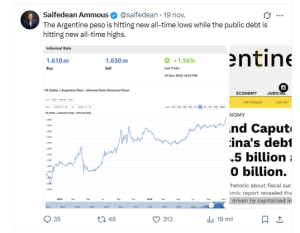
It’s amazing what can be achieved when a government forgoes the neoliberal structural conditions prescribed by multilateral institutions.
Data from the World Bank’s (WB) international report on poverty and economic growth has confirmed that eight years of progressive, worker-friendly government policies has helped lift 17.3 million Mexicans out of poverty. That figure is roughly equivalent to one-eighth of the country’s population.
As Henry Moon Pie noted in response to a recent post, it’s amazing what can be achieved when a government actually does something for its people. It’s also amazing what can be achieved when said government forgoes the neoliberal structural conditions and economic governance frameworks prescribed by the two Bretton Woods institutions (IMF and World Bank).
Mexico’s last two governments have departed from the script by focusing on expanding incomes at the bottom of the rather than engaging in the usual trickle-down approach to policy. Indeed, one of former President Andrés Manuel López Obrador’s last acts in government, in June 2024, was to take the International Monetary Fund to task for predicting that Argentina’s austerity-governed economy would grow faster than Mexico’s between 2025 and 2027:
“It has just been announced that the International Monetary Fund declared that Argentina will grow more than Mexico, when the International Monetary Fund, with all due respect, was the cause of Argentina’s economic disaster.”
Since AMLO made that statement Argentina’s economy has necessitated two bailouts — one from the IMF and other multilateral organisations and the other from the US treasury — and may soon need another one. Economists are now predicting that Argentina just slipped into technical recession, after the economy contracted for a second consecutive quarter in the July-September period.
As Sovereign Media notes, the economic toll of Milei’s austerity on steroids, all of it fully endorsed by the IMF, is mounting, with 32,290 fewer registered employers between November 2023 and July 2026, a 6.3% decline:
There were also 437,611 formal jobs lost, according to the Centro de Economía Política Argentina (CEPA). Around 32.3% of Argentines are living in poverty during the first half of 2026, up from 28.2% in the previous semester. Meanwhile, consumer spending is down 2.7% during the first nine months of 2026 compared with the same period in 2025. Manufacturing, construction, and retail have been hit hardest by collapsing domestic demand, weakened purchasing power, and competition from cheaper imports.
Meanwhile, export-oriented sectors including energy, mining and agriculture are relative winners on paper, which exemplifies the growing divide between resource-driven growth and the struggling domestic economy. The business class elite are making money, but the overwhelming majority of working people are not.
Back in Mexico, the findings of the World Bank report echo a similar report published in 2025 by the United Nation’s Economic Commission for Latin America and the Caribbean (CEPAL), which estimated that Mexico had accounted for 60% of poverty reduction across Latin America and the Caribbean in the 2024, 30 percentage points above Brazil’s contribution.
“Today, the living conditions of millions of families have improved, purchasing power has been recovered, the minimum wage has increased, and social programs reach those who need them most,” said Mexico’s Secretary of Interior, Rosa Icela Rodríguez, during the government’s official daily press conference on Monday. Rodríguez was deputising for President Claudia Sheinbaum, who was attending the APEC Summit in Shenzen, China.
According to the World Bank’s projections, Mexico’s monetary poverty rate will be 20% in 2026, a decline of 15.3 percentage points compared to 2018, and 18.7% in 2028. The number of people living in monetary poverty in Mexico is projected to be 25.2 million in 2028, representing a reduction of 18.7 million people compared to 2018. In addition, the WB report estimates a 3.4-point decrease in inequality, with the Gini coefficient falling from 46 in 2018 to 42.6 in 2024.
From Sin Embargo (translation by Mexico Solidarity Media):
According to the projections published in October by the World Bank, eight years ago the percentage of the population living on an income below US$8.30 was 35.3. Meanwhile, the projection for 2026 is 20 percent.
This means that in 2018 around 43.9 million people lived in poverty, while a figure of 26.6 million is projected for 2026. A reduction of 17.3 million.
The calculation considers those living on less than US$8.30 a day, adjusted for purchasing power parity, and combines observed data through 2024 with estimates for 2025 and 2026.
Table included in the World Bank report. Photo: Screenshot
The World Bank report identifies two main factors driving this trend: the AMLO and Sheinbaum government’s more than three-fold nominal increase in Mexico’s minimum wage, which broke with decades of contractionary wage policies; and their expansion of social programs, including universal cash transfers, such as pensions for adults, youth apprenticeships, and agricultural support.
As we reported In January this year, the AMLO and Sheinbaum governments’ double digit annual hikes to Mexico’s minimum wage have come in the face of stiff opposition from Mexico’s business, financial and political establishment, some of it ongoing. Meanwhile, the economic disasters those establishment figures forecast are yet to transpire:
A New Year’s Tradition
Double-digit minimum salary increases have become a New Year tradition in Mexico in recent times. Since 2018, the minimum daily salary has almost quadrupled in nominal terms, from the miserly 88 pesos (just under $5) granted by the former Enrique Peña Nieto government to today’s 315 pesos ($17.50).
As you can see in the graphic below, courtesy of Trading Economics, there have been seven steep increases in the minimum wage since December 2018, not counting the one that just went into effect.
Accounting for official inflation, the latest minimum wage increase will bring the accumulated rise in salaries to 154% in eight years. Yet when the former leftist President Andrés Manuel López Obrador began this process, many opposition politicians, business leaders and economists warned that it would fuel inflation as well as risk higher unemployment.
Neither of these things have come to pass. Today, official unemployment in Mexico is 2.7%, close to its lowest level on record. That is despite the impact of US President Donald Trump’s on-again, off-again tariffs and the acute uncertainty over the upcoming review of the United States-Mexico-Canada (USMCA) trade deal.
As you can see in the graph below, courtesy of Trading Economics, unemployment has actually been trending at lower levels over the past three years than it did before AMLO’s election in 2018. [Update: As of October 2026, official unemployment sits at 2.8%, just marginally above where it was in January]
In other words, Mexico’s eight year experiment with minimum wage increases has had a significant net positive effect on the incomes of millions of Mexican workers, helping to lift an estimated 13.4 million people out of poverty, without lowering their unemployment prospects.
Meanwhile, inflation in Mexico has waxed and waned since 2018, reaching a peak of 8.7% in 2022. However, that peak was largely fuelled by the pent-up demand and global supply chain pressures triggered by the opening up of the world’s COVID-19 locked down economies, and subsided relatively quickly. In fact, Mexico’s peak was somewhat lower than those of other OECD economies, including the US (9.1%), the UK (11.1%) and Spain (10.8%).
Mexico’s Consumer Price Index is now at 3.8%, which is one percentage point lower than the level it was at in late 2018, when the minimum daily wage was roughly 70% lower than it is today. [Update: there has been virtually no change in the official inflation rate since January]
As Luis F Munguía, the president of Mexico’s National Minimum Wage Commission, writes in an interesting article for Phenomenal World, one of the main reasons why inflation hasn’t surged as a result of the sharp minimum wage hikes is that the minimum wage was so low to begin with…
The turning point came in 2018, during the government of Andrés Manuel López Obrador. Faced with growing citizen demand for wage improvements, a team of economists from the progressive-oriented Colegio de México evaluated the feasibility of increasing the minimum wage without destabilizing the economy. Aiming to reconcile social justice with macroeconomic stability, a gradual and technically sustainable recovery strategy was implemented that restored the lost purchasing power within seven years.
The increases in minimum wage have not only helped working class Mexicans recoup some of their long-lost purchasing but have also had positive net consequences on Mexico’s employment structure. According to official data, the number of workers earning between one and two minimum wages has increased by more than 4 million since 2018. This has helped to improve employment quality and reduce working poverty levels.
This has all happened at the same time that poverty reduction has more or less stalled globally, according to the World Bank’s Poverty, Prosperity and Planet Report 2026. The 2026 Global Multidimensional Poverty Index (MPI), published by the UN Development Programme (UNDP) and the Oxford Poverty and Human Development Initiative (OPHI), warns that the estimated number of people living in multidimensional poverty has risen for the first time since the index was established in 2010.
As Jean Shaoul writes for WSWS, “the World Bank frames the problem as creating more and better jobs, increasing earnings, raising productivity, expanding employment, especially among women, and achieving stronger per-capita economic growth”:
It argues that poverty reduction has stalled because growth and job creation have been insufficient, not because of how resources are owned and distributed. The report repeatedly presents employment and earnings as the main route out of poverty.
The problem is not that these countries lack employment or that their populations are unwilling to work. Millions already work long hours in low-paid, insecure, and often dangerous conditions in agriculture, mining, manufacturing, and the informal economy. The question is who captures the wealth generated by their labour.
Much of the value is appropriated further along the production and distribution chains by commodity traders, processors, brand owners, retailers, and financial institutions that capture interest payments, repatriation, and ownership of productive assets, and intellectual-property holders who own the patents, platforms, and technological infrastructure. Their wealth is invested in and managed by the same financial institutions and private equity firms that hold the sovereign debt of these less developed countries. The workers and countries producing the wealth retain only a fraction of it.
The World Bank naturally has little to say about who captures the wealth, or that the wealth created by the working class is expropriated by the capitalist class. As the executive arm of the imperialist financial powers, it has spent four decades imposing structural adjustment, privatisation and austerity on the world’s poorest countries. Now its remedy— more jobs so that the poor can “produce more wealth”—reveals the logic of capitalism and imperialism. The poor are not human beings with needs; they are a labour force whose productivity must be raised so they can be exploited more efficiently.
The Bank’s admission that poverty reduction has “stalled” implies that poverty reduction was taking place and had merely hit a snag or a slowdown that could be resolved by more growth and more jobs. Far from being some aberration of capitalism that can be corrected, poverty is a permanent and necessary feature of an economic system based on the extraction of surplus value from the working class by the capitalist class. The Bank’s own “solution”, to intensify the exploitation that causes poverty, confirms this.
Meanwhile, the world appears to be on the precipice of another global financial crisis, or technological meltdown, that could further exacerbate global poverty, just as COVID-19 reversed decades of steady global poverty reduction by triggering a sharp economic contraction, mass job and income losses, and overlapping shocks like inflation and conflict.
Meanwhile, back in Mexico the Sheinbaum government’s next big challenge will be making its recent advances in poverty reduction sustainable, which, of course, will be easier said than done if a global financial crisis is indeed imminent.
A common source of criticism of both the AMLO and Sheinbaum governments is their apparent reluctance to undertake deep fiscal reforms that ensure that the richest individuals, families and companies, who have all done very well under both governments, pay a greater share of the tax burden.
Given Sheinbaum’s party, Morena, independently controls over 50% of the seats in both the Chamber of Deputies and the Senate, there will never be a better time to push through progressive tax reform. But that is simply not happening. Instead, Sheinbaum has set her sights on the informal economy in the hope of raising new revenues.
To that end, her government is on a mission to reduce cash use in Mexico as quickly as possible, including going so far as to prohibit its use in key areas of the economy. However, as we warned in our recent post, “Mexico, the Final Frontier of the Global War on Cash“, the people who will probably suffer the most as a result of Sheinbaum’s blitzkrieg war on cash will be the poorest — i.e., her main base.
Moreover, Brazil’s recent success at digitising its economy should serve not only as inspiration for Mexico but also as a cautionary tale. The rapid replacement of cash payments with digital alternatives, particularly the state-run Pix instant payments system, has significantly increased financial inclusion but it has also led to a massive increase in consumer debt, with as many as eight out ten Brazilians being “suffocated by debt”, in the words of El País.
