


[Today’s Iran war post launched more or less complete. I have had to run out and expect I will return too late to update this post by 8:30 AM EDT. So any new news will come in comments]
Many commentators have speculated about what Iran will do next as the US seems to be trying to keep the Iran war in a holding pattern through the midterms, so as to keep new news on this this epic US own goal out of the press as much as possible. The Iranians have the opposite incentive, to create as much pressure, ideally energy price pressure, on the Administration sooner rather than later. But the offset is they seem to have been mindful of avoiding undue damage to the global economy, which is a major offsetting consideration. Plus Trump cannot stand not looking like the driver of events, so he will be inclined to keep poking Iran.
A US drone attack on Iranian missile launchers on Larak Island, reportedly used to lay new mines after the US claimed to have de-mined the Strait of Hormuz, looks to be part of the Iran energy escalation. Many commentators, including this site, have commented on the US claims that it has gotten meaningful amounts of crude out via a channel on the Oman side of the Strait of Hormuz. Now that Oman has agreed that this route should be closed, that would seem to give Iran a freer hand to operate in choking down on this traffic harder to increase pressure on oil supplies and prices.
Malcolm Nance, in a new talk with Mario Nawfal, explains at length why the Iranian missile launchers have a 130 km range and could easily have re-mined the areas the US said it cleared from hidden positions well away from the coast. He contends that the point of putting them on Larak Island was to place mines as far down the UAE coast as possible in the Persian Gulf proper, as well as around and potentially even in the port of Fujairah, on the Gulf of Oman side. This operation would presumably cut down on the traffic and the ship-to-ship transfers on which these stealthy operations depend.
The entire talk is very much worth a listen, such as Nance’s discussion of how the Iranian mines work and how the US detected these launchers only after they’d been trundled into place, meaning Iran had likely already set some new mines before the strikes. That possibility is counter to the official story, that the US got the launchers before they set any new mines. Nance describes what it would take to get the launchers to Larak Island and for the US to locate them.
Key sections from Nance in a lightly edited machine transcript:
So the big question is why did they bring that damn rocket launcher to Larak Island? And the only answer that it can be is they needed to throw those rockets as far down the western coast of the United Arab Emirates and down the eastern coast of the United Arab Emirates as possible….
Dude, when you come over the mountains….and you start descending down the coast road to Fujairah, all you see is a minimum of 100 oil tankers in the in the water. Fujairah at a minimum has a 100 tankers in it at any given time. And now that they’re doing ship-to- ship transfers with these shuttle tankers that are coming from the oil fields, you’re going to see hundreds of them in Fujairah, more maybe 150 down there, which would be a cool place to drop sea mines that no one can detect until they hit the water, until a ship hits them, right? So if you blockade technically Fujairah and the the the shuttle tankers that are coming down the eastern side, uh you know, you don’t have to shoot an any anti-ship missile like that Saudi tanker that got hit or the Greek tanker that got hit the other day.
We are in both the fog of reporting and misinformation phases, so take what follows as subject to later revision. First from the Guardian on the initial US attack:
US forces have struck two Iranian launchers on Iran’s Larak island, a US official said, marking the first known American strikes since late July.
“I can confirm that earlier today US forces struck two Iranian launchers on Larak island. Islamic Revolutionary Guard Corps forces were observed preparing to launch rockets with sea mines into the strait of Hormuz,” the official said on Sunday.
The IRGC said the attack killed and wounded several soldiers and citizens and would be met with a “response and punishment” from Tehran, Iranian state media reported.
A spokesperson said the US would pay for the attack economically and militarily, according to the semi-official news agency Fars.
Iran’s semi-official Tasnim news agency reported the US had carried out a drone strike on the island.
On Sunday night, Reuters reported a US source as saying Iran had launched an attack on US forces in Jordan in apparent retaliation, with the source adding that all incoming missiles had been intercepted with no significant impact so far.
History shows that US claims of no damage have regularly been false
Another take on the Iran response from Hormuz Report on Twitter:
BREAKING: Iran’s IRGC has reportedly launched anti-ship cruise missiles and drones from Larak Island as U.S. KC-46A Pegasus provides U.S. military escort to vessels transiting the southern Omani corridor of the Strait of Hormuz, according to initial reports.
Three loud explosions were reportedly heard on Larak Island as Iranian forces stepped up surveillance of ships using the corridor, per EOS Risk Group’s Martin Kelly.
Kelly says an Iranian boat illuminated a passing vessel, identified it by name, and warned the crew that Iran was tracking its movement and could take action if it continued.
The U.S.-backed corridor is now reportedly facing both IRGC missile threats and aggressive Iranian monitoring.
More on various claims from Aljazeera:
Iran says it has attacked US bases in Jordan and US military targets at the Al Minhad airbase in the UAE after US forces bombed two rocket launchers on Iran’s Larak Island.
UAE’s Defence Ministry rejects Iranian claims that al-Minhad Air Base targeted.
Versus PressTV, which gives a prominent stop to the claim that the UAE was also on the receiving end:
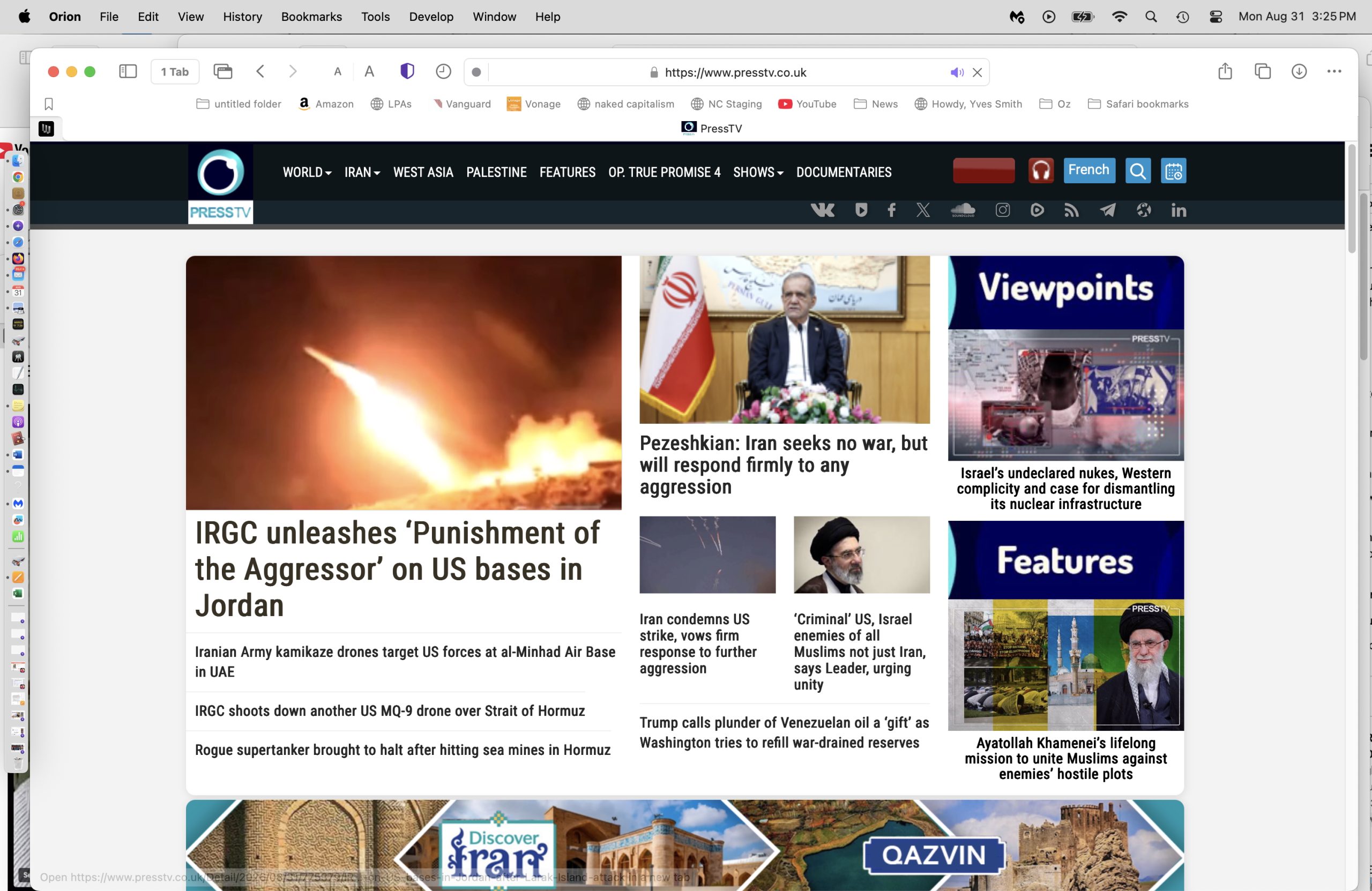
From its lead story, IRGC unleashes ‘Punishment of the Aggressor’ on US bases in Jordan after Larak Island attack:
The Islamic Revolution Guards Corps has announced that its Aerospace Force has struck American military positions in Jordan, delivering a decisive response to the American terrorist assault on Larak Island.
In a statement issued on Monday morning, the IRGC said a combined missile and drone operation, codenamed “Punishment of the Aggressor,” targeted the King Hussein and Al-Azraq military bases hosting US forces.
The operation hit “technical and repair infrastructure, as well as the enemy fighter deployment sites,” inflicting significant damage on the aggressor’s military assets.
The IRGC said the strike was the necessary and lawful answer to Sunday night’s attack on Larak Island in the Strait of Hormuz, which martyred and wounded a number of Iranian combatants and compatriots.
Note also the story at the bottom of the left column, IRGC Navy: Rogue supertanker brought to complete halt after hitting sea mines in Strait of Hormuz:
The Islamic Revolution Guards Corps (IRGC)’s Navy says a rogue supertanker attempting to navigate an unauthorized route in the Strait of Hormuz struck two sea mines, triggering massive fires on board the vessel and bringing it to a complete stop.
NO1 in his daily summary starts “The Iran war restarted overnight after five quiet weeks,” and adds:
US strikes Larak Island; Iran retaliates against US bases in Jordan and the UAE.First US strike on Iranian territory in ~30 days per HormuzLetter, targeting two IRGC missile launchers (Axios via zerohedge, MenchOsint). IRGC says the strike killed and wounded soldiers and civilians (BRICSinfo); MoloWarMonitor reports two IRGC soldiers killed and several injured, drone launched from a base in Jordan. Iran’s response: ballistic missiles and Shahed-136 drones at two Jordanian airbases (jonelmer), drones at Al Minhad in the UAE (AJENews, ejmalrai), sirens in Qatar over Al Udeid (MenchOsint), and an MQ-9A downed (MenchOsint). Confidence: HIGH (10+ sources).
Base naming is contested and worth flagging. IRGC’s own statement named “King Hussein” and Muwaffaq Salti; MenchOsint believes King Hussein is a typo for Prince Hassan Air Base, since King Hussein hosts an air college rather than US troops (MenchOsint). HormuzLetter reports Prince Hassan + Muwaffaq Salti. Intel_Sky and dana916 both name King Hussein (Aqaba) + Al-Azraq/Muwaffaq Salti. Impacts geolocated at Muwaffaq Salti by dana916 and AMK_Mapping_.
Launch origins spread across Iran: Bidganeh/Tehran province (sentdefender), Kermanshah (AMK_Mapping_), Borujerd/Lorestan (cym27s), Zanjan/Khorramabad/Tabriz (DD_Geopolitics).
US line: “no significant impacts, nearly all incoming intercepted” per a Fox source (CrusadeAgain). IRGC claims destroyed jets and technical/repair infrastructure at both bases. Both claims are unverified; treat the damage assessment as open.
Another recap that aligns with the Iranian accounts:
Iran-US confrontation summary update 30-31 August
• A supertanker was struck by 2 naval mines in the southern Strait of Hormoz, caught fire and was brought to a complete halt (despite Trump claiming they cleared all mines).
• Iran shot down a USAF MQ-9A Reaper drone over the… pic.twitter.com/RcTKvVro2C
— Arya Yadegaar (@AryJeayBackup) August 31, 2026
More from the text:
• Iran shot down a USAF MQ-9A Reaper drone over the Strait of Hormoz, early this morning.
• 🇦🇪 The Iranian Army Ground Forces used Arash-2 one-way attack drones to target Al Minhad Air Base in the UAE (Footage 1).
• 🇯🇴 IRGC targeted technical and repair infrastructure + fighter jet deployment sites at 2 US airbases: King Hussein and Muwaffaq al Salti AB in Jordan, using ballistic missiles (Footage 2).
According to @Younes_Shadlou
Iran used Kheybar Shekan missiles as well.
Footage 3-4 shows missile attacks in Jordan hitting US bases.
Additional confirmation of the tanker strike:
Kuwait tanker BURGAN, IMO 9656022 was the tanker struck on Saturday by the IRGC during outbound transit of SoH.
This was the second Kuwaiti tanker struck in a 48hr period.
Iran said one tanker was struck by 2 mines during transit of the southern route. JMIC said this did not…
— Martin Kelly (@_MartinKelly_) August 31, 2026
Larry Johnson adds in “We Own It”: The Wall of Steel Springs Another Leak at Larak in the Strait of Hormuz:
On Sunday, US forces struck two Iranian launchers on Larak Island — the first known American attack on Iranian soil since late July — because, a US official told Al Jazeera and Reuters, Guard units were observed preparing to fire rockets carrying sea mines into the strait the United States supposedly owns. One is left to wonder how Tehran plans to mine a waterway it does not control, into which it is not permitted to bring so much as a boat. The wall of steel, it seems, requires periodic bombing to stay upright….
For three weeks, Iran and Oman have been quietly negotiating who actually governs traffic through Hormuz — which is an awkward thing for two other countries to be doing about a strait the United States claims to own. Tehran’s deputy foreign minister, Kazem Gharibabadi, described the two sides as near agreement on the coordinates of a safe transit corridor, on the technical machinery to run it, and — critically — on a joint coordination center to manage maritime traffic and collect data from transiting vessels. It builds on the Muscat Protocol the pair signed in April, which stood up a jointly managed “Green Channel” policed by the IRGC Navy and the Royal Navy of Oman.
Two features of that emerging regime deserve a close read. First, per CNN‘s August 5 account, the new corridors would run partly through Iranian territorial waters, a departure from the decades-old arrangement routing commercial traffic through Omani waters. Second — and here is the detail that connects to Sunday’s strike — the proposed arrangement would close the temporary routes near Larak Island and through Omani waters in favor of the new, jointly administered channels.
So the island Washington bombed on Sunday sits at the geographic and administrative heart of an Iran–Oman condominium over Hormuz traffic: a regime that would formalize Iranian control of the chokepoint, potentially monetize it — Tehran has already floated tolls through its “Persian Gulf Strait Authority” — and quietly write the United States out of the management of a waterway its President insists is American property. CNN put it plainly: an agreement is taking shape, but not the one Trump wants.
The analytical observation, then: the counter-mining justification is real, but it may not be the whole of it. Striking Larak degrades a specific IRGC capability and — more to the point — signals that Washington will not sit still while Iran and Oman institutionalize a control regime that makes the “total control” boast look like what it is. The mine threat is the stated cause. The maritime-governance question is the strategic one, and it will still be there long after the rubble on Larak is cleared and the next Truth Social post declares the matter settled.
Some additional snippets on the arm-wresting for control:
Iranian authorities detained a bulk carrier on Monday after it allegedly discharged oily waste directly into the Persian Gulf, the Hormozgan Ports and Maritime Department said.
The vessel, which was carrying sugar, discharged a mixture of used oil, engine-room bilge water and…
— Iran International English (@IranIntl_En) August 31, 2026
The Washington Post published a remarkable lead story, Military leaders warn Hegseth against extending Iran war operations, which provides extensive detail from the Aug. 14 edition of the Secretary of Defense Orders Book. That means it is a current assessment. That plus its specificity means it almost certainly came from the very top of the armed services hierarchy. The most likely source is Dan Caine, head of the Joint Chiefs of Staff and one of the few known to have been an internal critic of the Iran campaign. Both Trump and Hegseth are likely to be incandescent over the disclosures, but experts opine that Trump cannot afford to fire Caine.1
The article is in line with the saying of famed short seller David Einhorn, “No matter how bad you think it is, it’s worse.” Even thought it is generally known, at least to those paying attention, that US defensive and even offensive weapons are depleted2 and the Navy is arguably at the breaking point, having had to strip down its Pacific presence to below what it used to consider the minimum (a full aircraft carrier group) to reinforce its Iran blockade.
From the Post:
Several U.S. military leaders have advised Defense Secretary Pete Hegseth that prolonging large-scale operations against Iran is unsustainable and risks weakening their ability to confront threats elsewhere, including the U.S. homeland…
The SDOB, typically produced twice monthly, outlines the worldwide availability of U.S. warships, aircraft, personnel and weapons systems. It reflects the president’s priorities for the force, which are carried out by the defense secretary, and includes insights from the military’s top generals and admirals that inform the directives the Pentagon issues.
As President Donald Trump has pressured Tehran to reopen the Strait of Hormuz and accept several U.S. provisions for ending the stalemated conflict, he has been adamant that all options remain available to him — including further military action. Consequently, U.S. Central Command, the headquarters responsible for prosecuting the Iran war, has kept a force of more than 50,000 troops on alert for months in case the president orders additional attacks.
The Aug. 14 orders book directs some troops deployed in the Middle East to remain there through September and some others into 2027, said those familiar with the document. The prospect of extending those forces further compelled military leaders to voice their concern, these people said.
Leaders of the U.S. European Command, the U.S. Pacific Command and the U.S. Southern Command, along with the Navy’s top admiral, responded with what is characterized in the SDOB as a “non-concur,” those familiar with the assessment said — meaning they disagree with the secretary’s order to extend their forces but will execute it nevertheless…
Army and Air Force leadership concurred with Hegseth’s desire to extend their deployed forces, but each emphasized that doing so would come with significant risk, these people said.
Overall, the tenor from the military leadership is that the ongoing Iran operation, having reached the six-month mark, has been “too much for too long,” said one person familiar with the assessment….
It’s common for commanders to discuss risk, said the one person familiar with the recent assessment. But the outlook now is “more dire” overall, this person explained, adding that certain generals and admirals were more expansive and frank than is usual in telling Hegseth they disagreed with orders to keep providing equipment and personnel when the operation’s trajectory remains uncertain.
This section is remarkable:
[Adm. Daryl] Caudle conveyed to Hegseth that barely one-fourth of the Navy’s destroyer fleet is ready to deploy, a sharp decline from prewar levels, said those familiar with the assessment.
Brandon Weichert and Mat Hoh, both of whom keep current on the state of US weapons systems, including ones in development, gave more color on the Washington Post account:
Some snippets of interest from a lightly-edited machine transcript:
Hoh: This [SDOB] is the most recent one available. So it’s up to date. And I think it’s pretty startling too though. I think if you take a step back, if we’ve taken a step back and objectively looked at it, and like to hear your thoughts on this because I know you do do a lot of work on this Brandon.
This idea that the American Navy can’t carry out its mission. Its mission is to go to war and it simply can’t do it. I mean the the the the fact that the Navy and this report and then the combatant commanders in the report are just going on about how they don’t have the ships, they don’t have the aircraft, everything’s been taken from them. they can’t do their missions and it, you know, the idea is being like the whole thing is broken. The American military could never have fought this war. You know, regardless of Hegath or Trump or anything like that, the American military is superficial. It’s corrupted.
It’s…
Weichert [interjecting] A Potemkin force.
Hoh: Yeah. It is. It is.
Robert Pape in his new weekly summary feature, showcases the embarrassing failure of the Bessent D-Day salvo:
From a lightly edited machine transcript:
First, let’s talk about Scott Bessent’s call to action to rally the global community to isolate Iran economically.
He started out very clear.
He wanted every country in the world to be either with the United States or you’re choosing to be against the United States.
You either are with us or against us.
The last time we heard that kind of talk was with George President George Bush after 9/11.
And this was for an economic war on Iran.
After 5 days, here’s what happened.
A big fat nothing is what happened so far.
No countries have formally agreed or signed on to the US Treasury Secretary Scott Bessent’s global call for action on Iran.
Just think about that.
He was expecting….We don’t know what exactly he was expecting, folks, but what we know is he put out this call for every country in the world to rally to this plan, the D-Day plan.
And not a single one stepped up after his call to action.
While we are rounding on Bessent, let us flag another aspect of his widely criticized scheme to manipulate the long end of the Treasury yield curve. Money managers, who never met a bailout they didn’t like, have been almost universally critical. They have pointed out that there has been no sign of stress or funding difficulties and the government should save its firepower for when it is actually needed.
We had pointed out that the Treasury lacks the firepower to do that much in the way of interventions because, unlike the Fed, it can’t create new dollars. Yet Bessent is contemplating even bigger scale meddling. We were remiss in not describing earlier how plans to do…by raiding the Treasury’s very big stash to pay ongoing expenses.
Patrick Boyle describes how the most successful trades Bessent ever was involved with were being on the other end of a government operation:
From a lightly-edited machine transcript:
CNBC reported that the Treasury was considering using the Treasury General Account to fund even bigger purchases. Now, to see why that raised eyebrows, you need to know what the TGA is. It’s basically the federal government’s current account held at the Federal Reserve. It’s the account that taxes flow into and things like salaries and government spending flow out of.
Basent has built it up to around $950 billion, which is a lot higher than prior governments kept it at. Using the government’s day-to-day checking account to buy long-term bonds and prop up their price is a very unusual idea. The Treasury’s own advisory committee has noted that the government pays out hundreds of billions every week just to function and that only a couple of hundred billion of that balance is really a safety buffer. There’s a word for spending your rent money to day trade your own IUS because you didn’t like the price the pawn shop quoted and it isn’t cash management.
Note that despite many commentators focusing on the $950 billion, the surplus Bessent built up over normal operating levels is under $200 billon, as in not enough to fight the tape on an ongoing basis:
Scott Bessent has now raised the Treasury General Account (TGA) to $983 billion, significantly over their $850 billion target.
Is he intentionally trying to cause a liquidity crisis in the bond market? 🤨 https://t.co/1TBnquGX6p pic.twitter.com/oTaufftjAp
— Financelot (@FinanceLancelot) October 31, 2025
Done for today! Tomorrow, depending on the news flow, we will either continue with the Iran war or turn to how AI debt looks pre-destined to blow up.
_____
1 And Caine might do a Joe Kent and become a vocal external opponent.
2 The US does have a lot of “gravity bombs” which can do immense damage in urban areas but those require getting planes pretty close to the target, while the US has been striking Iran mainly from standoff ranges to avoid the loss of aircraft.
