


Last week, news broke that Russia will no longer export oil from Kazakhstan to Germany via the Druzhba pipeline starting May 1. This is a disaster for Germany, and it could not have come at a worse time, with the global supply disruption caused by the US and Israel’s war against Iran.
Russia supplies Germany with Kazakh oil, which accounts for about 17% of the Shvet refinery’s supply, which supplies most of the diesel, gasoline and kerosene to East Germany, including Berlin.
Shvet itself was taken over by Russian oil company Rosneft in 2022, and as Germany scrambles to find new routes for transporting Kazakh oil, this latest saga is yet another reminder of how illusory and self-defeating this whole conflict with Russia is for Berlin. Meanwhile, the news media continues to peddle stories filled with half-truths, omissions, and outright lies. Politico’s weekly Berlin Bulletin not only shows us the alternate reality in which Germany’s ruling class lives, but also shows us what kind of gridlock Germany is in, if we make some important corrections and fill in the blanks.
Vladimir the Opportunist: As Berlin reels from the new energy shock caused by the Iran war, Russian President Vladimir Putin appears to have sensed a momentary opportunity.
Kazakhstan factor: Moscow confirmed this week that from May 1, it will stop supplying Kazakh oil to Germany via the Druzhba pipeline. Russian Deputy Prime Minister Alexander Novak said the decision was “related to existing technical capabilities.”
Residual influence: But experts and some German politicians we spoke to this week don’t think that’s a very plausible explanation. Following the Kremlin’s full-scale invasion of Ukraine in 2022, Germany withdrew from Russian natural gas and oil. However, Germany continues to receive small amounts of Kazakh oil through a tributary of the Druzhba pipeline through Russia, still giving the Kremlin direct influence over Germany.
EVERY BIT MATTER: The amount of Kazakh oil flowing into Germany isn’t huge, but every bit counts as energy shortages hit the German economy particularly hard and the government lowers its growth forecast this week. Kazakhstan’s suspension of oil spills, first reported by Reuters, comes as Chancellor Friedrich Merz faces increasing pressure to lower soaring fuel prices, and experts believe the Kremlin wants to maximize Germany’s pain.
There are multiple reasons. “This is an opportune time to compound the grief the refineries are in,” said Sergey Vakulenko, a senior fellow at the Carnegie Russia and Eurasia Center. But oil and gas industry expert Vakulenko suggested there could be another reason. Kazakh oil must be sent to Germany through Russian Baltic ports such as Ustiluga and Primorsky Krai, which are under attack by the Ukrainian military as it seeks to cut oil revenues that the Kremlin uses to fund its wars.
‘Shield’ to Moscow: Kiev stepped up targeting of Russia’s oil export infrastructure, including Baltic Sea ports, in late March to reduce Moscow’s energy windfall. Russia’s port oil infrastructure is vital to the Kremlin, serving as an export route to China and India. If Germany needed these ports to receive Kazakh oil, it could pressure Ukraine to stop drone attacks on these ports, acting as a kind of “shield” for Moscow, Vakulenko said.
Let’s try:
Important omission: Why is Russia suspending deliveries?
Moscow has not said, but Kazakh officials have said: “This is most likely due to recent attacks on Russian infrastructure,” Kazakh Energy Minister Yerlan Akkenzhenov said.
The Ukrainian offensive, with German support of course, continues to attack a wide range of Russia’s energy infrastructure. German and Western media love to claim that this is hitting Russia hard, but react with indignation when it affects German imports. Meanwhile, it turns a blind eye to other obvious sabotage of the infrastructure used to import Russian energy sources. A prime example is the recent conflict over the rehabilitation of the southern section of Druzhba, which sends oil to Hungary and Slovakia.
Zelenskiy said the damage was caused by a Russian attack and that Ukraine was finally able to complete repairs in time to receive a much-needed EU loan of 90 billion euros.
Of course, while demanding those billions, President Zelenskiy added: “No one can guarantee that a Russian attack on oil pipeline infrastructure will not happen again…”
And then those very sneaky Russians struck again.
Ukrainian drone attacks Druzhba pipeline base producing crude oil for export – Ukraineska Pravda news agency
Interestingly, Germany currently plans to receive Kazakh oil via Russian ports, namely the Caspian Pipeline Union terminal in the Black Sea and the Ust-Luga port in the Baltic Sea, both of which have come under attack by Ukrainian drones. In the case of Ustiluga, it is widely believed that the drone was traveling from Ukraine through the Baltic states (even if it was not launched from there), which is why Moscow has issued a strict warning to Riga, Tallinn and Vilnius.
Correction: Germany is not “withdrawing” from Russian natural gas and oil.
Take it away, clean energy wire:
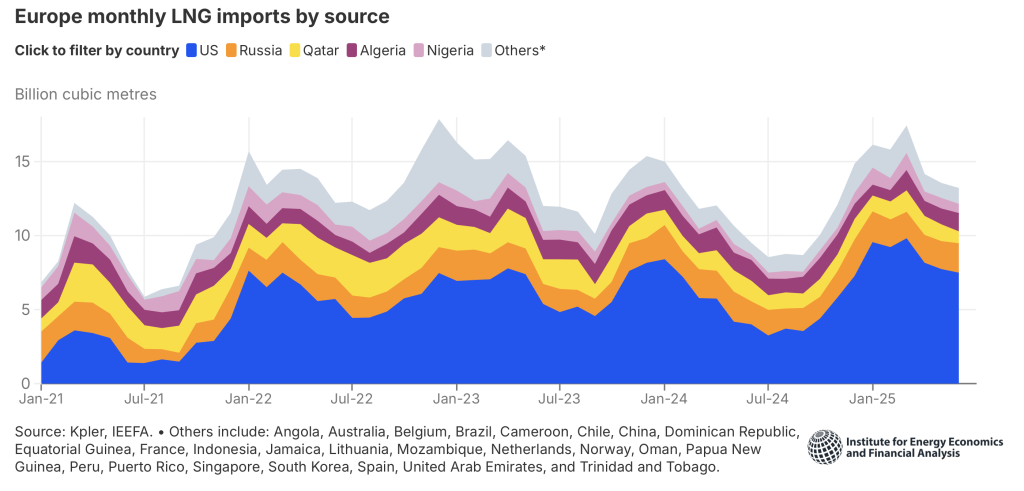
Norway is now Germany’s biggest gas supplier, with around 45% of its gas being transported by pipeline by 2025, according to energy industry group BDEW. About a tenth of the gas used domestically arrives directly as liquefied natural gas (LNG) at one of four import terminals along the coast. By 2025, about 95 percent of its LNG will come from the United States.
BDEW said it was difficult to determine the origin of much of the remaining gas that crossed the border into Germany from neighboring countries such as Belgium, the Netherlands, France and Denmark. This includes supplies from different parts of the world, with the United States, Algeria and Russia as major suppliers. Therefore, Russian gas arriving as LNG at Spanish, French and Belgian ports still ends up in Germany’s gas supply network, despite the suspension of direct imports. Think tank Agora Energiewende said that in 2025, around a third of Germany’s gas imports will come from the United States, taking into account the United States’ share in imports from neighboring Belgium and the Netherlands.
There is no doubt that the US is currently the dominant player, but Russia still exports large amounts of LNG to the EU.
And contrary to what BDEW says, it’s not that difficult to gather ideas to bring gas to Germany from neighboring countries. This gives you ideas like:
In other words, approximately 78 percent of Russia’s LNG imports to the EU are destined for Germany’s neighboring countries (France, Belgium, and the Netherlands). Separation from Germany won’t happen unless they create a magical system that prevents Russian gas from mixing with other gas before being sent to Germany.
The same goes for oil. Germany claims to deny it, but that is simply not true.
First of all, Kazakh oil delivered through Druzhba, the world’s longest oil pipeline, is likely mixed with Russian oil. Still, there is an argument that since Kazakhstan receives payments, Germany is in effect financially cut off from Russian oil. But this is also not true.
Kazakhstan’s oil is supplied by a consortium that includes Russian partners like Lukoil (though Kazakhstan is seeking U.S. approval for Lukoil’s purchase of Kazakh assets), and Moscow still earns transit fees.
Zooming out even further, crude oil is notoriously difficult to track on global markets because it is blended or blended. And despite many clever efforts by Western officials, Russian oil remains an essential part of world trade.
There are also more obvious cases, such as Azerbaijan, which has increased its oil and gas imports to the EU. As a result, it is receiving more supplies from Russia to cover domestic demand, which could be mixed with exports.
Turkey is increasing its oil imports from Russia and exports to the EU. That’s why we have India.
The EU’s 18th sanctions package, which came into force earlier this year, ostensibly seeks to ban imports of refined petroleum products derived from Russian crude, but it is riddled with loopholes. From RFE/RL:
In any case, critics have warned that some refineries may try to hide the origin of the crude oil used in their products to avoid EU sanctions.
They also suggested that exemptions for countries including the UK and Serbia would create opportunities for petroleum products refined from Russian crude to be re-exported to the EU.
Isaac Levi, an analyst at CREA, said similar tactics could be used domestically because the ban relates to ports and refineries importing Russian crude oil.
“It appears that there is a Georgian refinery in the Black Sea called the Krevy refinery that buys Russian crude oil and refines it into products…and then sends those refined products through another port,” he told RFE/RL.
Why provoke the enemy?
Politico’s article on Kazakhstan’s oil situation, like other articles in Western media, omits some important context. They fail to mention that it happened at the same time that Germany was enabling relentless attacks on Russian soil, inciting a war that would kill Russians, integrating arms production with Ukraine, converting car factories to arms production, and claiming (though they don’t say much) that it plans to become Europe’s strongest military to counter Russia.
Some would argue that Moscow’s response has been mild.
The only precision: perfect timing
If Kazakhstan’s oil suspension was indeed a Russian decision and not due to damage caused by Ukrainian aggression, then it is certainly timely. From DW:
Refineries likely have sufficient alternatives to maintain much of their supply, but the news comes as Europe and other parts of the world face one of the worst energy crises in decades.
The Iran war and the continued blockade of the Strait of Hormuz have reduced the flow of oil to Europe and Asia, driving up prices.
Kerosene, which is required for jet fuel and is the main product of PCK refineries, is currently in particular short supply due to the crisis. Airlines around the world have been forced to cut flights, with Lufthansa this week cutting 20,000 flights from May to October.
Illustrating the madness that continues to infect Europe’s elite thinking, this DW article concludes with the mantra that Russia has “weaponized” its energy exports and the only solution is to continue doubling down on large-scale withdrawals.
Meanwhile, the very same sources are shocked by the continued rise of the Alternative for Germany (AfD) party. The AfD is generally referred to as the “far right,” but there is debate as to how far to the right. Despite some controversial statements by party officials and support from Germans with neo-Nazi beliefs, the party is primarily made up of conservatives opposed to open borders, anti-EU nationalists, fraudsters, and free market enthusiasts.
Whether you believe that the AfD represents the rise of the Fourth Reich or that it is run by millions of political opportunists, the fact is that the party, which advocates for a higher cost of living and (sensibly) renewed energy ties with Russia, is currently leading the polls in Germany, and more Germans are responding to their alarm about the party’s downside with a single question:
There will be more clarity on this question in the fall. The AfD is likely to win a plurality of votes in Saxony-Anhalt and Mecklenburg-West Pomerania in September. If, during the preparation for these elections or immediately after, the establishment acts on the party’s demands for a ban, it is quite possible that Germany will fall to new depths. Yes, that is clearly in democratic Western countries.
