


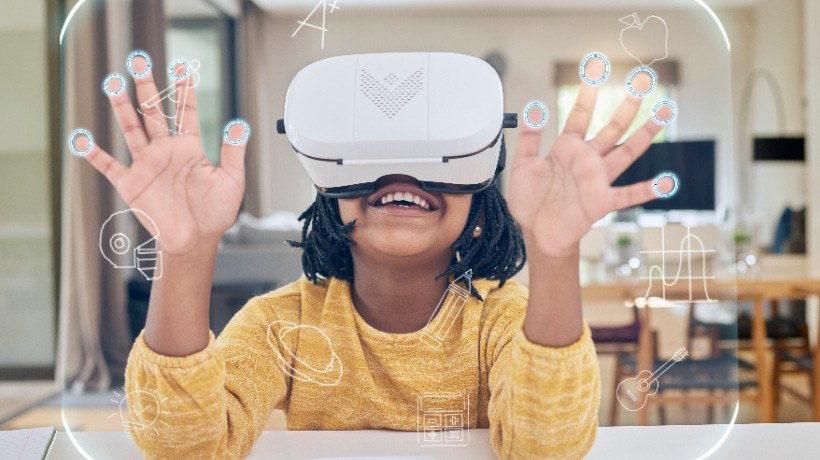
Understanding metaverse in an e-learning environment
As the boundary between the physical and virtual worlds becomes even more blurred, metaverse has proven to be a revolutionary factor in the way knowledge is learned, absorbed, and applied. By offering an immersive, interactive and personalized learning experience, Metaverse redefines traditional eRearning and opens up a new world of virtual education.
Metaverse is a continuous, shared virtual environment that combines augmented reality (AR), virtual reality (VR), artificial intelligence (AI), and blockchain technology to form a completely immersive virtual world. In this environment, users can communicate through avatars, engage in real-time simulations, access digital campuses, and collaborate in ways that simulate real-world social and educational environments. In contrast to traditional online learning environments based on 2D content, Metaverse adds 3D spatial elements, significantly increasing engagement and interactivity.
The role and advantages of metaverse in e-learning
1. Increased learner participation and retention
One of the lasting issues of e-learning is to maintain the interest of learners. Modified videos, slide modules, and text courses tend to not be involved and lose learners to reduce their retention levels. Metaverse solves this by transforming passive learning into active discovery. For example, within the virtual representation of ancient Rome, it is possible to provide historical lessons, allowing learners to navigate the city, engage with the ancient Romans, and observe historical events.
These experiences are not only more interactive, but also improve information retention. According to research in cognitive science, an immersive learning environment contains more sensations, leading to more efficient encoding into long-term memory. Students don’t just read about concepts. They live it.
2. Personalized adaptive learning
Metaverse supports high-level personalization. AI-driven virtual environments can respond in real time based on learners’ performance, learning pace and style. If learners are struggling with a particular idea, the system may provide simulations tailored to their needs or one-on-one instruction by a virtual coach. This adaptation model keeps learners behind and promotes acquisition-based progression compared to time-based graduation.
Additionally, students can design their own avatars and learning spaces, increasing their identity and ownership of the learning process. This is a motivational advantage and creates a more inclusive and powerful learning environment.
3. Social and collaborative learning
Social learning is an important aspect of successful learning, and metaverse is better than offering rich interactions. From anywhere in the world, students can meet together in virtual classrooms, collaborate on group projects, watch live demonstrations, and participate in discussion forums.
This feeling of “being there” improves collaboration and communication skills that are easily developed in standard online education. It also helps to mimic casual interactions and peer learning that take place spontaneously within on-campus educational settings.
4. Real-world skills development through simulation
One of the most powerful uses of Metaverse is simulation-based learning. Technical students, such as medicine, engineering, and aviation students, can practice complex procedures in a safe, virtual environment. For example, medical students can practice surgery with tactile feedback and receive AI-based feedback on performance immediately.
These learning through-empirical activities are invaluable in practicing skills and developing confidence in being ready to get into a real situation. They further allow institutions to reduce costs associated with physical labs and training facilities.
Issues and considerations
Even with that promise, incorporating metaverse into e-learning is not without its challenges. Infrastructure is the biggest hurdle. VR headsets, high-speed internet and compatible hardware are not ubiquitous, especially in developing regions. There is also a high barrier for teachers and developers to enter when developing and delivering content within these virtual worlds.
Privacy and data security should also be taken care of, especially when collecting behavioral data to personalize learning. Another important consideration is to make virtual spaces accessible and available to students with disabilities.
Finally, the cost of creating high-quality metaverse content can be prohibitive. Organizations should balance these costs with potential long-term benefits and consider scalable implementation methods.
The road ahead
Metaverse is not a science fiction idea. This is becoming a viable tool that providers can use today. As technology improves and prices drop, entry barriers continue to decline. Early adopters in corporate training, higher education and K-12 schools have already demonstrated successful applications, indicating that immersive virtual learning is more than a trend.
To stay relevant, e-learning providers should consider metaverse integration strategies to create immersive content, from testing VR-based lessons to partnerships with developers. This revolution requires only an investment, innovation and learning-oriented approach.
Conclusion
Metaverse rewrites the rules of eLearning by providing a rich, interactive and highly immersive learning experience. It is not only a technological revolution, but also an educational revolution, allowing learners to discover, create and connect in ways that were previously unimaginable. At the pinnacle of education and innovation, embracing metaverse can be key to unlocking the full potential of virtual education.
Hexalearn Solutions Private Limited
ISO Certified Learning & Software Solutions Company.
