


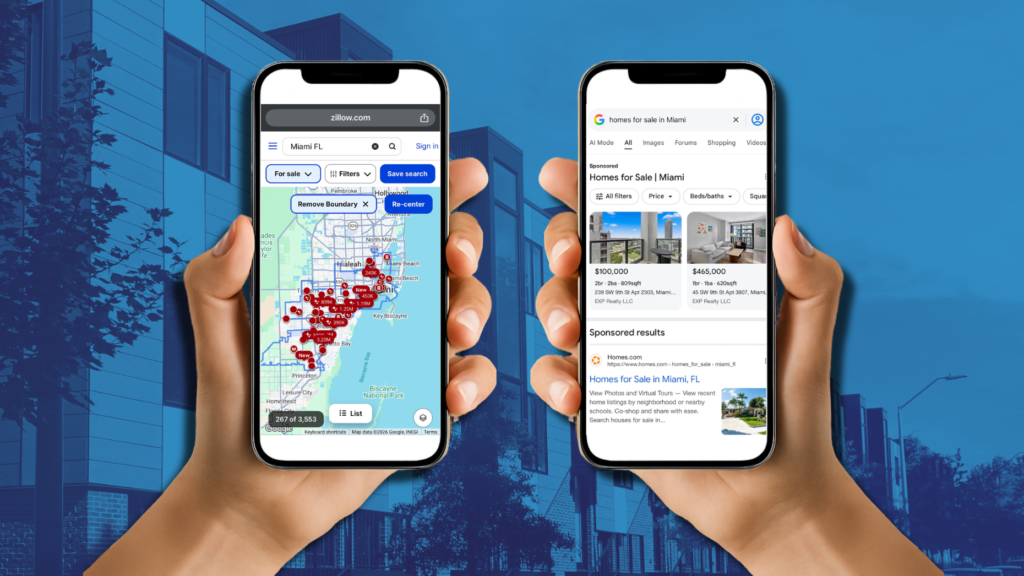
Zillow does not believe Google’s newly expanded home listing ads pose an immediate threat to its business, the home search giant told Inman, pointing to pilot market data that the company claims did not show a significant drop in traffic or search interest on Zillow.
This reaction comes shortly after Google announced the nationwide rollout of home listing ads using HouseCanary. The ads feature property details within mobile search results and allow consumers to connect with local agents.
The national rollout quickly raised questions about whether Google would become a more serious competitor to existing home search portals, but Zillow says early evidence points in a different direction.
Zillow said daily data from SimilarWeb that it reviewed showed no negative impact on traffic in the eight markets where Google’s pilot took place. A Zillow spokesperson told Inman that the company has seen traffic benefits in some markets.
The company also cited Google Trends data showing that “Zillow” is searched more frequently than “homes for sale” and “buying homes” (the types of terms that appear in listings in Google’s ad carousel). Zillow claims that data suggests that many consumers are not using Google instead of Zillow, but instead are using Google to access Zillow.
“The fact that people’s first instinct is to search Zillow may explain why 80 percent of Zillow’s traffic comes directly to our apps and sites,” a spokesperson said in an email.
business model issues
Zillow’s backlash reflects a broader question at stake in Google’s expansion and debate: whether the search giant is building something that could undermine Portal, or whether it is simply adding another layer to an ecosystem of listing distribution and agent advertising that already includes MLS feeds, intermediary websites, IDX sites, portals, and paid lead products.
Zillow’s view is that Google is moving toward a model more akin to traditional lead generation and agent advertising, even as Zillow increasingly builds its own strategy around housing a wider range of trading platforms and “super apps.”
“We feel like this is Google playing into the business model that we’re moving to,” a Zillow spokesperson said on the call. “It’s more of a pay-per-lead model, and we’re moving more and more beyond pay-per-lead to a success-based model.”
As such, the company sees Google’s expansion as a potential competitor to its traditional agent advertising and lead generation business, rather than a direct clone of Zillow.
“The search experience on Zillow is much more powerful, more comprehensive and dynamic than the search experience you get from Google,” the spokesperson said.
The spokesperson also said discussions around Google’s expansion tend to treat the big portals as a single category, despite their different business models and consumer experiences. In Zillow’s view, Google’s format may create new home search and agent advertising channels, but that doesn’t mean it poses the same kind of threat to all companies in the space.
When asked for comment, Realtor.com did not directly address whether Google’s expanded home listing ads posed a competitive threat, but emphasized the importance of access to comprehensive listings. “Consumers have the right to access all property information, all property details, and all professionals serving the market, not just some of the information available,” a company spokesperson said.
Homes.com’s parent company, CoStar Group, had not commented by the time of publication. The company has long positioned Homes.com’s “your listings, your leads” model as an alternative to what CEO Andy Florance has criticized as the “lead conversion” model employed by Zillow and Realtor.com, making Google’s agent ad format a potential test related to the portal’s broader disparity.
Brokers refer to separate exposure channels
Leo Pareja, CEO of eXp Realty, said that from the brokerage side, he sees Google’s expansion primarily as a new channel for listing exposure, rather than as a threat to the home search portal. Pareja said eXp is feeding all active coming soon properties from eXp Realty and NextHome into the program, as well as upcoming properties.
“I don’t see it that way, because this is just another way to display real estate,” Pareja told Inman, referring to the idea that Google’s expansion poses a threat to the portal. “I think Portal wins on the complete experience.”
Pareja said consumers often have different preferences between Zillow, Realtor.com, Redfin and other search portals based on user experience, app design and functionality. For eXp, he said, the value of Google’s program is more direct in terms of giving agents and sellers new visibility.
“It’s our job to stay curious and find every opportunity to promote our sellers’ listings,” Pareja said. “Whether this scales, whether it gains a meaningful amount of attention and voice share remains to be seen. But if we can generate that exposure with customers early on, I think that’s nothing but a good thing.”
This view is not necessarily inconsistent with Zillow’s argument. A Zillow spokesperson said the company agrees that sellers benefit from broader visibility of their listings. From Zillow’s perspective, Google may be another place where listings appear, but that doesn’t mean agents and sellers should choose Google instead of the main portal. Most sellers and agents want to be listed in as many places as possible, rather than just one platform, a spokesperson said.
“We believe there is probably no world in which an agency would post a listing on Google instead of Zillow,” the spokesperson said.
The company cited the rise of Homes.com as an example of a new portal that built an audience without significantly reducing Zillow’s traffic, and argued that real estate search is not necessarily zero-sum at the property distribution level.
A broader channel than just a portal rival
HouseCanary, which is driving Google’s expanded home listings ad format, also says its model is broader than just its portal competitors. House Canary said in a response to Inman last week that the pilot was “successful enough to lead to this national expansion” and is expected to be fully covered in the U.S. this summer.
HouseCanary said it is working with additional MLSs to coordinate more feeds and expects more partners to be announced in the coming weeks, possibly as early as this week. The company described the model as a combination of listing distribution, lead generation, agent advertising, and Google Local Services Ads integration.
A HouseCanary spokesperson said: “This is a great new channel for buyers to discover listings.”
Perhaps that ambiguity is the point. Google’s expansion doesn’t have to completely replace Zillow, Realtor.com, and Homes.com. This can be another place where listings are discovered, agents surface, and advertising dollars are spent.
Email AJ Latrace
