


Conor: From the Mesozoic era to modern times, the privatization of the commons has accelerated. After all, “data is the new oil”.
Sam Altman: “We’re looking at a future where intelligence becomes a utility, like electricity or water, and people buy it by the meter.” pic.twitter.com/AXnZ9zh0Ro
— Vivek Sen (@Vivek4real_) May 25, 2026
Christy Curry Rogers, DeWitt Wallace, Professor of Biology and Geology, Macalester College; Originally published on The Conversation.
On July 14, 2026, “Gus”, one of the most complete specimens of Tyrannosaurus rex, was sold to an as-yet-unidentified buyer for US$50.1 million. This auction at Sotheby’s set a record for the most valuable fossil ever sold. Another dinosaur has entered the luxury collectibles market, reminding us that even Earth’s deepest history can be sold to the highest bidder.
But to paleontologists like me, fossils like Gus, excavated from South Dakota’s Hell Creek Formation over a three-year period starting in 2021 by commercial collector Thomas Heitkamp and his team, are more than trophies or works of art. It is an irreplaceable academic archive. Fossils preserve evidence of evolution, extinction, growth, disease, damage, and ancient ecosystems. They are a finite and irreplaceable record of the history of life on Earth.
Science relies on independent verification of claims and healthy debate. Researchers must be able to revisit specimens, verify previous conclusions, and ask new questions.
However, once scientifically important fossils enter private collections, access for researchers is no longer guaranteed. Collectors usually sequester fossils in their homes. Even if a privately owned specimen is on loan to a museum, the owner may change his or her mind and terminate access at any time. This issue is especially tricky with regard to Tyrannosaurus. A 2025 study found that at the time there were 61 Tyrannosaurus fossils in public trusts, but 71 were in private storage.
That’s why the Society of Vertebrate Paleontology, of which I am a long-time member and president-elect, has long maintained that scientifically important vertebrate fossils belong to the public trust, are kept in museums and universities, are preserved forever, are made available for research, and are shared with the public.
find fossils
Proponents of commercial fossil sales often argue that without sales to private collectors, specimens like “Gus” will remain buried or eroded. They’re right about one thing: discovery matters. Many unusual fossils have been discovered by ranchers, hikers, amateur collectors, and commercial excavators. Paleontology is accessible to anyone with an eye for observing nature. You don’t need to be an academically qualified expert to make important discoveries.
But discovery is just the beginning. The scientific value of a fossil depends on careful records of where it was found, the surrounding rocks, and the plants and animals that were preserved with it. These details allow scientists to reconstruct ancient ecosystems, understand how animals lived and died, and interpret how their remains fossilized. If that contextual information is incomplete or lost, much of a fossil’s scientific value is also lost.
But their discovery, excavation, and publication only scratch the surface of the scientific importance of fossils. A specimen’s greatest scientific value often emerges decades later, when researchers ask new questions and apply new techniques that previous generations could not have imagined. A specimen that seems well-studied today may yield surprising new information tomorrow, but only if it is still available for study.
delay in discovery
Consider iconic dinosaurs like Tyrannosaurus, Triceratops, Diplodocus, and Stegosaurus that were first collected over a century ago. Early paleontologists could describe the shapes of bones, but they had no way to peer deep inside them. These specimens were preserved in museum collections, allowing future generations to revisit them using techniques that did not exist at the time of their discovery.
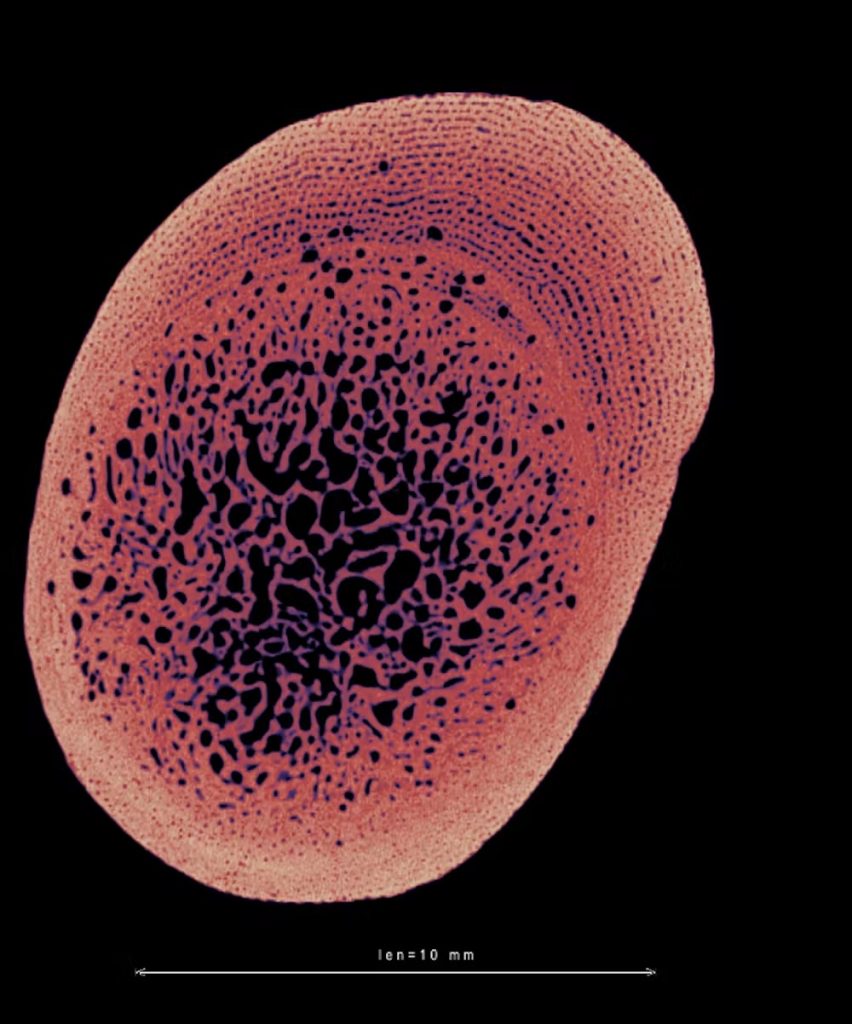
Nondestructive micro-CT scan of the fibula of a neonatal specimen of the long-necked titanosaur Rapetosaurus. Christina Curry Rogers
Ohio University paleontologist Larry Whitmer and his colleagues began using CT imaging 20 years ago to reconstruct the internal structures of historic dinosaur fossils without damaging them, based on the way X-rays pass through the specimens. Brain cavities, inner ears, spaces, nerves and blood vessels have been visualized for the first time, revealing how dinosaurs balanced, heard, smelled and perceived their world.
Henry Fricke, Thomas Cullen, and other geochemists have used isotopic signatures preserved in fossilized teeth and eggshells to reconstruct dinosaur diets, locomotor patterns, and body temperatures. This research has revealed how dinosaurs lived, what they ate, how they moved through ancient terrain, and even how warm their bodies were.
More recently, molecular paleontologist Jasmina Wieman and her colleagues identified chemical signatures preserved in fossilized bones, eggshells and skin, revealing aspects of dinosaur biology that would have been unimaginable a generation ago. Until now, paleontologists had no way of knowing details about metabolic rates, reproduction, or the color of their skin, feathers, and eggs.
Thin sections of a Diplodocus femur reveal the microscopic structure of the bone and preserve a record of the animal’s growth and life history. Christina Curry Rogers
In my own research, I use microscopes to uncover the hidden stories preserved within dinosaur bones and teeth. Thin sections of fossil bones reveal that dinosaurs grew more like mammals and birds than oversized reptiles. Microscopic modifications to the bones have captured traces of ancient scavenging, and tiny marks deep within the bones of baby dinosaurs indicate the moment of hatching.
None of these discoveries would have been possible if the original fossils had disappeared into inaccessible private collections.
Shared natural heritage on the auction block
Fossils are not static objects whose scientific value, once explained, is exhausted. Their value increases as science advances, but only if future researchers can continue to study the original specimens.
Of course, dinosaur fossils can sometimes be rescued from obscurity by being purchased and immediately deposited or donated to a natural history museum. Some of the world’s most important dinosaur fossils are now accessible today. This is because individuals, companies, and organizations with the means to obtain special specimens recognize that these fossils belong in a place where scientists can continue to study them and where future generations can learn from them.
Purchasing fossils to place in public trust in perpetuity is fundamentally different from purchasing fossils for private collections. One expands access, the other leaves access uncertain.
But as the price of fossils rises into the millions of dollars, museums are increasingly unable to compete. The most important fossils are no longer securely in public collections. Rather, it is becoming a luxury asset where market value takes precedence over scientific value.
Dinosaurs belong to our common natural heritage. They cause wonder because they connect us all to a world that is inconceivably older than ours. For me, the question raised by auctions like the July 14th “Gas” auction is not who can afford to own these relics of the past. It’s about whether future generations will have the opportunity to study and learn from them.
