


Last November, the Department of Health and Human Services announced the elimination of “black box” warnings on hormone replacement therapies, aiming to reverse nearly two decades of stigma surrounding a key treatment for menopause symptoms.
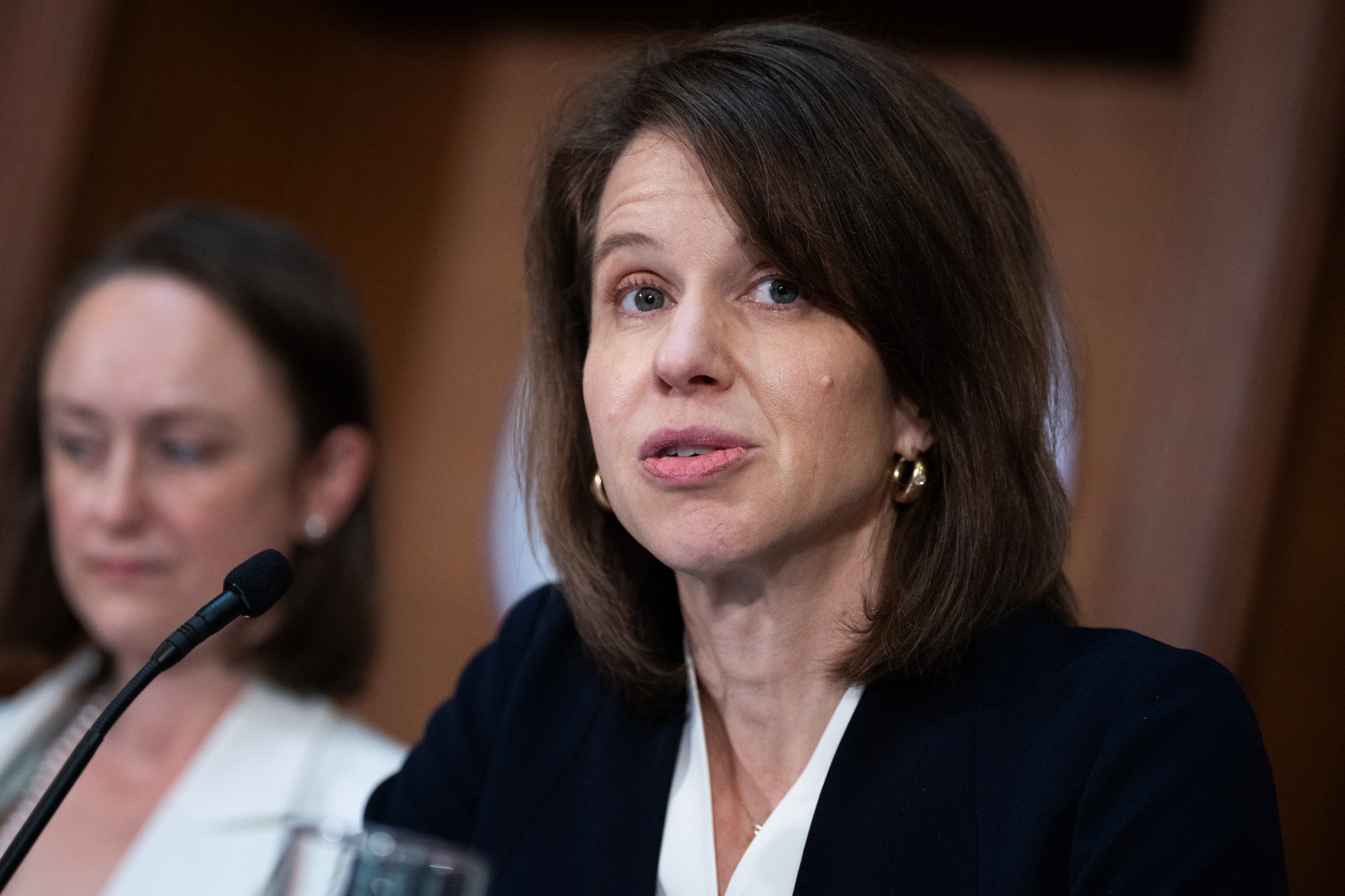
Among the officials at a press conference about the decision was Alicia Jackson, director of a federal health agency that invests taxpayer money in medical technology and research. As Jackson stood behind a lectern adorned with the HHS logo, she praised the new policy, calling it a victory for women and science.
“Today we have the opportunity to add up to a decade of healthy years to the life of every woman that you love,” Jackson said. “The science is clear: Hormone therapy is safe and effective. And it is hugely beneficial to the vast majority of women.”
Less clear that day were the financial benefits the new policy could bring Jackson, according to disclosure records obtained by ProPublica.
Jackson is the founder and former chief executive of Evernow, an online platform that connects women with medical experts who treat the symptoms of menopause. Although she left for federal service last year, she kept at least $115,000 in Evernow stock and an unknown amount of stock options, records show.
Those are just part of a multimillion-dollar portfolio Jackson holds with her husband, a venture capitalist, that poses potential conflicts of interest with her work overseeing the Advanced Research Projects Agency for Health, known as ARPA-H.
It’s unclear what role, if any, Jackson played in dropping the black box warning, the most serious type of federal safety warning that is reserved for drugs with severe side effects or life-threatening risks. A different agency, the Food and Drug Administration, regulates drugs, and its panel of experts had recommended an end to the warning requirement months before Jackson arrived in government.
But ethics experts called Jackson’s official endorsement of the warning removal “alarming” and an “obvious conflict of interest,” noting federal law prohibits government employees from participating “personally and substantially” in matters that could influence their personal finances — even making statements at a press conference or in a news release, as she also did.
“We should care because her company is apparently intending to profit off this change in policy that she endorsed as a government official while still retaining a financial interest in the company,” said Virginia Canter, who served as an ethics lawyer at the White House, Treasury Department and Securities and Exchange Commission during the presidencies of George H.W. Bush, Bill Clinton, George W. Bush and Barack Obama.
“I say it puts her within the zone of a potential violation,” she said.
Months after the announced end to the warning notices, Evernow launched a nationwide expansion.
Under federal law, agency officials like Jackson are required to submit financial disclosure forms, which must then be certified as complying with ethics laws. But Jackson’s two financial disclosures — filed last October and two months ago — remain uncertified. Canter said it is not unusual for an agency’s ethics office to ask the inspector general to investigate if staff cannot certify that an individual’s disclosure forms meet ethics standards.
Over two months, ProPublica sought comment from Jackson and submitted questions about her work, investments and ethics records. Jackson did not respond, and HHS never addressed our detailed questions.
But in a statement to ProPublica last week, an agency spokesperson said Jackson has been placed on administrative leave and HHS would “assess the facts before determining any change in her status. HHS requires all officials to comply with federal ethics laws, regulations, and policies.”
HHS declined to answer additional questions about the reasons for Jackson’s leave, the decision’s timing or whether the inspector general was investigating.
Earlier this week, Bloomberg Law reported on the HHS statement that Jackson was on leave and made public a draft memo by one of the agency’s senior officials that would have granted Jackson a conflict waiver involving many of her and her husband’s extensive investments. Since she joined ARPA-H, the memo said, Jackson and her husband’s financial ties required her to recuse herself from “a significant portion” of her duties, including discussions about funding awarded by her agency. The waiver named 30 investments and would have allowed Jackson to take part in decisions that could affect those interests. Evernow is not listed.
Bloomberg reported that two firms with ties to Jackson sought ARPA-H funding, but it was unclear if either received any. HHS did not respond to ProPublica’s questions asking whether the waiver was ever granted or if the firms had received money from ARPA-H. The Office of Government Ethics does not list Jackson among federal officials who have received waivers.
Jackson’s disclosures are among 2,400 added Thursday to ProPublica’s Trump Team Financials database, a searchable tool launched in March. The records detail the finances of more than 2,300 officials appointed by President Donald Trump. Since last year, we’ve requested disclosure records from 127 federal agencies and the White House. Disclosures from roughly 1,500 appointees remain unreleased.
The Trump administration’s massive cuts to the federal bureaucracy have taken a toll on the ranks of ethics staff. By the end of 2025, there were 274 fewer full-time ethics officials, according to a recent analysis of federal survey records by the government watchdog group Campaign Legal Center. Some agencies said the losses hampered ethics officers’ ability to conduct training and monitor employee compliance.
Trump appointees failed to file nearly 420 legally mandated public financial disclosure reports last year, almost a fourfold spike compared with the Biden administration’s last full year, the center found. Nevertheless, our database provides the most complete source yet for this administration’s ethics documents.
Potential Serious Conflicts
Jackson spent years navigating the worlds of technological research, government and entrepreneurship, according to her government bio and LinkedIn profile.
After earning a doctorate in materials science from the Massachusetts Institute of Technology in 2007, she worked briefly as a U.S. Senate policy staffer. She subsequently joined the Pentagon’s Defense Advanced Research Projects Agency as a program manager, later becoming deputy director of its first biotechnology office.
Jackson left the Defense Department in mid-2015, going on to lead several biotech businesses before starting Evernow in 2019. The San Francisco-based company connects women experiencing sometimes debilitating menopause symptoms with medical providers who prescribe treatments.
Evernow offers patients one-time treatments or memberships for frequent care. Its website lists celebrity angel investors, including Gwyneth Paltrow, Cameron Diaz, Demi Moore and Drew Barrymore.
Jackson was appointed by Trump as ARPA-H’s second director and was sworn in on Oct. 20, 2025. The agency, created three years earlier to spur revolutionary biomedical research and technologies, has a $1.5 billion budget. It has issued numerous contracts and grants, including $160 million for genetic medicines combating rare diseases and $144 million to study existing treatments for age-related illnesses.
In both of her financial statements, Jackson said she owned Evernow stock worth between $115,002 and $300,000. (Federal disclosures include value ranges, not specific figures.) She also listed company stock options whose value, she said in her most recent financial report, were “not readily ascertainable.” (In a statement late Wednesday, Evernow said Jackson does not currently hold a financial interest in the company. The firm did not immediately respond to follow-up questions.)
Jackson’s disclosures also show investments in Gameto Inc., a Texas-based biotechnology company working through a two-year, $10 million award from ARPA-H to create ovarian treatments preventing menopause-related diseases. The award predated Jackson joining ARPA-H. But as her office oversaw Gameto’s project, her stock’s value increased, documents show.
Jackson’s Gameto investment was worth between $15,001 and $50,000 in her October 2025 disclosure. Her Aug. 13 filing shows it grew to between $50,001 and $100,000. It’s unclear what drove the increase in value.
In addition, Jackson owns more than 60 venture capital and private equity funds that she says do not disclose their holdings to investors.
These include at least 13 funds managed by 137 Ventures, a venture capital firm co-founded by Jackson’s husband, Alex Jacobson. The company invests in a wide range of industries, including healthcare, digital health and medical device companies, according to its website.
Federal appointees must list their spouses’ employment, but Jackson never included her husband’s role at 137 Ventures on her public disclosures. Jacobson did not respond to requests for comment.
Ethics experts said Jackson’s funds could pose a serious conflict of interest if the underlying businesses they invested in received grants or contracts from her agency. To resolve such risks, federal agencies typically require employees to work with the investment vehicles to identify the contents of such funds. If the investment firms insisted on anonymity, employees could be required to sell the funds or recuse themselves from actions potentially affecting the assets, the experts said.
However, 10 months after starting work at HHS, Jackson retained the funds and their underlying investments remained undisclosed, according to her August financial statement.
Kedric Payne, Campaign Legal Center’s vice president, general counsel and senior director for ethics, said Jackson’s lack of disclosure about her husband and the funds she owns “suggests that agency leaders may be hiding their conflicts of interest from the public, and there is no ethics enforcement to stop it.”
The disclosures also show her husband owns between $5 million and $25 million worth of stock in Palantir Technologies, which had a $19 million contract from Jackson’s agency when she became ARPA-H director. Palantir, which has similar contracts with other federal agencies, is using its software and AI technology to build and improve ARPA-H’s data infrastructure and operational systems. In June, ARPA-H extended the company’s contract by a year, records show. The renewal is worth up to $13.7 million for Palantir.
The draft waiver obtained by Bloomberg would have allowed Jackson to take part in decisions that could affect Palantir, Gameto and more than two dozen other investments but says she must still comply with the terms of an ethics agreement. The draft waiver includes a note dated April 30 — six months after Jackson started the job — that says discussions about the ethics agreement were ongoing. In addition to Evernow, the waiver does not specifically mention the funds managed by 137 Ventures.
HHS officials would not answer repeated questions about whether Jackson recused herself from Palantir’s contract, has an ethics agreement or has divested any assets. The agency has not produced an ethics agreement in response to a July Freedom of Information Act request.
Public Good or Personal Gain?
Since January 2025, ProPublica has continually obtained disclosure records to investigate how personal financial interests have intersected with government decision-making inside the Trump administration. The new disclosures added to our searchable tool Thursday include many that have raised concerns about additional conflicts of interest, including at HHS.
Health Secretary Robert F. Kennedy Jr., Jackson’s ultimate boss, has drawn questions about whether he used his office to help his wife, actress Cheryl Hines.
Cheryl Hines, wife of Health Secretary Robert F. Kennedy Jr., watches her husband testify during his Senate Finance Committee confirmation in 2025. Anna Moneymaker/Getty Images
According to his latest financial disclosure, Hines’ media company, Youngster Productions Inc., received $210,000 in consulting fees from MAHA Action, a nonprofit promoting Kennedy’s Make America Healthy Again agenda. Under the contract, Hines has vigorously advocated for MAHA Action, appearing in several videos and press releases. The group has also claimed credit for policy actions launched by Kennedy’s HHS.
News of the contract, first reported by The New York Times, prompted the Campaign Legal Center to ask the HHS inspector general to examine whether Kennedy made or influenced policies that benefited his wife. Kennedy also received more than $270,000 in gifts from allies working to bolster MAHA, his disclosure showed.
“Americans deserve to know whether their leaders are prioritizing the public good or focusing more on their personal financial gain,” said Payne of Campaign Legal Center.
HHS denied any wrongdoing by Kennedy, telling the Times the secretary “complies with all applicable federal ethics laws, regulations and financial disclosure requirements.”
Campaign Legal Center’s analysis of federal ethics staff this year found Kennedy’s cuts to the agency eliminated nearly 30% of HHS’ full-time ethics workers.
Another HHS official whose disclosures raised ethical alarms was the agency’s top attorney, Mike Stuart. Stuart was reassigned after a Washington Sun investigation found he invested in a company doing business with the department and repurchased stock in other businesses that ethics officials had required him to sell.
The Office of Government Ethics refused to certify Stuart’s annual disclosure report “due to continued non-compliance” with his ethics agreement, the Sun revealed.
Stuart said he didn’t know of the company’s involvement with the department and immediately sold his stock when ethics officials raised questions. “My whole career, I’ve never had even a whiff of an ethical issue. I’m extra careful that I am completely in compliance,” Stuart told the Sun.
The disclosures obtained by ProPublica since early last year have revealed potential conflicts across the federal government, including at the highest levels.
In December, ProPublica reported that Trump had appointed more than 200 people who collectively owned — personally or with their spouses — between $175 million and $340 million in cryptocurrency investments at the time they filed their disclosures. Some hold positions overseeing or influencing crypto industry regulation.
Among them is Todd Blanche, Trump’s former criminal defense attorney and now the nation’s attorney general. Blanche’s disclosures show that he owned at least $159,000 in crypto-related assets last year when, as the Justice Department’s second-highest official, he shut down investigations into crypto companies, dealers and exchanges.
Democrats in Congress accused Blanche of a “glaring conflict of interest”; a Justice Department spokesperson said Blanche’s action was “appropriately flagged, addressed and cleared in advance.” An Office of Government Ethics official noted on Blanche’s latest disclosure that the inspector general “declined further action” related to the crypto holdings.
Former U.S. Attorney General Pam Bondi speaks with Todd Blanche, then her deputy and now attorney general, in the White House in January. Mandel Ngan/AFP via Getty Images
Other disclosures helped show that senior executive branch officials, including Pam Bondi when she was attorney general, made well-timed securities trades, selling stocks just before markets plunged because Trump announced new tariffs. (The officials either did not respond to requests for comment or denied having insider information before trading.)
Disclosure forms also revealed in July that Federal Communications Commission officials took pricey gifts from Paramount, including tickets worth $12,000 and skybox seats worth $125,000 each for the annual honors gala at the Kennedy Center. The media giant provided the perks while seeking FCC approval for its mergers with Skydance and Warner Bros. Discovery. (The FCC said agency ethics officers approved the commissioners’ attendance as consistent with ethics law.)
Our database has helped other news organizations uncover potential conflicts of interest. The Lever, for instance, found that the Pentagon’s chief technology officer was “a central figure in the decision to blacklist the AI company Anthropic” while owning a stake in a competitive AI developer. A Defense Department spokesperson said the official, Emil Michael, fully complied with ethics requirements.
