


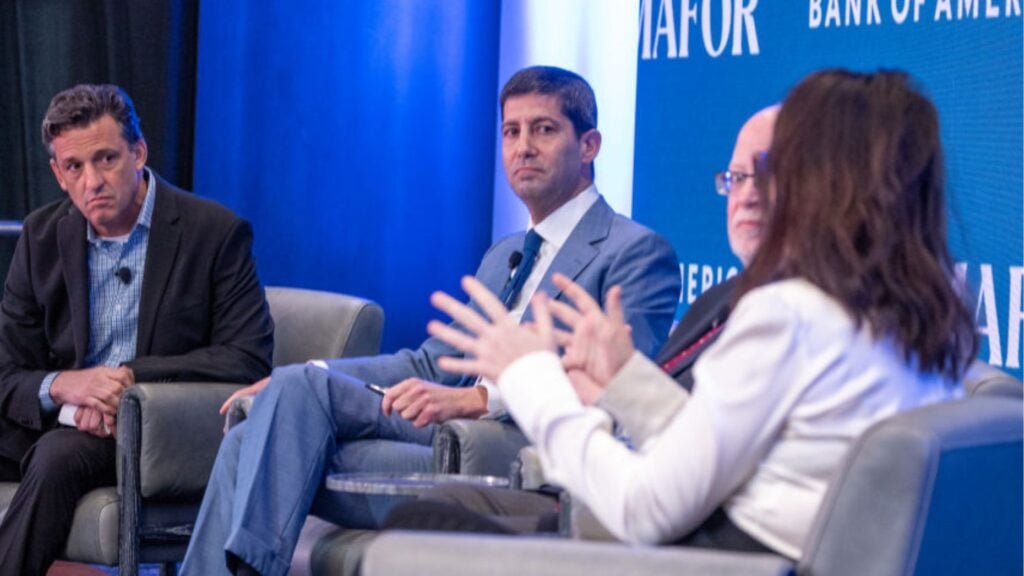
The president made the announcement Friday on Truth Social. Warsh will need Senate confirmation to take up the central bank post.
President Trump has nominated Kevin M. Warsh to replace Federal Reserve Chairman Jerome Powell, whose term ends in May.
The president made the announcement Friday morning via a post on Truth Social.
Warsh will also need Senate confirmation to assume the central bank governor’s post.
“I have known Kevin for a long time and have no doubt that he will go down as one of the great Fed Chairs, perhaps one of the best,” Trump wrote. “Above all, he is ‘core casting’ and will never let you down. Congratulations, Kevin!”
Other candidates for Fed chair the Trump administration considered included Trump economic adviser Kevin A. Hassett, current Fed director Christopher J. Waller, and BlackRock Inc. executive Rick Rieder.
In his announcement, Trump did not mention Powell, who is currently under investigation by the Justice Department, but characterized the Fed chair as politically motivated.
Since taking office, the president has put Mr. Powell under intense scrutiny, threatening to fire him if he doesn’t lower interest rates more quickly while Americans grapple with the effects of inflation and a weak labor market.
This pressure campaign has called into question whether the central bank can remain an independent institution. In the wake of the criminal investigation into Mr. Powell, some Senate Republicans strongly objected to supporting the Fed chairman and vowed to block any new nominee until the investigation is resolved.
President Trump has made no secret of the fact that his main criteria for a new Fed chair is someone who supports deep interest rate cuts.
The Federal Reserve voted to keep interest rates unchanged at a range of 3.5% to 3.75% at Wednesday’s meeting.
Mr. Warsh, a conservative economist, previously served as an aide to President George W. Bush and served as a member of the Federal Reserve’s Board of Governors from February 2006 to March 2011. During that time, he also served as the Fed’s representative to the G20 and played a key role in the Fed’s response to the 2008 financial crisis, including helping broker the sale of Bear Stearns to JPMorgan Chase. Prior to joining the Fed, Mr. Warsh worked in M&A at Morgan Stanley.
Most recently, he has worked with billionaire investor Stanley Druckenmiller and is a senior fellow at Stanford University’s Hoover Institution.
During his first tenure at the Fed, Warsh became known as a “hawk” when it came to lowering inflation by raising interest rates.
But since becoming a candidate for Fed chair, Mr. Warsh has reversed his views on interest rates and inflation, and he has publicly voiced criticism of the central bank.
“I think the reluctance to cut rates is actually… quite a disadvantage,” Warsh said in an appearance on CNBC in July. Warsh also called for “a change in policy management,” adding, “In my view, the lack of credibility lies with the Fed’s incumbents.”
Economists have long considered the Fed’s independence to be critical to financial market and economic stability. Warsh’s ability to maintain the agency’s independence will be a concern for many during his confirmation hearing. He has said in the past that Fed independence is “essential,” but he has recently suggested that complete independence may not be ideal.
“History tells us that independent management is essential in conducting monetary policy,” he told CNBC in July. “But that does not mean that the Fed is independent in all other activities.”
Email Lillian Dickerson
