


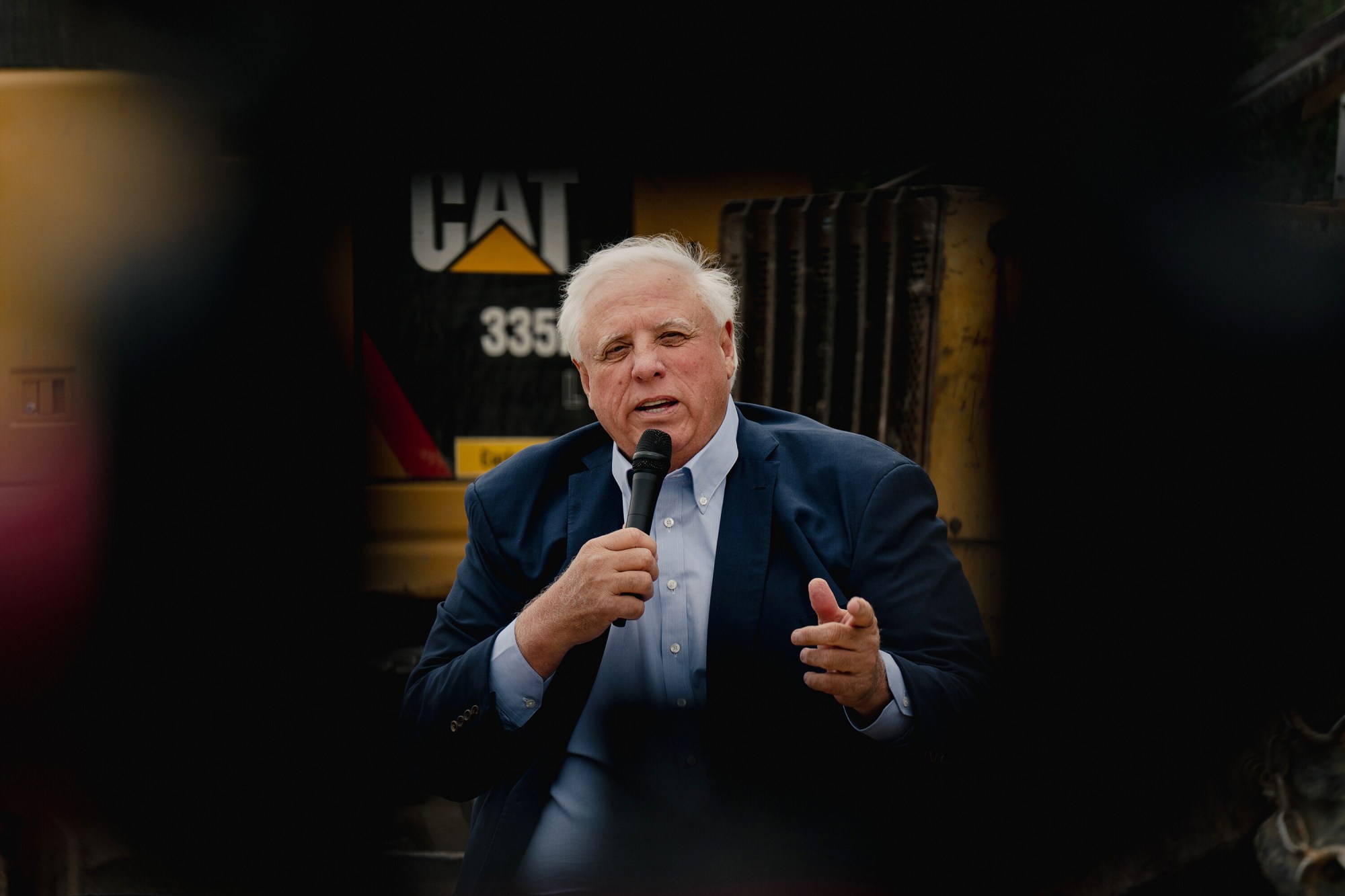
Trump administration officials earlier this year killed off a federal criminal investigation into a coal empire owned by Sen. Jim Justice, a Republican from West Virginia and a close ally of the president.
The probe primarily looked into possible Clean Water Act violations by mining operations in multiple states run by Justice’s son Jay, according to current and former officials familiar with the matter.
The criminal investigation was a significant escalation in a years-long effort to crack down on serial pollution crimes by Virginia-based Southern Coal and dozens of affiliated mining operations controlled by its family. Over the past decade, Southern Coal and other justice companies have racked up tens of thousands of alleged Clean Water Act violations and have been repeatedly sued by state and federal prosecutors for failing to properly comply with environmental laws at mining sites.
The investigation, which was terminated by the Trump administration, was a joint effort by prosecutors and investigators from the Environmental Protection Agency, the Justice Department’s Environmental Crimes Division, and the U.S. Attorney’s Office for the Western District of Virginia to determine whether persistent violations of anti-pollution laws rose to the level of criminal activity, officials said.
People familiar with the investigation told ProPublica that prosecutors believe they have strong charges. They initially received blessings to move forward from Robert Tratch, President Donald Trump’s top official for the Western District of Virginia.
But in recent months, the deputy attorney general’s office closed the investigation as prosecutors battled law enforcement officials in court over subpoenas for the records. Todd Blanche, who was still serving as chief justice at the time, became acting attorney general in April.
“They were told, ‘Put down your pencil,'” said a person familiar with the investigation.
People said it was noteworthy that prosecutors were even conducting a criminal investigation, since the Justice Department only prosecutes about a dozen criminal cases related to the Clean Water Act each year. People familiar with the case say it is unusual for Justice Department officials to derail a criminal investigation started by a career employee at such an early stage.
Former federal prosecutor Rick Mountcastle outlined the Justice Department’s protocol and said, “I’ve never heard of anything like that happening before.” Mr. Mountcastle served as a prosecutor in the Western District of Virginia for 24 years. “There shouldn’t be a list of untouchables that escapes enforcement.”
The move is part of a pattern at the top of the Justice Department to move forward with lawsuits against President Trump’s political opponents and soften against allies.
Under the second Trump administration, environmental regulations for large-scale polluters were significantly reduced. Just days after taking office, the administration reappointed the Justice Department’s top career environmental lawyer overseeing the Southern Coal case to work on the president’s immigration crackdown. Earlier this year, Mr. Blanche personally ordered prosecutors to drop the case over diesel emissions cheating.
Stephen Ruby, Justice’s attorney, said Justice only learned of the criminal investigation earlier this year.
“Ultimately, the government’s findings were that there was no evidence necessary for criminal charges,” Ruby said. “There was never any intentional wrongdoing by the company.”
He said that while the company fought the subpoena in court, it simultaneously persuaded the Justice Department to drop the case.
“Because Sen. Justice is the governor and now the state senator, Justice-related companies are being singled out and put under the microscope, and the news reports on violations, consent orders, compliance actions, etc.,” Ruby said. “But the fact is, such problems exist across the industry.”
Current and former government officials familiar with the companies’ environmental records called them habitual villains.
Spokespeople for the EPA and the Western District of Virginia referred questions to the Department of Justice. The Justice Department’s Senate office did not respond to questions.
“We cannot conduct a criminal investigation here,” Justice Department spokeswoman Emily Covington said in an email. “Career prosecutors who paint criminal cases as powerful are simply deep state prosecutors who continue to advance the Biden administration’s priorities.”
The Deputy Attorney General’s Office is routinely involved in reviewing cases, she added. The department determined that the case did not align with the Trump administration’s priorities and was more appropriate to be resolved through less punitive civil litigation, she continued. “The bottom line is that this was a politically motivated prosecution of a case that can and should be resolved civilly,” she wrote.
The Justice family owns a vast coal-mining enterprise spread throughout the South. Estimates of its fate vary. Forbes has calculated that Jim Justice’s net worth will reach $1.9 billion by 2021. More recently, he declared himself “bankrupt” and $1 billion in debt. But environmental groups have accused his companies of misrepresenting their assets to avoid paying environmental fines.
Ruby said the company’s finances are on a seesaw because coal is a “boom and bust” industry.
Justice, the first Democrat to be elected governor of West Virginia, announced he had become a Republican at a Trump rally in 2017. Trump endorsed Justice’s candidacy for the Senate in 2023, amid a contested Republican primary. Justice continued to win the seat, helping Mr. Trump win the Republican majority in the Senate.
Coal mines often leach dangerous chemicals such as arsenic into waterways, and pollutant emissions must be strictly monitored and kept below certain limits. The family’s companies have resolved numerous environmental violations charges by agreeing to pay fines and invest in pollution control improvements without admitting or denying liability.
But in recent years, the company has repeatedly flouted regulators and legal process. Jay Justice has previously failed to attend court hearings related to Clean Water Act violations, and in 2024 an Alabama judge issued a civil contempt order against him for repeatedly failing to respond to such lawsuits. Mr. Ruby, the Justice attorney, argued that the violations in this case were caused by surrounding facilities not owned by the family. The case is currently in mediation.
A number of recent legal proceedings have revealed that Justice Companies may have knowingly violated environmental laws, an important standard for bringing criminal charges.
These allegations surfaced in a 2023 civil lawsuit brought by Robert Fowler, Justice Companies’ former head of environmental compliance. Fowler alleged in his lawsuit that Jay Justice blocked him from spending funds needed to comply with environmental laws, including court-ordered payments and equipment repairs. As a result, the company sometimes received complaints about violations of permit water requirements on an almost daily basis, according to emails disclosed in the lawsuit.
In his resignation letter and subsequent court filing, Fowler said he was concerned that the situation exposed him to “potential civil and criminal liability.” Mr. Fowler declined to comment.
The Justice Company denied Mr. Fowler’s accusations. The Justice firm believes the government’s criminal investigation is based primarily on Mr. Fowler’s allegations, which Mr. Ruby dismissed as the claims of a “disgruntled” former employee.
Last month, an Alabama jury found that the Justice Company had made false statements about Mr. Fowler’s role, but denied him the millions of dollars in damages he had sought in his lawsuit. The judge has not yet issued a final verdict.
With the Justice Department’s investigation into Southern Coal closed, prosecutors and federal officials have begun collecting evidence, reviewing testimony from judges in various civil trials and reaching out to former employees for information. Government lawyers also sent subpoenas seeking more documents, but the company’s lawyers objected, according to people familiar with the investigation.
Justice Department lawyers are prepared to fight the judge’s lawyers over the subpoena, according to people familiar with the case.
However, before they can proceed, Blanche’s office shuts it down.
