


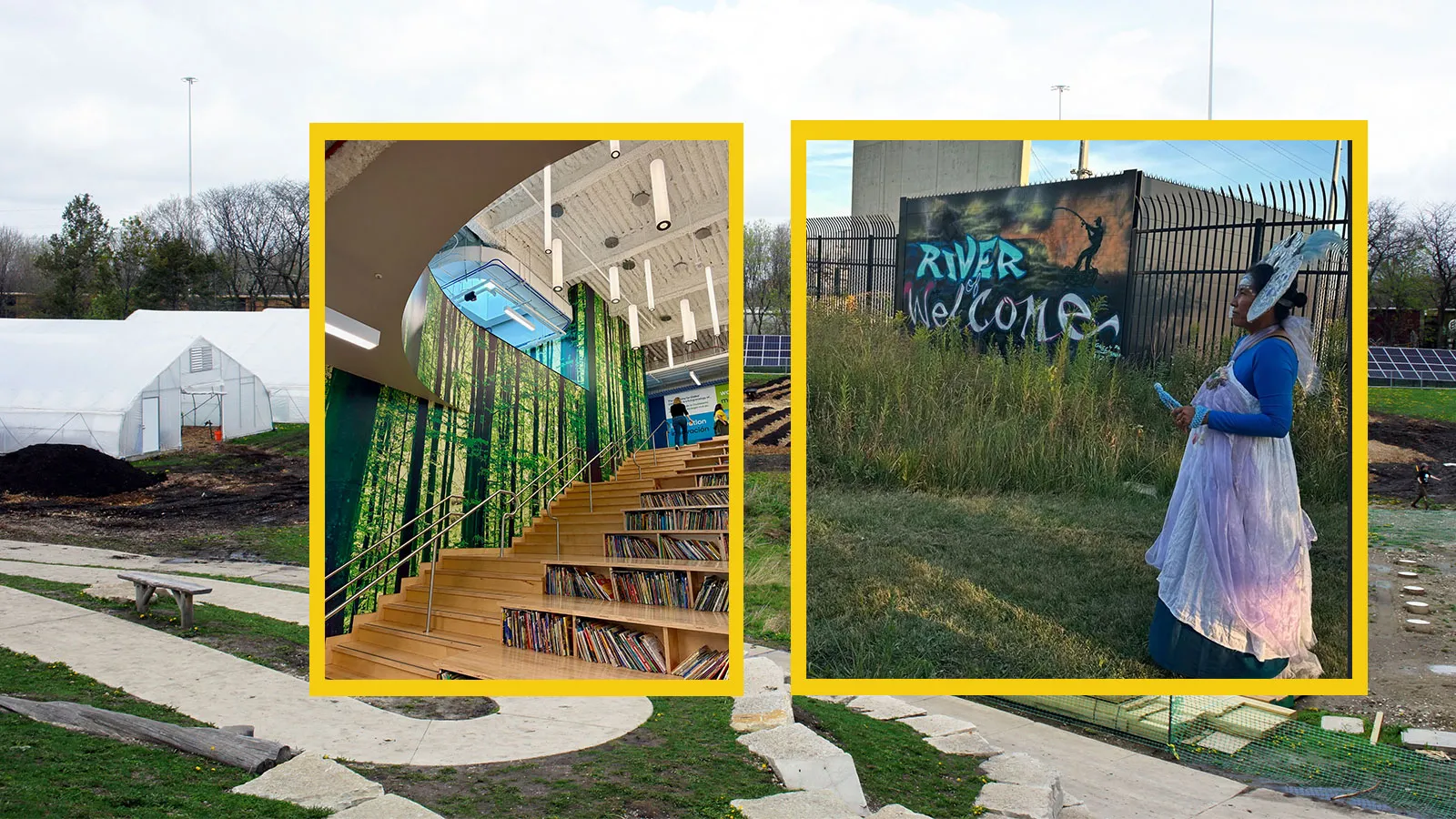
It was a beautiful spring day as I approached Academy for Global Citizenship, a kindergarten through eighth-grade charter school two miles north of Chicago Midway Airport. For the first time, I noticed an overgrown plot of grass. The block around the school was overgrown with weeds. Fifteen years ago, the city demolished hundreds of public housing units here, forcing families from their homes and sowing the seeds of the deterioration visible today.
Berenice Salas spent her teenage years walking past public housing developments known locally as the Courthouse.
“It was public housing, but it had a computer lab and a basketball court,” said Salas, who is now co-principal of the Academy for Global Citizenship. “It had a lot of resources and was thriving in many ways.”
She and her fellow educators hope to reignite the spark in the area, also known as “chispa,” as Salas calls it in Spanish. They are starting with land. Install geothermal energy in farms, rain gardens, native plants and trees, outdoor classrooms, solar panels, and schools.
The academy is part of a broader effort across three U.S. cities to bring Latino communities closer to nature. GreenLatinos, a national environmental organization, has funded $2.6 million in efforts in Chicago, Los Angeles and Albuquerque, with support from the Bezos Earth Fund.
School leaders expect to harvest 10,000 pounds of produce during the first full year of production, which will be used to feed students and sold at a discount to the community. When I visited, I saw elementary school children carting trays of strawberries to the kitchen staff.
The effort also improves Chicago’s Canal Origins Park, a nearly three-acre park about nine miles northeast of the academy, builds an urban farm and expands recreational access to the Calumet River, all in an area where Latinos can enjoy a change.
This is important because nearly 70% of Latinos live in areas with no natural habitat. Research has found countless benefits associated with access to nature, including improved mental health, increased physical activity, lower blood pressure, and a stronger sense of community. Trees and other plants can also help lower temperatures in neighborhoods and prevent flooding, as climate change caused by fossil fuel pollution makes the weather increasingly unstable. A recent Nature Communications study found that trees reduce heat in cities around the world.
“These projects aren’t just about beautification,” said Lucy Contreras, GreenLatinos’ Illinois state director. “They also aim to address historic disinvestment, pollution burdens, and unequal access to green space in Latino and frontline communities.”
Like much of Chicago’s South Side, the 6-acre Global Citizenship Academy campus is surrounded by pollutants such as freeways, railroad tracks, and airports. The local asthma rate ranks in the highest percentile.
Nationally, wealthier and whiter areas are disproportionately likely to have access to nature. Chicago is no exception, with Latino neighborhoods having 33% less park space than average. A 2023 study found a correlation between decreased green space and lower life expectancy in Los Angeles’ Black and Latino communities.
“Urban greening is more than just planting trees,” Contreras said. “This is also a public health issue.”
Heat is a particularly sensitive issue in a city like Chicago, explains Juan Decle Barreto, senior social scientist for climate vulnerability at the Union of Concerned Scientists. In 1995, the city suffered a five-day heatwave that killed more than 700 people. Since then, the city has expanded its emergency notification system, installed cooling centers and identified residents most at risk.
“That heat wave happened decades ago, but it still teaches us lessons in prioritizing the most vulnerable in society,” Decret-Barreto said.
I proposed a scenario to illustrate how immigrant families are at risk. White-collar workers can be exposed to heat waves in air-conditioned cars and offices. Their employers provide them with health insurance, so they see their doctors regularly and stay updated. But recently arrived immigrants can get to work riding in the back of a pickup truck or bicycle. Work involves exposure to the sun, often on construction or landscaping sites. Their bosses may not offer them health insurance or labor protection. They go home at the end of the day, live in an apartment, and even though they own an air conditioner, they can’t afford to run it.
“These are two very different profiles of people under the same sun, the same heat load, the same global warming, but with very different heat exposures in their daily lives,” Decre-Barreto said.
Green spaces keep neighborhoods cool
Increased tree and vegetation cover can offset some of these effects, making neighborhoods feel up to 14 degrees Fahrenheit cooler.
Enter Canal Origins Park. On the day I visited, a beaver was nearly biting one of the three oak trees there. Overhead, I was bombarded with a cacophony of bird calls: northern cardinals, red-breasted blackbirds, brown creepers, and yellow warblers.
Like the Global Citizen Academy, the park is surrounded by industry, including a 30-acre data center, a chicken processing plant, and a now-defunct coal-fired power plant. Community leaders representing the Little Village and Pilsen neighborhoods closed the coal-fired power plant 14 years ago. Currently, they are focusing on this park with the goal of revitalizing it.
“I grew up in Pilsen, and before gentrification, we weren’t allowed to go outside and play because it was really dangerous,” said Rebecca Ramirez, a member of the environmental justice group Pilsen Environmental Rights and Reform Organization (PERRO). “My mother was going to keep me locked up with my brother.”
“Me too,” added PERRO Chairman Gitlali Paes. “There was a lot of gang violence and my mom literally wouldn’t let me go out.”
The organization wants to break that cycle for the next generation. Eighth grade students at the school picked up trash in the park in February. And DOG prioritizes community feedback. The organization has held five events, including one featuring Mexican folklorico dancers, and has worked with approximately 190 local residents to help them understand the value the park brings to their lives. By August, the team will have something to showcase their work. The $190,000, 24-square-foot picnic pavilion has two tables, one with space for a wheelchair.
As we prepared to leave Canal Origins, we spotted a group of rowers rowing out onto the water. I remember Saras, the co-principal of the academy. When she was in high school, she was a member of the school’s first women’s rowing team.
“We had this rickety hand-me-down boat, but we made it work,” she recalls. “We had bike shorts. Black pants and white T-shirts. That was it.”
Her team practiced at Canal Origins Park and departed from a small dock. During practice, Orr pulled up used condoms and tampons. But as they moved up the Chicago River, the stench dissipated. The water is now clean.
That’s what Latinos on Chicago’s South Side want, too. The water is clean enough to swim in and the park is green enough to cool off.
Benefits of accessing nature at school
Back at Global Citizen Academy, Salas explained that his father was an organic bean farmer in Mexico. I moved to America and lost that way of life.
“I feel the same way about other parents who feel a strong connection to our farm,” she said. “People miss that connection.”
At last year’s Fish and/or Resist event, artist Delilah “Zena” Salgado arrived ready to work on resist-style art that combines unlikely materials. In this case, Salgado combined crayons and watercolors. (Image source: Pilsen Environmental Rights Reform Organization)
Salas recalled a time when a student’s mother tried to pick a pumpkin that had withered from its stem. She wanted to turn dried pumpkin into a natural sponge.
“That’s part of our roots,” Salas said. “Many of the pueblitos and towns in Mexico are being very resourceful because they have to. They sustain their communities with what they grow. They don’t have access to Walmart.”
Third-year student Kara Solis-Cortes is on the academy’s green team. The 9-year-old excitedly told me about the group’s recent seedling sale and harvest of honey from the campus beehive.
“I don’t have to go to school as much, yippee!” she joked.
She’s right. Many students spend a lot of time outdoors.
This is an approach that really has merit. Students ask to go for a walk regularly to calm their minds, Salas explained. This school is designed so that students can see out the window no matter where they are (except in the bathroom).
This kind of education comes at a price.
Academy leaders hope other schools can replicate what they’ve built, but that’s easier said than done. The facility cost $53 million to build and was made possible through private philanthropy, state funding, and federal tax credits. This approach costs $22,100 per student per year, which is comparable to other charter schools in Chicago.
But in many ways, the value of this approach to education is immense.
Camila Ontiveros, an eighth-grader who wears round glasses and braces, said she can concentrate better when taking classes outdoors. Emily Gaitan, also an eighth-grader with clear hazel eyes, quietly nodded in agreement.
When I met eighth-grader Joaquin Cervantes, it was photo day, so he was wearing a fresh black suit. He lights up when he talks about teaching his father how to grow chili peppers in the backyard.
“He didn’t really know how to do it, but he graduated from this school and learned a lot about gardening and soil. Now I can grow flowers and vegetables, so that’s useful in my life,” Cervantes said of his father.
