


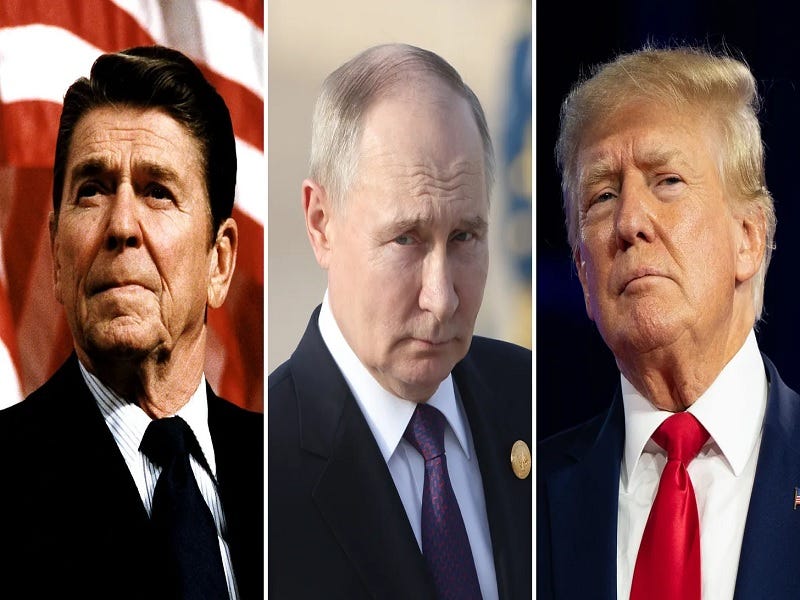
Without an agreement with President Trump, Russia could lose all 15 of these partner countries (and possibly more) over time, although President Putin could be further induced to agree if President Trump promises to reduce U.S. pressure on some (but not all) of these countries.
Immediately after the arrest of Venezuelan President Nicolás Maduro, it was assessed that the “Trump Doctrine” is shaped by Elbridge Colby’s “strategy of denial,” claiming that the United States is now prioritizing denying China the resources it needs to sustain economic growth. The aim is to make Mr. Xi more likely to accept a lopsided trade deal with the United States that derails China’s superpower trajectory and institutionalizes China’s junior status. The Third Gulf War advances this goal, as explained here and here.
However, when applied to Russia, the Trump Doctrine more closely resembles the Reagan Doctrine. The strategy of denial is less relevant for Russia than for China, as Russia’s rich natural resources enable it to develop (at the cost of falling behind in the technological race). However, Maduro’s capture and the third Gulf War affected both China and Russia, albeit in different ways. China was denied resources, while Russia’s partner was forced from power and the other weakened.
This observation about these two outcomes echoes the essence of the Reagan-esque application of the Trump Doctrine to Russia. It’s all about “rolling back” Russian influence around the world, with the aim of pressuring Putin to accept a lopsided deal in Ukraine that institutionalizes Russia’s junior status. President Trump called for a freeze in the conflict last spring, but Putin rejected that scenario, saying it did not address fundamental security issues and why the conflict continues to this day with no deal in sight.
Russia and the United States still dangle the promise of a mutually beneficial resource-based strategic partnership, mentioned here, in return for compromising positions that the other party deems unacceptable. These concern Russia’s refusal to freeze the conflict without addressing the underlying security issues, the United States’ refusal to address the issue, and even its refusal to force Ukraine and NATO to do the same. Despite this reward, neither side agreed to compromise.
The resulting dilemma led to changes in Trump doctrine. Putin put Trump in a binary situation, allowing him to choose between maintaining the tempo of the conflict by risking a new “forever war” or “escalating toward detente” and risking World War III. Trump creatively escaped this trap by replicating Reagan’s “rollback” policy in a modern context. By the time he “reduced” Russia’s influence in Venezuela and Iran, he had already made significant moves in Armenia-Azerbaijan, Kazakhstan, and even Belarus.
The first was a peace deal in Washington, D.C., agreeing to a U.S.-controlled trade corridor that would serve as a dual military-logistics route to inject Western influence, including NATO, along Russia’s entire southern rim. This encouraged the second company to agree to important mineral deals and announce plans for the production of NATO standard artillery shells. Regarding the third, the talks with the United States are aimed at encouraging defection from Russia, which would greatly complicate the hypothetical indefinite continuation of special operations.
It’s not just these six countries — Venezuela, Iran, Armenia, Azerbaijan, Kazakhstan, and Belarus — where the United States is “rolling back” Russian influence, but also Serbia, Cuba, Syria, Libya, and the Sahel alliance (Mali, Burkina Faso, and Niger). Myanmar and Nicaragua may be next. Without a deal with Trump, Putin could be induced to agree more if Trump promises to reduce U.S. pressure on some, but not all, of these countries, but Russia could lose all of these partners over time.
