


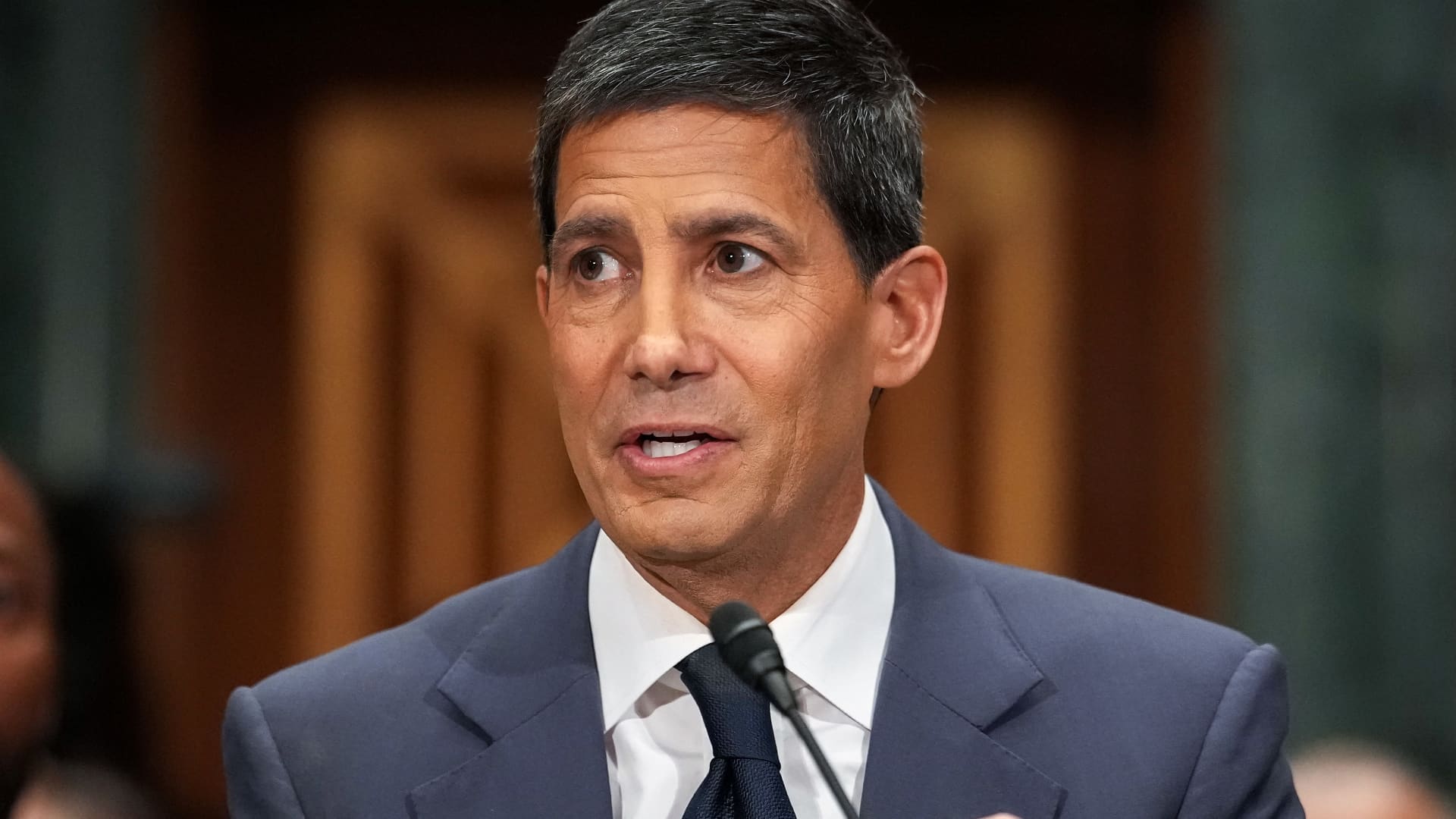
On April 21, 2026, Kevin Warsh, then President Donald Trump’s nominee for Federal Reserve Chairman, delivers an opening statement during his confirmation hearing before the Senate Banking, Housing, and Urban Affairs Committee at the Dirksen Senate Building in Washington, DC.
Andrew Harnik | Getty Images
Incoming Federal Reserve Chairman Kevin Warsh’s comments about “systematic change” at the central bank have sparked speculation about everything from interest rates to major personnel changes to fundamental changes to how it operates and communicates.
But what it ultimately looks like will be more subtle, but perhaps more consequential. It’s about rethinking how the Fed manages the financial plumbing of the U.S. economy and the massive balance sheet it built over nearly 18 years of fighting the crisis.
Interviews with former Fed officials and economists, as well as a growing library of research, suggest that Mr. Warsh could lead the Fed to scale back its role in day-to-day financial markets while also setting clearer rules for when and how to intervene.
In short, the debate centers on whether the Fed should continue to use its balance sheet as a regular tool to influence financial conditions and support markets, as it has done throughout much of the post-crisis era, or whether it should reserve it for periods of market dysfunction or more harmful economic stress.
Rewriting the Fed’s strategy
The debate over the $6.8 trillion balance sheet is technical in nature, hidden from the more general discussion about Fed policy. But the stakes are pretty high.
Since the financial crisis that erupted in 2008, the Fed has aggressively used its holdings of Treasury securities and mortgage-backed securities to stabilize markets and influence broader financial conditions.
Before the crisis, the Fed’s balance sheet was relatively small, about $800 billion, but at one point it grew to about $9 trillion. The Fed’s holdings now represent about 23% of the U.S. economy, or about seven times more than before the financial crisis.
Efforts to change the system could have far-reaching implications, potentially affecting Treasury yields, mortgage rates and other interest rate-sensitive areas of the economy, as well as how policymakers respond to future crises.
“This is a discussion that we’re going to see later this year,” said Lou Crandall, chief economist at Wrightson ICAP and a longtime Fed watcher. “But one of the encouraging things about all of this is that no one, including Kevin Warsh, is arguing that this can be done quickly.”
“It will have to be done carefully and some of the changes… will probably take some time to implement,” he added. “Everyone is looking at this as a medium-term project, not part of the day-one agenda.”
Warsh said in an op-ed in the Wall Street Journal last year that the balance sheet is “bloated” and could allow the Fed to lower interest rates while shrinking the balance sheet at the same time.
What does “regime change” entail?
While Mr. Warsh has talked a lot about shrinking the Fed’s footprint, Wall Street is already considering what the new operating framework will look like.
Some of the more provocative ideas come from Steve Blitz, chief U.S. economist at TS Lombard, who argues that the Warsh Fed could place more emphasis on the overnight repo market (the short-term financing system that supports the Treasury’s market functions) rather than solely relying on the federal funds rate (what banks charge each other for overnight loans) as a key policy transmission mechanism.
“The repo rate will become the policy rate,” Blitz said in a client note.
In fact, it can create unusual power relations. As policymakers grapple with persistent inflationary pressures, Mr. Warsh may be able to meet President Trump’s calls for lower interest rates while maintaining tougher fundamental funding conditions.
But he is likely to quickly face opposition from his fellow policymakers, some of whom are skeptical both of the Fed’s ability to significantly reduce its holdings and of the benefits it would bring.
“I think shrinking the balance sheet is the wrong goal. Many of the proposals to achieve this goal would undermine bank resilience, impede the functioning of money markets, and ultimately threaten financial stability,” Federal Reserve President Michael Barr said in a speech last week. “Some may actually expand the Fed’s influence in financial markets.”
Barr’s argument is essentially that looking only at the size of the balance sheet is too narrow: other issues are also important, such as how the balance sheet is structured in terms of duration and structure. He argues that ignoring these issues could have “perverse” consequences, including increased volatility and the possibility of further intervention by the Fed. At the same time, he said cutting banks’ reserve requirements could destabilize the system.
Understand how it works
The balance sheet structure for reserves is simple.
When building its balance sheet, the Fed credits itself with digital cash and uses it to purchase assets from banks and create reserves. This provides liquidity to banks and, in theory, flows to the financial system. Conversely, when the Fed is shrinking its balance sheet, it no longer purchases assets, and at the same time allows the proceeds of purchased bonds to be rolled off rather than reinvested.
On the other side of policy, the Fed uses trading desks to achieve target interest rates. Central banks have a number of other tools, including interest they pay on reserves, discount window rates, and, importantly, overnight reversal buyback operations to keep funds flowing.
The Fed operates under a “rich” reserve regime, a vague term that essentially means above typical but not in excess, which is what “rich” is. Warsh suggested the Fed could return to its pre-crisis policy of “deficit” foreign exchange reserves with the option to add to them as needed.
“Reasonable people could disagree with this,” said Bill English, a former Fed chief and current professor at Yale University. “The Fed could certainly go back to a reserve-scarce regime. That would work perfectly fine. Getting there might be a little complicated. You’d want to do it slowly, but I think it can be done.”
The market will be watching closely, having relied on the Fed’s balance sheet for much of the past 18 years to keep its operations running smoothly, and which critics will argue is supporting a bull market in stocks.
“I would very much like to see the Fed have an open discussion about establishing a framework for future operations, so that we don’t just assume that the market is going to do policy without limit,” said Wrightson economist Crandall. Doing so “will allow the market to make smarter predictions about what will happen.”
As it stands, the Fed has never communicated clear rules about when and how to use its balance sheet.
Markets have adopted the terms quantitative easing (QE) for expansion and quantitative tightening (QT) for contraction, but the Fed has never given clear guidance on when to use either. This is especially true when distinguishing between addressing the functioning of financial markets and supporting the dual goals of inflation and employment.
“They’ve never really set the framework for when to use quantitative easing,” said Loretta Mester, former president of the Cleveland Fed. “I don’t think the Fed has done a very good job of differentiating when it purchases assets for monetary policy reasons.”
Change message
This is where Warsh in particular could come into play.
The direction of policy guidance lies squarely within the chairman’s control tower, and Mr. Warsh could try to temper market expectations that the Fed will step up its asset purchases if Wall Street starts to get nervous.
He also said he supports the efforts of Michelle Bowman, the Fed’s vice chair for banking supervision, to ease some bank regulations. Part of the effort will change what types of assets banks can claim as reserves and be available in times of crisis, and Dallas Fed President Laurie Logan touched on the effort in a recent speech, saying she was looking forward to “how that goes.”
Logan has first-hand experience with the dynamics involved in balance sheet management. Prior to his current role, he served on the New York Fed’s trading desk, where he was responsible for implementing the central bank’s open market strategy.
Logan also said in his April 2 speech that the Fed has other tools at its disposal to support liquidity flows, essentially drawing on elements of both Warsh and Barr’s arguments.
Like others, she took a stand in favor of moving slowly to address the problem.
“I would like to emphasize that balance sheet changes need to be gradual and carefully planned,” Logan said.
work has started
Inside the Fed, Fed officials are preparing for discussions.
Central bank researchers have published several papers on this issue, including one titled “A User’s Guide to Federal Reserve Balance Sheet Reduction.”
The paper concluded that up to $2.1 trillion in cuts could be achieved through the current policy framework, with no support in either direction, and further cuts were possible if the Fed pivoted to a reserve deficit approach to banking. The paper also claims that “it will take at least a year and probably several years” before the process begins.
All of these proposals are likely to be considered after Warsh is sworn in on Friday.
He inherited a Fed that faces not just economic challenges but also high political expectations, and he regularly attacked outgoing Chairman Jerome Powell, repeatedly threatening to fire him for not following through on President Trump’s desire to lower interest rates and dubbing him “too slow.”
For all the talk of “regime change,” former officials say Mr. Warsh’s lofty goals are coming closer to reality at the central bank, and warn not to expect a dramatic overhaul overnight.
Mr. Warsh will inherit the Federal Open Market Committee, a consensus-based organization where even major policy changes are typically deliberated only after lengthy internal discussions. These officials say political considerations remain outside the central bank’s walls.
“When I was attending the FOMC meeting, [Alan] It’s been that way for a long time, with Greenspan as chairman. “Politics never enters the room. Political considerations never enter the discussion,” said Mester, a former Cleveland Federal Reserve president.
Never miss the most trusted news moments in business news when you choose CNBC as your preferred source on Google.
Source link
