


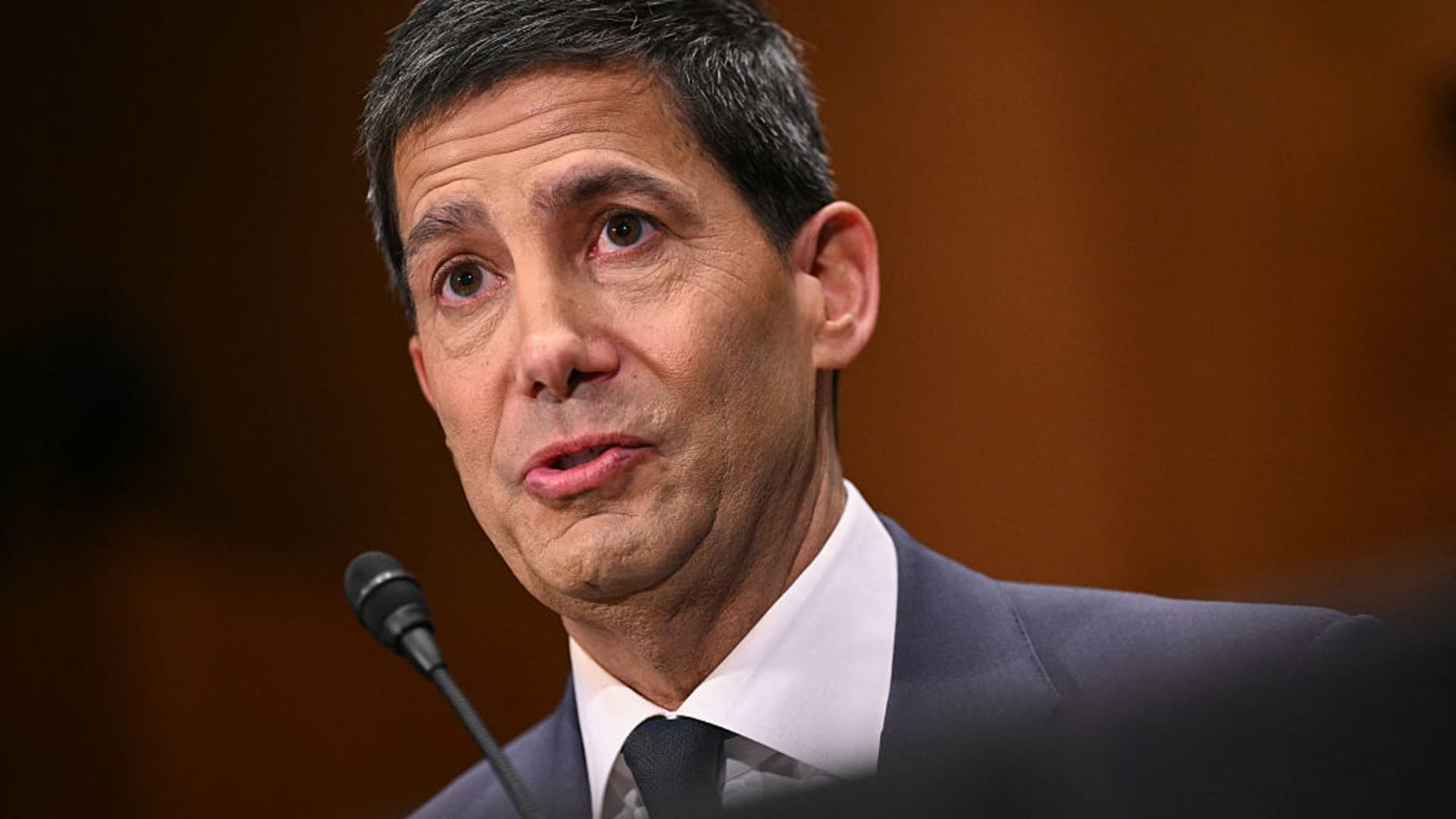
U.S. Federal Reserve Chairman candidate Kevin Warsh testifies during a Senate Banking Committee hearing on his nomination on April 21, 2026, at the U.S. Capitol in Washington, DC.
Mandel Gunn | AFP | Getty Images
Kevin Warsh was confirmed Wednesday as the next Federal Reserve chairman, taking over the central bank as President Donald Trump pushes to cut interest rates even as new inflation data complicate the debate.
In the most divisive vote yet for the Fed chair, Mr. Warsh, 56, won confirmation to replace Jerome Powell, who has held the top leadership position since 2018 and whose term expires on Friday.
The Senate voted 54-45 to confirm Mr. Warsh, ending a month of turmoil that included a massive search to find Mr. Powell’s successor that began in the summer of 2025. The vote was almost entirely along party lines, with only Sen. John Fetterman, Democrat of Pennsylvania, voting for Mr. Warsh, who would become the 11th Fed chairman of the modern banking era.
President Trump has made no secret that he expects Warsh to cut interest rates after he has repeatedly criticized Powell for monetary policy that the president feels is too restrictive. Warsh was part of a derby that at one point included nearly a dozen candidates, including current governors Christopher Waller and Michelle Bowman.
But the confirmation follows other reports this week showing that inflation is well above the Fed’s 2% target and pipeline pressures are accelerating to their highest levels in more than three years. Expectations for interest rate cuts are waning in the market, and even the possibility of interest rate hikes by the end of the year is being factored in.
Rep. French Hill (R-Ariz.) praised the Fed’s decision and Mr. Warsh’s record on combating inflation.
“Chairman Warsh has repeatedly emphasized the importance of keeping affordability and price stability at the center of our economic agenda,” Hill said in a statement. “His commitment to disciplined monetary policy will help restore confidence in our economy and support our long-term prosperity.”
Warsh could not be reached for comment.
This will be Warsh’s second stint at the Federal Reserve.
He first served as president from 2006 to 2011, during which time Fed officials initially denied the dangers of the subprime mortgage collapse that sparked the global financial crisis and then implemented a historic series of policies aimed at saving the economy. Part of that relief package included an unprecedented expansion of asset purchases that would push the Fed’s balance sheet by more than $4 trillion, a program known as quantitative easing that Warsh argued at the time had gone too far.
Warsh has consistently criticized the Fed’s monetary policy since leaving office, and last year called for “systemic change” at the central bank in an interview with CNBC. During that time, he has also served as a lecturer at Stanford University School of Business and as a member of various boards of directors.
Warsh will replace Stephen Millan, who was appointed as Fed governor in September 2025, to fill the remaining months of Adrianna Kugler’s term after she unexpectedly resigned in August.
Millan has opposed every Federal Open Market Committee vote since taking office. When the committee voted to cut interest rates by a quarter of a percentage point in each of its last three meetings in 2025, Milan expressed support for an even larger cut of half a percentage point. He opposed a vote this year to keep the federal funds rate unchanged and has advocated for a quarter-point cut.
Warsh’s first meeting as FOMC chair is scheduled for June 16-17.
He will also be the richest Fed chairman in history, with assets well over $100 million. As Fed chairman, he will have to sell many of his investments under tough new policies introduced since revelations of questionable trade practices among government officials.
Make CNBC your preferred source on Google and never miss a moment from the most trusted names in business news.
Source link
