


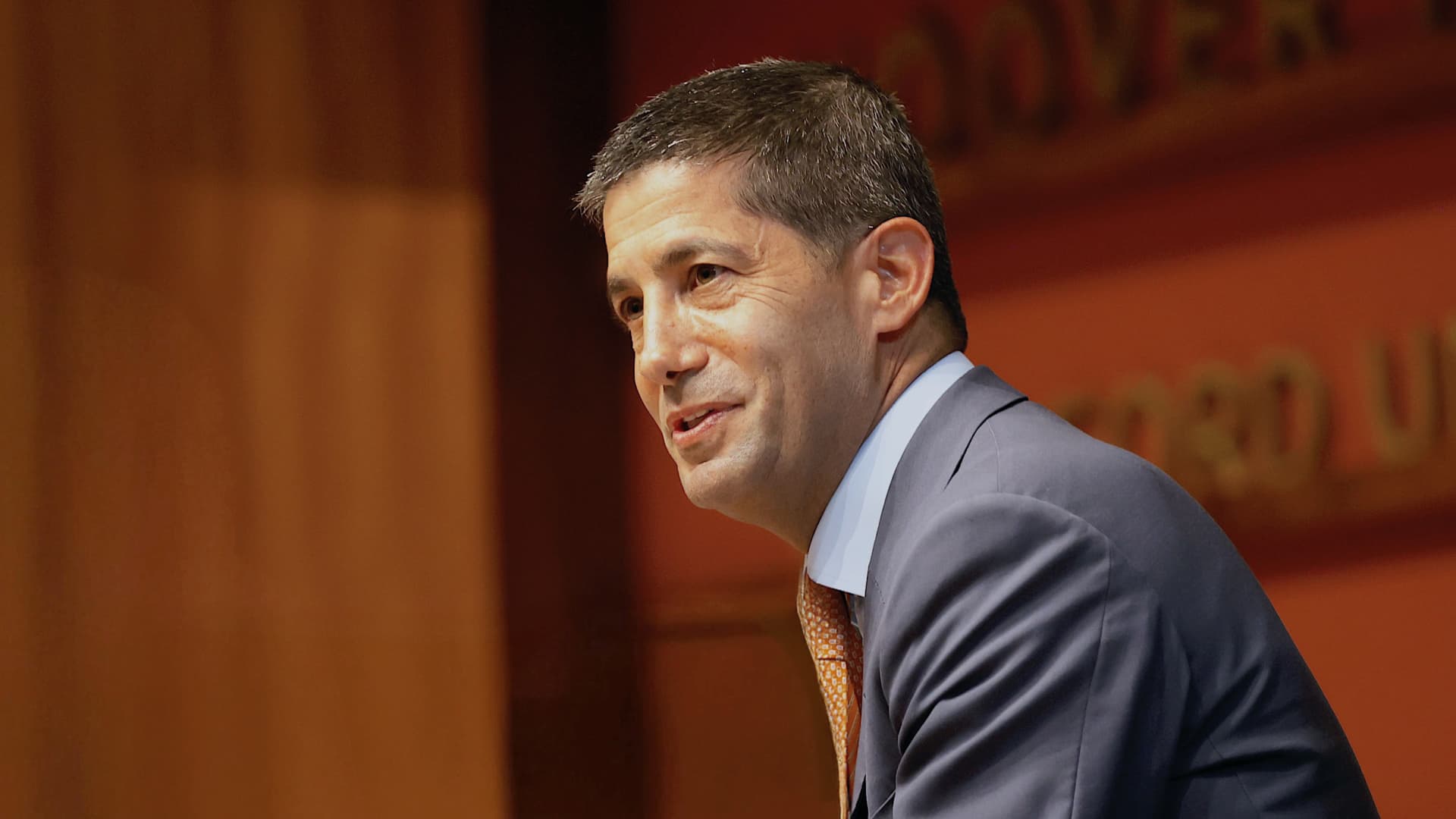
Kevin Warsh, former member of the Federal Reserve Board;
Provided by: Hoover Institution
Federal Reserve Chairman candidate Kevin Warsh visited Capitol Hill on Tuesday to convince lawmakers that the president’s push to lower interest rates can be carried out without political constraints on policy decisions.
In a much-anticipated hearing before the Senate Banking Committee, the former Fed chief will face questioning on topics ranging from monetary policy to banking regulation to his own complex personal finances.
Nothing could be more important than establishing boundaries between Fed decision-making and politics.
“He has a difficult communication problem,” said Bill English, a professor at the Yale School of Management who served as the Fed’s monetary director from 2010 to 2015, a tenure that overlapped with Mr. Warsh’s.
“I think his way of dealing with this is to make clear his view that interest rates could probably be lowered, probably by a significant amount,” English said. “But at the same time, when asked directly about independence, I want him to make it clear that he values independence. He believes that independence is important and that less Fed independence is bad for the country in the medium to long term.”
Political independence has become a key issue in the search for a successor to current Chairman Jerome Powell.
Warsh’s views on independence
In remarks he plans to make to the committee at the start of the hearings, Mr. Warsh expressed his genuine support for the Fed’s independence.
“So let me be clear: monetary policy independence is essential. Monetary policymakers must act in the country’s interest, and their decisions are the product of analytical rigor, meaningful deliberation, and clear decision-making,” he said in a prepared statement.
But he noted that he did not believe the central bank’s independence would be threatened if its actions were questioned by elected leaders, saying “the Fed should stay in its own lane” and not veer toward “fiscal and social policies for which it has no authority or expertise.”
Mr. Warsh is likely to face many questions over his political allegiance to President Donald Trump, who has publicly said his willingness to lower interest rates is a litmus test for candidates. Trump nominated Warsh in late January after a lengthy search process that included nearly a dozen candidates.
Congressional Democrats, including powerful Sen. Elizabeth Warren (D-Mass.), are expected to pursue candidates on independence issues and raise questions about finances.
If confirmed, Warsh would easily become the richest Fed chair in the central bank’s 113-year history. Disclosures filed ahead of the hearing show that he will need to sell a significant amount of his holdings to comply with the Fed’s stricter rules on where senior officials invest.
Warren met with Warsh on Thursday and left with “deep concerns that, if confirmed, I will become a puppet of Donald Trump.” She also claimed that Mr. Warsh had not disclosed “over $100 million in assets.”
Regardless of concerns about Warsh’s views, it may be some time before the nomination itself makes it out of committee.
Sen. Thom Tillis (R.N.C.) has vowed to hold off on his nomination until the U.S. Attorney’s Office in Washington, D.C., completes its investigation into the renovations to the Fed’s headquarters. The court canceled a subpoena against Powell from U.S. Attorney Jeanine Pirro, but Powell has vowed to appeal.
White House officials are confident that Mr. Warsh will ultimately meet the approval of the committee, which has a 12-10 Republican vote.
National Economic Council Director Kevin Hassett said Monday on CNBC: “Once everyone watches his hearings and realizes how skillful he is on his feet, how knowledgeable he is about the Fed, and how good his ideas are to get the Fed back on a nonpartisan path, it will be hard to resist voting ‘yes.'”
Building a consensus
Once in office, Warsh will chair the Federal Open Market Committee, a group filled with officials who have expressed concerns about the next step in monetary policy. Although the market expects the committee to be on hold for the rest of the year, officials themselves are still determined to cut rates, and Mr. Warsh has also expressed support for a rate cut.
San Francisco Fed President Mary Daly said last week that Mr. Warsh “will come in with an idea of what he thinks and what he wants to do, and then the economy will deliver what we’re actually working on.” “You work with the economy you have and plan the economy you want to achieve.”
As for approaches other than rate-setting, Mr. Warsh last year called for a change in power at the Fed, arguing that current officials have a “lack of credibility” that he wants to fix.
Mr. English, a former Fed official, said his experience with Mr. Warsh showed him as someone who could work with others, a quality needed at a consensus-driven central bank.
“He wasn’t really a difficult person to work with, for other policymakers or staff or anyone,” English said. “So I don’t know if he’s going to really shake things up right away without moving other policymakers. To get them moving, he’s going to have to make the argument and make his case in a rational way.”
Make CNBC your preferred source on Google and never miss a moment from the most trusted names in business news.
Source link
