


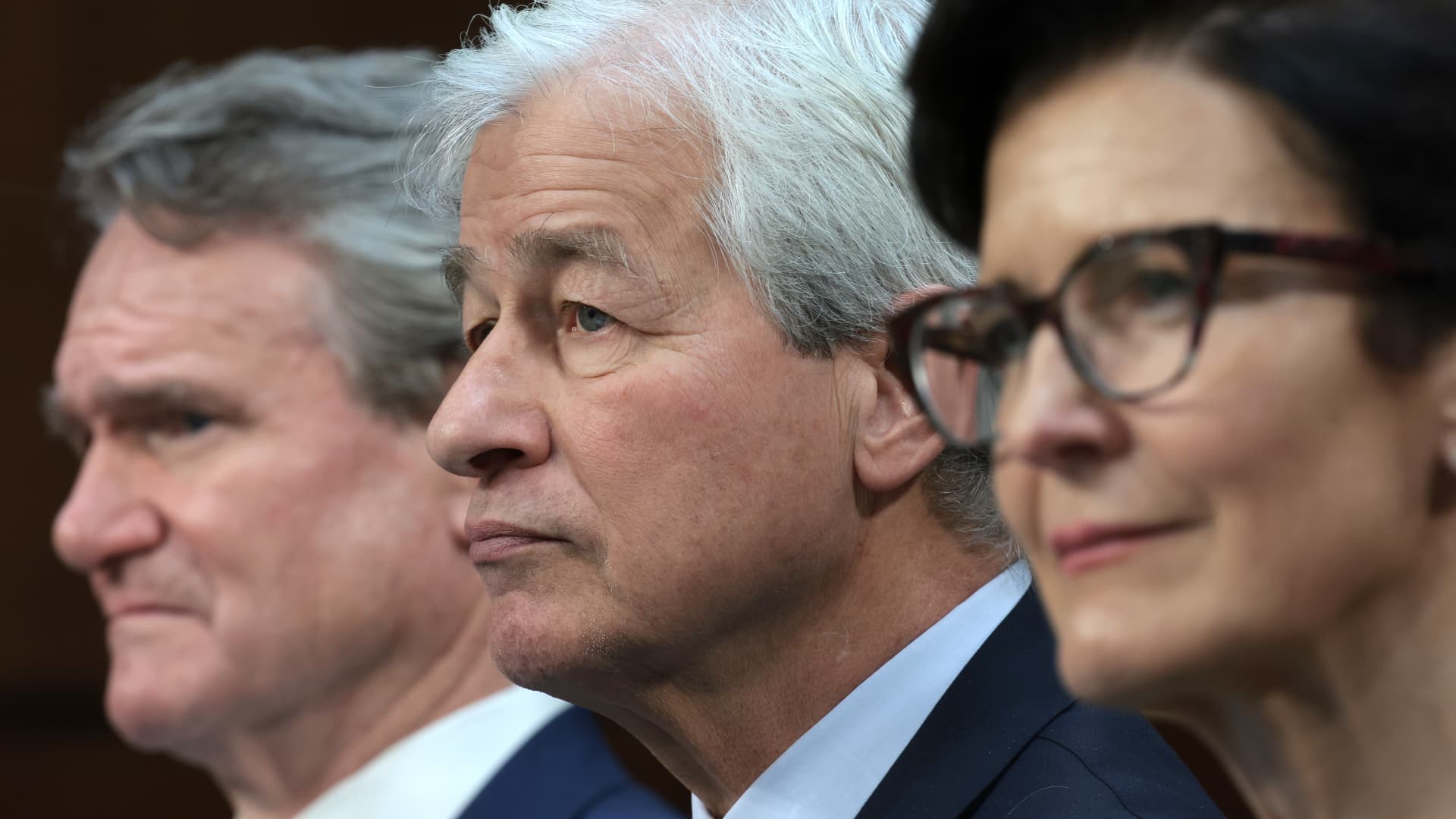
(LR) Brian Moynihan, Chairman and CEO, Bank of America. Jamie Dimon, Chairman and CEO of JPMorgan Chase. Citigroup CEO Jane Fraser. Testifying at a Senate Banking Committee hearing on December 6, 2023, at the Hart Senate Office Building in Washington, DC.
Win McNamee | Getty Images
As banks, led by JPMorgan Chase & Co. and Bank of America Co., begin reporting second-quarter results on Tuesday, hopes are rising that stock and bond trading revenues will approach or surpass records set earlier this year.
This is a key part of what veteran Wells Fargo analyst Mike Mayo calls the current financial sector’s “sweet spot.” Wall Street and Main Street, the sources of banks’ profits, are both in growth mode at the same time.
Big U.S. banks have been collecting higher fees by helping companies go to market, in the wake of SpaceX Inc.’s mega-IPO last month, while risk-taking traders are also thriving as geopolitical unrest such as the Iran war increases volatility across the asset class.
“We’ve seen the largest IPO in history, the pace of mergers in what’s shaping up to be a record year, and an expanded scope of deals to include stocks and bonds in countless geographies,” Mayo told CNBC.
The major banks’ results for this quarter come at an unusually convenient time for the industry. After years of weathering recession fears due to rising interest rates and inflation, lenders are benefiting from a rare combination of strong Wall Street activity, resilient consumer lending and a long-awaited recovery in business lending.
“There’s not much more I could ask for,” Mayo said.
Mayo said these trends are consistent with the Trump administration’s push to deregulate banks, helping financial stocks outperform the broader market for the second year in a row. The streak also raises the stakes, as investors look for signs that this momentum could continue into 2027.
JPMorgan, Bank of America, Citigroup, Wells Fargo and Goldman Sachs are scheduled to report their results early Tuesday, while Morgan Stanley will report on Wednesday.
“Big money earner”
KBW analyst Chris McGratty said the group’s investment banking revenue could rise 26% year-on-year, while trading revenue could rise 14%.
In addition to the hundreds of millions of dollars in fees that SpaceX paid to banks, led by Goldman Sachs and Morgan Stanley, for the IPO itself, the companies are reaping the debt-raising fees of newly public companies and also give the companies a chance to manage the wealth of newly minted billionaires and billionaires.
In addition, Goldman and Morgan Stanley likely received so-called “soft dollars” from SpaceX’s IPO, said Jay Ritter, professor emeritus of finance at the University of Florida’s Warrington College of Business.
SpaceX CEO Elon Musk speaks on-screen remotely from SpaceX headquarters in Starbase, Texas, before the launch of SpaceX’s initial public offering (IPO) on the Nasdaq Market site in New York on June 12, 2026.
Adam Jeffrey | CNBC
Soft dollars are essentially fees hedge funds pay investment banks for a portion of oversubscribed IPOs, Ritter said.
“For investment banks, the big benefit in IPOs is not the bank fees, but the ability to allocate shares to hedge funds and some active mutual funds that pay soft dollars,” he said.
Trading gains, meanwhile, were driven by higher stock prices as the stock market rose during the quarter, as well as higher fixed income activity following fluctuations in oil prices, interest rates and currencies following the Iran conflict, McGloughty said.
“Banks have done a good job of capturing the upside of volatility recently, but in previous cycles they have been caught offside,” McGratty said.
“Demand is coming back.”
But Mayo argued that the more important developments this quarter may be happening away from Wall Street.
He said the unglamorous business of commercial lending may be turning a corner after years of stagnation as banks seek to take market share from private credit lenders and an artificial intelligence-powered consumer boom ripples through the economy.
“Demand is returning as companies embrace uncertainty as the new normal, building new factories, investing and restarting operations,” Mayo said.
Mayo said the trend could benefit regional financial institutions, including Fifth Third, because commercial loans make up a larger portion of their business than large, diversified companies like JPMorgan.
Construction of a $16 billion data center developed by Associated Digital for Oracle and Open AI on May 6, 2026 in Saline, Michigan.
Jim West | Universal Images Group | Getty Images
Consumer banks also appear to be healthy. Losses are limited as unemployment remains low, allowing borrowers to continue taking out mortgages, auto loans and credit cards.
While the absence of new “cockroaches” has eased concerns for most banks, there are still some risks in the quarter, including a possible explosion in the private credit sector. “If you see one cockroach, there’s probably more,” JPMorgan CEO Jamie Dimon warned analysts and investors last year after the collapse of subprime car lender Tricolor Holdings.
Another is whether competition for deposits is increasing, as some players have to pay higher interest rates to attract and retain savers’ money, McGratty said. In an environment of stable or rising interest rates, lenders’ margins can be squeezed.
After two years of market-beating returns, investors are starting to care less about how strong last quarter was and more about whether this unusually favorable situation will continue.
“We know this quarter is going to be strong, so I think the questions you ask yourself are about sustainability, right?” McGratty said. “Is it all sustainable?”
Never miss the most trusted news moments in business news when you choose CNBC as your preferred source on Google.
Source link
