


[Today’s Iran war post launched before complete because scheduled commitments. Please return at 8:00 AM EDT or refresh this page then for the final version]
We had said this Iran War would not end in a negotiated settlement. That prediction seems to be coming to pass. Less than Trump’s inauspicious execution of the Memorandum of Understanding (MOU) in Versailles, the two sides are engaging in escalating attacks. Many Iran-backers were disappointed that Iran had not taken any action over flagrant Israel violations of the MOU by continuing to raze southern Lebanon save stern finger-wagging.1
However, the US has made it easy for Iran to formally ditch the MOU if Iran determines that that is the best way to proceed. Escalating attacks and counter-fire between the US and Iran, Iran maintaining only it controls the Strait of Hormuz even as the US has made an escort on the Oman side of four tankers. Even though the Navy seems very unlikely to be able to regularize this activity, one can expect it will keep the oil market happy.
For a bit more on the latest developments: Even though we have argued that Iran lacked a sound basis for sending a drone into a ship transiting the Strait of Hormuz on the Oman side, meaning in Oman waters, when Oman had not given Iran authorization to engage in any operation there. David Pyne, in a fresh talk with Nima, argued that the US attacks on Iran following the Iran drone hit were unwarranted. The ship was Singapore flagged, so the US has no responsibility to protect it, and took such minor damage that it was able to continue on its voyage.
The short version of what happened next was the US attacked four sites in Iran, claiming they were drone bases and storage. Iran denied that they could be targeted (those spots are apparently underground) but conceded the US had damaged a communications tower. Iran then attacked the US operations in Bahrain (as if there are any left) but also hit a Panama-flagged VLCC and set it on fire. Even so, this looked like largely performative exchanges even if some was done.
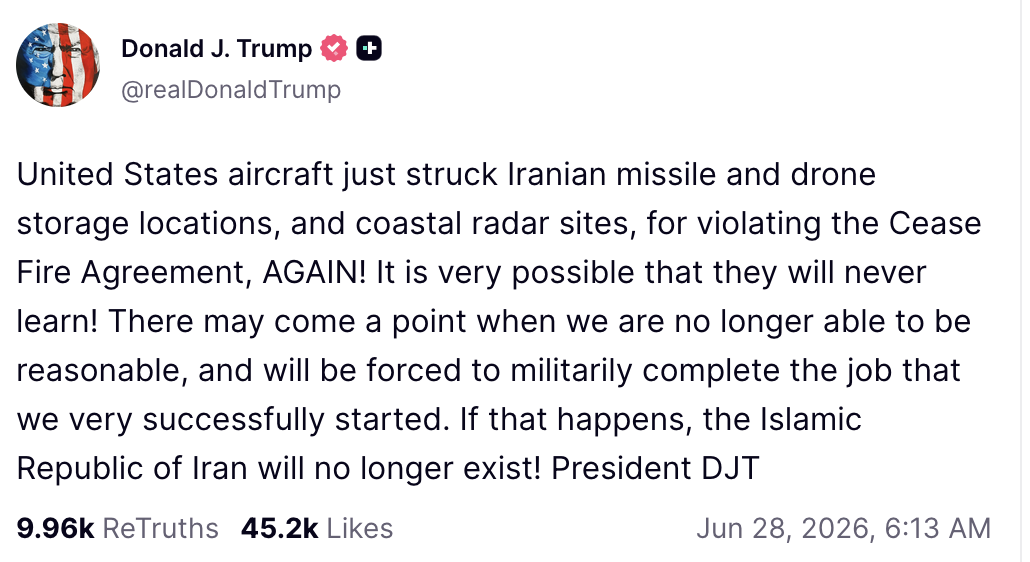
But Trump decided to ratchet up:
The second round of strikes on Iran were harsher than the first.
Fox reporting the US is carrying out a new round of air strikes against Iran right now: This seems to be escalating and throwing into question whether this ceasefire is going to hold pic.twitter.com/PORyarq2TG
— Acyn (@Acyn) June 27, 2026
US AND IRAN EXCHANGE STRIKES AS CEASEFIRE FRAYS
US CENTCOM hit 10 Iranian military targets overnight on drone storage, air defence, surveillance and minelaying sites near the Strait of Hormuz
Trigger was Iran’s drone strike on MT Kiku, a Panama-flagged tanker carrying 2 million… pic.twitter.com/4zx7SaQGQV
— Nabila Jamal (@nabilajamal_) June 28, 2026
And Iran has quickly hit back. From Aljazeera’s landing page as of 2:00 AM EDT:
And from its live feed:
The US has bombed Iran for a second day, hitting Qeshm Island and the cities of Sirik and Bandar-e Lengeh, after a drone attack on a commercial vessel near the Strait of Hormuz.
Iran says it has launched retaliatory attacks on US forces in Bahrain and Kuwait and warns of a “crushing response” to further attacks.
And on the state of Strait of Hormuz transits. Note the first tweet is roughly 8 hours before the first post launch time:
My analysis of the Strait of Hormuz over the last 24 hours.
If the tankers use the Iran route, they are dominantly Iran-related. If the tankers use the Oman route, they are not, and never sanctioned.
I have heard from ship owners that most tankers cannot use the Iran route… pic.twitter.com/9LnQkGuBv4
— HFI Research (@HFI_Research) June 28, 2026
Earlier the US escorted one tanker out:
One tanker passing through with all of those assets is not a proof of concept. It’s one success and no more. Unless Iran attempted to stop the vessel by force and failed, it’s only a proof that Iran did not try to do anything to stop it.
That is an enormous amount of resources… https://t.co/ayTFx0zw6t
— Daniel Davis Deep Dive (@DanielLDavis1) June 27, 2026
As far as I can tell, the total is now four. The fact of inbound transits is significant:
Two oil tankers and two LPG carriers are crossing the Strait of Hormuz **inbound** via the Omani route with their AIS turned on (under heavy US Navy / Airforce watch). Washington trying hard to keep the Omani route on.
— Javier Blas (@JavierBlas) June 28, 2026
I suspect we will hear a lot more from the US soon, if nothing else via Sunday political talk shows. But in the meantime, Iran’s Foreign Minister Abbas Araghchi has thrown down a hard marker, that Iran will control the Strait of Hormuz. From Iran Embassy in Slovenia on Twitter:
·
Iran’s Foreign Minister Abbas Araghchi (@araghchi):
🔹Under the memorandum of understanding, the Strait of #Hormuz will return to its pre-war operating capacity within 30 days under the management adopted by Iran and after the obstacles are removed by the Islamic Republic of Iran.
🔹These arrangements are currently being implemented, and responsibility for them rests solely with the Islamic Republic of Iran. No other institution or country bears responsibility in this regard.
🔹According to the memorandum of understanding signed between Iran and the United States, any interference in this matter, or any attempt to establish new or separate arrangements from those currently being implemented by the Islamic Republic of Iran, will only complicate the situation, delay the reopening of the Strait of Hormuz, and increase tensions.
🔹As we witnessed over the past two nights, incidents in the Strait of Hormuz have already contributed to rising tensions and confrontations.
🔹I call on all parties not to interfere in the management of the Strait of #Hormuz or in the arrangements being made by the Islamic Republic of Iran for its reopening. They should abide by the signed memorandum of understanding and not allow it to deviate from its intended course.
The IRCG has also issued fresh warnings. From Aljazeera’s live feed:
IRGC warns it will ‘respond even more forcefully’
Iran’s Islamic Revolutionary Guard Corps (IRGC) has pledged to meet any US attacks with a more forceful response as tit-for-tat strikes continue in the Gulf.
“As we predicted, the enemy is an enemy that breaks its commitments, is deceitful, and cannot be trusted. At any moment, at any stage of the negotiations, it may take certain actions,” IRGC spokesperson Hossein Mohebi told state-run SNN TV.
“Whatever action the enemy takes in this regard, we have responded to it, and we will respond to it. We repeat: If the enemy breaks its commitments and violates the ceasefire, we will respond more strongly than before, and we stress we will respond even more forcefully. We regard such moves by the enemy as natural because we know the enemy’s nature,” Mohebi said.
A wee issue is that on top of the US clearing digging to undermine that, the Gulf States are also opposed. They do not want to become Iran’s hostages.2
Jeff Currie so far has looked a bit overly bullish on the timing of the oil crunch, but that does not make him directionally incorrect:
Commodities expert Jeff Currie on the oil market and Strait of Hormuz traffic:
“There’s only two little shipping lanes that are open. You still can’t get much more than a trickle out.” pic.twitter.com/lrMwEnnlCb
— Steve Hanke (@steve_hanke) June 28, 2026
Strait of Hormuz, June 27.
Outbound: 18 vessels, 1 running dark. Inbound: 22. Outbound wet cargo ~4.12M barrels, ~3.91M crude (@Vortexa).
At dawn, a general cargo ship and a crude tanker began transit and turned back. An OFAC-sanctioned tanker ran inbound with AIS on.
At Kharg,… pic.twitter.com/obb3OJ68GZ
— Windward (@WindwardAI) June 28, 2026
Before the second Iran retaliation, Anthony Aguilar discussed what he made of the US operation with Mario Nawfal. Aguilar contends that the strikes looked pre-planned:
Daniel Davis, after the second round of US strikes, questioned what the US thought it was doing, since the US is not able to subdue Iran before and remains critically low on weapons:
It may be that this escalation is the result of Trump being unable to cope with his inability to dominate Iran and is lashing out. Trump can be relied upon to be his worst enemy.
But it may be that the US is fully cognizant of the fact that their ability to bomb Iran with conventional weapons is even lower than before, due both to depleted supplies and as Davis adds, psychological exhaustion of front line forces. I am concerned that the US and Israel have a different sort of attack at ready, say yet another futile decapitation campaign or perhaps a massive cyber strike. 3
From Aljazeera’s live feed, confirming our reading at the opening of this post:
US ‘trying to find its way out of MoU, while obliging Iran to its end of terms’:
Hassan Ahmadian, an associate professor at the University of Tehran, says the attacks could set off a domino effect of strikes between the US and Iran.
“I think we’re up for escalation because, obviously, the Iranians will retaliate,” he told Al Jazeera.
Ahmadian argued that Article 5 of the MoU says that “Iran will make the arrangements for the safe passage of commercial ships” for 60 days, and afterwards, it will be “Iran and Oman that will make the arrangements”.
“And now, the United States wants different arrangements in place as opposed to the MoU that it itself signed,” he said. “What we see is the United States trying to find its way out of this memorandum of understanding, while obliging Iran to its end of the terms.”
The US has done the same in Lebanon by brokering a new framework agreement, he said.
Ahmadian added that the Iranians “will not let go of this”.
“They want only commercial ships to pass through the strait, so any ship that doesn’t coordinate might be a military one, might carry military stuff. The Iranians do not want this,” he said.
“There’s a logic behind Iran insisting that safe passage should be arranged by them, and there should be only commercial ships for the two months. So, I don’t see the Iranians stopping. I see them actually escalating if the United States is to continue to escalate.”
As readers know, I differ with the Iranian reading, since the US and Iran can make undertakings only with respect to their legal and practical power. Iran has a solid case for deeming Israel to be a military dependency of the US. Thus, the US commitment in the first clause of the MOU, for a ceasefire and effectively to an Israel withdrawal, requires the US to bring Israel into compliance. By contrast, Oman is a neutral state, was not consulted in the MOU process and has not made any commitments to Iran with respect to the MOU. Oman allowed traffic on its side of the Strait during the hot phase of the conflict. So Iran asserting it has rights over passage on the Oman side of the Strait is a big stretch, particularly since that section also requires Iran to “make arrangements using its best efforts for the safe passage of commercial vessels.” Attacking commercial ships is a violation.
We have skipped over the disgraceful negotiations between the Quisling government in Lebanon and Israel. As some readers may appreciate, the reason that Hezbollah is defending the lives and property of Lebanese citizens in southern Lebanon is not just the fact that the government is captured. The US has kept it boot on Lebanon’s neck by making sure that Lebanon never had a military capable of doing much of anything, in particular checking Israel. So when Hezbollah stepped into that vacuum, the cardboard Lebanon military has been unable (I suspect also unwilling, but this is speculation), the official military has been ineffective, as it was designed to be.
Araghchi also weighed in on the US violation of the MOU by not forcing Israel’s compliance with its first clause, which called for a ceasefire and effectively, an Israeli withdrawal:
Araghchi warns against interference in Strait of Hormuz reopening, says US responsible for ending attacks on Lebanon
——
Speaking alongside Iraqi Foreign Minister Fuad Hussein in Baghdad, Iranian Foreign Minister Abbas Araghchi called for a new regional security framework led… pic.twitter.com/zlHRGlJsyx
— The Cradle (@TheCradleMedia) June 28, 2026
The Middle East Eye live feed reports fresh Israel bombing of south Lebanon, and the death of an Israeli soldier, and:
Lebanese President Joseph Aoun confirmed implementation of the Lebanon-Israel framework agreement and continued efforts to restore state authority.
Netanyahu said Israel and Lebanon had agreed on two pilot security zones and announced a phased withdrawal from selected villages in southern Lebanon.
Israeli defence minister Israel Katz instructed the military to prepare for a long-term presence in designated security zones in southern Lebanon.
Hezbollah leader Naim Qassem rejected the framework agreement, calling it a surrender of sovereignty and insisting the provisions of the US-Iran memorandum should be fully implemented.
On the energy front, Mario Nawfal had a very informative discussion with commodities/investment expert Chris Martenson. Martenson weighted in on the debate over how close the US oil cliff might be, based on the depletion of the Strategic Petroleum Reserve. Martenson says it could arrive in 2 weeks or 10. He contends that the US is required to keep 10% above the absolute operational minimum for disasters and potential military needs. Clearly, Trump could continue to walk on the wild side and draw into that 10% emergency buffer. But the 2 weeks now is consistent with Trump’s statement about ten days ago that there were only 4 weeks to economic disaster.
Martenson also describes at length how the paper oil markets are being manipulated to keep the price via massive short interests. Martenson is a bit gobsmacked at the firepwower being deployed. He points to a similar effort in the 1960s, in the dying days of the gold standard where the suppression worked until it ended and prices exploded.
Two days ago, Larry Johnson gave a long-form report of the reading by an energy expert on the state of diesel supplies in the US. Recall that economies run on diesel, not gasoline. Larry suggested in 13-18 DAYS: THE PRACTICAL DIESEL BUFFER… Does It Preclude Bombing Iran? that the dire state of diesel inventories would stay the US hand in resuming a hot conflict. But that does not seem to be happening. From the body of the post (which does present a lot of supporting detail and analysis):
According to this person, who has 35 years experience in the oil industry:
The U.S. does not have a month of freely deliverable diesel in a stress event. The headline EIA number shows 106.1 million barrels of total distillate fuel oil stocks and 3.631 million b/d of four-week average distillate product supplied, implying 29.2 days on paper. But that national inventory includes barrels in pipelines, refineries, terminals, regional storage, and operational positions that cannot all be allocated immediately to critical distribution hubs.
Operational estimate: applying a 45%-60% practical deliverability factor to total distillate stocks leaves roughly 48-64 million barrels of usable, allocable diesel-equivalent supply. At 3.631 million b/d, that is approximately 13.1-17.5 days, rounded to 13-18 days….
Let’s use the worst case: 13 days. Thirteen days means that if anything disrupts the supply chain — a refinery outage, a pipeline failure, a crude supply disruption — the effects reach the real economy within two weeks. There is no meaningful time to arrange alternatives. A tanker from a replacement crude source takes longer than 13 days to arrive. A refinery turnaround takes longer than 13 days to complete. The buffer is shorter than the lead time for almost every possible remedy.
The geography makes it worse. The 13-day figure is a national average, which means some regions have more and some have less. The Southeast is particularly exposed, being heavily dependent on the Colonial Pipeline, which is itself a single point of failure that demonstrated its criticality when it was shut down for six days in 2021. Six days is nearly half the total national buffer.
What about aviation fuel? Here is where the two problems collide mechanically, and why it creates a genuine bind rather than just a theoretical tradeoff.
Diesel and jet fuel are not different products from different parts of the refinery. They are competing claims on the same physical fraction of crude oil — the middle distillate cut that comes off the atmospheric distillation column in the same boiling range. Every refinery scheduling decision is, at its core, a daily argument about how to divide that fraction between the two products.
With a 13-day diesel buffer, the refinery cannot let diesel output fall. The economic and political consequences of a diesel shortage materialize too quickly and too severely. Diesel production becomes, in practical terms, the floor that cannot be breached.
Now layer in a wartime demand for military jet fuel. JP-8 is pulled from the same middle distillate fraction. The military’s operational requirements are also non-negotiable — aircraft do not fly on goodwill. So you now have two inelastic demands competing for one fixed supply of middle distillate from each barrel of crude processed….
The 13-day buffer is what makes this bind acute rather than manageable. With sixty days of diesel inventory, a refinery operator can tolerate shifting the middle distillate split toward jet fuel for several weeks without civilian consequences. With thirteen days, the same shift starts a visible countdown almost immediately. Now do you understand why Donald Trump signed the MoU with Iran?
If the United States decides to renew its bombing campaign of Iran, that would likely trigger the stress event outlined above. Based on that fact I believe that Donald Trump, notwithstanding his threats, will not run the risk of crashing the US economy by bombing Iran again.
But he has. So what gives?
Mind you, there are theoretical ways to come up with an equitable solutions, such as the US and Gulf States paying off Iran bigly (release of all frozen assets, Gulf states really truly leading the way in funding the $300 billion in reparations, sanctions waivers, a JCOPA-like uranium enrichment regime) in return for Iran giving up control of Hormuz, with an explicit proviso that it can reassert control in the event of a resumption of war or re-imposition of non-UN approved sanctions. But as they are wont to say in Maine, “You can’t get there from here.”
____
1 Mind you, Iran could well have suspended the technical talks, set to resume on June 28, based on the US failure to implement Article 1.
2 See starting at 3:50:
3 From an admittedly American perspective, which is why I relegated it to a footnote: Admiral Montgomery contends Iran is losing leverage. The US is now sending counter-drone systems and they seemed to be effective when used in the fresh defense of Bahrain. But they are not cheap and it will take time to adequately kit out the Gulf states that might want them. He also argues that the Omani route plus pipeline shipments can get adequate oil supplies to market. Of course, Ansar Allah can interfere with shipments out of the Saudi pipeline to the Red Sea.
