


Conner: Perhaps what the authors call the “holy grail of environmental policy” – economic growth through lower emissions – needs to be reconsidered. If there is no conflict, sooner or later, due to global warming, they will have no choice and degrowth will be imposed on us in some way. For example, the European Central Bank announced last year that extreme weather could reduce the eurozone’s GDP by up to 5% by 2030. The question of whether this will happen through something like organized withdrawal or solidarity, or in some other form, is rapidly growing, and early results do not seem very encouraging.
Written by Marina Requena y Mora, Postdoctoral Fellow in Environmental Sociology, University of Sheffield. Autonomous University of Barcelona; Dan Brockington, ICTA-UAB, Icrea Research Professor at the Faculty of Private Law at the Autonomous University of Barcelona. Originally published on The Conversation.
The holy grail of environmental policy is an economy that produces prosperity without requiring the consumption of ever-increasing raw materials.
Increasing incomes while reducing environmental pressures requires “decoupling” energy emissions from economic growth. Some countries in the world economy are moving in the right direction.
However, this good news can be misleading. Our new research examines the economies of more than 100 countries over a longer period of time (over 50 years) and the UK economy over an even longer period of time (over 150 years). Our findings are not very reassuring.
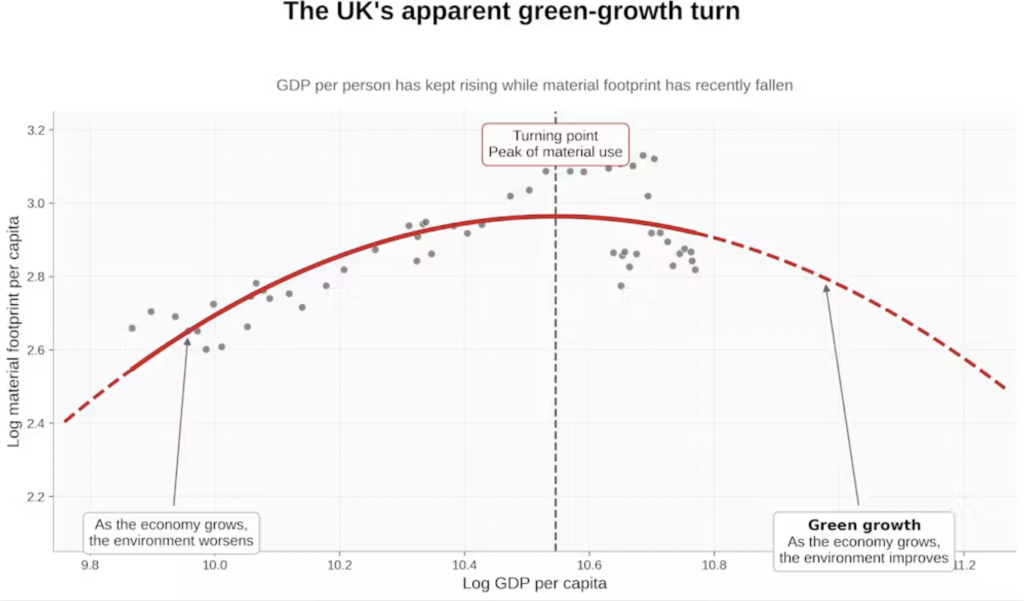
We used the latest data for measurements called material footprints. This counts everything a country actually consumes, including resources extracted abroad for import. First, the results were positive. Twenty-five countries appear to have achieved decoupled growth, including the UK. While substance use is on the decline, GDP continues to rise.
However, certain claims were exaggerated in three ways. This is not to say that green growth is impossible, just that the evidence is too strong.
1. Resource usage has not decreased enough
The economy has not reached the safe limits we need to operate. Imagine you owe £50,000 on your credit card. Last year your debt increased by £5,000. This year I only gained 4,000 pounds. It’s improving. But you’re still going further into the hole every month, and the hole is already deep.
Marina requena y mora. Author’s own data based on the World Bank and UNEP IRP Global Material Flow Database
Researchers estimate that the world’s significant per capita share of the material is 6 to 8 tons per year. The UK is now more than twice that range. Spain, Germany and Belgium are also in the same region. Their line on the chart is curved downward, but at a level that is too high to call it a success story. In contrast, Cuba and Somalia, like many other low- and middle-income countries, are within the sustainable marginal corridor, although their income levels are much lower.
2. Non-worldly turning point
If we look at the overall picture of 105 countries, we do not see a tipping point. As countries become richer over time, their use of resources accelerates, especially at the top of the income ladder.
Marina requena y mora. Author’s own data based on the World Bank and UNEP IRP Global Material Flow Database.
If you repeat this exercise every year from 1970 to today, the same upwardly curved shape will return. The promised recession will never arrive.
This suggests that the 25 success stories are an exception and not a sign of a pattern that other countries can follow as they grow. They are not used as a guide for the path we should take. These are outliers that could be avoided in other countries.
Success also has multiple origin stories. Europe’s decline is largely due to the 2008 financial crisis and subsequent housing bust, not a quiet technological revolution.
Some commodity exporters look greener as high prices boosted GDP while domestic construction remained flat. Through decades of agroecology and urban agriculture, Cuba has kept its material use modest while its per capita GDP has increased.
Taken together, these cases do not demonstrate the smooth technological progress envisioned in the green growth narrative. This decline stems from a variety of historical processes, including crises, housing busts, price effects, and specific political choices, rather than an overall global transition to cleaner production.
3. The dip only takes a moment.
The third problem is time. Direct substance use records only go back to 1970. The UK has a wealth of historical data on trade, household expenditure and investment as well as substance use, and we used this to reconstruct substance use in the UK going back to 1875. The neat downward bend we see starting in 1990 disappears.
For almost 150 years, the relationship between income and resource use in the UK has been essentially linearly upward. The current decline has happened before. That may just be the prelude to more growth, a long upward climb.
Marina requena y mora. This figure is based on data from the Bank of England, UNEP IRP, Streeck et al. (2020), Madison Project
It’s not that wealthy countries are doing nothing. Serious efforts have been made and recent lines on the chart are moving in the right direction. But what if it’s not rotation but wobble? What if we don’t bring countries below safety standards? What if we don’t become an effective model for other countries to follow?
To make real progress, countries that consume more than their fair and sustainable share of the world’s materials, including the UK, need to not only slow their growth in consumption, but also reduce it in absolute terms. And it’s possible. Several countries, including Cuba and Somalia, have reduced substance use while increasing income within their limits.
How they manage it varies and is worth studying in detail, but it shows that the goal is real. Going forward, growth and resource use must be honestly measured over time and against real-world limitations.
