


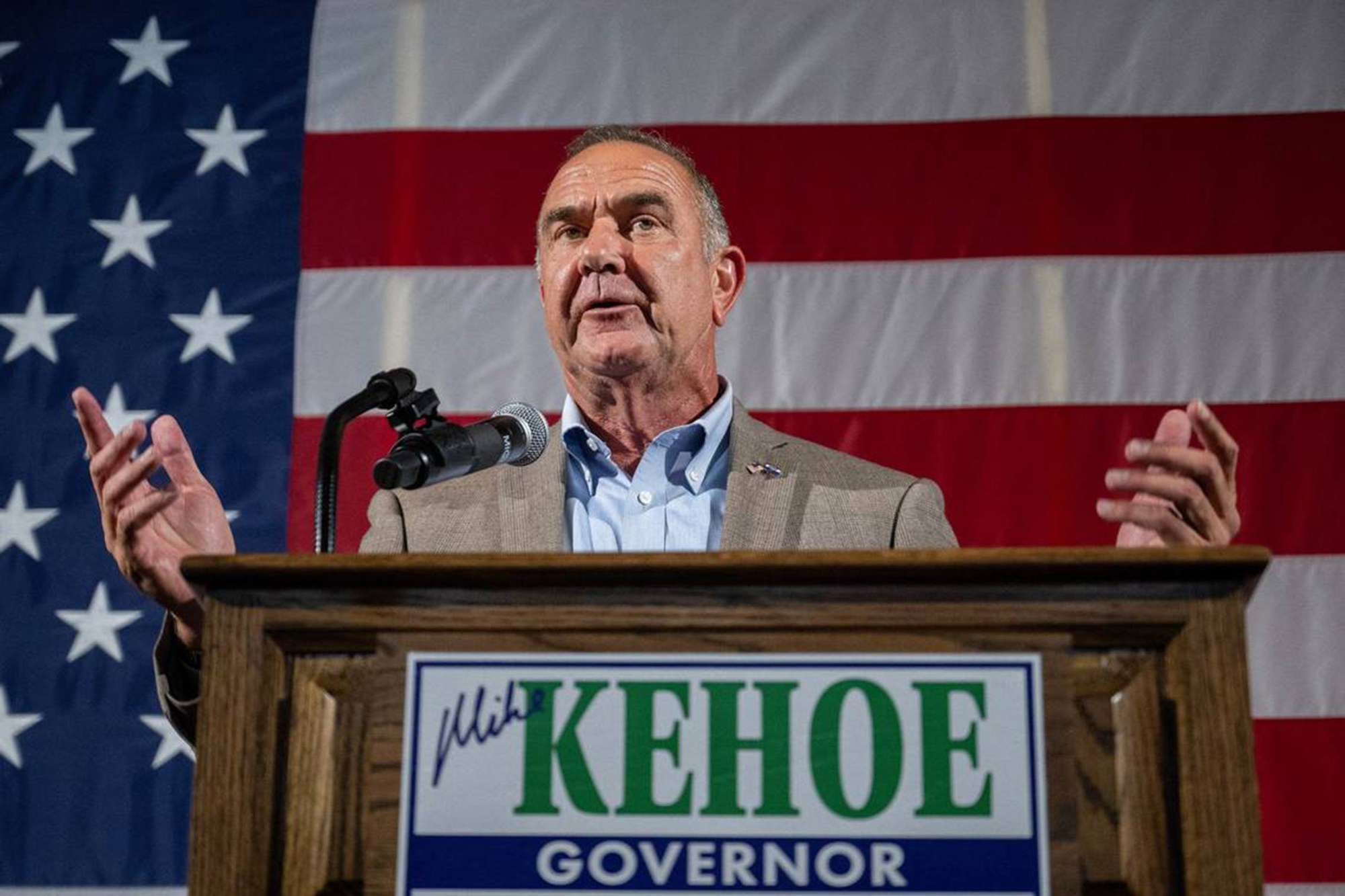
Missouri Gov. Mike Kehoe has spent months telling voters that the state’s constitution is being threatened by “out-of-state special interests” who are using voting initiatives to bypass the Republican-controlled Legislature and enact major policy changes. The measures include legalizing recreational marijuana, expanding Medicaid, and restoring abortion rights.
This argument is central to Kehoe’s support for the Fourth Amendment, a bill that would make it harder for Missourians to amend the constitution through citizen-initiated ballot initiatives in the Aug. 4 primary.
“Our Constitution should not be the victim of out-of-state special interests who spend millions of dollars to deceive voters and pass ill-conceived policies,” Kehoe said in a video posted to social media site X.
But another constitutional amendment that is central to Mr. Kehoe’s own agenda is benefiting from financial support provided by a Delaware nonprofit, which does not disclose the identities of its donors.
Kehoe plans to put Amendment 5, which puts Missouri on track to eliminate the state income tax, on the August ballot, along with Amendment 4.
While the governor and other supporters argue that phasing out the income tax will make Missouri more economically competitive and lower the overall cost of living, opponents argue that imposing new sales and use taxes on products and services not currently taxed would shift the tax burden to working-class households and increase Missouri’s existing sales tax rate.
Critics also warn that the tax increase could put Missouri retailers at a disadvantage, especially in the Kansas City and St. Louis areas, where consumers can easily cross state lines to make big purchases. These cities are each within a few miles of Kansas and Illinois.
Missouri Promise PAC, a pro-Fifth Amendment political action committee, received $1.9 million late last year from Missouri Promise, Inc., a nonprofit with a nearly identical name incorporated in Delaware. Neither the nonprofit nor the PAC has disclosed the identity or location of the donors who funded the campaign.
These pro-Fifth Amendment ads on Facebook were paid for by Missouri Promise PAC. facebook
Missouri Promise PAC placed ads online and on TV. The 30-second ad follows the governor as he tours the city and manufacturing plants, ending with him wearing a cowboy costume and riding a horse.
“He made a promise,” says the narrator. “Now he’s going to deliver.”
Kehoe’s office did not respond to a request for comment.
Missouri Promise is led by Garrett Lott, a longtime Missouri Republican and political fundraiser, and Alex Melendez, an Ohio-based political consultant with the Clark Folk Group who has consulted with conservative campaigns.
Neither Mr. Lott nor Mr. Melendez responded to requests for interviews or questions about the group’s operations.
Mark Ellinger, an attorney and treasurer for Missouri Promise PAC, said the campaign has released all the information required by Missouri law. Ellinger Law Firm is also listed as the address for Secure Missouri, a Missouri nonprofit founded last year that recently donated $1.5 million to the PAC.
Asked about the identities of donors to Missouri Promise and Secure Missouri, Ellinger said he could not comment on what disclosures the nonprofits themselves might ultimately make about their donors on their tax returns to the Internal Revenue Service. And he questioned whether any of the articles would also investigate the funding of opponents of the Fifth Amendment. One anti-Fifth Amendment campaign was funded almost entirely by a $1.9 million donation from Missouri Realtors PAC, which is $1 more than Missouri Promise’s contribution to a pro-Fifth Amendment campaign.
Ellinger suggested that donations are not necessarily more transparent than funds behind the Fifth Amendment and questioned whether the public knows the ultimate source of real estate agents’ funds. But unlike Missouri Promise and Secure Missouri, which do not disclose their donors, the real estate agency’s political committee reports its donors in public filings with the Missouri Ethics Commission. These filings allow the public to see who has provided how much money to the commission.
Mr. Ellinger has been involved in tax policy campaigns in Missouri for many years. In 2010, he served as a spokesperson for a ballot initiative backed by St. Louis investor Rex Sinquefield that sought to require regular voting on a 1% tax on wages paid by residents and workers in St. Louis and Kansas City. Missouri voters approved the measure, requiring both cities to submit taxes to voters every five years.
Over the past two decades, Mr. Sinquefield has spent millions of dollars supporting efforts to reshape Missouri’s tax system, including campaigns to eliminate the state income tax and rein in local income taxes. Sinquefield did not respond to a request for comment.
Critics of both amendments said it would be difficult to reconcile Kehoe’s position.
“There’s no way it’s going to go unnoticed that the governor is directly profiting from the faces and images plastered on Missouri’s television screens, either by underground financial groups in Delaware or elsewhere,” said Mark Jones, a political strategist and spokesperson for the Missouri National Education Association, which opposes both amendments.
Ken Warren, professor emeritus of political science at Saint Louis University and co-director of the SLU/YouGov poll, said Kehoe’s complaints about out-of-state funding shaping Missouri politics were somewhat surprising. Money from outside state lines routinely flows into voting control campaigns and other political battles across the country.
“The use of dark money is not good for democracy,” Warren said. “Voters need to know where their money is coming from, whether it’s in-state or out-of-state, because voters should know when they’re making choices. So I agree in principle, but I’m wary of him being hypocritical. A lot of Republican policies are funded by out-of-state funds and candidates. I’m funded by out-of-state funds and candidates. I don’t disagree with them because that’s how campaigns work.”
Taken together, the two amendments raise the risk of the August election, which typically has low turnout.
By putting them on the primary ballot rather than the November general election ballot, Mr. Kehoe ensured that the decision would be made by a smaller, more likely Republican-leaning electorate. The decision also separates the measure from the November ballot, which features a high-profile fight over abortion rights that has proven to have the potential to mobilize large numbers of Missouri voters.
The argument that outside interests are driving constitutional changes has become a common refrain among conservatives in Missouri and other Republican-led states, where voters have enacted ballot-driven policies that diverge from the priorities of Republican lawmakers.
Republican lawmakers in Missouri and other Republican-led states are countering by repealing voter-passed laws and making it harder for voters to amend their state constitutions.
Under Missouri’s current system, supporters of citizen-initiated constitutional amendments must first collect signatures from voters in the state to qualify for the ballot. Once there, the proposal would only need a simple majority of votes statewide to pass. Under the Fourth Amendment, in addition to winning statewide, citizen-initiated constitutional amendments must pass in each of Missouri’s eight congressional districts. As a result, proposals that win statewide but fall short in a single district will fail, no matter how large the statewide margin.
Critics say requiring measures to win in every district will require a level of political consensus that is increasingly rare in a state marked by sharp geographic and ideological divisions.
Supporters counter that such a requirement would ensure that constitutional changes reflect broad consensus across the state, rather than concentrating support in a few population centers.
“It’s going to take a bigger deal to change a key state document, and then we’ll get a deal,” said state Rep. Brian Seitz, a Republican from Branson who supports the Fourth Amendment.
This new requirement applies only to constitutional amendments proposed by the public through an initiative process. Amendments placed on the ballot by the Missouri General Assembly (such as Amendment 4 and Amendment 5) still pass with a simple majority statewide.
This difference is at the heart of the debate over the Fourth Amendment. Critics say the proposal would create two different rules to amend the same constitution. If a statewide majority is no longer enough for the people to amend the Constitution, they wonder why it should continue to be enough when lawmakers propose amendments.
Supporters say citizen-led efforts are particularly susceptible to influence by wealthy donors and national interest groups and should be required to demonstrate support across Missouri’s diverse regions. Seitz said he’s comfortable with the possibility that raising standards could someday make it harder for Republicans to pass constitutional amendments if Democrats take control of state government. Because, in his view, the goal is to make it more difficult to amend the constitution, regardless of which party is in power.
Seitz said the Legislature itself has a role in preventing one region of the state from dominating another. He argues that because legislators are elected from districts across Missouri, any proposals put to voters have already been vetted by urban and rural representatives alike.
“We are not a democracy,” he said. “We are a representative republic.”
