


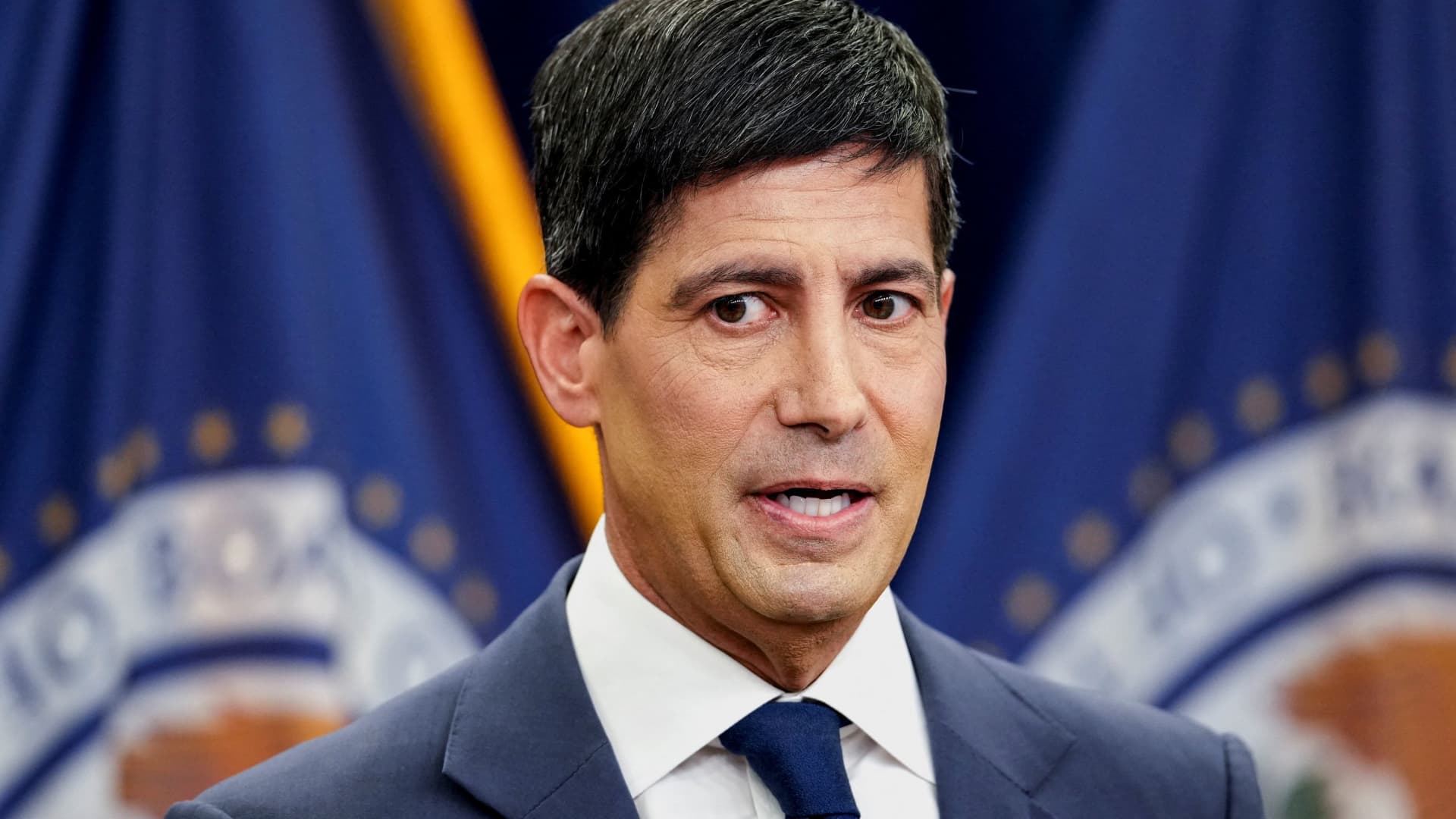
Fed officials disagreed last month about the future of interest rates, with policymakers considering scenarios in both directions, according to meeting minutes released Wednesday.
At Kevin Warsh’s first meeting as chairman of the Federal Open Market Committee on June 16-17, participants saw an outcome in which inflation would ease and interest rates could be cut, while others envisioned a scenario where price increases remained high and led to rate hikes.
In a post-meeting press conference, Warsh claimed the discussion was a “family dispute” and ended with the committee unanimously voting to keep the Fed’s benchmark funds rate in the range of 3.5% to 3.75%, where it has remained throughout 2026.
However, the minutes did not elaborate on the drama that had transpired, instead outlining a variety of views from members without biasing the committee in either direction. The grid, which Mr. Warsh dotplotted with the forecasts of each member who did not participate, tilted slightly towards one rate hike this year and then every two years thereafter.
Asked to judge the most likely scenario, “many participants indicated that the appropriate level for the federal funds rate would be within or slightly below the current target range at the end of this year,” the minutes said.
“However, many other participants assessed that the appropriate level for the federal funds rate would be above the current target range at the end of this year,” the document said.
“Participants noted that future policy actions will depend on incoming information,” the minutes read.
At 14 pages, the meeting summary was slightly shorter, although not significantly shorter than typical announcements, and followed Warsh’s repeated remarks that Fed officials should not communicate too much about their future intentions.
Accordingly, the post-meeting statement was about one-third the size of a typical communiqué. Officials at the meeting appeared to approve of the tougher message.
“Many participants noted that now is an appropriate time to consider significant changes to the FOMC’s postmeeting statement,” the minutes read. “The majority of participants said there were benefits to keeping statements short.”
Otherwise, the document outlines what happened during the two-day meeting in which the Federal Open Market Committee approved a brief statement that stated it was determined to keep the benchmark interest rate unchanged and restore “price stability” to the U.S. economy.
In particular, language indicating previous moderation bias was removed because “most participants emphasized that they preferred not to repeat the word.”
The post-meeting statement removed boilerplate language explaining the state of the economy and the committee’s approach to achieving its twin goals of low inflation and full employment.
The minutes were released less than two months into Warsh’s term as chairman, who was appointed by President Donald Trump. For years. The president had criticized Warsh’s predecessor, Jerome Powell, for not lowering interest rates.
Since taking office, Mr. Warsh has promised to overhaul the Fed’s operations in a number of ways.
At a press conference in June, he outlined five task forces that will address specific topics such as communications. The minutes only mention the group’s creation and note that “some participants commented that they welcomed the opportunity to review the committee’s communication tools and practices.”
Since then, Warsh has made only one public appearance. At the European Central Bank’s forum in Portugal, the central bank’s leaders were largely cautious about their views on the direction of policy, consistent with their aversion to so-called forward guidance on monetary policy intentions.
Choose CNBC as your preferred source on Google and never miss a moment from the most trusted names in business news.
Source link
