


Eve, here. For someone with only a minimal understanding of AI power usage, the headline might be, “Huh, you think so?” item. But this post documents an important point. Not only is AI significantly increasing the demand for electricity, but that demand is being sufficiently met by fossil fuels to reverse the decarbonization of electricity production.
Written by Alessandra Bonfiglioli, Rosario Curino, Mattia Filomena, and Gino Gancia. Originally published on VoxEU
While AI and other data-intensive technologies can help optimize energy use, the technologies themselves are power-hungry. This column examines how the spread of AI affected U.S. emissions from 2002 to 2022 and finds that regional AI growth is increasing emissions by boosting economic activity and energy use. It will also lead to an increase in the carbon intensity of electricity generation as plants transition from renewable to non-renewable sources. The “green” promise of AI will remain elusive unless the power sector itself rapidly decarbonizes.
Quantifying the carbon footprint of AI is an increasingly urgent challenge. Policymakers are debating whether AI-related surges in electricity demand will jeopardize decarbonization goals. Data centers, the core infrastructure that supports AI models, are projected to account for 8% of U.S. electricity demand by 2030, up from 3% in 2022 (Davenport et al. 2024). Concerns have been raised that this surge in power generation will delay the retirement of coal-fired power plants. On the other hand, AI and digital industries are often touted as “green” technologies that can increase efficiency and reduce emissions.
Research on past waves of digitalization (e.g. Lange et al. 2020) has shown that while ICT can reduce some forms of waste, the overall effect is often an increase in energy use. Cryptomining has recently been implicated in rising regional electricity prices (Benetton 2023), and debate continues over whether data center expansion will force the grid to rely on fossil fuels for longer (Electric Power Research Institute 2024, Knittel et al. 2025).
A recent study (Bonfiglioli et al. 2025) contributes to this debate by providing systematic evidence on how the proliferation of AI has affected U.S. emissions over the past two decades. Our findings suggest that the “green” promise of AI is unlikely to be realized unless the power sector itself rapidly decarbonizes.
New datasets connect AI, data centers, and power plants
To perform our analysis, we built a new dataset that links AI, emissions, and data center and power plant locations in 722 commuting zones in the United States from 2002 to 2022. This period coincides with the rise of the digital economy, cloud computing, and early AI applications. To understand the carbon footprint of these phenomena, we define AI as algorithms applied to big data and measure its prevalence using changes in employment in data-intensive occupations (software developers, data scientists, systems analysts, and related computer science jobs) identified from the O*NET database (see Bonfiglioli, Crinò, Gancia, and Papadakis 2024, 2025).
We then map the geographic locations of more than 2,000 data centers and link them to nearby power plants and their fuel blends. Finally, we measure emissions from the high-resolution Vulcan dataset (Gurney et al. 2009, 2025). This dataset tracks CO2 from fossil fuel combustion by sector and location, and is complemented by satellite-based data on other pollutants.
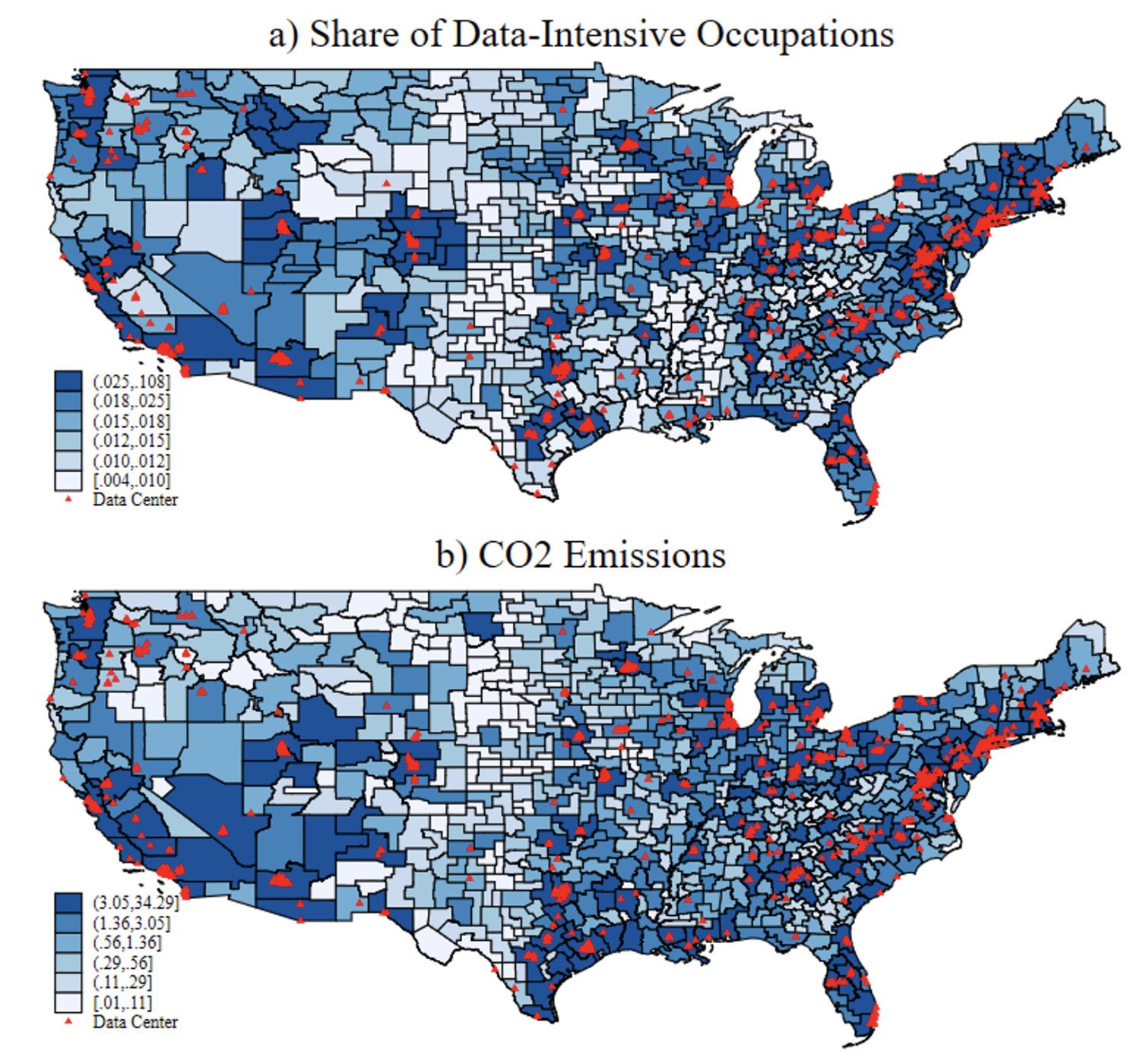
Figure 1 shows a color map showing how employment in data-intensive occupations (panel a) and CO2 emissions (panel b) vary across U.S. commuting areas. Darker colors indicate higher levels of recruitment or shedding during the sample period. The red triangle also indicates the location of the data center. The figure shows that regions with more workers in data-intensive occupations tend to have higher emissions and are more likely to have at least one data center. However, this correlation cannot be interpreted as evidence of causation, as both AI and emissions can be caused simultaneously by other shocks.
Figure 1 Data-intensive occupations, data centers, and CO2 emissions
Note: Panel (a) shows the share of employment in data-intensive occupations in each commuting area in 2022. Panel (b) shows the total CO2 emissions in each commuting area for the same year. Darker colors represent higher levels of recruitment or displacement of data-intensive occupations during the sample period. A red triangle indicates the presence of a data center site.
To address the fact that AI adoption itself can be influenced by regional demand and productivity trends, we use the ShiftShare (Bartik) tool. Specifically, we identify commuting zones that are exogenously more exposed to the arrival of AI as industry-specific zones that have historically experienced faster growth in data-intensive occupations than the country as a whole.
Impact of AI on emissions
Our analysis yielded four important findings. First, AI slows down the green transition at the local level. Regions specializing in industries with faster data-intensive employment growth experienced a much slower decline in CO2 emissions (Figure 2). From 2002 to 2022, emissions fell by an average of 16%. In contrast, a hypothetical commuter area with no AI penetration would have 37% higher CO2 emissions than average. Our empirical strategy distinguishes national effects, so these numbers should not be interpreted as a counterfactual exercise, but they still suggest that regional AI penetration increases emissions relative to less exposed regions.
Figure 2 AI penetration rate, CO2 emissions, and power generation amount
Note: This figure shows estimated coefficients and 90% confidence intervals for the impact of AI penetration on various types of emissions and the share of non-renewable energy in net electricity generation. The estimation sample includes 722 commuting zones observed over four five-year periods from 2002 to 2022.
Second, the increase in emissions is mainly due to scale effects. Decomposing the drivers of emissions into size, composition, and technology (Levinson 2009) shows that increased regional economic activity is the main channel through which AI impacts emissions. Industry-specific sectors with rapid growth in data-intensive employment have attracted more workers and businesses, increasing total output and, in turn, energy use (Figure 2). Due to changes in industrial composition, emissions have slightly decreased rather than increased.
Third, power generation becomes more carbon-intensive. Even after controlling for scale, per capita emissions from electricity generation increased in regions with high AI penetration (Figure 2). This happens because power plants located in more exposed areas switch their generation from renewable to non-renewable energy (Figure 2). The energy demand driven by AI applications and data centers is primarily met by fossil fuel plants, supporting concerns that they cannot guarantee the stable and continuous supply needed for high-performance computing.
The fourth and final finding is that data center location matters. Electricity is not easy to store at scale, so power grids must balance supply and demand in real time. Due to high transmission loss costs, power plants are affected by nearby demand sources, especially data centers that require a stable and high-capacity power supply. Consistently, we find that proximity to data centers is associated with power plants producing more CO2 emissions and relying more on non-renewable energy sources (Figure 3).
Figure 3 Distance to data center and power plant activities
Note: This figure shows the estimated coefficients and 90% confidence intervals for the effect of average power plant-to-data center distance on various power plant activities. The estimation sample consists of 11,500 power plants observed during four five-year periods from 2002 to 2022.
conclusion
These results put into perspective the concerns often expressed by climate analysts. If the power sector does not accelerate its transition to lower carbon sources, the spread of AI could slow or even reverse recent emissions reductions.
In particular, our research covers the period from 2002 to 2022, during which time an explosion in generative AI is predicted. The expected efficiency gains from these new technologies may ultimately help decarbonize the economy, but training and running today’s large-scale language models consumes far more energy than early AI applications on data. Therefore, the next wave of AI is likely to have an even bigger impact on emissions in the short term, unless it is accompanied by major investments in clean electricity.
Our research points to the uncomfortable truth that digital transformation and decarbonization cannot be treated as separate challenges. The proliferation of AI represents a classic challenge in technological progress. Innovations that promise long-term efficiency gains can increase environmental externalities in the short term by increasing energy demand. The solution is not to slow down AI, but to accelerate the transition to clean energy. This may require incentives for more energy-efficient hardware, locating data centers in regions with abundant clean energy capacity, and strengthening power transmission infrastructure. Without this coordination, the race for increasingly powerful algorithms could inadvertently lock economies into higher-emission paths.
See original post for reference
