


This is Naked Capitalism fundraising week. 101 donors have already invested in our efforts to combat corruption and predatory conduct, particularly in the financial realm. Please join us and participate via our donation page, which shows how to give via check, credit card, debit card, PayPal. Clover, or Wise. Read about why we’re doing this fundraiser, what we’ve accomplished in the last year,, and our current goal, strengthening our IT infrastructure.
The U.S. Army’s New Rifle
For more than half a century, the American infantryman’s standard rifle has fired essentially the same cartridge. The M16 entered service during the Vietnam War firing the 5.56×45mm NATO round. The shorter M4 and M4A1 carbines eventually replaced it as the standard infantry weapon but retained the same caliber. Weapons, ammunition, optics and accessories evolved enormously while the basic cartridge remained.
The U.S. Army has now decided that 5.56mm is no longer enough for its close combat forces. The Next Generation Squad Weapon (NGSW) program replaces the M4A1 with the M7 rifle and the M249 Squad Automatic Weapon with the M250 automatic rifle. Both fire a new high-performance 6.8×51mm cartridge. They are paired with the M157 computerized fire-control sight, incorporating variable magnification, a laser rangefinder, ballistic computer, atmospheric sensors and digital display. The Army describes the combination as providing greater range, accuracy, hit probability and lethality than the weapons it replaces.
This is not a frivolous modernization. Experience in Afghanistan exposed infantrymen to engagements at ranges where the short-barreled M4 and 5.56mm ammunition were less effective, while improved body armor raised concerns about the ability to defeat protected opponents. The Army wanted what it calls “overmatch”: the ability to engage protected and unprotected opponents more effectively and at greater distances than existing rifles permit. This article does not argue that the M7 is a bad rifle, that 6.8mm is a bad cartridge, or that the engineers who developed them failed. The more interesting question is whether the Army optimized the right thing.
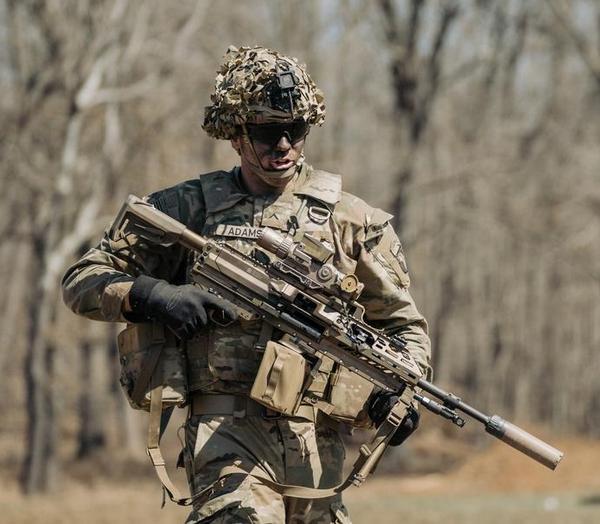
Soldier with M7 rifle – too much of a good thing?
That question has become particularly important because the weapon is already changing. Soldier experience with the M7 led the Army to approve the XM8, a shorter and lighter derivative intended to improve mobility and controllability while retaining 6.8mm ammunition and compatibility with the M157 fire-control system. The Army accepted its first XM8 delivery in April 2026 and says the weapon will replace the M4A1 for soldiers in the Close Combat Force.
A lighter, shorter derivative appearing so soon after the M7 is not necessarily evidence of procurement failure. Military weapons routinely evolve after feedback from users. But it does invite a larger question. If greater cartridge performance produced a weapon whose physical characteristics subsequently required correction, what exactly was being optimized—the cartridge, the rifle, the infantryman, or the combat effectiveness of the squad? This question takes us beyond whether 5.56mm or 6.8mm is the better rifle cartridge and into the more consequential problem of how military organizations make complex weapons-development decisions.
The Requirement That Drove the Weapon
For decades, the Army steadily improved the performance of the 5.56mm weapons inherited from the Vietnam era. Better ammunition, barrels, optics and accessories made the M4A1 much more capable than an early M16. But incremental improvement eventually encounters physical limits. The Army concluded that 5.56mm ammunition had largely plateaued and could not provide the combination of range and lethality expected against future opponents.
Combat in Afghanistan renewed interest in longer-range infantry engagements, while increasingly effective body armor raised the prospect that future opponents might withstand conventional rifle ammunition at tactically significant ranges. The Army’s small-arms research consequently emphasized greater effective range and advanced armor-piercing capability. Its 2017 Small Arms Ammunition Configuration Study led toward development of the Next Generation Squad Weapon (NGSW).
The resulting 6.8×51mm cartridge is much more than an enlarged 5.56mm round. Its 51mm case is the same nominal length as the 7.62×51mm NATO cartridge once fired by the M14 and still used in American and NATO machine guns and rifles. Advanced projectiles, propellants and hybrid cartridge construction permit the new ammunition to operate at very high performance levels. The Army describes the 6.8mm family as providing increased range, accuracy and lethality, and current general-purpose ammunition incorporates a steel penetrator for use against personnel wearing body armor.
The M7 is therefore best understood as one component of a system built around this new ballistic capability. The M250 automatic rifle fires the same ammunition, while the M157 fire-control sight helps the soldier exploit the cartridge’s longer-range performance. Weapons, ammunition and fire control are fielded together as a squad-level capability intended to restore overmatch against near-peer opponents. The Army’s acquisition objective initially called for more than 111,000 M7 rifles, 13,000 M250 automatic rifles and 124,000 M157 fire-control systems.
One Step Forward and One Step Back
There is little reason to doubt that the NGSW substantially advances the ballistic capabilities it was designed to improve. The more important question is what the infantry squad gives up to obtain them. The 6.8mm cartridge represents a significant step forward in small-arms ballistic performance, but it also takes the American infantryman back toward an ammunition burden the Army deliberately left behind more than sixty years ago. The tradeoff is dictated by physics. Greater bullet mass and velocity require more energy, and generating that energy imposes costs. The 6.8×51mm cartridge uses sophisticated hybrid-case construction and advanced propellants, but technology cannot avoid the underlying tradeoff. The new cartridge is substantially larger and heavier than the 5.56×45mm round it replaces.
The result is an intriguing historical reversal. The Army adopted the 5.56mm M16 during the 1960s in part because a smaller cartridge allowed an infantryman to carry substantially more ammunition for a given weight. The M16 was further trimmed down to the M4 carbine in 1994. The standard rifle magazine capacity grew from the M14’s 20 rounds to 30 rounds for the M16 and M4. The M7 returns to a 20-round magazine and ammunition much closer to the weight class of 7.62mm than 5.56mm. The Army has recovered and surpassed ballistic performance surrendered when it moved away from 7.62mm, but it has also returned most of the size and weight burden that accompanied the M14.
Army officials acknowledged during the NGSW program that the M7 was approximately two pounds heavier than the M4 when comparing empty weapons. The difference becomes more consequential when the soldier carries the weapon, suppressor, advanced optic and multiple magazines of heavier ammunition. Soldiers evaluating the NGSW have specifically commented on the increased weight of the M7 and its 6.8mm magazines when carrying a full combat load.
Infantry load is a weight budgeting problem. Additional weight devoted to rifle and ammunition competes with body armor, water, communications equipment, batteries, grenades, medical equipment and other necessities. The heavier M7 rifle and ammunition potentially impose weight reductions elsewhere in the soldier’s gear. Alternatively, the soldier can preserve approximately the same total load by carrying fewer rounds.
Magazine capacity creates a related tradeoff. Thirty rounds rather than twenty provides 50 percent more ammunition before shooting must be interrupted for a magazine change. In a short engagement that difference may be irrelevant. During suppression, close combat or a prolonged engagement, it may be vitally important.
The Army has already responded to the weapon-weight problem. Soldier feedback contributed to development of the XM8, an M7 derivative with an 11-inch barrel that is more than a pound lighter and approximately 3.5 inches shorter than the M7. The Army says the XM8 now weighs approximately the same as an M4A1 while retaining the 6.8×51mm cartridge and sufficient performance to exceed its lethality requirements.
This is sensible adaptive engineering, but it is also revealing. The original requirement produced a more powerful cartridge; the more powerful cartridge helped produce a heavier rifle; the heavier rifle generated demand for a shorter and lighter rifle. Shortening the barrel, in turn, necessarily sacrifices some of the velocity that helped justify the more powerful cartridge in the first place.
None of this proves that the M7 or 6.8mm ammunition is a mistake. It demonstrates something more important: there is no free ballistic performance. The Army has moved one step forward in range, energy and penetration while moving one step back in rifle and ammunition weight, magazine capacity and overall soldier burden.
From Afghanistan to the Modern Battlefield
One influence on the Army’s search for a more powerful infantry rifle was experience in Afghanistan. American troops sometimes exchanged fire with insurgents across the long distances created by mountainous terrain. The short-barreled M4 was not optimized for such engagements, contributing to concern that American infantry needed greater effective range. The observation was legitimate. Whether it justified providing long-range capability to every rifleman is a different question.
Afghan fighters did not possess some revolutionary class of infantry weapon that rendered American units technologically obsolete. Their conventional assault rifles were supplemented by machine guns, RPGs, mortars and other weapons. American infantry similarly combined M4 carbines with machine guns, grenade launchers, designated-marksman and sniper weapons, mortars and supporting fires. An individual rifleman could certainly find himself unable to respond effectively with an M4 to distant enemy fire. It does not follow that the infantry unit lacked the ability to engage at that distance.
Afghan mujahideen fighters – Note range of weaponry and absence of body armor
This distinction is fundamental. Afghanistan demonstrated an episodic need for long-range infantry fire. It did not demonstrate a universal need for a long-range infantry rifle. If an enemy machine gun is firing from 700 meters, the relevant systems question is not necessarily how to enable every rifleman to engage it. The question is what combination of rifles, machine guns, precision rifles, mortars, grenade launchers and supporting fires gives the unit the greatest probability of defeating it while preserving effectiveness across the other circumstances in which infantry must fight. A soldier may occasionally need to engage an enemy at 600 meters or beyond. He carries his rifle and ammunition every meter of every patrol, assault, and movement whether or not he ever shoots at that distance.
The subsequent evolution of warfare has made that tradeoff more consequential. The infantry battlefield emerging in Ukraine bears little resemblance to the relatively permissive electromagnetic and aerial environment of Afghanistan. Reconnaissance drones make concealment increasingly difficult. FPV drones attack vehicles, positions and individual soldiers, while artillery and other fires can be rapidly directed against detected targets. Forces have consequently dispersed and adapted movement and logistics to persistent observation and attack from above.
The infantryman’s load is evolving with this battlefield. Radios, batteries, drone detectors, electronic-warfare equipment, counter-UAS systems and increasingly drones themselves compete with weapons, ammunition, armor and water for finite carrying capacity. A pound devoted to ammunition is therefore not merely a pound the soldier must endure. It is a pound unavailable for another capability.
Body armor presents a parallel problem. Future American forces may encounter opponents wearing advanced ballistic protection, and defeating that protection is desirable. But the existence of a requirement does not determine how universally its solution should be distributed. Heavy body armor is itself burdensome and is unlikely to be worn uniformly across every climate, mission and adversary. Moreover, much of the lethality demonstrated in Ukraine comes from artillery, mines, grenades and explosive drones against which improved resistance to rifle bullets offers limited protection. Army analysis estimates that unmanned aircraft were responsible for 70–80 percent of battlefield casualties in Ukraine on both sides by mid-2025, although wartime casualty attribution is necessarily imprecise.
There is an irony in making advanced body armor a principal justification for a heavier cartridge. American soldiers must also be protected against increasingly lethal weapons, and body armor imposes its own substantial weight burden. Protection is not binary: relatively light configurations provide limited soft-armor protection, while increasingly comprehensive rifle protection can push the armor load toward 30 pounds or more. Improvements in protection encourage heavier weapons and ammunition capable of defeating them; more powerful weapons in turn encourage still heavier protection.
The possibility of long-range engagements establishes a need for long-range unit firepower, but not necessarily a long-range rifle for every soldier. The possibility of encountering advanced body armor establishes a need for armor-defeat capability, but not necessarily an armor-defeating rifle in every pair of hands. The battlefield requirement should determine the mix of capabilities, rather than a particular capability determining the structure of the entire infantry squad. This leads to the most important question raised by the M7: What is the proper unit of analysis—the rifle or the squad?
The Wrong Focus of Analysis
A rifle is not an independent weapons system. It is one component of an infantry squad, which is itself one component of a larger combined-arms organization. Evaluating the M7 principally by comparing its performance with the M4 therefore risks optimizing at the wrong level. Suppose the M7 can engage protected targets at greater range than the M4. On a rifle-versus-rifle comparison, that is an unequivocal advantage. But the relevant military question is not which rifle possesses the greatest capability. It is which combination of weapons and equipment produces the most effective squad.
Infantry organizations have long recognized this principle through specialization. Machine guns provide sustained fire. Grenadiers engage targets ordinary rifles cannot. Designated marksmen extend precision range. Other soldiers carry radios, drones, anti-armor weapons, breaching equipment or specialized systems. The squad collectively acquires capabilities that no individual member needs to possess completely.
Long-range armor defeat can be analyzed in the same way. Even if the requirement is accepted without reservation, it does not follow that every rifleman needs a 6.8mm weapon. A squad containing some 6.8mm rifles and some lighter 5.56mm carbines could retain the ability to engage protected targets at extended range while preserving greater ammunition capacity, lower weight and easier handling for other soldiers. Machine guns, designated-marksman weapons, grenade launchers and supporting weapons further broaden the available mix.
Such heterogeneity creates complementary capabilities. A 6.8mm rifleman can exploit the new cartridge’s range and penetration when those characteristics matter. A soldier carrying a 5.56mm carbine can carry substantially more ammunition for the same weight, maneuver more easily in confined spaces, and provide a larger reserve of rifle fire during prolonged engagements. Neither weapon needs to be superior in every dimension because the squad, rather than the rifle, is the system being optimized.
A mixed approach has costs. Two rifle cartridges complicate ammunition distribution, training and battlefield resupply, and ammunition cannot be freely exchanged among every rifleman. Standardization has genuine military value. But those costs are variables in the analysis rather than reasons to exclude heterogeneity from consideration. U.S. infantry already manages multiple ammunition types within squads and platoons because different weapons provide capabilities worth the logistical complication.
The universal-rifle approach makes a different trade. It maximizes commonality and ensures that every equipped rifleman possesses the new ballistic capability, but it also distributes the cost of that capability universally. Every rifleman carries the heavier ammunition whether or not his role or the engagement requires it. The entire close-combat force accepts the burden required to solve a problem that may arise only intermittently.
The Army’s subsequent development of the XM8 makes the systems question more conspicuous. After creating a rifle around the performance of the 6.8mm cartridge, the Army shortened and lightened the weapon in response to soldier concerns about size and weight. That is a rational engineering response. But it preserves the assumption that the cartridge, and therefore the ballistic capability that drove the program, must remain constant while other characteristics adapt around it.
This reverses the proper relationship between component and system. A component capability should be optimized for system effectiveness. The system should not be optimized around preserving a component capability. Once this distinction is recognized, the M7 debate changes fundamentally. The question is no longer whether the M7 is a better rifle than the M4, or even whether 6.8mm is a better cartridge than 5.56mm. Those comparisons are too narrow. The relevant question is whether equipping the close-combat force with 6.8mm rifles produces greater overall combat effectiveness than alternative combinations of weapons, ammunition and equipment the same soldiers could carry.
The Marines Choose Another Path
The strongest evidence that the Army’s solution was not inevitable comes from another American military service. The Marine Corps examined the same developments in body armor, ammunition, optics and infantry combat but has continued to organize its rifle squads around 5.56mm weapons rather than adopt the Army’s 6.8mm cartridge.
This is significant because the Marines have hardly been conservative about small-arms modernization. The Corps replaced the M4 as the standard weapon in its infantry squads with the M27 Infantry Automatic Rifle, a 5.56mm weapon originally acquired to replace the M249 Squad Automatic Weapon. It subsequently expanded M27 distribution throughout the rifle squad and paired the weapon with advanced optics. The Marine Corps therefore embraced improving the individual infantryman’s ability to identify and accurately engage targets while declining, at least so far, the Army’s move to a substantially heavier cartridge.
Both services want greater infantry lethality. Both recognize advances in body armor, have access to modern optics and ammunition technology, and must prepare for peer warfare. Yet these circumstances do not dictate a single solution. The Marine approach emphasizes accurate fire from a relatively light, low-recoil 5.56mm weapon while preserving the ammunition capacity of the smaller cartridge. The Army has placed greater emphasis on extending the ballistic envelope of the individual weapon. Neither approach eliminates tradeoffs.
The comparison also exposes an ambiguity in the meaning of overmatch. If overmatch means that every American rifleman should possess greater effective range and penetration than an opposing rifleman, the M7 is a logical response. But infantry combat does not consist of symmetrical comparisons between individual weapons. A rifle squad combines different capabilities precisely because the effectiveness of the whole can exceed that of any one component.
The Marine Corps has extended this principle through its broader force redesign. Its infantry formations increasingly incorporate small drones, loitering munitions, improved sensors and other capabilities reaching far beyond conventional rifle range. A distant target need not necessarily be engaged by a rifle merely because a rifleman can see it. The growing density of precision weapons and unmanned systems expands the ways a squad or platoon can attack a target without requiring every soldier to carry a heavier cartridge.
This does not establish that the Marine approach is correct and the Army approach wrong. Different services can legitimately optimize for different missions, organizations and operating concepts. The divergence demonstrates something more useful: the Army’s solution was a choice, not an operational inevitability.
That choice becomes revealing when viewed in sequence. The Army identified deficiencies in range and armor penetration and developed a cartridge that substantially corrected them. The cartridge imposed penalties in weapon weight, ammunition weight and magazine capacity. The Army then began modifying the weapon to reduce those penalties while preserving the cartridge.
At every stage, the ballistic requirement remained privileged. A complex military problem had been simplified around one particularly compelling characteristic, and subsequent decisions increasingly organized themselves around preserving it.
Destructive Simplification
Complex military systems resist simple optimization because their characteristics interact. Increasing protection adds weight. Increasing range requires energy. Increasing speed consumes fuel. Reducing signatures constrains shape, materials and payload. Adding capability increases cost, maintenance and training demands. Improvements in one dimension therefore propagate consequences throughout the system.
This makes military procurement vulnerable to a seductive analytical shortcut: identify an important deficiency, convert its correction into a requirement, and optimize the system around satisfying it. We might call this destructive simplification. It commonly begins with a valid military problem or opportunity. American riflemen sometimes encountered enemies at long range in Afghanistan. Advanced body armor can reduce the effectiveness of existing rifle ammunition. Aircraft combining vertical takeoff with fixed-wing speed and range offer obvious advantages. So do aircraft difficult for radar to detect.
The problem begins when one desirable characteristic becomes the organizing principle around which the larger system is designed. The M7 provides a compact example. Greater range and armor penetration favored a more powerful cartridge. The cartridge increased ammunition weight, recoil and weapon stresses. The weapon became heavier. Magazine capacity fell from thirty rounds to twenty. The Army then sought a lighter and shorter rifle while preserving the ballistic capability that had driven the design.
Nothing in this sequence requires an irrational decision. Each engineering response can be sensible within the constraints inherited from the preceding decision. The danger lies in the sequence itself. Once the privileged characteristic becomes effectively non-negotiable, the remaining characteristics must absorb the compromises.
The analytical progression looks something like this:
Complex operational problem → salient deficiency → simplified requirement → privileged technical solution → system-wide penalties → compensatory engineering
This progression can produce a requirements ratchet. The original requirement creates penalties; the penalties generate new requirements; and new engineering addresses them while preserving the original requirement. Greater ballistic performance produces a heavier rifle; the heavier rifle creates a requirement for a lighter rifle; the weapon is shortened and redesigned while the 6.8mm cartridge remains fixed. Each response can be rational while the sequence progressively insulates the original assumption from reconsideration.
The ratchet strengthens as programs accumulate commitments. Specifications are established, contracts awarded, production capacity created, training developed and supply chains constructed. Reconsidering an upstream assumption becomes more disruptive than solving the latest downstream problem. Once the 6.8mm cartridge is treated as fixed, designing a lighter rifle around it is perfectly sensible. The question that disappears is whether the cartridge should still be fixed.
Sound systems analysis therefore requires a willingness to reopen the design boundary. Requirements should not become sacred merely because engineering has successfully satisfied them. If meeting a requirement produces sufficiently damaging consequences elsewhere in the system, the correct response may be to reconsider the requirement rather than engineer around every consequence.
This is especially important when the benefit is conditional but the penalty is universal. Long-range rifle performance is valuable when long-range rifle engagements occur. Armor penetration is valuable when an enemy’s protection requires it. The heavier weapon and ammunition are carried regardless. The capability appears when needed; the burden exists continuously.
Destructive simplification can therefore create procurement momentum without requiring incompetence, bad engineering or bad faith. A component may become increasingly successful at performing its assigned function even as the compromises required to support it reduce the effectiveness of the larger system. The M7 is useful not merely as a case study in small-arms procurement, but as a particularly visible example of a recurring defense-acquisition problem: solving salient requirements while losing sight of system optimization.
The Problem Pattern Scales
The M7 is a relatively modest weapons program, but destructive simplification is not confined to small arms. The same pattern can appear in systems costing tens or hundreds of billions of dollars. Two aircraft programs illustrate the point: the V-22 Osprey and F-35 Joint Strike Fighter.
The V-22 began with an enormously attractive capability: combine the vertical takeoff and landing of a helicopter with the speed and range of a fixed-wing aircraft. The Osprey successfully delivers this combination. During its early deployment to Iraq, the Government Accountability Office found that the aircraft completed its assigned missions and used its greater speed and range to move personnel and cargo faster and farther than the helicopters it replaced.
But combining these capabilities imposed substantial system costs. Vertical flight and airplane-like cruise required enormous proprotors, swiveling engine nacelles, complex transmissions and flight controls, and a structure capable of functioning in two very different flight regimes. Early operational experience revealed substantial maintenance, reliability, supply-chain and availability problems. GAO also identified limitations affecting shipboard and high-threat operations.
This does not establish that tiltrotor aviation was a mistake. It raises the systems question that should precede the platform question: How much of the force actually needs both capabilities in the same aircraft? A heterogeneous aviation force of helicopters and fixed-wing transports sacrifices the Osprey’s unique combination of capabilities but avoids imposing the cost and complexity required to combine them on every mission.
The F-35 illustrates the same phenomenon on a still larger scale. A common aircraft family would serve the Air Force, Navy and Marine Corps while incorporating stealth, advanced sensors, networking and precision weapons. Three variants would satisfy radically different operating requirements, including conventional runways, aircraft carriers and short takeoff/vertical landing.
Again, the resulting capabilities are real. The relevant question is what happens when several highly desirable characteristics become dominant requirements within a single aircraft family. Stealth constrains geometry, weapons carriage, materials and maintenance. Commonality requires three services with different operating environments to share substantial portions of an aircraft architecture. Short takeoff and vertical landing adds another demanding design problem. Each requirement can be justified individually; their combination creates interactions that propagate through design, production and sustainment.
The resulting program has required extraordinary resources. GAO reported in 2025 that the Defense Department estimated F-35 acquisition costs at about $485 billion and lifetime operating and sustainment costs at least another $1.58 trillion. GAO has also reported persistent availability problems and rising sustainment costs.
These difficulties do not prove that stealth, commonality or vertical landing were mistaken requirements, nor can every F-35 problem be attributed to them. They demonstrate how consequential the initial system boundary can become. Once the objective is defined as producing a stealthy, highly networked aircraft family spanning three services and multiple operating modes, enormous engineering effort must be devoted to making that particular combination work.
The figures in the above table are not directly comparable accounting measures, and the programs differ enormously in purpose and complexity. The comparison is conceptual rather than financial. A desirable characteristic becomes a dominant requirement. Engineering provides it. The resulting system incurs penalties elsewhere, and additional engineering is required to manage those penalties while the original characteristic remains largely beyond reconsideration.
This is why destructive simplification deserves attention in the M7 program even though its financial stakes are small compared with those of a tactical aircraft fleet. The pathology is easiest to correct near the beginning, when the question is still whether a particular capability belongs in every rifle. By the time the same analytical error has propagated through a vastly larger weapons system, reopening the original assumptions may be enormously expensive.
Optimize the Squad, Not Just the Rifle
The alternative to destructive simplification is not indecision. Military organizations must identify deficiencies, establish requirements and acquire equipment. The difference lies in where the analysis begins. For the NGSW program, the appropriate starting point was not the performance of the individual rifle. It was the combat effectiveness of the infantry squad.
Instead of asking what cartridge could defeat advanced body armor at extended range, the Army might have asked: What combination of weapons, ammunition and equipment gives the squad the greatest combat effectiveness across the expected range of future engagements?
Armor penetration and range would remain important variables, but they would compete with ammunition endurance, weapon weight, controllability, magazine capacity, mobility, training, logistics and the growing burden of electronics, drones and counter-drone equipment. None would automatically receive priority over the others.
Such an analysis might still have favored the M7. The probability of encountering armored opponents, the importance of extended-range engagements and the lethality gained from 6.8mm might outweigh the penalties imposed by heavier ammunition and reduced magazine capacity. If so, universal or near-universal deployment would have a coherent systems justification.
But alternative force structures should be treated as competing solutions rather than deviations from the objective. One might retain 5.56mm as the general-purpose cartridge while distributing 6.8mm weapons to designated members of the squad. Another might combine improved 5.56mm weapons with machine guns, precision rifles, grenade launchers and other systems for targets outside the ordinary rifle envelope. Different mixes could be optimized for different missions.
These alternatives must be evaluated at the level where their consequences converge. A lighter rifle is not automatically preferable if it cannot defeat important targets. A more powerful rifle is not automatically preferable if its ammunition burden reduces squad endurance. The purpose of systems analysis is precisely to prevent any one characteristic from deciding the question by itself.
The comparison must also account for changing opportunity costs. Every pound allocated to rifle ammunition is unavailable for drone batteries, reconnaissance systems, electronic-warfare equipment, counter-UAS devices, water, medical supplies or other equipment. A weight tradeoff that appeared reasonable when the NGSW requirement was conceived may become less attractive as the battlefield changes.
The Army’s continuing modification of the NGSW family suggests that some optimization is now occurring within the 6.8mm architecture. The XM8 may substantially improve the balance by reducing weapon weight and length. But optimization within an architecture is not the same as comparing that architecture with alternatives capable of producing the same unit-level effects.
The governing principle is simple: The requirement should describe the military effect the system must produce, not prematurely prescribe the capability every component must possess. Had the NGSW problem been framed this way from the beginning, the Army might still have arrived at the M7. But it would have arrived there by demonstrating that the weapon improved the effectiveness of the squad as a system, rather than by demonstrating that the rifle successfully maximized the characteristics selected for the rifle.
Conclusion
The M7 may prove to be an excellent rifle. The 6.8×51mm cartridge provides capabilities that 5.56mm ammunition cannot match, and the M157 fire-control system adds another dimension of sophistication. None of these accomplishments resolves the central question raised by the NGSW program. The issue is not whether the Army built a better rifle. It is whether this rifle replacement program produces a better infantry force.
That distinction raises the question of destructive simplification. Complex weapons programs can successfully optimize a component while degrading characteristics elsewhere in the system. Once a particular capability becomes privileged, technical success can reinforce the original decision: the capability performs increasingly well while engineering effort expands to compensate for the consequences of providing it.
The M7 makes this process unusually easy to see. Greater range and penetration can be weighed against ammunition burden, magazine capacity, recoil and soldier load. Similarly, the V-22 and F-35 programs show how this analytical problem can operate on much larger scales. In each case, the relevant question is not whether a desirable capability can be achieved, but whether the larger military system is improved enough to justify the compromises required to achieve it.
This discipline becomes more important as warfare changes. Soldiers increasingly operate as nodes in networks of sensors, drones, communications and precision weapons. Their strength, attention and logistical capacity are finite resources. A rifle requirement established in isolation from these competing demands can become obsolete even while engineers satisfy it brilliantly.
Perhaps the M7 will ultimately justify its costs. Perhaps the XM8 will resolve enough of the weapon’s weight and handling penalties to enhance battlefield performance. Combat experience may provide answers that peacetime testing cannot. But the larger procurement lesson does not depend on how the M7 performs: A component capability should be optimized for system effectiveness. The system should not be optimized around preserving a component capability. This principle applies whether the component is a cartridge, a rifle, an aircraft or a trillion-dollar weapons program. The purpose of military procurement is not to produce weapons that deliver a few capabilities most impressively; it is to produce the force that fights most effectively.
