


It is perplexing to see nominal experts and independent commentators be blinded by ideological leanings. The fact that the US and Europe are in less than robust economic shape (CBS has just reported that 28% of Americans are skipping meals due to food inflation) does not make China a paragon. We’ll soon discuss a new Wall Street Journal article on China’s electric vehicle glut, providing fresh information on a problem ferociously denied by too many China boosters, even though China’s top leaders have admitted to it and have been trying to address it” that of overcapacity and overproduction. The short version is Chinese factories can make over three times as many cars as Chinese consumers buy in a year, and offshore markets will not absorb the surplus.
I may be more sensitive to the dangers of conflating manufacturing prowess and a general high level of managerial competence with having an overall sound economic model from my time with Japan during its heyday in the 1980s. I had worked closely with a special team from Sumitomo Bank, then one of Japan’s two most prestigious financial institutions, as a McKinsey consultant. One big reason I took the nutty risk of later joining them as the first gaijin hired into the Japanese hierarchy was the impressive caliber of this group…despite speaking in English, as in not their native language, and in which none was highly fluent. One partner at McKinsey remarked, “If all of Japan is like this, we are screwed.” I was so persuaded of the superiority of Japan’s economy that I bought Japanese stocks a couple of years into the post bubble era. Ooopsie!
Specifically, there is great resistance among anti-imperialists to admit that China’s investment and export driven economic model has hit its limits, yet China is having great difficulty in shifting to the course that experts have long advocated, that of having a more balanced demand/growth model, with internal consumption playing a much bigger role. China has an overproduction production which Chinese leaders call “involution” (does clever branding somehow change the underlying problem?).
Keep in mind that the overcapacity problem has been on the official radar for well over a year. From a 2025 post:
We’ve had readers vigorously attempt to deny that there is such a thing as overinvestment and too much capacity. Yet we are seeing precisely that pattern play out in China, as its officials increasingly hector companies in a broad swathe of industries to stop cutting prices to preserve domestic market share. The reason for the alarm is that deflation, when it takes hold, is both more destructive and harder to combat than inflation.
China fans are particularly hostile to suggestions that there is anything amiss in the Middle Kingdom. Yet here, the ever-sharper criticism is coming from Xi on down. So a knee-jerk rejection is not a well-informed response….
Consider this sighting of ruinous competition from the Economist in early June, Now China’s ultra-cheap EVs are scaring China:
China’s ability to make electric vehicles (evs) cheaply has caused angst in countries with big carmakers, prompting governments to investigate China’s subsidies for the sector and to erect trade barriers. Now, though, it is China’s own government that is worrying about how cheap its producers’ evs are. The race to the bottom shows no sign of letting up, and the industry has become emblematic of some of the broader problems facing the economy.
On May 23rd China’s biggest ev manufacturer, byd, caused shockwaves when it slashed the cost of 22 electric and hybrid models. Now the starting price of its cheapest model, the Seagull, has fallen to a mere 55,800 yuan ($7,700). The move came just two years after byd had originally unveiled the electric hatchback, at a then astonishingly low cost of 73,800 yuan…..
On May 31st China’s industry ministry told Xinhua, the state-run news agency, that “there are no winners in the price war, let alone a future.” …
The backlash comes as leaders crack down on unproductive, self-harming competition between firms and local governments that has created overcapacity and lowered profits….
Or from the Financial Times on July 8 in China criticises manufacturers over price war as deflation fears mount, before the producer price figures came in even worse than expected:
China has strongly criticised companies and local governments for fuelling overproduction that it blames for driving down prices..
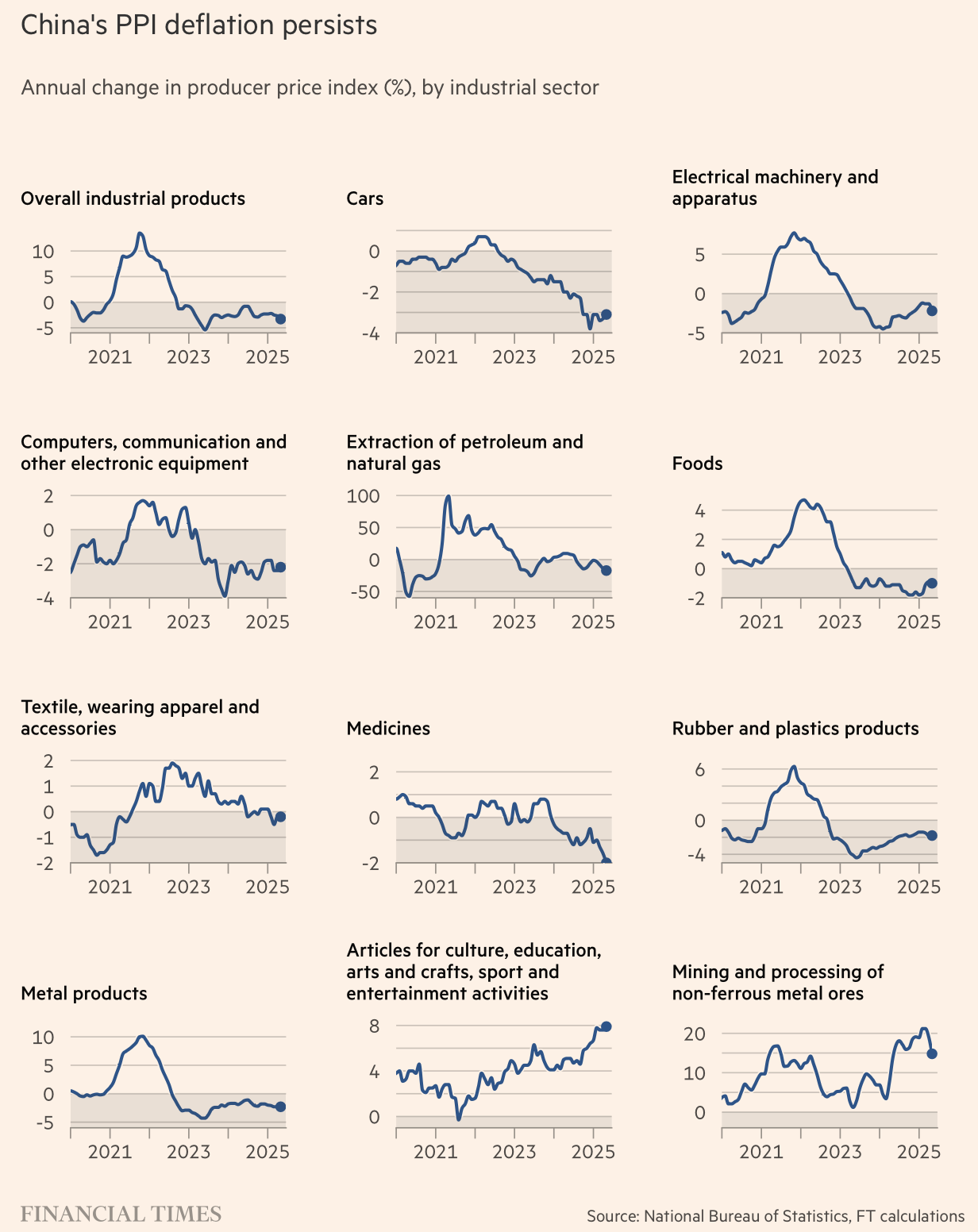
Chinese producer prices have been mired in deflationary territory since September 2022, posing a challenge for policymakers accustomed to relying on manufacturing and exports to drive economic growth.
In articles across state and party media, Chinese President Xi Jinping and other leading officials have attacked what they call neijuan, or “involution”, meaning excessive price competition….
Overcapacity is a sensitive issue for China, which has sought to dispel complaints that its industrial policy has flooded its partners’ markets with artificially low-cost goods…
The Chinese Communist party’s leading policy magazine Qiushi conceded last week that “overcapacity” was an issue…
Chairing a meeting of the party’s Central Commission for Financial and Economic Affairs last week, Xi said: “Efforts must be made to regulate enterprises’ disorderly price competition”.
The Economist, at the end of June, again before China reported its 3.6% year-on-year producer price decline, honed in on Xi’s response in Xi Jinping wages war on price wars:
In May the state reprimanded carmakers not for raising prices, but for cutting them….
Carmaking is not the only part of the economy suffering: factory-gate prices fell year on year in May in 25 out of 30 major industries. In eight, including coal-mining and steelmaking, the drop was even steeper than for cars. Across China’s vast industrial machine, average prices have now fallen for 32 months in a row.
Manufacturing investment, especially in high-tech ventures, has been a bright spot for China’s struggling economy in recent years as it weathers a prolonged property crisis. But the rapid decline of industrial prices and profits has raised doubts about the sustainability of even this capital-expenditure boom…..
According to Zhao Wei of Shenwan Hongyuan, a Chinese securities firm, the problem most severely afflicts electrical machinery, steelmaking and products such as cement, ceramics and glass, where prices fell faster than the national average last year. These parts of the economy also suffer from unusual amounts of idle capacity. And, by his reckoning, another 15 industries, from cars to tobacco, show some involutionary tendencies, such as weak profit growth, rapid increases in debt, falling prices or low rates of capacity use….
Many industries now suffering from involution are led by less biddable private firms. Electric cars and solar panels, for example, are dominated by sophisticated commercial enterprises, using cutting-edge technology.
Readers can tell themselves that China once pulled itself out of a similar situation [its 2012-2016 bout of overcapacity and deflationary pressure]. But that was before Trump started his small-bore war on China when he took office, which has now become a much bigger dustup. And as indicated, in the earlier supply-side housecleaning, China could pro-actively engage in creative destruction by accelerating capacity cuts in weak and inefficient enterprises. Now the big sinners in the ruinous competition game are often in China’s most productive sectors, even national champions like EVs. So this issue will continue to bear watching.
And from a January 2026 post:
We have been warning of China being in the grips of deflation. If it becomes entrenched, which is a realistic risk, the downside is considerable. Deflation leads to business closures, falling incomes and job losses. Those effects can then kick off a deflationary spiral. Bad economic conditions and falling prices lead businesses to hunker down and defer spending, which then intensifies the contraction. On top of that, falling prices increase the cost of debt in real terms. That produces defaults, which reduce investor incomes and can lead to bank failures, or at least to a great reduction in new lending, again amplifying the depression.
China is particularly exposed due to its lack of demographic growth and further decline in births, and its high private debt to GDP levels. Some sources put that on the par with the US, which is particularly striking given that China is a less developed and supposedly less financialized economy…
We’ll turn to new evidence that the situation is getting worse, not better, despite China reporting 5% GDP growth for the last quarter. Aside from the fact that there is long-standing skepticism about China’s official growth figures, the growth that China has been having had been in its exports. It has not been sufficiently widely noted that the increased dependence on exports is a shift.
Even though China had been stereotyped as export driven (it has yet to transition to a consumer-led economy), it had for many years had investment, particularly in real estate, as a bigger driver of growth. The Economist last week took note of the shift:
.
The unexpected strength of China’s exports last year made up for the weakness of other sources of spending. The government had set itself the task of “vigorously boosting consumption”, but households did not play along. They saved an even higher share of their income in 2025 (32%) than they had the year before (31.7%)…..
China has usually relied on investment spending to keep its economy humming. But according to the official figures, fixed-asset investment (FAI) shrank in 2025 for the first time since 1989 (see chart 2). The slump in property investment continued, accompanied by a decline in infrastructure spending and negligible growth (0.6%) in manufacturing investment. The combined figure is so awful that many economists refuse to take it at face value.
Another official measure of investment—gross capital formation—suggests that capital spending continued to expand, albeit slowly, last year.
China’s trade surplus is so large that it is already pushing the limits of what its partners can absorb. China is already deporting deflation to Southeast Asia. Europe is facing poor growth prospects, so its ability to absorb much more in the way of exports from China is questionable….
And from the South China Morning Post at the beginning of January, China must take action to avoid Japan-style deflation spiral, scholars warn:
As China grapples with persistent deflationary pressure, scholars from one of the country’s top universities have urged the government to take more forceful action to prevent the economy from becoming trapped in a Japan-style downward spiral…
“Japan’s experience has shown that once households form the expectation that prices won’t rise over the medium to long term, it becomes nearly impossible to break that mindset,” said He Xiaobei, a professor at Peking University’s National School of Development.
“Japan has only just emerged from deflation – but that was largely driven by external shocks like the pandemic and the Russia-Ukraine war,” she said, stressing that it was not caused by changing public expectations.
We next provided an extensive recap of a then-fresh Wall Street Journal story, The Deflation Doom Loop Trapping China’s Economy and added:
The article omits a key reason why China may not be able to free itself from this trap. President Xi is deeply committed to China’s having technological and manufacturing primacy and is philosophically opposed to much in the way of social safety nets. From a 2023 post:
However, as we have pointed out (following Michael Pettis and Marshall Auerback, among others) and PlutoniumKun highlights, China seems not just to be having what would be expected difficulty in changing from an investment/export led growth model to one with domestic consumption being far more important. China also appears to have an ideological, or one might say political problem in making this shift. Higher consumption would require lower savings rates. Not only do Chinese consumers not feel secure enough to do that (too much history of crises in China and its neighbors) but China under Xi is unwilling to implement the social safety nets that would encourage more spending.
I don’t want to take up too much time with this intro, but some relevant recent sightings. Note that Setser among other things is the man on dollar holdings and flows outside the US:
I suspected that parts of China’s top leadership objected to a household focused stimulus. Turns out the epicenter of opposition is Xi himself: “Xi sees such growth as wasteful and at odds with his goal of making China a world-leading industrial and technological powerhouse”
2/
— Brad Setser (@Brad_Setser) August 27, 2023
Beijing’s mind seems made up — but Chinese policy makers have this backwards.
Using the central government’s clean balance sheet to support household demand would actually make it easier for households, property developers and local governments to delever.
— Brad Setser (@Brad_Setser) August 27, 2023
A hypothesis: there can be no durably stable Chinese and global economy so long China’s national savings rate stays around 45% of GDP …
(note that, contrary to the IMF’s forecasts, savings has been rising since 2020 …)
— Brad Setser (@Brad_Setser) August 28, 2023
China’s shoppers hesitate to spend big in face of deflation via @FT
🇨🇳
”Excess savings in China have increased in the first half of the year compared with the same period last year, and there is still a gap between pre-pandemic and current consumption” https://t.co/dvQvhP1lrU
— Iikka Korhonen (@IikkaKorhonen) August 29, 2023
Even though many have predicted that China’s growth model would hit its sell-by date many year ago, and China has defied those expectations, as economist Herbert Stein said, “That which can’t continue, won’t.” China looks finally to have hit that limit.
Apologies for what may seem an unduly long set-up to the new Journal article, but the depth and intensity of China fandom made it necessary. Now to China’s Car Industry Is Wowing the World—but Crashing at Home. It starts with a long discussion of Skyworth, whose main plant could make 100,000 cars a year in 2021. Its 2026 sales through September were 660:
For decades, local governments teamed up with the private sector to invest in the car industry. When EVs became a national priority in the last decade, Chinese cities—each hoping to become the Detroit of the EV era—poured billions of government dollars into local champions. The number of Chinese EV brands selling at least one product rose to a record 143 at the end of 2025, according to a tally by management consultant AlixPartners.
Now, in a country with a shrinking population, reliable big-city mass transit and a growing robotaxi industry, sales of passenger cars to regular Chinese families are unlikely to ever again record a sustained surge, analysts said. But cities and their private-sector partners are reluctant to admit that their lofty ambitions won’t be fulfilled, which would result in factory closures and lost jobs.
As an aside, we have also for some time pointed to many signs of weak demand in China. Back to the Journal:
The industry’s woes aren’t just Beijing’s problem. Desperate for customers, Chinese carmakers are piling into overseas markets with hypercompetitive products developed in a market where workers are paid a fraction of European and American wages. Although Chinese carmakers generally can’t sell their vehicles in the U.S., the five largest players grabbed a 11.7% share in Europe in September.
“You get an earthquake in China, you get a tsunami outside,” said Michael Dunne, founder of advisory firm Dunne Insights…
China’s car business developed in two stages. Starting in the 1980s, state-owned industrial companies expanded rapidly, particularly through joint ventures with leading foreign automakers…
That initial success triggered a wave of copycat deals between struggling Chinese EV makers and local governments, entrenching regional links between the private and public sectors, according to a recent paper by Fengming Lu of the Australian National University in Canberra and Xiao Ma of Peking University in Beijing.
Some startups got factories from local authorities for little money and tax credits for machinery, according to people familiar with the arrangements. Local banks provided easy financing….
The proliferation of brands and vehicles has spurred widespread innovation. The world’s top battery maker is China’s CATL, which last year demonstrated flash charging of an EV battery in less than 10 minutes—a feat quickly matched by BYD, the biggest Chinese carmaker and the world’s biggest seller of EVs. Geely Automobile now says it can get a battery nearly full in less than five minutes….
Heavy investment made sense when the market was growing rapidly….
The problem is that the domestic growth has stopped, leaving way too much capacity. This year, China has plants capable of producing around 63 million light vehicles a year, according to data provider Mobility Global. That is more than triple the number of cars Chinese consumers are expected to buy this year….
China’s struggling carmakers have a couple of options. One is to reduce prices to grab a bigger piece of a shrinking domestic pie. Chinese vehicle prices have fallen by almost one-fifth since the start of 2023, according to AlixPartners. In the first eight months of this year, the industry’s profit margin fell to a multiyear low of 3.6%, according to the China Passenger Car Association.
The second option is to export. China is on track to export 12 million vehicles this year, the car association’s head said, up from around a million annually at the beginning of this decade….
Beijing shows little sign of doing anything about its car mess, partly because it doesn’t enjoy full control. Local government officials who promoted car manufacturing are reluctant to pull the plug, said Tu Le, managing director of consultant Sino Auto Insights….
The rapid shift to EVs and plug-in hybrids means China also has too many old-school plants churning out cars with traditional internal combustion engines….
The Chinese Communist Party government in Beijing has expressed concern about what it calls “involution,” or excessive competition. It has called on automakers not to cut prices as much and to accelerate payments to struggling suppliers. In August, the government started a campaign to tighten oversight of car safety, expressing concern that “irrational competition” could lead carmakers to cut corners….
Lu of Australian National University said China successfully tempered excess capacity in its steel and aluminum industries in the 2010s, but cars were a harder nut to crack. “Car factories employ so many people and are so deeply embedded in local economies,” he said.
Even in a world hungry for electric cars due to high gas and petrol prices, key electric vehicles are very likely to go the direction of the US with the Japanese vehicle influx of the 1980s, of demanding higher local content. What happens then?
Plus it seems very likely that demand from Europe will fall as its economies buckle under high energy prices and government insistence on more household sacrifice to bulk up militarily against the marauding Russian bear.
Having said all of that, some China skeptics who actually do have solid data about China’s economic tsuris badly undermine their case by throwing in bogus tropes about Chinese being unable to innovate (patent applications scream loudly otherwise) due to the evils of Communism. This example is cringe-making with its bizarre combo-plate of solid reporting on long-standing forces and Western exceptionalist stereotyping:
Actually one can quibble with Snider’s data too since he makes overmuch of nominal, as opposed to PPP measures of GDP. Keep in mind Snider has been stellar on the US, particularly household budget stress and the weak state of the job market, which he was on top of long before the BLS revised its 2025 job growth figures downward by over 1 million, resulting in a meager 181,000 additions.
So we have ideologically blinkered takes on both sides of the China debate. So keep your eye as best you can on relevant facts and trends.
