


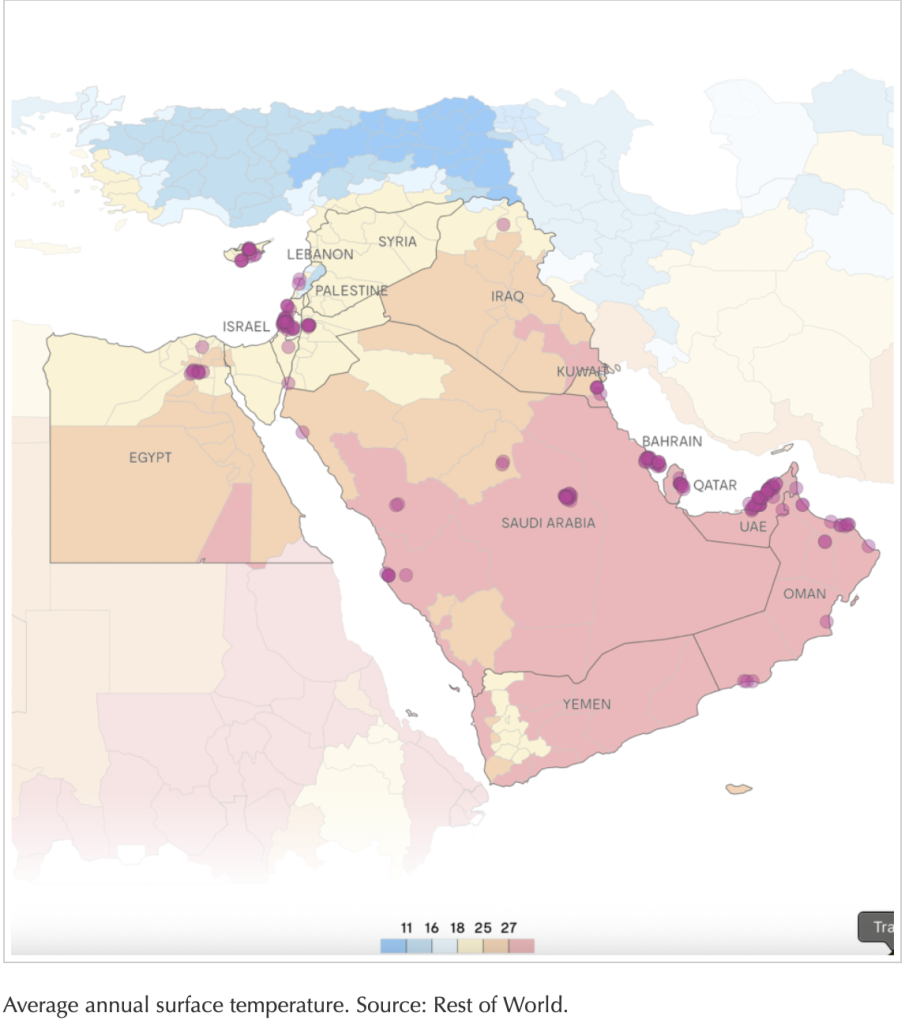
The $1 trillion Middle East AI dream had it all. Unlimited energy to build vast data centers in the desert. It is a major geopolitical success, as America’s technological capabilities strengthen its presence in an energy-rich region. The center of America’s digital and dollar hegemony. And perhaps most importantly, there are endless opportunities for corruption to flourish.
Well, it was fun while it lasted.
Let’s start a few years ago when the India-Middle East-Europe Economic Corridor (IMEC) was first introduced at the G20 Summit in New Delhi in September 2023. A network of rail, ship-to-rail, road transport routes, energy pipelines and high-speed data cables linking South Asia, the Gulf and Europe was, in theory, supposed to be some sort of answer to China’s Belt and Road Initiative (BRI). It didn’t make much sense as a logistics corridor, as cargo would have to be moved from India to the UAE via ship, loaded onto trains passing through the UAE, Saudi Arabia, Jordan and Israel, and then put back on board ships for Israel to Europe.
But the Trump administration, following Silicon Valley’s lead, shifted Biden’s focus away from logistics corridors and toward cesspools of digital corruption where Israel plays a leading role and where each region of IMEC consolidates a new pole of advantage for US hegemony. It was an invitation to AI supremacy from Europe to India written in the blood of genocide, but it is now falling apart as the Persian Gulf on which that “plan” depended goes up in flames.
Let’s take a look at what the Persian Gulf Computing Corridor was billed as and what the reality is today.
The US shared technology with Gulf states such as Saudi Arabia and the UAE in exchange for guarantees that AI-enabled exports produced using US chips would be billed and settled in dollars, or dollar-backed stablecoins. The Persian Gulf was supposed to provide capital, land and large amounts of electricity for data centers, provide U.S. computing power to flow out of the oil monarchy, provide billions in corruption payoffs for the Trump family and other U.S. government officials, and help keep the bubble inflated.
Before the war, more than 3.3 gigawatts of AI-oriented computing power was planned across the Gulf. In the words of Guy Lalon, this is what the Persian Gulf monarchies were meant to be, even if only a portion of them were ever built.
…The Sovereign Computing Corridor: A region where energy systems, capital flows, chip diplomacy, and model training capabilities are boldly connected. Indeed, for all its technological innovations, the United States lacks the power and space to train models on a planetary scale without clogging up the power grid. Gulf provides the chassis.
When the US agreed to export up to 70,000 advanced NVIDIA chips to the UAE and Saudi Arabia in 2025, the Trump administration claimed the deal would “promote America’s continued AI dominance and global technological leadership.”
That’s not all. As the New York Times reported last year, “digital assets are one of, if not the single, largest source of funds for the Trump family.” Eric Trump’s World Liberty Financial has signed a $2 billion deal with UAE state-owned AI investment firm MGX, which holds rights to Trump’s USD1 stablecoin. MGX uses it for billions of dollars of trading on Binance. The Binance exchange has always been on the wrong side of the law, with its founder Zhao Changpeng pleading guilty to anti-money laundering failures in 2023 and receiving a pardon from President Trump in October.
Still, U.S. geopolitics and blatant corruption usually go hand in hand. To be sure, the scale of President Trump’s takeover may be unprecedented, but there was a semblance of strategy, however clever. Edward Ongweso, Jr. details the rationale behind computing stack imperialism.
Unsubsidized electricity prices in the Gulf region average $0.10 per kWh, compared to Europeans who pay $0.29 per kWh and Americans who pay an average of $0.17 per kWh. Through “intensive planning and execution,” the GCC could quickly build out its power infrastructure. Saudi Arabia plans to add 42 GW of gas capacity by 2030, 40% more than the US.
The second reason is due to geographical advantage. The Gulf is located at the crossroads of three continents and an extensive undersea cable network that can serve 4 billion internet users within 100 milliseconds of latency, the threshold for AI interactions to feel “instant.” If that wasn’t enough, the region also has the world’s largest desalination infrastructure (40% of the world’s desalinated water). Geographically, it is well suited to provide enough water to service inference workloads around the world and to cool increasingly overbuilt, power-hungry AI data centers.
There are also financial benefits. With a war chest of nearly $5 trillion in sovereign wealth funds, we have a little more patience than greedy Western financiers.
This “plan” was still several months away.
things fall apart
These Persian Gulf data centers not only required energy-intensive cooling;
Not only was energy-intensive desalination required;
But they were also being built in areas where it was clear that major conflict was on the horizon. And this happened.
March 1: Iran’s Shahed drone attacks two Amazon Web Services data centers in the United Arab Emirates (UAE). A third data center in Bahrain was also damaged.
March 11: The United States and Israel attack an Iranian bank’s data center. Iran’s Revolutionary Guards has threatened retaliation against American companies with ties to Israel that support military technology applications, including Google, Microsoft, Palantir, IBM, Nvidia, and Oracle.
March 31: Iranian government reiterates threats against technology companies.
April 2: Iran attacks Oracle data center in Dubai.
In the event of another violent conflict between the United States and Israel, OpenAI’s massive $30 billion Stargate project in the UAE, along with the rest of its data centers, would become a target for Iran. There are a lot of easy targets.
embedded military technology
Although there seems to be a straightforward claim that Iran is attacking “civilian” infrastructure by attacking data centers, in reality these Silicon Valley companies are an extension of the Department of Defense. Although it is not entirely clear whether each data center in the Persian Gulf was used by the US military, the data centers frequently directly support military operations, as the Pentagon reportedly uses AI to plan air raids, create kill lists, and coordinate programs to overthrow governments.
Data centers are therefore like military weapons embedded in civilian infrastructure. From the conversation:
When service members use Claude, the models and the computing infrastructure powering their analysis are typically sent to the secure Amazon Web Services Cloud, which hosts sensitive government data and software tools.
Commercial data centers are where the cloud resides. The next time you fire up Netflix and watch your favorite show, chances are it’s streaming the show from a data center like AWS. When an AWS data center goes down, all kinds of entertainment, news, and government functions are affected.
As AI becomes a driver of economic growth, data centers are a critical form of infrastructure. These will ensure the continued execution of AI, as well as much of the underlying internet that governments and industry rely on. When Iran attacked data centers in the UAE, it caused widespread disruption to the local banking system.
Commercial data centers power much of the technology that powers the modern world, including AI systems. Disrupting them is the key to disrupting the country’s military and society. Given that AWS provides and operates many of the commercial data centers in which the cloud resides, its data centers may continue to be a target for competition.
I can’t see anything, I can’t hear anything
Attacks on data centers have already caused economic damage, and the possibility of further conflict and further damage calls into question Silicon Valley’s presence in the Persian Gulf and America’s “strategy” as a computer hub.
Amazon is currently undergoing months of repairs as banks and others face turmoil. These repairs and future staffing may be made more difficult by two types of shortages: materials and labor. The key materials needed to build AI infrastructure are currently difficult to obtain, and on labor issues, CNBC notes:
…As frontline workers face increased safety risks, Pure DC is offering some benefits to staff in the Middle East. [CEO Gary] Wojtaszek said.
“We are not mandating anyone to enter a facility. They have to make a decision based on what is right for them and their families…It’s a really tough situation,” he said, adding that workers who choose to remain on site will receive “additional comforts.”
Some of these benefits include location flexibility for non-essential workers who can travel abroad with their families and work remotely, as well as additional benefits packs for all staff members.
Data center developers are now focusing on ways to remotely control their facilities through electronic means.
William Self, chief workforce strategist at global workforce consulting firm Mercer, previously predicted that data center workers could increasingly see “hazard pay” included in their paychecks in the future.
How wonderful! PMCs can work from the relative safety of their homes, while blue-collar workers can earn a few extra dollars a month against the risk of bombing. Everything is like a pandemic.
Let’s go back to poor old Amazon. The company had to waive customer fees in its Middle East cloud region for the entire month of March, costing the company an estimated $150 million, according to The Register. Tech Policy Press has detailed coverage of the risks that all these American companies in the region face if they are hit by an Iranian attack.
Technology service providers typically apply force majeure clauses, arguing that acts of war are unforeseeable events that exempt them from liability and refunds to customers.
However, the local civil law framework places strict limits on the use of force majeure in the event of an ongoing dispute. Three landmark judgments from Dubai courts. Primary, Appeal, and Cassation, published in 2017, provides definitive guidance on how local courts allocate risk. The court adjudicating a civil aviation dispute over the cancellation of a charter flight triggered by the sudden closure of Saudi airspace during the 2015 war in Yemen has ruled firmly against the service provider.
The court clarified that the provision of contracted services is not just a “duty of care” but a “duty to achieve results.” A violation occurred because the operator failed to provide results. Importantly, the court eliminated the force majeure defense on the basis of foreseeability. Entering into a contract while a regional war is underway means that military disruption is an expected operational risk.
The Dubai Court of Cassation based its decision on the absolute principles of impossibility and automatic annulment. If enforcement becomes impossible due to sovereign military intervention, the contract will be dissolved and all risks will be borne by the service provider, who is the “obligor of the obligation”.
Applying this precedent to the 2026 Iran war will be a stark warning. If a cloud facility is disabled by a strike, a district court is likely to view that event as a foreseeable risk of operating in a disputed area. Absent a specifically and explicitly drafted military disruption clause that shifts financial risk to customers, technology providers would be legally obligated to absorb upstream sunk costs and fully refund customers.
Does all this mean that Silicon Valley and Washington may be rethinking their entire Persian Gulf computing strategy? Not a chance. For now, like the AI bubble, the world of technology keeps reality at bay.
The Iran war has made clear that it is no longer possible to operate safely within Iran’s range by sleeping with Washington and Tel Aviv. This trend is expected to continue in other conflicts initiated by the United States and Israel.
But much like the UAE, held up by technology accelerationists as a paradigmatic example of how to organize a society, they are following the same illogical path of distributing small facilities more widely and acquiring their own anti-drone and air defense systems. One would think that if their artificially intelligent machines were so smart, they would tell us that this is a bad idea.
