


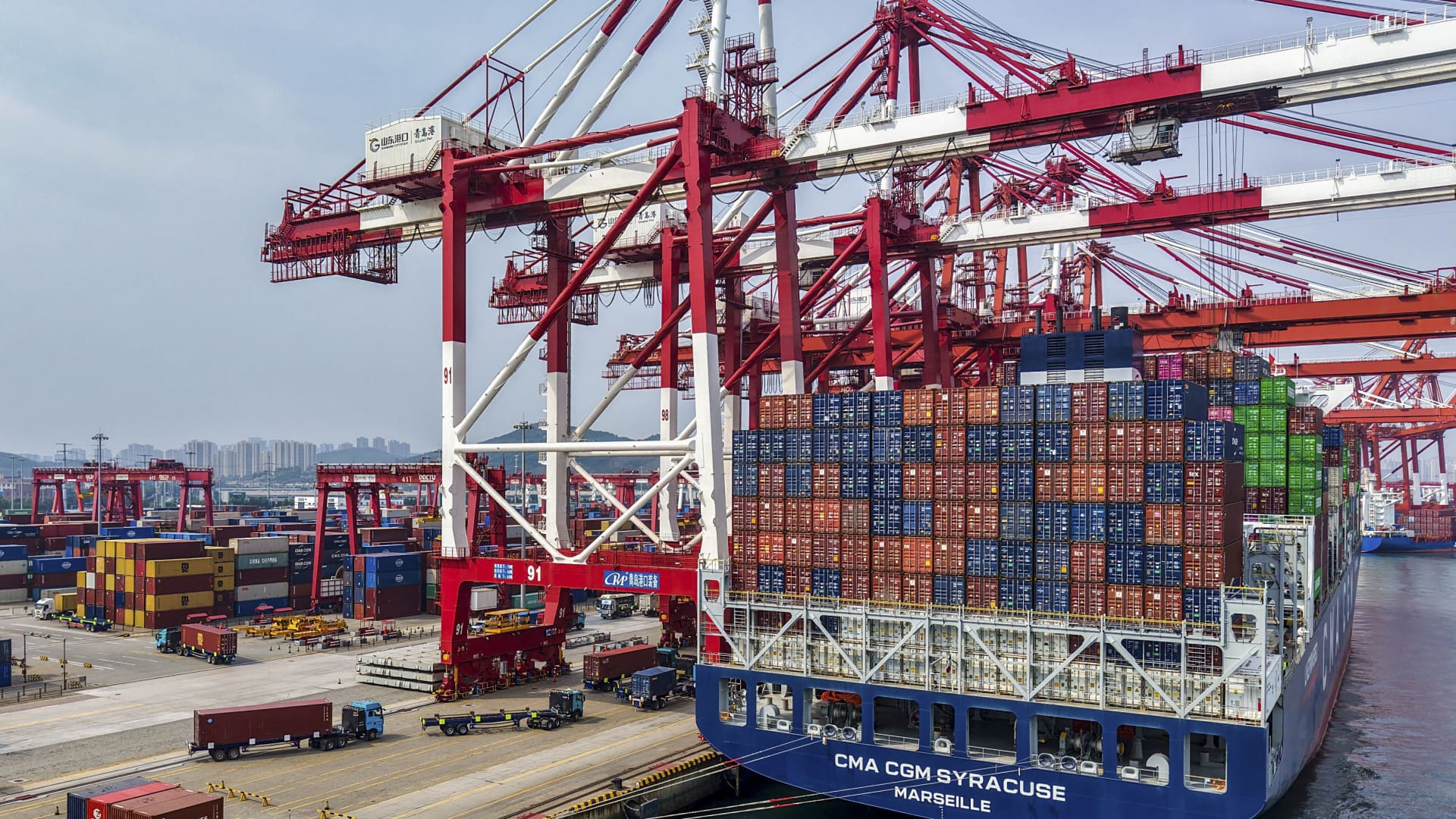
A container ship docks at a container terminal in Qingdao, eastern China’s Shandong province, on June 25, 2026.
– | AFP | Getty Images
China’s economy is showing signs of recovery, due in part to a recovery in shipments to the United States
China Beige Book, an independent research organization that tracks Chinese companies, said on Monday that “manufacturing was the clearest improvement, with retail sales recovering steadily.” The survey, which surveyed 1,321 businesses from June 1 to 22, found that while luxury goods sales were surging, tourism-related spending remained stagnant.
“The second quarter is ending on a better note than it started, but this performance will need to be repeated in July and August to have a legitimate cause to celebrate,” the report said.
The world’s second-largest economy lost momentum in April and May after a strong first quarter. China’s retail sales in May fell for the first time since the pandemic, according to official figures, while data from the 618 Shopping Festival, held from mid-May to mid-June, showed sales growth slowing sharply.
Chinese financial data provider Wind Information said investment in manufacturing fell on a year-to-date basis in May for the first time since December 2020, dragged down by declines in metals, chemicals and automobile production.
But Beige Book said in June that factory activity had “accelerated” and “orders to the U.S. have once again increased significantly year over year.” China’s exports to the United States have rebounded in recent months, rising 11.3% and 35.4% in April and May, respectively, after declining by double digits for much of last year when President Donald Trump gradually increased tariffs on Chinese goods.
S&P Global said last week that freight rates between Asia and the United States rose to the highest in nearly two years, as importers brought forward shipments ahead of fuel surcharges and price hikes from Asian suppliers. It says the stockpile could shrink by late July.
However, growth in China’s export orders to Asia and other developing countries slowed in June from May, while growth in export orders to Europe remained steady, according to Beige Book.
Trump’s meeting with Chinese President Xi Jinping suggested that tariffs are likely to remain low for some time, but the U.S. has not yet imposed additional tariffs that could emerge from the U.S. government’s Section 301 investigations of countries with confirmed overcapacity or forced labor practices. The 10% tariffs imposed by President Trump under Section 122 on goods from most major trading partners expire on July 24th.
Tiancheng Xu, senior economist at the Economist Intelligence Unit, said companies were rushing to ship goods to the United States ahead of the possibility that tariffs would rise again.
Reflecting the trade recovery, China’s exports to the United States in May reached nearly 90% of 2024 levels, according to official data. In contrast, May 2025 statistics showed that China’s exports to the US had fallen to 70% of 2024 levels.
“China’s weak momentum is likely to turn around in June,” Xu said, adding that “the improvement remains first and foremost driven by external sectors.”
He added that strong demand for artificial intelligence technology and components, as well as lower oil prices following the easing of tensions around the Strait of Hormuz, will help ease pressure on China’s economy.
China is scheduled to release June retail sales, industrial statistics and second quarter GDP on July 15th, and June trade statistics are scheduled to be released on July 14th.
The earliest official figures on the economic performance for June are due to be released on Tuesday, when the Office for National Statistics is due to release the official Manufacturing Purchasing Managers Index. According to a Reuters survey, the index of business activity in June is expected to be in expansion territory at 50.1.
Goldman Sachs on Sunday revised its third-quarter GDP growth forecast upward from 4.5% to 5% annualized from 4.5% in anticipation of lower oil prices and faster fiscal spending in the coming months, after a weak second quarter in which it predicted 3.5% growth.
Make CNBC your preferred source on Google and never miss a moment from the most trusted names in business news.
Source link
